Chapter One
The House Without a Daughter
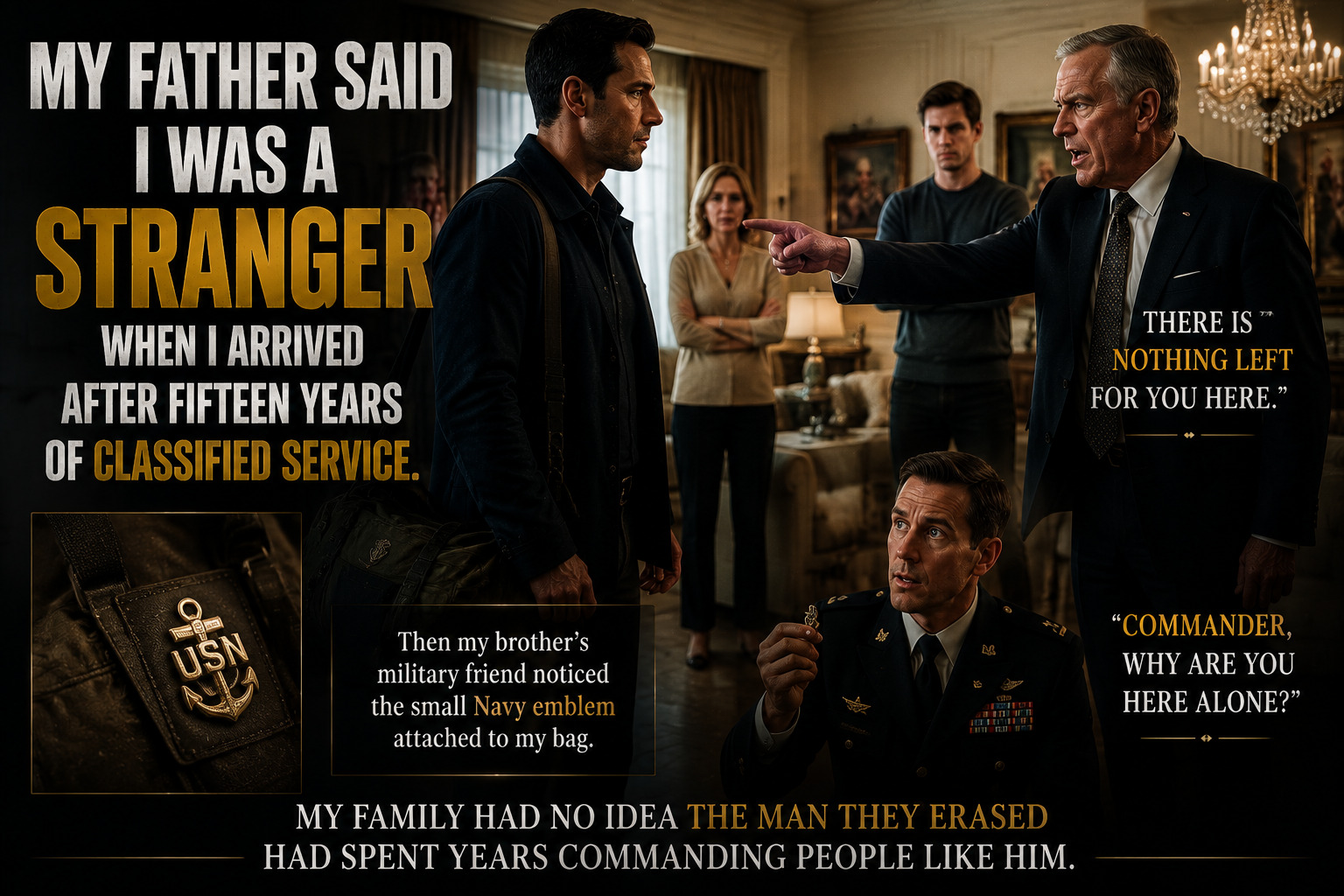
My father opened the door, looked directly at me, and asked, “Can I help you?”
Rain slipped from the edge of the porch roof between us.
For a moment, neither of us moved.
August Vance had aged in the disciplined way powerful men often did. His white hair had thinned but remained perfectly combed. His shoulders still filled the dark dinner jacket beneath his wool overcoat. Even at seventy-two, he stood as if an invisible photographer might appear at any moment to capture the founder of Vance Maritime Systems looking unbreakable.
Behind him, warm light poured across polished oak floors. A string quartet played somewhere deeper in the house. Laughter rose above the clink of crystal glasses.
It was the same house where I had learned to walk.
The same brass knocker I had dented with a hammer when I was nine.
The same man who had once carried me upstairs after I fell asleep beneath the Christmas tree.
Yet his eyes moved over my weathered canvas bag, my wet boots and the old black coat covering my shoulders as though I were a stranger asking for directions.
“It’s me,” I said.
His jaw shifted.
Not surprise.
Recognition.
He had known me the moment he opened the door.
That hurt more.
“Mara.”
Fifteen years had not erased the way he said my name when disappointed. Two clipped syllables, each carrying its own verdict.
I looked past him.
The hallway table still held my mother’s blue porcelain bowl. The staircase still curved beneath the tall window overlooking Chesapeake Bay. But the framed photographs along the wall had changed.
My brother Daniel in his sheriff’s uniform.
Daniel graduating from the academy.
Daniel beside his wife and two daughters.
My father shaking hands with senators, admirals and defense executives.
There had once been a picture of me at eleven, barefoot and sunburned, holding a fishing rod twice my height.
It was gone.
So was the photograph from my high-school graduation.
So was the family portrait taken six months before my mother died.
Every trace of me had been removed with surgical care.
“You’re having a party,” I said.
My father glanced toward the black vehicles lining the circular drive.
“An anniversary gala.”
“For the company?”
“For people who stayed.”
The string quartet continued playing.
My fingers tightened around the handle of my bag.
I had walked away from burning buildings with less effort than it took to keep my face still.
“I wrote.”
“You sent postcards without return addresses.”
“I called.”
“Three times in fifteen years.”
“I couldn’t always—”
“Do not tell me what you couldn’t do.”
His voice remained low. That was how my father expressed rage. He did not explode. He compressed.
“You disappeared while your mother was dying. You abandoned your education. You left your brother and me to bury her, then resurfaced whenever guilt became inconvenient.”
The rain struck the stone steps harder.
My mother had not been dying when I left.
She had been frightened.
There was a difference, and it had haunted me through deserts, jungles and nights when the water around my body had been so cold I could no longer feel my hands.
But the truth belonged to a classified file stored behind three levels of federal access.
My father knew only the lie I had been ordered to give him.
“I’m sorry,” I said.
He laughed once.
There was no humor in it.
“Of course you are.”
A shadow moved behind him.
My brother stepped into the hall.
Daniel was thirty-nine now, broad through the chest, his dark hair cut short above a face that had grown harder than the boy I remembered. A gold sheriff’s badge rested against his belt beside a holstered pistol. He had come directly from duty.
He looked from my father to me.
The warmth vanished from his expression.
“You actually came.”
“Hello, Danny.”
“No one calls me that.”
“You used to.”
“I used to wait at the window every birthday because Dad said you might show up.”
His voice was louder than our father’s.
Guests near the drawing room began turning toward us.
Daniel noticed.
He did not lower his voice.
“I used to tell people my sister was overseas doing something important. Then I told them you were working. Then traveling. Eventually, I stopped lying for you.”
“I never asked you to.”
“No. You just left us to invent explanations.”
My father stepped back from the doorway.
For one foolish second, I thought he might let me inside.
Instead, he looked toward the valet station.
“Daniel, have someone remove her.”
The words entered my chest like cold metal.
Daniel’s eyebrows drew together.
“She’s still my sister.”
“She stopped being my daughter fifteen years ago.”
The quartet faltered.
Several conversations behind him ended at once.
My father turned so the room could hear him clearly.
“I will not have tonight poisoned by a woman who appears only when there are cameras and wealthy people in the house.”
Guests had gathered at the edge of the hall now.
Board members.
Local politicians.
Naval officers.
Employees who had known me as a child.
A woman near the staircase lifted her phone.
My father saw her and continued anyway.
“You are not in my will. Your name is not connected to this company. You have no claim on this house, my reputation or this family.”
Daniel stared at him.
“Dad.”
“No.”
My father’s gaze never left mine.
“I should have said it years ago.”
I could have told him about the men whose lives I had carried across mountains.
I could have shown him the scar beneath my ribs where a bullet had entered during a rescue operation that officially never happened.
I could have told him I had spent the previous forty-eight hours aboard a submarine beneath the Atlantic, then flown in silence to Virginia because Naval Intelligence believed someone inside his company planned to sell a weapons-guidance system before midnight.
Instead, I placed my bag on the porch.
“Are you finished?”
His nostrils flared.
“You always did mistake silence for strength.”
“No,” I said. “I learned the difference.”
A man near the drawing-room entrance watched us without pretending otherwise.
Everett Shaw.
My father’s closest friend.
Chief operating officer of Vance Maritime Systems.
He held a glass of bourbon in one hand. His silver suit fit perfectly, but the muscles around his mouth remained too tight.
Fifteen years earlier, Everett had stood beside my father at my mother’s funeral and placed a comforting hand on my shoulder.
An hour ago, a secure intelligence packet had identified him as the probable source of a leak involving Project Black Current.
Now he looked at me as if he had just seen a ghost step out of the rain.
His bourbon stopped halfway to his lips.
That reaction was the first useful thing anyone had given me since I arrived.
I turned back toward my father.
“I need five minutes with you.”
“You have already taken enough.”
“This concerns the company.”
“You know nothing about my company.”
“I know Pier Four was opened tonight despite being sealed under a Navy security order.”
The color left Everett’s face.
My father’s eyes narrowed.
“Who told you that?”
From somewhere beyond the house, across the lawn and down the slope toward the private shipyard, a metal door slammed.
Then the lights went out.
The quartet stopped in the middle of a note.
A second later, three muffled gunshots came from the direction of the water.
And Everett Shaw quietly placed his bourbon on the nearest table.
Chapter Two
Black Current
Emergency lights washed the hall in red.
Guests screamed.
Someone dropped a tray. Glass shattered across the floor.
Daniel drew his pistol and shoved our father behind the stone column beside the staircase.
“Everybody down!”
His command carried through the room with the force of training and habit.
People crouched behind furniture. A retired admiral pulled his wife beneath the grand piano. Two board members tried to reach the side exit.
“Stay away from the doors!” Daniel shouted.
I had already counted the shots.
Three rounds.
Suppressed.
Equally spaced.
Not panic fire.
Execution or signal.
The house’s emergency lights had activated, but the exterior security lamps remained dark. The backup generator should have powered both.
Someone had separated the systems before cutting electricity.
Daniel reached for his radio.
I caught his wrist.
“Don’t transmit.”
He looked down at my hand.
“Let go.”
“They’ll be monitoring the sheriff’s band.”
“You don’t know that.”
“The power failure is selective. The shots were suppressed. Cell service disappeared before the lights did.”
He pulled his arm free.
“How would you know about the cell service?”
“My phone lost its signal while Dad was disowning me.”
“You checked your phone during that?”
“I was checking theirs.”
I nodded toward the front windows.
The black vehicles outside had not moved, but one contained a compact directional jammer concealed inside a luggage carrier.
Daniel stared at me as if deciding whether I was delusional.
“What have you gotten involved in?”
“Not now.”
He raised his radio.
I pressed the transmit button before he could speak.
Static crackled.
Beneath it came a rhythmic digital pulse.
Daniel heard it.
His expression changed.
“That isn’t normal interference.”
“No.”
“What is it?”
“A capture system. The second you identify yourself, they know your position and your available response.”
He released the radio slowly.
My father stepped from behind the column.
“This is my property. Who are ‘they’?”
Before I could answer, Everett moved beside him.
“We should get August to the security room.”
“No,” I said.
Everett looked at me.
The red emergency lighting carved deep lines into his face.
“The security room has reinforced doors,” he said.
“It is also connected to the shipyard network.”
“That is precisely why we should use it.”
“If the network is compromised, the security room becomes a locked box controlled from outside.”
Everett’s tone sharpened.
“And your expertise comes from where?”
“Experience.”
“With what? Disappearing?”
A few guests looked toward us.
Even now, Everett knew exactly where to place the knife.
My father’s face hardened.
“Enough. Daniel, get everyone into the ballroom. It has no ground-level windows.”
“The ballroom has two service entrances,” I said. “The west corridor creates a blind approach.”
My father turned on me.
“You are not in command here.”
“No,” I said. “But whoever shut down your power is.”
A woman in a navy-blue evening dress emerged from the crowd.
Dr. Nora Talbot.
Chief systems architect for Vance Maritime.
She was forty-six, thin, with tightly braided hair and a crescent-shaped burn mark near her right wrist. I had seen her photograph in the intelligence file.
She looked at me only once.
Then she touched two fingers to the burn scar.
A prearranged signal.
Source in immediate danger.
My pulse remained steady.
Nora approached my father.
“Mr. Vance, we need to leave the main house.”
“Why?”
She glanced toward Everett.
It lasted less than half a second.
Too long.
Everett noticed.
Nora’s throat moved.
“The prototype storage vault at Pier Four was opened at nine fourteen.”
My father stared at her.
“That is impossible.”
“I received an automated alert before the system went offline.”
“What prototype?” Daniel asked.
My father ignored him.
“Black Current isn’t physically stored here.”
Nora’s eyes remained on Everett.
“The guidance core is.”
Everett took a step toward her.
“Nora, you are frightened and confused.”
“No,” she said. “For the first time in six months, I’m not confused at all.”
The first window exploded.
A small cylindrical object bounced across the floor.
I recognized it before it stopped moving.
“Flash!”
I grabbed my father’s jacket and pulled him behind the column.
White light swallowed the hall.
The detonation punched through my chest.
Guests cried out. Several fell.
Through the ringing in my ears came the heavy crash of the front doors opening.
Boots entered.
At least six people.
Daniel fired twice toward the doorway.
Return fire chipped stone above his head.
I crawled through broken glass, reached the first attacker as he passed the column and drove my palm beneath his chin.
His head snapped back.
I trapped his rifle against his chest, turned with his momentum and sent him into the base of the staircase.
Before he hit the floor, the rifle was in my hands.
I fired one round into the ceiling above the second attacker.
Plaster and crystal fell into his face.
He flinched.
Daniel shot him in the shoulder.
I pivoted toward the entrance.
Two more figures moved behind ballistic shields.
Not ordinary criminals.
Their spacing was disciplined. Their weapons had infrared modules and custom suppressors. No insignia marked their black armor.
One of them pointed toward me.
“Target female!”
That confirmed what I had feared.
They had not attacked because I came home.
I had been invited home because they knew I would.
Everett seized my father and dragged him toward the west corridor.
“Security room!”
I caught Nora by the arm.
“Come with me.”
She shook her head violently.
“They need my biometrics.”
“Then they cannot have you.”
A bullet struck the wall beside us.
Daniel moved behind an overturned table.
“Mara!”
I threw the captured rifle toward him.
He caught it awkwardly.
His eyes dropped to the weapon, then lifted to me.
“How did you—”
“Safety is already off. Three-round selector. Aim low. Their plates won’t cover the hips.”
He stared.
The red lights reflected in his pupils.
“You’ve done this before.”
The attackers advanced.
I pulled a slim ceramic blade from the seam of my coat.
Daniel saw that too.
His mouth opened.
There was no time for questions.
“Get Dad away from Everett.”
“Everett is protecting him.”
“No,” I said. “Everett is why they’re here.”
Across the hall, my father disappeared into the west corridor with the man he trusted most.
An attacker raised his weapon toward Nora.
I stepped between them.
For fifteen years, my family had believed I had run from responsibility.
Now the first bullet tore through the sleeve of my coat, missing my arm by less than an inch.
I moved toward the gunfire.
Chapter Three
What My Brother Saw
I struck the attacker before he could correct his aim.
The ceramic blade entered the gap between his glove and forearm guard. His fingers opened.
I caught his weapon, twisted beneath his elbow and drove him face-first into the marble floor.
Daniel fired from behind the table.
One of the shield carriers stumbled as a round hit his thigh.
“Move!” I shouted.
Nora ran toward the kitchen corridor.
I followed, covering her retreat.
Daniel reached us seconds later.
His breathing was fast, but his weapon remained level.
“You left Dad.”
“He left with Everett.”
“Exactly.”
I slammed the kitchen door behind us and wedged a steel serving cart beneath the handle.
“They aren’t protecting him.”
“You keep saying that.”
“Because you keep refusing to hear it.”
We crossed the dark kitchen.
Copper pans hung above stainless counters. Half-prepared desserts rested beneath plastic covers. The air smelled of sugar, smoke and burned electrical insulation.
Nora led us toward the pantry.
“There is a service stairwell to the basement.”
Daniel caught her shoulder.
“What is Black Current?”
Nora hesitated.
I answered for her.
“An autonomous navigation architecture for unmanned underwater vehicles.”
Daniel looked at me.
“In English.”
“It lets a submarine drone find and strike a target without satellite navigation, external communication or human correction.”
His grip tightened around the rifle.
“That sounds illegal.”
“It is supposed to help damaged naval vessels navigate through jammed environments,” Nora said. “But the core can be adapted.”
“To carry weapons,” Daniel said.
“To find almost anything underwater,” I replied. “Submarines. Communication cables. Harbor defenses.”
“Who wants it?”
“Several governments.”
“And Everett is selling it?”
Nora’s eyes glistened.
“For six months, he has been transferring fragments through subcontractors. I found irregularities. He told me the company was drowning in debt and the Navy intended to cancel three contracts.”
“Is that true?”
“Yes,” Nora whispered. “Partly.”
That was how intelligent people were recruited into terrible decisions. Not with obvious lies. With carefully arranged truths.
Nora pressed her hand against the pantry wall.
A concealed panel released.
Behind it, a narrow concrete staircase descended beneath the house.
Daniel stared.
“Dad built this?”
“Your mother did,” Nora said.
I stopped.
“What?”
She looked at me.
“Evelyn designed the original emergency access between the house and the shipyard tunnels.”
My mother’s name changed the temperature in the room.
Daniel noticed.
“Why would Mom design escape tunnels?”
“Vance Maritime handled classified contracts during the final years of the Cold War,” Nora said. “The property required secure movement between facilities.”
I stepped onto the first stair.
“Where does it lead?”
“Old communications room. Then the dry dock.”
We descended.
Daniel closed the panel above us.
Darkness settled until Nora activated a small maintenance light.
The tunnel walls sweated with moisture. Rusted pipes ran overhead. Somewhere beyond the concrete, waves struck the pilings beneath the shipyard.
Daniel walked behind me.
I could feel his questions accumulating.
Halfway down, he finally asked the one that mattered.
“Who are you?”
I kept moving.
“Mara.”
“Don’t do that.”
“Do what?”
“Use my own memories to avoid answering.”
My boot touched the basement floor.
The communications room had been abandoned for years. Dust covered the consoles. Old maps curled beneath cracked glass. A faded civil-defense sign hung beside a steel cabinet.
I checked the door leading toward the dock tunnel.
No trip wire.
No pressure switch.
No visible camera.
Still, I did not open it.
Daniel stood in front of me.
“You took apart an armed man in three seconds.”
“He was off balance.”
“You identified military jamming equipment from the porch.”
“I pay attention.”
“You knew how to use a rifle I’ve never seen.”
“It was still a rifle.”
His face tightened.
“Stop talking to me like I’m stupid.”
“I don’t think you’re stupid.”
“You think I’m a civilian.”
The word came out with more bitterness than I expected.
I looked at the sheriff’s badge on his belt.
“You are.”
“I served twelve years in law enforcement.”
“And I respect that.”
“No, you don’t.”
“Yes, Daniel. I do.”
“Then tell me where you learned to move like that.”
The tunnel vibrated.
A distant explosion rolled beneath our feet.
Dust fell from the ceiling.
Nora looked toward the dock passage.
“They’re breaching the vault.”
I removed my canvas bag from my shoulder.
Daniel had seen me leave it on the porch.
I had retrieved it during the confusion because it contained equipment no one else could access.
I placed it on the communications table.
“Watch the door.”
“What’s in the bag?”
“Watch the door.”
He did not move.
I opened the outer flap and pressed my thumb against a flexible biometric strip hidden beneath the seam.
A compartment unlocked.
Inside were a compact encrypted radio, a suppressed sidearm, medical supplies, two magazines and a black waterproof packet bearing the seal of the United States Navy.
Daniel stared at it.
The anger drained from his face.
I handed the radio to Nora.
“Channel four. Say nothing unless you receive the phrase ‘low tide.’”
She nodded.
I checked the sidearm.
Daniel reached toward the packet.
I caught his wrist.
“Don’t.”
“What is it?”
“Something you don’t need.”
“My family is under attack.”
“So is mine.”
His eyes flashed.
“You don’t get to say that.”
I released him.
“You’re right.”
The admission stopped him more effectively than an argument.
I moved toward the steel door.
Behind me, paper shifted.
Daniel had taken the packet.
“Put it down.”
He unfolded the first page.
His eyes moved across the lines.
I saw the moment the information stopped making sense to him.
Then the moment it made too much sense.
COMMANDER MARA EVELYN VANCE.
UNIT AFFILIATION: NAVAL SPECIAL WARFARE COMMAND.
ACCESS LEVEL: OBSIDIAN.
OPERATIONAL STATUS: ACTIVE.
The photograph showed me in dress whites, hair pinned beneath my cover, ribbons arranged above my left breast.
Daniel’s gaze dropped to the qualification insignia printed beneath the photograph.
The golden eagle.
The anchor.
The trident.
His lips parted.
“No.”
I took the paper from him.
He looked at my face as though trying to align it with the sister he remembered.
“You’re Navy.”
I resealed the packet.
“Yes.”
“Commander?”
“Yes.”
His eyes returned to the trident.
The room seemed to contract around us.
“Ma’am…”
His voice failed.
He swallowed.
“SEAL commander?”
Nora turned toward us.
I closed my eyes for one second.
Not because the title embarrassed me.
Because I had imagined this moment too many times.
In some versions, Daniel hugged me.
In others, he hit me.
In every version, I explained everything and somehow made the lost years understandable.
The truth offered no such mercy.
“Do not call me ma’am,” I said.
“But you—”
“I’m still your sister.”
His expression hardened again, though the anger had fractured.
“My sister sold her car and disappeared the week Mom died.”
“I was ordered to report.”
“Ordered by whom?”
“I can’t answer that.”
“You outrank people, carry secret radios and apparently have permission to kill, but you can’t answer a basic question?”
“No.”
“Did Dad know?”
“No.”
“Did Mom?”
I looked toward the dark tunnel.
“Yes.”
Daniel stepped back.
It was a small movement.
It felt like a door closing.
“She knew.”
“She helped arrange my departure.”
“Our mother was dying, and she helped you leave?”
“She wasn’t dying when I left.”
Daniel’s face went still.
“What does that mean?”
Before I could answer, the encrypted radio came alive.
A man’s voice emerged through static.
“Nightglass, this is Harpoon Actual. Perimeter compromised. Hostiles have your father and eleven civilians moving toward Pier Four.”
Daniel stared at the radio.
The voice continued.
“Satellite confirms thermal charges beneath the main dry dock. Estimated detonation in fifty-two minutes.”
I pressed the transmit switch.
“Status of assault element?”
“Four minutes offshore. Electronic countermeasures prevent precision approach.”
“Hold position.”
“Commander, authorization requested to breach.”
“Denied. Too many hostages.”
Daniel looked at me.
Nightglass.
Commander.
Assault element.
Every word pulled me farther from the person he thought he knew.
The radio crackled again.
“Additional intelligence: Everett Shaw initiated a financial transfer twelve minutes ago. Buyer vessel is approaching from international waters.”
Nora covered her mouth.
I answered.
“Prepare secondary extraction. No entry until my signal.”
“Copy, Nightglass.”
The transmission ended.
Daniel stood beneath the weak maintenance light, holding a captured rifle and fifteen years of unanswered questions.
“Who was that?”
“My team.”
“How many?”
“Enough.”
“And they take orders from you?”
“When they’re smart.”
He almost smiled.
Then the tunnel door rattled.
Someone was unlocking it from the other side.
I switched off the maintenance light.
Darkness swallowed us.
Daniel moved beside me.
For the first time since I arrived, he did not ask what to do.
He waited for me to tell him.
Chapter Four
The Man My Father Trusted
The door opened three inches.
A flashlight beam cut through the darkness.
I waited until the first man entered.
Then I trapped his wrist, drove his weapon into the wall and struck the nerve beneath his jaw. He collapsed without firing.
The second man reacted faster.
Daniel hit him with the rifle stock.
Bone cracked.
The man dropped to one knee, and Nora slammed a rusted fire extinguisher into the side of his helmet.
He fell.
She stared at what she had done.
“I’m a systems engineer.”
“Tonight you’re versatile,” I said.
Daniel crouched beside the first attacker and searched him.
He found a radio and a plastic access card.
“No identification.”
“They won’t carry any.”
“Mercenaries?”
“Former military contractors.”
“How can you tell?”
“Their equipment is expensive. Their movements are practiced. Their discipline disappears as soon as the first plan fails.”
Daniel looked at the unconscious men.
“Sounds like half my department.”
I glanced at him.
There he was.
The brother who had once made jokes during our mother’s worst arguments because silence frightened him more than anger.
I touched his shoulder.
He looked down at my hand.
“I’m sorry,” I said.
“For what part?”
“All of it.”
“Not good enough.”
“I know.”
He stood.
“Then stay alive long enough to improve the answer.”
We entered the dock tunnel.
The passage opened beneath the main assembly building, a vast steel structure extending over the water. Machinery hummed above us. Emergency strobes flashed through grated floor panels.
Nora led us to a ladder.
“This reaches the observation corridor outside Pier Four.”
I climbed first.
Through the grille overhead, I saw hostages kneeling inside the dry dock.
My father was among them.
His dinner jacket had been torn at the shoulder. Blood darkened one side of his forehead.
Everett stood beside a waist-high black case positioned beneath industrial lights.
Three armed men guarded the exits.
Four more worked near the waterline, attaching cables from the case to a compact submersible drone.
A digital timer glowed against a support column.
44:17.
44:16.
Thermal charges.
Enough to collapse the dock, destroy the prototype and kill everyone inside.
Nora leaned beside me.
“That case contains the guidance core.”
“Can it be removed?”
“Not without my biometrics.”
“Can Everett bypass them?”
“Eventually.”
“Does he know about the charges?”
Her silence answered.
Daniel looked through the grille.
“He’s going to kill Dad.”
“He plans to kill everyone,” I said.
“Why?”
“To erase the evidence and create a national-security incident large enough to hide the financial trail.”
Nora shook her head.
“That was never the plan.”
I looked at her.
“What did you think the plan was?”
Her face tightened with shame.
“I thought Everett was selling a degraded copy.”
Daniel turned on her.
“You helped him?”
“I altered several security logs.”
“Why?”
“Vance Maritime is carrying nine hundred million dollars in debt.”
Daniel stared.
Nora continued.
“The Navy delayed payments. Two foreign contracts were blocked. Your father refused to close the Newport facility because two thousand families depend on it.”
“He never told us.”
“He mortgaged this estate. His personal accounts. Everything.”
I looked through the grille at my father.
He knelt straight-backed despite the blood on his face.
Even as a hostage, he refused to appear diminished.
“Everett said one unauthorized sale could stabilize the company,” Nora whispered. “No weapons. No operational version. Just enough architecture to prove capability.”
“And you believed him.”
“I believed the alternative was watching thousands of people lose their homes.”
Her voice broke.
“I was wrong.”
“No,” I said. “You were useful to him.”
Daniel looked at me.
“That is not better.”
“It isn’t meant to be.”
Above us, Everett began speaking to my father.
“You should have accepted the foreign partnership.”
My father raised his head.
“I do not sell American defense technology to governments that threaten American sailors.”
“You sold it to Washington for half its value and waited eighteen months to be paid.”
“I built equipment, not excuses.”
Everett crouched in front of him.
“You built monuments to your pride.”
My father’s gaze moved toward the black case.
“What happened to you?”
Everett smiled sadly.
“I learned arithmetic.”
He stood.
“Payroll. Interest. Penalties. Pension obligations. The number of children whose fathers would lose work because August Vance refused to admit his company was dying.”
“You could have come to me.”
“I did. Twelve times.”
“You asked me to compromise security.”
“I asked you to survive.”
My father’s voice remained flat.
“Not like this.”
Everett looked toward the hostages.
“This is not how it was supposed to happen.”
One of the armed contractors approached.
“Buyer vessel is twenty-eight minutes out.”
Everett nodded.
The contractor glanced at the timer.
“What about the witnesses?”
Everett’s eyes moved toward my father.
For a moment, I saw hesitation.
Then he looked away.
“Maintain schedule.”
My father heard him.
Something changed in his face.
Not fear.
Grief.
Everett had stood beside him for thirty-eight years. They had started the company in a rented warehouse with one government contract and six employees.
My father had trusted him more than either of his children.
Now that trust was kneeling beside him with a gun.
Daniel whispered, “We need to move.”
“Not yet.”
“They have Dad.”
“They also have a timer connected to charges we haven’t located.”
“We can’t wait.”
“We can’t rush.”
His teeth clenched.
“You always sound so certain.”
“I’m not.”
That surprised him.
I watched Everett.
“I’m terrified.”
Daniel studied my face.
“Of dying?”
“No.”
“Then what?”
“Of choosing who does.”
The timer reached forty-one minutes.
A contractor dragged a woman toward the biometric case.
Dr. Nora Talbot.
Not the real Nora beside me.
A woman wearing Nora’s dress and hairstyle.
Daniel frowned.
“Who is that?”
“An operative.”
My team had placed her inside the gala before I arrived.
The decoy struggled convincingly as Everett pressed her hand toward the scanner.
The system rejected her.
A red warning flashed.
Everett struck her.
My muscles tightened.
Daniel noticed.
“One of yours?”
“Yes.”
“You sent her in there?”
“She volunteered.”
“That doesn’t answer the question.”
“It is the only answer people like us receive.”
Everett grabbed the operative by the hair.
“Where is Talbot?”
She spat blood onto his shoe.
His composure broke.
He struck her again.
My father looked toward her, then toward Everett.
“Leave her alone.”
Everett laughed.
“You always did defend employees more easily than family.”
The words turned my father’s face to stone.
Everett leaned closer.
“Mara came back tonight, didn’t she?”
My father said nothing.
“I saw her on the porch.”
Still nothing.
“I wonder whether she told you what she really is.”
My father’s eyes narrowed.
Everett smiled.
“You don’t know.”
He looked almost delighted.
“After all these years, you still believe she ran away.”
My father lunged.
A guard struck him across the face with a rifle.
Daniel’s hand tightened around the grille.
I caught his arm before he could move.
Below us, Everett knelt beside my father.
“Your daughter didn’t abandon you, August.”
Blood ran from my father’s mouth.
Everett’s next words crossed fifteen years and found me beneath the floor.
“She was recruited because of what your wife discovered.”
Chapter Five
My Mother’s Last Mission
My father stared at Everett.
“What are you talking about?”
Everett turned toward the hostages, enjoying the attention despite himself.
That was his weakness.
He had spent decades standing beside August Vance while newspapers printed my father’s name. He had saved contracts, managed crises and kept the company alive, yet every building still carried VANCE in six-foot steel letters.
Now, with weapons in the room, Everett finally had an audience that could not leave.
“Evelyn found the first transfers,” he said. “Small pieces of sonar architecture. Harmless by themselves.”
My father’s breathing changed.
“She accused a subcontractor.”
“She accused me.”
The room became silent.
My father shook his head once.
“No.”
Everett smiled without warmth.
“You told her she was imagining things.”
“I told her to bring me evidence.”
“She did.”
My father’s eyes moved toward the black case.
Everett continued.
“She also contacted the Navy without telling you.”
Above the dock, rain hammered the metal roof.
I saw my mother as she had been the night before I left.
Barefoot in the kitchen.
Hands shaking around a cup of tea she never drank.
A bruise beneath her wrist where someone had grabbed her.
She had placed an envelope on the table between us.
“You’re better at seeing danger than your father,” she had said.
I was twenty-four.
Angry.
Impatient.
Desperate to begin a life that belonged to me.
“What did you do?” I had asked.
She looked toward the dark windows.
“I trusted the wrong man.”
The Navy investigators arrived before dawn.
They offered me a choice because I already held a commission and had completed advanced combat training.
Leave immediately and assist the investigation.
Or stay and risk alerting whoever was watching the family.
I chose the mission.
My mother promised to follow two days later.
She died before sunrise on the second day.
Her car left the Chesapeake Bridge in clear weather.
The official report blamed speed and fatigue.
My father believed my disappearance had broken her concentration.
Daniel believed she had been driving to find me.
Only three people knew she had been carrying evidence.
Two were dead.
The third stood inside Pier Four.
My father’s voice shook.
“You killed Evelyn.”
Everett looked toward the water.
“I told the driver to frighten her.”
A sound came from my father’s throat.
Not a word.
Something older.
Everett’s eyes hardened.
“She was supposed to surrender the documents. She fought.”
“You murdered my wife.”
“I protected the company.”
“You protected yourself.”
“At first.”
Everett’s face tightened.
“Then I protected everything we built. The investigation would have frozen every contract. Thousands of people would have lost their jobs because your wife suddenly developed a conscience after twenty years of enjoying the money.”
My father surged forward again.
Two guards restrained him.
Everett stepped closer.
“And your daughter? She knew enough to destroy us both. So I gave Naval Intelligence evidence that suggested Evelyn had acted alone.”
My blood went cold.
Nora looked at me.
Daniel whispered, “He framed Mom.”
Everett continued below.
“Mara disappeared into the system. You blamed her. The Navy buried the case. And I spent fifteen years keeping this company alive while you mourned the wrong betrayal.”
My father’s face had become gray.
“You knew where she was?”
“Not exactly. Those people hide their assets well.”
He looked toward the ceiling as though he could feel me somewhere above him.
“But I heard stories.”
A smile touched his mouth.
“A female operator in places women were not supposed to be. A commander who completed missions no one could acknowledge. Someone called Nightglass.”
Daniel turned toward me.
My father followed Everett’s gaze.
For the first time, hope and horror appeared together in his eyes.
“Mara?”
Everett straightened.
“I knew she would come if I opened Pier Four.”
The operation had not merely anticipated my arrival.
It had been built around it.
I pressed the transmit switch on my encrypted radio.
“Harpoon Actual.”
“Go, Nightglass.”
“Enemy has seven confirmed inside Pier Four, additional unknown near water access. Thermal charges active. Prepare silent approach on my mark.”
“Copy.”
Daniel touched my sleeve.
“What is the plan?”
I looked at the dock.
“My operative creates movement. Nora disables the core. You release the hostages through the east service gate.”
“And you?”
“I take Everett.”
“You mean arrest him.”
“If possible.”
“That isn’t what your face says.”
I checked the sidearm.
“My face has never been cooperative.”
Nora studied the timer.
“The charges are connected through the old maintenance network. I may be able to interrupt the sequence from the observation console.”
“May?”
“The system was modified.”
“How long?”
“Eight minutes if I’m lucky.”
“You have five.”
Daniel looked between us.
“You just said forty minutes remain.”
“The buyer vessel is twenty-eight minutes out. Everett will accelerate if he knows we’re here.”
“How will he know?”
I removed the grate.
“Because I’m going to tell him.”
Daniel grabbed my arm.
“No.”
Fifteen years of anger stood behind that one word.
“You don’t get to appear for one night, reveal you’re some classified war hero and then walk into a room full of guns.”
“I’m not a hero.”
“I don’t care what you call it.”
His voice cracked.
“You don’t get to leave again.”
The dock blurred for half a second.
I had been shot, drowned, burned and buried beneath a collapsed wall in Mosul.
Nothing had prepared me for my brother asking me to stay.
“I’ll come back,” I said.
“You promised Mom that too?”
I did not answer.
His face folded.
The cruelty of the question hurt him as soon as he asked it.
“I’m sorry.”
“She asked me to go,” I said. “She believed it would protect you.”
“Did it?”
I looked down at our father, kneeling before the man who had killed her.
“No.”
Daniel released my arm.
I touched my forehead to his.
It was something our mother had done when we were children.
One breath.
One promise.
Then I dropped through the opening.
Chapter Six
Public Reckoning
I landed on the observation walkway twelve feet above the dry dock.
Every weapon turned toward me.
Everett smiled.
“There she is.”
My father looked up.
For fifteen years, he had imagined me drifting through an undisciplined life, too selfish to return home.
Now I stood beneath emergency lights with a suppressed pistol in my hand and blood drying across my sleeve.
He stared at me as if I had arrived from another world.
“Put the weapon down,” Everett said.
I looked at the operative kneeling beside the case.
Her left eye had swollen shut.
“You first.”
Everett laughed.
“Still theatrical.”
“You invited me.”
“I needed Nora Talbot. I suspected she had contacted someone. I did not expect the Navy to send its favorite ghost.”
My father’s gaze moved between us.
“Mara, what is he talking about?”
I kept my weapon centered on Everett.
“Later.”
His face tightened at the familiar answer.
Even now, later sounded like abandonment.
Everett saw it too.
“Tell him,” he said. “You owe the man something.”
“I owe you a bullet.”
“You see, August? That is what they made from your daughter.”
My father rose despite the guards holding him.
“No.”
Everett glanced at him.
My father’s voice became stronger.
“That is what she became while I was too proud to ask whether I had misunderstood her.”
The words struck me harder than I expected.
Everett’s smile vanished.
“You disowned her twelve minutes ago.”
“Yes.”
“In front of everyone.”
“Yes.”
“You erased her from your house.”
My father looked at me.
“I erased what I was afraid to understand.”
The hostages watched us.
So did the contractors.
So did Daniel from the darkness above.
My father took one step forward.
A guard forced him back down.
“I was wrong,” he said.
There was no speech.
No attempt to protect his dignity.
Only three words from a man who had built his life around never needing them.
Everett’s face twisted.
“How touching.”
He raised a remote control.
“The charges are tied to my pulse sensor. Kill me, and the dock collapses.”
Nora whispered through my earpiece.
“He’s lying. Remote is manual.”
Everett could not hear her.
I lowered my weapon slightly.
He relaxed.
That was the reaction I needed.
The operative beside the case moved first.
She rolled beneath the nearest guard’s rifle and drove both feet into his knee.
I fired.
The round struck the remote in Everett’s hand.
Plastic exploded.
Daniel opened fire from the observation corridor.
His first shot hit a guard’s shoulder.
His second shattered the chain securing the east service gate.
Hostages surged toward it.
Nora reached the console.
Alarms screamed.
The contractors returned fire.
I crossed the space between Everett and me before he could retreat.
He swung a pistol from beneath his jacket.
I trapped his wrist.
The first shot entered the ceiling.
The second struck the floor beside my boot.
He was stronger than I expected.
Desperation had stripped the age from him.
“You destroyed this family!” he shouted.
I drove my elbow into his throat.
He staggered but kept hold of the weapon.
“My mother discovered you.”
“She would have destroyed everything!”
“She trusted my father to choose the truth.”
“Your father chose the company every time.”
Behind us, my father helped an injured employee toward the east gate.
He heard Everett.
He stopped.
Everett saw him and laughed.
“Ask him, Mara. Ask him how many safety reports he buried to protect contracts. Ask how many marriages his company consumed. Ask whether he ever loved any of you as much as he loved his name on those buildings.”
My father’s face tightened.
The accusation was not entirely false.
That made it more dangerous.
Everett twisted free and fired.
The round struck my armor beneath the coat.
Pain burst across my ribs.
I fell against the black case.
My father shouted my name.
Everett aimed again.
Daniel fired from above.
His bullet struck Everett’s forearm.
The pistol spun away.
I rose and drove Everett into the railing.
Below us, black water churned inside the dry dock.
He gripped my wounded side.
I struck his elbow and broke the hold.
“You could have stayed gone,” he hissed.
“You killed my mother.”
“She was going to expose me.”
“She gave you a chance to surrender.”
“She pitied me.”
“No,” I said. “She believed you were still human.”
His eyes changed.
That was the wound.
Not guilt.
Recognition.
He had spent fifteen years insisting he had acted for the company, the workers, my father and the national interest.
My mother’s mercy had threatened that story.
Everett lunged toward the fallen pistol.
I kicked it into the water.
Daniel reached the dock floor and tackled the last armed contractor.
My operative secured the others.
Overhead, the roof shuddered.
Nora shouted from the console.
“The charges shifted to secondary control!”
The timer changed.
03:00.
02:59.
The hostages had not all escaped.
My father remained beside an injured board member.
Daniel looked at the timer.
“I thought we had forty minutes.”
“Everett accelerated it,” Nora said.
She struck commands into the console.
“Someone activated a dead-man sequence from the buyer vessel.”
Everett laughed from the floor.
“You can’t stop it.”
I pressed my radio.
“Harpoon Actual, execute breach. Repeat, execute breach.”
The response came instantly.
“Copy, Nightglass. Coming home.”
The eastern wall detonated inward.
Water mist and steel fragments filled the air.
Four figures emerged through smoke in black maritime gear, moving with synchronized violence.
The lead operator crossed the dock and dropped beside me.
Master Chief Jonah Reed.
Forty-eight.
Gray in his beard.
A scar cut through his right eyebrow.
He had followed me into places where names were replaced by grid coordinates.
His eyes checked the blood on my coat.
“You’re hit.”
“Armor caught it.”
He looked toward Everett.
“That him?”
“Yes.”
Jonah’s expression promised a private solution.
“Alive,” I said.
“Disappointing.”
My father heard the exchange.
He looked at Jonah’s uniform, then at the others securing the dock.
One by one, they turned toward me.
“Commander,” Jonah said. “Hostage corridor secure.”
Daniel stood beside him.
For the second time that night, my brother looked at me as if I had become impossible.
Jonah noticed the sheriff’s badge.
“You family?”
Daniel nodded.
“Brother.”
“My condolences.”
Daniel almost laughed.
The timer reached two minutes.
Nora pulled open the console housing.
“I need access to the underwater relay.”
Jonah pointed toward the submersible drone.
“Relay is beneath the hull.”
“I’ll go,” I said.
Daniel stepped in front of me.
“You were just shot.”
“Bruised.”
“You can barely breathe.”
“I only need one lung underwater.”
“Mara.”
Jonah handed me a compact rebreather.
Daniel looked at him.
“You’re encouraging this?”
“I gave up discouraging her in Pakistan.”
My father approached.
His face was streaked with blood.
“What happens if you cannot disable it?”
I secured the rebreather.
“The charges collapse Pier Four and ignite the fuel storage beneath the western facility.”
“How many people?”
“Everyone still on the property.”
He stared at the black water.
Then at me.
“I will go.”
“No.”
“I designed the original relay channels with your mother.”
“You’re seventy-two.”
“You’re injured.”
“You’re untrained.”
“So were you once.”
The timer reached ninety seconds.
I met his eyes.
For the first time since childhood, my father was not ordering me.
He was asking to stand beside me.
I gave him a second rebreather.
Daniel swore beneath his breath.
“You are both insane.”
My father looked at him.
“Your mother mentioned that.”
We jumped together.
Chapter Seven
Beneath the Dock
The water erased every sound.
Cold closed around my body.
Below us, industrial lights cast narrow green columns through the darkness. The submersible drone hung from its loading cables like a metal predator.
The relay box was mounted beneath its central hull.
My father struggled against the drag of his dinner jacket.
I caught him and cut the fabric away with my ceramic blade.
For one absurd second, I remembered him teaching me to swim in the bay.
He had stood waist-deep with both hands beneath my back.
Stop fighting the water, Mara.
It wants to hold you.
Now I guided him through black water beneath a weapon his company had built.
The timer on my wrist displayed sixty-two seconds.
We reached the relay.
Nora’s voice entered my waterproof earpiece.
“Two access points. Manual release is beneath the forward panel.”
My father found it first.
He pulled.
Nothing moved.
“Rotated lock,” Nora said. “Evelyn designed a mechanical override in the original system.”
My father touched the panel.
His hand stopped.
I saw recognition in his eyes.
He traced three bolts, then pressed the center plate and turned the left fastener half a rotation.
A narrow compartment opened.
Inside were two cables.
One red.
One black.
Even underwater, my father looked offended by the cliché.
Nora’s voice crackled.
“Do not cut either. Separate the optical bridge beneath them.”
The timer reached thirty-two seconds.
I reached into the compartment.
My fingers were losing sensation.
The optical bridge sat behind a protective bracket.
Too narrow for my gloved hand.
My father removed his glove.
He reached inside.
The metal edge cut his palm.
Blood unfurled through the water.
Twenty seconds.
He found the bridge.
It would not release.
I braced his wrist.
Together we pulled.
The connector tore free.
The timer stopped at eight seconds.
For one heartbeat, nothing happened.
Then the underwater lights went dark.
The charges were disabled.
My father’s eyes met mine through the rebreather mask.
He touched his forehead to mine.
One breath.
One promise.
We surfaced beside the drone.
Daniel and Jonah pulled us onto the dock.
My father collapsed onto his back, coughing.
Daniel knelt beside him.
“You nearly died.”
My father removed the mouthpiece.
“I have recently discovered that poor judgment is hereditary.”
Daniel looked at me.
“It skipped me.”
Jonah snorted.
The crisis was not finished.
A contractor shouted from the east gate.
“Boat approaching!”
The buyer vessel entered the dry dock channel at high speed.
A low black craft.
No navigation lights.
At least four armed figures aboard.
Jonah lifted his radio.
“Harpoon Two, intercept.”
Outside, engines roared.
Two Navy patrol boats emerged from the darkness and crossed the channel.
A helicopter descended over the shipyard, its searchlight turning rain into silver needles.
The buyer vessel attempted to turn.
It struck the sea wall and stopped.
Armed operators surrounded it within seconds.
Inside Pier Four, Everett sat handcuffed against the railing.
He watched the operation collapse around him.
My father approached.
Everett looked up.
For decades, they had been partners, rivals and brothers in every way except blood.
Now water dripped from my father’s torn shirt. Blood ran from his palm. The great August Vance looked old and terribly human.
“You should have listened to Evelyn,” Everett said.
My father stared at him.
“Yes.”
The answer unsettled Everett.
“You think admitting that saves you?”
“No.”
“Your pride built this.”
“Yes.”
“You ignored the debt. You ignored me. You made everyone worship your principles while I handled reality.”
My father looked toward the employees being led to safety.
“I confused control with leadership.”
Everett’s mouth tightened.
“I protected this company.”
“You used it to justify yourself.”
“So did you.”
My father accepted the blow.
“Yes.”
Everett looked away first.
Federal agents entered the dock.
They lifted him to his feet.
As they passed me, Everett stopped.
“You could have exposed me fifteen years ago.”
“The evidence was incomplete.”
“You protected him.”
He nodded toward my father.
“I protected Daniel.”
My brother looked at me.
Everett smiled faintly.
“And he hated you anyway.”
The truth of it entered the silence.
I stepped closer.
“You spent fifteen years believing that pain made you right.”
His smile disappeared.
“It only made you dangerous.”
The agents took him away.
My father stood beside me.
Neither of us spoke until Everett vanished beyond the dock doors.
Then he said, “I removed your photographs.”
“I noticed.”
“I burned your letters.”
I looked at him.
His face tightened.
“Not all of them.”
The admission came reluctantly.
“I kept the last postcard.”
It had shown a lighthouse on the coast of Maine.
I had sent it before my first deployment.
The message contained only seven words.
Still alive. Still watching the water. Love, Mara.
“Why?” I asked.
He looked toward the rain-dark bay.
“Because I wanted proof that you had once loved me.”
My throat closed.
“I never stopped.”
He lowered his head.
“I did not know how to love someone I could not control.”
“That isn’t love.”
“No.”
The word barely carried above the rain.
“But I would like to learn the difference.”
Daniel stood several feet away.
His uniform was torn. Blood marked his cheek. In his hands, he held my waterproof Navy packet.
He walked toward us.
“Commander Vance,” he said.
I gave him a warning look.
He smiled tiredly.
“Sorry. Habit.”
“You developed that habit twenty minutes ago.”
He held out the packet.
“I read the first page.”
“I know.”
“I also saw the commendation list.”
My father looked at the packet.
“What commendations?”
Daniel’s eyes remained on me.
“Navy Cross.”
My father stopped breathing for a moment.
“Twice.”
“Daniel.”
“Silver Star. Three Purple Hearts.”
“Those are not the important parts.”
“What are?”
I looked toward my team.
Jonah was helping Nora wrap a blanket around the wounded operative. Another SEAL carried an injured contractor toward the medics despite the man’s attempt to kill us minutes earlier.
“The people who came home.”
Daniel’s eyes filled.
“And the ones who didn’t?”
My mother’s face returned to me.
So did others.
Men and women whose families had received folded flags without ever learning where they died.
“They come home differently.”
Daniel stepped forward and wrapped his arms around me.
For a second, my body reacted as it had been trained to react to sudden contact.
Then I recognized my brother’s breathing.
I let my weapon hang at my side.
I held him.
My father stood beside us, uncertain.
Daniel reached out and pulled him in.
The three of us remained beneath the broken roof while rain fell through the steel beams.
No cameras captured the moment.
No guests applauded.
Nothing was repaired.
But for the first time in fifteen years, none of us stepped away.
Chapter Eight
The Name on the Wall
By sunrise, the front lawn had become a field of emergency vehicles, federal command vans and satellite trucks.
The gala guests were interviewed inside heated tents.
News helicopters circled beyond the temporary flight restriction.
Someone had uploaded the video of my father disowning me.
By six thirty, millions of people had watched him say I was no longer his daughter.
By seven, footage appeared of Naval Special Warfare operators addressing me as Commander.
By eight, every network in the country had placed the two clips side by side.
PUBLICLY DISOWNED WOMAN IDENTIFIED AS DECORATED NAVAL OFFICER.
FATHER CALLS DAUGHTER A FAILURE MINUTES BEFORE SHE SAVES HOSTAGES.
MYSTERY SEAL COMMANDER RETURNS HOME AFTER FIFTEEN YEARS.
Most of the details were wrong.
That did not slow anyone down.
I sat on the rear step of an ambulance while a medic examined the bruise spreading across my ribs.
Daniel approached carrying two paper cups of coffee.
He handed me one.
“You still take it black?”
“Yes.”
“Some things remain classified for no reason.”
He sat beside me.
For several minutes, we watched federal agents carry evidence from the house.
“You could have told me something,” he said.
“I wanted to.”
“That isn’t the same.”
“No.”
He drank his coffee.
“I hated you.”
“I know.”
“I practiced what I would say if you ever came back.”
“How close was tonight?”
“I planned to be colder.”
“You need practice.”
He looked at me over the rim of the cup.
“Did you ever check on us?”
“Yes.”
“How?”
“Public records. Local news. A friend sent photographs.”
“My academy graduation?”
“I saw it.”
“My wedding?”
“Yes.”
“The girls?”
“I know Emma hates carrots and Sophie broke her arm falling from the oak tree.”
Daniel stared.
“Sophie was six.”
“She climbed higher than I expected.”
“You watched my children?”
“I made sure no one else was.”
The anger left his face slowly.
“Were we in danger?”
“Sometimes.”
“Because of Mom?”
“Because of me.”
He looked toward our father, who stood inside the open front door speaking to investigators.
“He didn’t know.”
“No.”
“Would you have stayed away forever?”
I looked at the house without my photographs.
“I told myself I was protecting you.”
“That isn’t what I asked.”
“No,” I said. “I don’t think I could have stayed away forever.”
Daniel nodded.
“Good.”
He stood.
“Because Sophie is going to think having a SEAL commander aunt is the greatest thing that has ever happened to her.”
“I am not discussing operations with children.”
“She will defeat you.”
“Many have tried.”
“She negotiates bedtime like a hostage crisis.”
He walked toward the house, then stopped.
“Dad is in the library.”
“I need to report to command.”
“He knows.”
“Daniel.”
“He waited fifteen years. He can wait another ten minutes, but I don’t think he should.”
The library smelled of wet wool, old paper and wood smoke.
My father stood beneath the family portrait painted when I was seventeen.
It had been removed from the hallway and stored behind a cabinet.
Dust covered the frame.
My mother sat in the center wearing a pale green dress. Daniel stood beside her, too thin for his suit. My father rested one hand on my shoulder.
The painted version of me looked impatient to escape.
My father wiped dust from the lower corner.
“I told the housekeeper to throw this away,” he said.
“She didn’t.”
“No. Your mother hired people more stubborn than I did.”
On the desk lay a metal box.
He opened it.
Inside were seven postcards, two unopened letters and the blue ribbon I had worn during my high-school graduation.
“I said I burned them.”
“You lied.”
“Yes.”
“Why?”
“Because hatred is easier to maintain when you destroy the evidence against it.”
He lifted one unopened letter.
“This arrived eleven years ago.”
I recognized the envelope.
It had been sent through a Navy casualty office after an operation in the Horn of Africa. Standard practice required us to prepare final letters before deployment.
The mission ended without my death, so the letter should have been destroyed.
A clerical mistake had mailed it.
“You never opened it,” I said.
“I was afraid it contained another excuse.”
“It was a goodbye.”
His hand tightened around the envelope.
“To whom?”
“You. Daniel. Mom, though she was already gone.”
He placed the letter on the desk.
“I do not deserve to open it.”
“No.”
He flinched.
I stepped closer.
“But you should.”
His fingers shook as he broke the seal.
The paper inside had yellowed along the folds.
He read silently.
Halfway down the page, he sat.
I remembered every sentence.
Dad,
There are things you will be told about me that may make it easier to be angry. Believe them if you need to. Anger is lighter to carry than fear.
I did not leave because I loved you too little.
I left because Mom asked me to protect what remained.
Daniel will need you to listen instead of instruct. I know that will be difficult.
You will think I inherited your stubbornness. The truth is worse. I learned it by watching you.
I hope one day I can come home and tell you where I have been.
If I cannot, please remember me before we became people who only knew how to disappoint each other.
Your daughter,
Mara
My father lowered the page.
Tears moved silently down his face.
I had never seen him cry at my mother’s funeral.
Or when the company nearly collapsed.
Or when he publicly erased me from his life.
Now he did not hide.
“I failed both of you,” he said.
“Yes.”
His face tightened.
“You could make this easier.”
“We spent fifteen years making it easy.”
He nodded slowly.
“What happens now?”
“Everett goes to prison. The Navy takes control of Black Current. Vance Maritime undergoes a complete investigation.”
“The company may not survive.”
“No.”
“Two thousand employees.”
“I know.”
He looked toward the windows.
Morning light had begun breaking through the storm clouds above the bay.
“I built the company to provide for my family.”
“Then it became the family.”
“Yes.”
He folded the letter carefully.
“What do you want from me?”
At the gala, he had accused me of returning for money, status and access to his name.
The truth was smaller.
Harder.
“I want my mother’s photograph back in the hallway.”
He looked at me.
“And mine.”
His mouth trembled.
“Yes.”
“I want Daniel told the complete truth when the investigation allows it.”
“Yes.”
“I want the company records to clear Mom’s name.”
“They will.”
“And I want you to stop calling public humiliation honesty.”
He closed his eyes.
“Yes.”
I turned toward the door.
“Mara.”
I stopped.
He stood.
There was no command in his posture now.
Only an old man beside a dusty portrait, trying to understand how much life had passed while he defended his pride.
“Are you still my daughter?”
The question remained between us.
Blood did not make the answer simple.
Neither did rank, sacrifice or regret.
“I never stopped being your daughter,” I said. “You stopped behaving like my father.”
He accepted it.
“May I try again?”
I looked at the photographs waiting to be returned to the wall.
“Yes.”
The word did not forgive him.
It did something more difficult.
It left the door unlocked.
Epilogue
Attention on Deck
Three months later, Vance Maritime Systems reopened Pier Four under federal oversight.
The company survived, though it became smaller.
My father sold the estate’s western acreage to preserve employee pensions. He testified against Everett and admitted his own failures before the board, the Navy and the families whose livelihoods had nearly been destroyed.
Daniel was promoted to undersheriff.
He claimed it had nothing to do with helping stop an international weapons theft.
I claimed not to believe him.
My mother’s name was cleared in a public report.
A bronze plaque was installed inside the shipyard entrance.
EVELYN VANCE
ENGINEER, WIFE, MOTHER
SHE CHOSE THE TRUTH BEFORE IT WAS SAFE.
My father asked whether the wording was sufficient.
I told him it was a beginning.
On a cold morning in November, my unit held a private ceremony on the pier.
No reporters.
No politicians.
Just family, operators and the employees who had rebuilt the damaged dock.
Daniel arrived in uniform with his wife and daughters.
Sophie ran toward me carrying a plastic trident from a costume shop.
“You forgot yours,” she said.
“Mine is smaller.”
“Why?”
“Budget cuts.”
She considered this seriously.
My father approached last.
He wore no expensive suit.
Only a dark sweater beneath an old sailing jacket that had belonged to my mother.
When the ceremony began, Jonah called the formation to attention.
My father stood beside Daniel.
Both men watched as I crossed the pier in dress uniform.
For years, I had entered rooms where nobody knew my real name.
That morning, every person present knew exactly who I was.
Commander Mara Vance.
Daughter of August and Evelyn.
Sister of Daniel.
Leader of people who had followed me into darkness because I had promised not that we would survive, but that no one would be abandoned without a fight.
Jonah read the citation for an operation that could finally be acknowledged.
When he finished, the pier remained silent.
My father raised his hand in salute.
He was not military.
His posture was imperfect.
His fingers trembled.
Daniel adjusted his elbow.
My father tried again.
This time, the salute held.
I returned it.
Behind them, mounted on the shipyard wall, hung the restored family portrait.
My mother in green.
Daniel trying not to smile.
My father’s hand on my shoulder.
And the younger version of me staring beyond the frame, unaware that coming home would someday require more courage than leaving.
The wind moved across Chesapeake Bay.
For once, no one mistook silence for absence.
And no one in my family looked away.