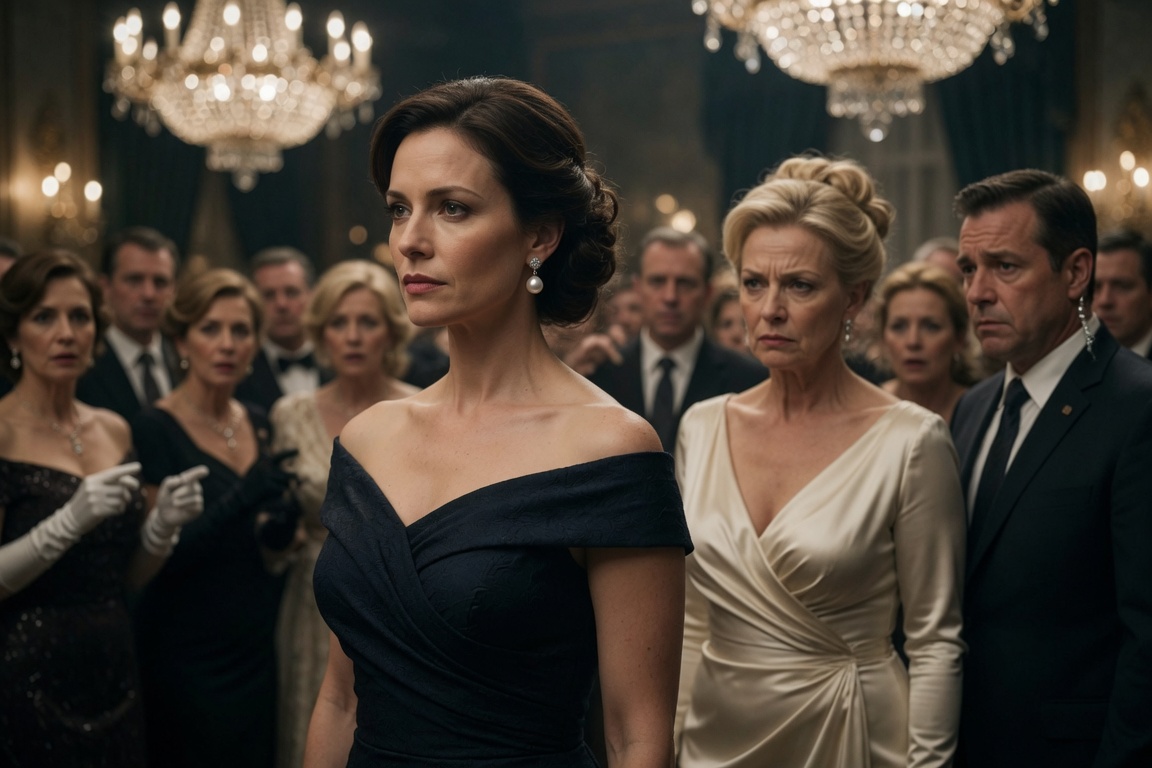
THE BILLIONAIRE INVITED A BEGGAR TO HIS PARTY FOR FUN—BUT THE OLD MAN’S WORDS FROZE THE ENTIRE ROOM
The old man was standing beneath the golden entrance of the Imperial Crown Hotel when Nathan Vale decided to make him the evening’s entertainment.
Rain had soaked through the man’s gray coat. One shoe was held together with black electrical tape, and a paper cup rested beside his feet. Behind him, a line of black cars slid beneath the hotel canopy, delivering politicians, television hosts, athletes, investors, and executives to the most exclusive party in the city.
Inside, six hundred guests were waiting to celebrate Nathan’s fortieth birthday and the eight-year anniversary of Vale Meridian, the logistics empire valued that morning at eleven-point-eight billion dollars.
Outside, Nathan stopped beneath the cameras and looked at the old man.
“You know what would be memorable?” he said.
His communications director, Claire Rowe, glanced at him. “Nathan, the livestream starts in six minutes.”
Nathan smiled toward a group of reporters.
“Invite him in.”
Claire followed his gaze. “The homeless man?”
“Exactly.”
The reporters heard him. So did the influencers standing nearby.
Phones immediately rose.
Nathan stepped toward the old man and held out his hand as though he were welcoming a visiting head of state.
“What’s your name?”
The old man looked at Nathan’s hand but did not take it.
“Tonight?” he asked.
A few people laughed.
Nathan smiled wider. “Tonight and every other night.”
“Elias Ward.”
“Well, Mr. Ward, would you like to attend my birthday party?”
The old man’s eyes moved past Nathan toward the enormous silver letters above the entrance.
VALE MERIDIAN: EIGHT YEARS OF MOVING THE WORLD FORWARD.
“Why?” Elias asked.
Nathan turned slightly so the cameras could capture his better side.
“Because everyone deserves a seat at the table.”
The sentence was perfect.
Claire knew it immediately. By midnight it would be quoted beneath photographs of Nathan helping a homeless man through the doors of a billion-dollar celebration. By morning, the company’s public relations team could connect it to Nathan’s housing initiative.
But Elias did not move.
“Is that the truth?” he asked.
Nathan’s smile tightened.
“It can be, if you come inside.”
The old man studied him for several seconds.
Then he reached down, picked up his paper cup, and poured the rainwater from it.
“I’ll come,” he said. “On one condition.”
Nathan laughed. “You have conditions?”
“I want three minutes at your microphone.”
The people around them laughed louder.
One reporter whispered, “This is gold.”
Nathan looked toward Claire. She shook her head once.
He ignored her.
“Three minutes,” Nathan said. “But keep it clean.”
Elias nodded.
“I have spent eight years waiting for those three minutes.”
Nathan did not notice the way he said it.
He was already turning toward the cameras.
The Grand Meridian Ballroom had been transformed into a monument to Nathan’s success.
A ceiling of artificial stars shimmered above crystal tables. A string orchestra played beside a wall of white roses. Images from Nathan’s life rotated across three enormous screens: Nathan as a scholarship student, Nathan ringing the opening bell at the stock exchange, Nathan shaking hands with presidents, Nathan opening hospitals, Nathan standing beside driverless trucks bearing the Vale Meridian logo.
At the center of the room stood an empty glass chair.
It represented Mira Bell.
Every guest knew her story.
Eight years earlier, when Nathan had been a nearly unknown entrepreneur with a failing software company, his fiancée had died in a tunnel accident. Nathan had later said that grief gave him the strength to complete the platform they had dreamed about together.
That platform became Meridian.
The company grew from twelve employees to forty-eight thousand. Its software coordinated ports, hospitals, warehouses, emergency supply chains, and transportation networks across thirty-one countries.
Nathan often spoke about Mira during interviews.
“She believed movement should serve people,” he would say. “Everything I built began with her.”
Her photograph hung in every regional headquarters.
Her name was attached to scholarships, medical clinics, and an annual award for young innovators.
To the public, Nathan was not simply a billionaire.
He was a man who had transformed tragedy into purpose.
Only a few people knew that he rarely looked at the glass chair when he entered a room.
That night, the chair stood beside the main stage.
Nathan’s mother, Evelyn Vale, sat near it in a silver gown. At sixty-eight, Evelyn still possessed the controlled elegance of a woman who had spent decades entering rooms she once cleaned for other people.
Beside her sat Julian Cross, the chief financial officer of Vale Meridian and the first investor who had believed in Nathan.
Julian was tall, white-haired, and calm. He had the habit of touching his cuff links whenever something displeased him.
He touched them when Nathan entered with Elias.
“What is that?” Julian asked.
Evelyn followed his gaze.
Nathan was leading the old man through the ballroom while hundreds of guests turned to watch.
“A publicity stunt,” Evelyn said.
Julian’s expression changed.
He stared at Elias longer than anyone else did.
Then the color slowly left his face.
“Where did Nathan find him?”
“At the entrance.”
Julian pushed back his chair.
Evelyn caught his wrist.
“Sit down.”
“You know who that is?”
Her fingers tightened.
“Yes.”
Across the ballroom, Nathan showed Elias to an empty seat at Table Forty-Nine, near the service doors.
The guests at the table shifted uncomfortably.
One woman moved her handbag onto her lap.
A young technology investor leaned toward his companion and whispered loudly enough for Elias to hear.
“I suppose this is the charity portion of the evening.”
Elias removed his wet coat and folded it over the back of the chair.
Beneath it, he wore a clean but faded blue shirt. His hands were scarred. His white beard was uneven, but his fingernails were carefully trimmed.
A waiter approached and asked whether he wanted champagne.
“Water,” Elias said.
The investor laughed. “Take the champagne. You may never see it again.”
Elias looked at him.
“I have seen men drink champagne before,” he said. “It usually tastes better before they know what it cost.”
The investor stopped smiling.
Claire watched the exchange from across the room.
Something about Elias troubled her.
It was not fear or confusion. He did not look like a man overwhelmed by wealth. He looked like a man who had entered a courthouse carrying evidence.
She approached Nathan near the stage.
“You need to withdraw the microphone offer.”
Nathan adjusted his cuff.
“We invited him. We can let him say thank you.”
“He did not come to say thank you.”
“He is a homeless man standing in a room full of cameras. What exactly do you think he’s going to do?”
“I don’t know.”
Nathan glanced at Elias.
“Then relax.”
Claire lowered her voice. “Julian recognized him.”
That made Nathan turn.
Julian was speaking urgently to the head of security.
Nathan’s smile disappeared.
“Recognized him from where?”
Before Claire could answer, the orchestra ended its final piece.
The lights dimmed.
A voice announced Nathan’s name, and the room rose in applause.
Nathan walked onto the stage as gold light filled the ballroom.
He was good in front of an audience.
He knew when to pause, when to lower his voice, and when to make success sound like a shared achievement. He thanked employees, investors, city leaders, and his mother.
Then he turned toward the empty glass chair.
“And, of course, there is one person without whom none of this would exist.”
The screens changed.
Mira Bell appeared behind him.
She was twenty-nine in the photograph, with dark hair gathered loosely behind her head and a pencil tucked above one ear. She was laughing at something outside the frame.
The room became quiet.
Nathan placed one hand on the glass chair.
“Mira taught me that the true measure of success is not what we accumulate, but what we move forward for others.”
At Table Forty-Nine, Elias closed his eyes.
Nathan continued.
“Her life ended too soon. But her vision lives in every hospital we supply, every family we employ, and every young person who receives a Mira Bell scholarship.”
Elias opened his eyes again.
This time, there was no sadness in them.
Only decision.
Nathan finished his speech to a standing ovation.
As the applause faded, he lifted a hand.
“Before dinner, I want to recognize an unexpected guest.”
The cameras turned toward Elias.
“We speak often about inclusion,” Nathan said. “But values mean nothing unless we practice them. Tonight, I met a gentleman outside this hotel who reminded me that dignity should not depend on a person’s bank account.”
Elias remained seated.
Nathan smiled.
“Mr. Elias Ward, would you join me?”
Every face turned.
The old man rose slowly, lifted his folded coat, placed it over one arm, and walked toward the stage.
Someone near the front began clapping.
Others followed.
By the time Elias climbed the steps, the applause had grown warm and theatrical.
Nathan offered him the microphone.
Elias did not take it immediately.
He looked at Nathan, then at the photograph of Mira behind them.
“You still use that one,” he said.
Nathan’s fingers tightened around the microphone.
“Excuse me?”
“That photograph. She hated it.”
Nathan’s smile remained in place, but only because six hundred people were watching.
“Did you know Mira?”
Elias took the microphone.
“I knew her before you did.”
The room changed.
The laughter did not stop all at once.
It seemed to fall away table by table.
Nathan stared at the old man.
Elias turned toward the audience.
“My name is not Elias Ward.”
Julian stood up.
The head of security moved toward the stage.
Claire stepped into his path.
“Wait.”
Julian pointed at Elias. “Cut the microphone.”
Claire looked toward Nathan.
Nathan had not moved.
“My name,” the old man said, “is Dr. Elias Bell.”
Evelyn’s champagne glass slipped from her hand.
It struck the edge of the table, shattered against the floor, and sprayed across Julian’s polished shoes.
Nathan heard the name, but his mind refused to hold it.
Dr. Elias Bell.
Mira’s father.
The man Nathan had met only three times. The man who had disappeared after his daughter’s funeral. The man Julian said had suffered a breakdown and left the country.
Nathan looked more closely.
The beard, the hollow cheeks, the scar above the eyebrow—those things had hidden him.
The eyes had not changed.
“You’re dead,” Nathan whispered.
Elias heard him.
“No,” he said. “That was my daughter.”
A murmur passed through the ballroom.
Elias faced the guests again.
“Or at least, that is what the man beside me has spent eight years telling the world.”
Nathan reached for the microphone.
Elias pulled it away.
“You promised me three minutes.”
“This isn’t the place.”
“It is exactly the place. You built this room for her ghost.”
Two security officers approached the stairs.
Claire lifted her hand.
“Do not touch him.”
Julian pushed through the crowd.
“This man is unstable,” he announced. “He has attempted to extort the company before.”
Elias looked down at him.
“Good evening, Julian.”
Julian stopped.
Elias’s expression did not change.
“You look better than you did outside St. Gabriel’s Hospital.”
The room went silent again.
Julian turned to the audio technician and drew a finger across his throat.
The technician reached for the sound controls.
Claire’s phone vibrated.
A message appeared from the livestream manager.
The feed has been mirrored to three external servers. We can’t cut it without cutting every screen in the building.
Claire looked toward Elias.
He had planned this.
But an old man living on the street could not have done it alone.
Someone inside Vale Meridian had helped him.
Elias reached into his shirt and removed a worn photograph.
He held it up.
“Eight years ago, my daughter, Mira Bell, was not a symbol. She was not a scholarship name. She was not an empty chair at a billionaire’s party.”
The screens behind him changed.
The polished company tribute disappeared.
In its place appeared a photograph of Mira in a small apartment, sitting on the floor beside two computers and a tower of takeaway boxes. Nathan was asleep against the sofa. Mira was looking at the camera with one finger pressed to her lips.
“She was a systems engineer,” Elias said. “She was the primary architect of a logistics program called Lantern.”
Nathan felt pressure building behind his eyes.
No one outside the first six employees knew the name Lantern.
The software had become Meridian One after Mira’s death.
Elias continued.
“Lantern was designed to find what large systems overlooked. A delayed truck. A missing medicine shipment. A remote clinic that had been forgotten because it was not profitable enough to matter.”
A page of handwritten code appeared on the screens.
At the top, in Mira’s handwriting, were seven words:
Make the system kind to the invisible.
Nathan looked at those words and felt the stage shift beneath him.
The sentence had become Vale Meridian’s global slogan.
He had repeated it in speeches for years.
He had told journalists it came to him while sitting alone after Mira’s funeral.
Elias turned toward him.
“You remember this notebook?”
Nathan said nothing.
“You were in the room when she wrote that sentence.”
“I never claimed—”
“You claimed everything.”
A wave of whispers moved across the ballroom.
Julian reached the stage.
“That notebook was company property,” he said.
Elias nodded calmly.
“Thank you.”
Julian frowned.
“For what?”
“For admitting that it existed.”
On the screens, the image changed again.
A contract appeared.
The heading read:
INTELLECTUAL PROPERTY ASSIGNMENT: LANTERN SYSTEMS
Mira’s name was printed beneath Nathan’s.
Her signature appeared at the bottom.
Elias looked toward the nearest camera.
“This document transferred all rights to Lantern to a holding company controlled by Julian Cross.”
Julian laughed once.
“The document is legal.”
“It was signed on October seventeenth.”
“Yes.”
Elias waited.
Someone in the room checked a phone.
Evelyn closed her eyes.
Nathan suddenly understood what Elias was about to say.
October seventeenth was three days after Mira’s funeral.
Elias allowed the date to remain on the screens.
Then he displayed a certified death record.
According to the record, Mira Bell had died on October eleventh.
A former attorney general seated near the stage leaned forward.
Elias looked at Julian.
“Perhaps Mr. Cross can explain how a dead woman signed a contract six days after her death.”
Julian’s face hardened.
“This is forged.”
“The contract?”
“The material on those screens.”
Elias nodded toward the guests.
“Fortunately, the original is in Vale Meridian’s legal archive.”
Julian looked toward Nathan.
For the first time that night, there was fear in his eyes.
Nathan took one step away from him.
“Is it?”
Julian lowered his voice. “Do not engage with this.”
“Is the original in our archive?”
“Nathan, he is manipulating the room.”
“Answer me.”
Julian reached for Nathan’s arm.
Nathan pulled away.
Elias did not raise his voice.
He did not need to.
“In the final weeks before the accident, Mira discovered that Julian had created a second company to receive Lantern’s patents. She also discovered that investor presentations described Nathan as the sole creator.”
Nathan shook his head.
“She accused you of stealing the code.”
“No,” Elias said. “Julian told you she had accused you.”
Nathan remembered a printed email.
He remembered Julian placing it on a restaurant table.
He remembered Mira’s supposed words: Nathan understands investors. He does not understand the system. Once the financing closes, I can remove him.
He had confronted her.
She denied writing it.
He had called her a liar.
Elias looked at him with unbearable calm.
“The email was fabricated.”
“You can’t prove that.”
A data report appeared on the screens.
“Recovered metadata. The message was created on a company laptop assigned to Julian’s executive assistant.”
Julian turned toward Claire.
“You are fired.”
Claire met his gaze.
“No,” she said. “I resigned forty minutes ago.”
Nathan looked at her.
Claire’s face was pale, but steady.
“For six years,” she said, “I managed requests sent to the executive office. Last month, I found a restricted archive with correspondence from Dr. Bell. Julian’s name was on every denial.”
Nathan stared at her.
“You knew about this?”
“I knew enough to stop believing him.”
Julian pointed at the screens.
“This is a coordinated attack before our public offering.”
Elias’s eyes moved toward the investors seated near the front.
“That offering is why I am here tonight. If it completes tomorrow, the lie becomes too large for anyone to admit.”
Nathan stepped closer to Elias.
“What happened to Mira?”
It was the first question he asked that did not concern the company.
Elias looked at him for a long time.
“Do you want to know what happened to her?”
Nathan’s voice dropped.
“Yes.”
“Then listen without interrupting.”
Elias faced the room again.
“On October eleventh, eight years ago, Mira was driving to Pier Eighteen. She had asked Nathan to meet her there.”
Nathan remembered the call.
It had come at 7:42 p.m.
He had been in a private dining room with Julian and three investors from Singapore.
Mira had sounded breathless.
She told him she had proof.
She told him they needed to speak before he signed anything.
Then she said something else.
Something Nathan had buried beneath eight years of interviews, awards, acquisitions, and carefully repeated grief.
“I’m pregnant.”
The words returned so clearly that he almost heard her voice inside the ballroom.
Nathan had stood near the restaurant window while Julian watched from the table.
Mira had asked him to come alone.
Nathan asked whether the child was his.
There had been silence on the line.
He had been angry. Humiliated. Terrified that the investment would collapse.
“You asked her if the baby belonged to you,” Elias said.
Several guests looked at Nathan.
His mouth opened.
No sound came.
Elias continued.
“She told you it did.”
Nathan remembered his reply.
“You chose a convenient time to say that.”
Mira had begun crying.
He had never told anyone that.
Elias knew.
“You told her you were tired of being manipulated. You said if she wanted to destroy the company, she could do it without you.”
Nathan’s hand moved toward his mouth.
“You ended the call,” Elias said. “She drove toward the pier anyway.”
At 8:16 p.m., a freight vehicle entered the Harbor Tunnel too quickly. It struck a maintenance barrier, crossed two lanes, and hit Mira’s car.
The car spun into a service passage and caught fire.
Emergency crews found a burned handbag, Mira’s phone, and the body of a woman near the rear passenger door.
The body was identified as Mira Bell.
Nathan remembered arriving after midnight.
Julian had met him outside the police barrier.
Evelyn had held him while he stared at the black mouth of the tunnel.
The funeral took place three days later.
The coffin remained closed.
Elias placed both hands on the microphone.
“The woman buried under my daughter’s name was called Elena Marquez.”
A photograph of a smiling woman in a restaurant uniform appeared on the screens.
“She was thirty-four years old. She worked nights at a bakery and cleaned offices during the day. She had entered the service passage on foot because she missed the final bus and used the tunnel as a shortcut.”
The guests stared at the photograph.
“Her family reported her missing. No one connected her to the accident because the identification process had already been closed.”
Nathan looked toward Julian.
“You identified the body.”
Julian did not answer.
“You told me dental records confirmed it.”
“The police made the identification.”
“No,” Elias said. “A private medical consultant made it. A consultant employed by a firm that received two hundred and forty thousand dollars from Julian Cross.”
Julian’s jaw tightened.
“This is absurd.”
Elias displayed the payment.
The ballroom filled with the sound of people inhaling.
“What happened to Mira?” Nathan asked again.
Elias looked back at him.
“The impact threw her through a damaged maintenance gate into a drainage channel beneath the tunnel.”
A municipal worker found her almost two hours later, unconscious and without identification. He transported her in his own vehicle to St. Gabriel’s Hospital because emergency access to the tunnel was blocked.
She had a fractured skull, internal bleeding, three broken ribs, and severe injuries to her left hand.
The hospital registered her as an unidentified patient.
She remained unconscious for twenty-six days.
“When she woke,” Elias said, “she did not know that the world had buried her.”
Nathan’s knees weakened.
He reached for the glass chair behind him.
Elias saw it.
“That chair is stronger than the one beside her hospital bed,” he said. “I slept in that one for eleven weeks.”
“You found her?”
“Eventually.”
“How?”
“Because unlike the people who wanted her dead, I kept looking.”
The sentence struck Nathan harder than a shout.
Elias had refused to accept the closed coffin. He requested complete medical records, but the identification consultant denied him. He asked for photographs and was told they were too disturbing.
He contacted every hospital within fifty miles.
At St. Gabriel’s, a nurse remembered an unidentified pregnant woman brought in on the night of the tunnel fire.
By the time Elias arrived, Mira had undergone three operations.
Her pregnancy had survived.
Her memory returned in fragments.
The apartment.
The code.
Nathan’s voice on the telephone.
The last thing she remembered before the crash was driving toward the pier and repeating the same sentence to herself.
He will come when he sees the proof.
Nathan lowered his head.
“She asked for you every day,” Elias said.
Nathan looked up.
“No one told me.”
“Not at first.”
The room waited.
Elias removed a small digital recorder from his pocket.
He pressed a button.
Static filled the ballroom.
Then Mira’s voice emerged through the speakers.
It was weak, strained, and unmistakable.
“Nathan, it’s Mira. I don’t know what they told you. I’m alive. The baby is alive. My father says I should rest, but I need you to know Julian lied about the emails. I have the original server files. Please come to St. Gabriel’s. Room three-fourteen. Please come alone.”
The recording ended.
Nathan stood completely still.
The voice he had mourned in public for eight years had just spoken to him in front of six hundred witnesses.
Elias pressed another button.
A receptionist answered.
“Vale Meridian executive office.”
Mira’s weak voice asked for Nathan.
There was a pause.
Then another voice came onto the line.
Evelyn Vale.
Nathan turned toward his mother.
Evelyn gripped the edge of the table.
In the recording, Mira began to cry.
“Mrs. Vale, please tell Nathan I’m alive.”
Evelyn’s younger voice remained cold.
“Nathan has suffered enough.”
“I need to speak to him.”
“You need to leave him alone.”
“I’m carrying his child.”
“You have already nearly destroyed his future.”
A sound moved through the ballroom, part shock and part disbelief.
On the recording, Mira whispered, “You know Julian forged the email.”
“I know my son finally has a chance.”
“He deserves the truth.”
“He deserves a life that is not built around rescuing you.”
The call ended.
Nathan stared at his mother.
Evelyn’s lips trembled.
“Nathan,” she said.
He stepped away as she approached the stage.
“You knew?”
“I thought I was protecting you.”
“You knew she was alive.”
Evelyn looked around the ballroom as though the strangers watching her were responsible for the question.
“You had nothing,” she said. “You were sleeping on an office floor. The company was days from collapse. Julian said the investors would leave if Mira challenged the patents.”
“So you let me bury her.”
“I saw what losing her did to you. By the time she called, you had already begun rebuilding.”
“She was carrying my child.”
“I did not believe her.”
Her voice broke on the final word.
Nathan’s face changed.
Until then, he had looked confused, frightened, and wounded.
Now he looked at his mother as though he had never seen her before.
Elias spoke quietly.
“She sent medical records.”
Evelyn closed her eyes.
“She sent an ultrasound.”
“I was afraid.”
“No,” Nathan said. “You made a choice.”
Evelyn’s eyes filled with tears.
“So did you.”
Nathan flinched.
Elias watched him.
The room seemed to contract around the stage.
Nathan turned back toward the old man.
“What does she mean?”
Elias reached into his coat and removed a large brown envelope.
It had been opened once and sealed again inside a transparent evidence sleeve.
On the front was Nathan’s name.
Across the lower corner were the words:
DELIVERED BY HAND—EXECUTIVE SIGNATURE REQUIRED.
Nathan recognized the signature immediately.
It was his.
The date was nearly seven years earlier, eleven months after Mira’s funeral.
A memory returned.
A package arriving during a board meeting.
Julian saying it came from a woman attempting to exploit Nathan’s grief.
Nathan signing the delivery form without looking.
Julian asking whether legal should handle it.
Nathan saying, “Make sure she never contacts me again.”
His stomach twisted.
“No,” Nathan whispered.
Elias held the envelope toward him.
“You received this.”
“I didn’t know it was from her.”
“Her name is written on the back.”
Nathan stared at it.
He remembered turning the envelope over.
He remembered seeing the name.
Mira Bell.
For one impossible second, hope had risen inside him.
Then Julian said scammers often researched dead relatives.
Nathan had pushed the package away.
“I thought it was a lie.”
Elias’s voice remained calm.
“You hoped it was a lie.”
Nathan looked at him.
“That is different.”
“I was grieving.”
“So was she.”
“I trusted the people around me.”
“And you refused to trust the woman you claimed to love.”
There was no anger in Elias’s voice.
That made it worse.
Nathan reached for the envelope.
Elias did not release it.
“Do you want to know what is inside?”
Nathan nodded.
Elias handed it to him.
Nathan opened the evidence sleeve.
Inside was a letter, a photograph of a newborn child, copies of medical records, and a storage key.
His hands began to shake.
The photograph showed Mira in a hospital bed, thinner than Nathan remembered, with a scar along her temple. A baby slept against her chest.
On the back, Mira had written:
His name is Leo. He has your eyes. I will wait until Friday at noon. Come alone. If you do not come, I will understand that silence is your answer.
Nathan turned the card over again as though another message might appear.
“There was a key,” Elias said. “It opened a bank deposit box containing the original Lantern source files, development logs, and records of Julian’s payments.”
Nathan looked at the key resting in his palm.
“Why didn’t you go to the police?”
“We did.”
“What happened?”
“Julian’s lawyers said Mira was mentally unstable after the accident. They produced the signed patent transfer. They produced your public statements describing yourself as Lantern’s creator. They produced a medical report claiming Mira had memory damage.”
Elias glanced toward Julian.
“They also produced a witness who said Mira planned to sell the code overseas.”
Nathan looked at Julian.
“Who?”
Julian said nothing.
Elias answered.
“Your mother.”
Evelyn sat down as though her legs had failed.
The first guests began moving away from her table.
Not dramatically.
Just one chair, then another.
The distance widened around her.
Elias continued.
“The legal fight lasted four years. It consumed my savings, my home, and my medical practice. When I refused to stop, a professional complaint appeared accusing me of prescribing controlled medication without authorization.”
Elias lifted his scarred hands.
“I was suspended. The accusation was later withdrawn, but the clinic never reopened. I lived in my car until it was repossessed. Then I lived wherever the police did not move me.”
The technology investor from Table Forty-Nine stared down at his untouched champagne.
Elias looked at him.
The man could not meet his eyes.
Nathan struggled to speak.
“Why didn’t Mira come publicly?”
“She tried.”
A video began playing on the screens.
Security footage showed the lobby of Vale Meridian’s original headquarters.
The date in the corner was seven years earlier.
Mira entered the building with a cane. Her left hand was wrapped in a compression glove. Elias followed, carrying an infant.
She approached the security desk and placed documents on the counter.
A guard made a call.
Two men arrived.
One was Julian.
The other was Nathan’s former head of security.
Julian looked at the documents but did not touch them.
The footage had no sound, but his gestures were clear.
Leave.
Mira refused.
The security chief took her arm.
She pulled away.
The baby began crying.
Employees crossed the lobby, staring.
Then someone appeared on the upper balcony.
Nathan.
He had no memory of it until he saw himself on the screen.
He remembered leaving a meeting and hearing a disturbance below.
He remembered seeing a thin woman near the entrance.
He remembered Julian stepping beside him and saying, “That’s the woman who sent the package. Security is handling it.”
On the screen, Mira looked up.
She saw Nathan.
Their eyes met across the lobby.
Nathan watched his younger self turn away.
A sound escaped him.
Not a word.
Something smaller.
Something broken.
Elias paused the video on the moment before Nathan disappeared from view.
Mira’s face filled the screens.
Her mouth was open, calling his name.
Her body leaned forward while the guard held her back.
Nathan’s face appeared in the corner, already turning toward the elevator.
“This,” Elias said, “was the moment she stopped waiting for you.”
Nathan stared at the screen.
Mira had not been a blurry stranger.
He had recognized her.
Not fully. Not logically.
But something in him had known.
He had turned away because accepting that she might be alive would have required him to question everything his success depended upon.
Elias lowered the microphone.
For several seconds, no one moved.
Julian was the first to recover.
He climbed onto the stage.
“Enough.”
He reached for the microphone.
Nathan blocked him.
Julian stopped.
“Nathan,” he said quietly, “think carefully. The offering opens in nine hours. Forty-eight thousand employees depend on you. Pension funds depend on us. Hospitals depend on our systems.”
“You forged her signature.”
“You do not know that.”
“You identified the wrong body.”
“I hired experts.”
“You blocked her calls.”
“I protected the company.”
“You destroyed her father.”
Julian’s eyes hardened.
“I built you.”
The words carried through the microphone.
Julian realized too late that the room had heard him.
Nathan looked at him.
“You built me?”
“You were talented, but talent is common. I gave you discipline. I gave you investors. I made people believe you could lead.”
“You used Mira’s work.”
“We used an asset that would otherwise have died in a hospital room.”
A collective gasp moved across the ballroom.
Julian looked toward the audience and understood what he had said.
His confidence cracked.
Elias watched his face.
The moment of recognition did not arrive as panic.
It arrived as stillness.
Julian’s shoulders lowered. His mouth remained slightly open. His hand, which had been reaching for Nathan, fell to his side.
All around him, phones were recording.
The attorneys at the front table were no longer whispering to one another. They were typing.
Two board members had already left their seats.
A federal transportation official stood near the exit, speaking into her phone.
Julian looked toward the cameras, then toward the enormous image of Mira in the lobby.
He finally understood that this could not be contained by a payment, a threat, or another sealed agreement.
The lie was no longer in a private archive.
It was in the room.
It was on the livestream.
It was being watched across the country.
Elias moved closer to Julian.
“You made one mistake.”
Julian swallowed.
“What?”
“You believed poor people disappear.”
Elias looked toward the servers, guards, drivers, and hotel staff standing along the walls.
“A nurse saved Mira’s messages. A receptionist kept copies of the call records. A municipal worker remembered where he found her. A security technician preserved the lobby footage because he was ordered to delete it.”
Claire stepped forward.
“And an assistant kept Julian’s original laptop.”
Julian turned sharply.
At the edge of the stage stood Anna Reyes, his executive assistant from the company’s first year.
She was sixty now, wearing a plain black dress and an employee badge.
Nathan remembered her leaving without explanation shortly after Mira’s funeral.
Anna held up a sealed computer drive.
“Julian told me to create the email that made Mira look disloyal,” she said.
Julian’s expression changed.
“You signed a confidentiality agreement.”
“I also gave sworn testimony to federal investigators yesterday.”
The room erupted.
Reporters rushed toward the stage.
Guests stood.
Security officers received competing instructions through their earpieces.
Julian stepped back from Anna.
“This is revenge because I terminated you.”
“You terminated me because I asked whose body we buried.”
Julian looked toward the nearest exit.
Two men in dark suits entered the ballroom.
One showed identification to the head of security.
Julian saw the badge.
His face collapsed.
Nathan watched him grip the edge of the glass chair.
The chair dedicated to Mira.
For one absurd second, Julian seemed to seek support from the memory he had helped manufacture.
Elias stepped between him and the chair.
“Not that one,” he said.
Julian released it.
Nathan looked toward Elias.
“Where is she?”
Elias did not answer.
“Please.”
“You had seven years to ask that question.”
“I’m asking now.”
Elias studied the man in front of him.
Nathan’s expensive suit, the lights, the screens, the billion-dollar company—none of it seemed to interest him.
“She does not want your money.”
“I understand.”
“No, you don’t.”
“I want to see her.”
“That is still a request about what you want.”
Nathan looked down at the photograph of Leo.
The baby would be almost eight years old now.
“Does he know about me?”
“He knows your name.”
“What did she tell him?”
“The truth.”
Nathan’s eyes filled.
“Which truth?”
“That his father became a man who could move anything in the world except himself.”
Elias placed the microphone on the glass chair.
He lifted his coat.
Nathan reached for his arm but stopped before touching him.
“Why tonight?”
Elias looked around the ballroom.
“Because tomorrow, your company planned to sell another piece of her work to the public. Because every year you placed flowers beside an empty chair while the living woman behind the name struggled to pay for the therapy that allowed her to walk.”
He stepped closer.
“And because your son asked why a man who built a company to find forgotten things had never found him.”
Nathan closed his eyes.
When he opened them, Elias was walking down the stage steps.
The crowd moved aside.
No one laughed at his coat.
No one looked at his taped shoe.
Nathan followed him with his eyes.
At the ballroom entrance, Elias stopped and turned.
Six hundred people waited.
The old man never raised his voice.
“I came here to finish a story you never stayed to hear.”
Then he looked directly at Nathan.
“She’s still waiting, Nathan. And she has your son.”
Elias walked through the doors.
For several seconds, the room remained completely silent.
Then every phone in the ballroom began to vibrate.
News alerts.
Market notices.
Messages from lawyers, journalists, employees, relatives, and investors.
The livestream had already been shared millions of times.
Vale Meridian’s board announced an emergency meeting.
The company’s largest investor demanded that the public offering be suspended.
Three directors submitted temporary resignations.
By the time Nathan stepped off the stage, Julian was speaking to federal investigators near the service corridor.
Evelyn stood alone beside the broken champagne glass.
“Nathan,” she said.
He continued walking.
She caught his sleeve.
“I did it for you.”
He turned.
His mother was crying openly now.
Nathan had seen her survive eviction, debt, illness, and the death of his father without crying in front of anyone.
It no longer moved him as it once would have.
“You did it for the version of me you wanted to create.”
“I was terrified you would lose everything.”
“I did.”
She shook her head.
“You have the company.”
Nathan looked toward the stage.
Mira’s photograph still filled the screens.
“No,” he said. “I have the evidence.”
Claire found him in the executive suite forty minutes later.
He was sitting alone at a conference table, still holding Leo’s photograph.
Outside the glass wall, lawyers, board members, security staff, and crisis advisers argued over what statement to release.
Claire entered and closed the door.
“The board is waiting.”
Nathan did not look up.
“Did you know he would say all of it?”
“I knew Mira survived. I knew Julian intercepted correspondence. I did not know about your mother until the recording played.”
“Did you know about my son?”
“No.”
Nathan turned the photograph over.
“Find Elias.”
“He left on foot.”
“Find him.”
“What are you going to do when we do?”
Nathan looked through the glass at the executives waiting to save the company.
“I don’t know.”
Claire sat across from him.
“That answer is why he may not tell you where she is.”
Nathan’s jaw tightened.
“He destroyed us in front of the world.”
“No. He described what happened in front of the world.”
“You think I don’t understand that?”
“I think part of you is still measuring the damage by how much it costs you.”
Nathan stood so quickly that the chair rolled backward.
“What do you want from me?”
“Nothing.”
Claire remained seated.
“But forty-eight thousand employees need you to decide whether you will spend tonight protecting the company from the truth or protecting the truth from the company.”
Nathan stared at her.
The board counsel knocked on the glass.
“We need you now.”
Nathan entered the emergency meeting at 12:18 a.m.
Julian’s chair was empty.
Evelyn was not invited.
Fourteen faces appeared around the table and on video screens from London, Singapore, Toronto, and Dubai.
The lead director began immediately.
“We have prepared a statement identifying Elias Bell as a distressed former claimant presenting unverified allegations.”
Nathan sat at the head of the table.
“Are they unverified?”
“We are reviewing them.”
“Is Mira’s contract in the archive?”
No one answered.
Nathan looked at the general counsel.
“Is it?”
The woman removed her glasses.
“Yes.”
“Was it signed after her recorded date of death?”
“Yes.”
“Do we have correspondence from her?”
“There are sealed files.”
“Open them.”
“We need a court order to override the internal restrictions placed by Mr. Cross.”
Nathan placed the storage key on the table.
“Remove every restriction.”
The lead director leaned forward.
“Nathan, a complete disclosure could destroy the offering.”
“Then stop the offering.”
The screens filled with overlapping objections.
Billions of dollars were at risk. Employees’ equity would collapse. Competitors would exploit the chaos. Governments might suspend contracts.
Nathan listened.
For years, he had been praised for making decisions faster than other people.
That night, he made the first decision of his career without calculating whether it would benefit him.
“Stop the offering,” he repeated.
The objections ceased.
“Effective immediately, I am stepping down as chief executive pending an independent investigation. Release every document connected to Mira Bell, Lantern, and the Harbor Tunnel identification.”
The lead director stared at him.
“Your attorneys strongly advise against a personal admission.”
“I am not asking my attorneys.”
“Nathan, anything you say publicly may be used against you.”
“It should be.”
At 2:07 a.m., Nathan returned to the ballroom.
Most guests had gone, but the press remained behind the barricades. Hotel employees were clearing the tables. The flowers around the glass chair had begun to wilt beneath the lights.
Nathan stood at the same microphone Elias had used.
There was no prepared backdrop.
No music.
No introduction.
“I spent eight years telling the world that I built Vale Meridian to honor Mira Bell,” he said.
The remaining conversations stopped.
“Tonight, I learned that while I was speaking her name on stages, people inside my company were preventing her from speaking mine.”
Cameras moved closer.
“I was deceived. Documents were hidden from me. Evidence was manipulated.”
He paused.
For one moment, the old instinct returned.
The instinct to stop there.
To present himself as another victim.
Then he looked toward the frozen image on the screen: his younger self turning away from Mira in the company lobby.
“But deception is not the whole truth,” Nathan said. “I was given reasons to ask questions, and I chose not to ask them. I received a package from Mira Bell. I saw her name. I allowed someone else to remove it because believing she was alive would have threatened the life I had begun building.”
A reporter lowered her phone slightly.
Nathan continued.
“I benefited from silence. I benefited from work that was not mine alone. I benefited from the destruction of people I claimed to love.”
He announced the suspension of the offering, his resignation, and the release of the company archives.
He promised full cooperation with investigators.
Then he said the only sentence that appeared on every front page the following morning.
“I do not yet know how much of my fortune belongs to Mira Bell, but I know how little of my story belongs only to me.”
When the press conference ended, Claire approached him.
“We found Elias.”
Nathan’s head lifted.
“He sleeps behind the old North Line station. One of the hotel kitchen workers recognized him.”
“Take me there.”
“No security convoy.”
Nathan removed his jacket.
“No convoy.”
“No lawyers.”
“Agreed.”
“And no cameras.”
Nathan looked toward the reporters.
“Agreed.”
They found Elias sitting beneath an abandoned railway sign at three-thirty in the morning.
He had spread his coat beneath him. Beside the wall were two blankets, a plastic bag of clothes, and a cardboard box containing carefully organized documents.
Elias watched Nathan approach.
“I thought you would send someone.”
“I have done too much of that.”
Claire remained near the car.
Nathan stopped several feet away.
“I suspended the offering.”
“I know.”
“I resigned.”
“I know.”
“The archives will be opened.”
“I heard you.”
Nathan held out the photograph of Leo.
“I want to meet him.”
Elias did not take the photograph.
“What will you tell him?”
“The truth.”
“Which part?”
“All of it.”
“You do not know all of it.”
“Then tell me.”
Elias looked toward the dark tracks.
“Mira lives in a house on Cedar Street. Number eighteen. She runs a small scheduling service for community clinics.”
Nathan’s throat tightened.
“She still works in logistics?”
“She says systems are not guilty of what people do with them.”
“Will she see me?”
“No.”
Nathan absorbed the answer.
“Then why give me the address?”
“Because your son wakes at seven. He walks to school at seven-forty. You can stand across the street and see what your silence looks like.”
Nathan glanced at the blankets beneath Elias.
“You’re coming with me.”
“No.”
“I’ll get you a room.”
Elias smiled for the first time.
It was not a kind smile.
“You still think a room is the first thing I want from you?”
“What do you want?”
“I wanted my daughter believed.”
“She will be.”
“I wanted my name cleared.”
“It will be.”
“I wanted Elena Marquez’s family to know where she was buried.”
Nathan lowered his eyes.
“That will happen.”
Elias leaned back against the wall.
“Then perhaps tomorrow, you can begin asking what people need instead of announcing what you will give them.”
At seven-twenty, Nathan stood across from Number Eighteen Cedar Street.
It was a narrow brick house between a laundromat and a closed florist. Yellow curtains covered the lower windows. A bicycle rested against the steps.
Nathan had changed into plain trousers and a dark sweater Claire found in an all-night store. Without his suit, his driver, and the wall of people who normally moved ahead of him, he looked smaller.
At seven-thirty-five, the front door opened.
A boy stepped outside.
He wore a red backpack and carried a cardboard model of a city intersection. His dark hair refused to lie flat. He knelt beside the bicycle and adjusted a wire beneath the model.
Nathan stopped breathing.
The boy had Mira’s mouth.
But the eyes were Nathan’s.
Not simply the color.
The concentration.
The way his left eyebrow rose when something did not fit.
A woman appeared behind him.
Mira.
For eight years, Nathan had imagined her at twenty-nine.
The woman standing in the doorway was thirty-seven.
Her hair was shorter. A pale scar crossed her temple. She leaned slightly on a black cane, and her left hand rested stiffly against the doorframe.
But it was Mira.
Alive.
She told Leo to hurry.
He said something that made her laugh.
Nathan had heard that laugh every night for a year after the funeral. It used to wake him from sleep.
Now it crossed the street and reached him as naturally as the morning traffic.
Mira looked up.
She saw him.
The laughter left her face.
Leo followed her gaze.
Nathan did not move.
Mira descended one step and placed herself between Nathan and the boy.
The gesture was small.
It told him everything.
“Mom?” Leo asked.
Mira’s eyes remained on Nathan.
“This is Nathan Vale.”
Leo looked across the street.
“The company man?”
Nathan felt the words in his chest.
Mira nodded.
Leo studied him with the open curiosity of a child who had not yet learned how adults hid shame.
Nathan crossed slowly and stopped at the gate.
“Hello, Leo.”
The boy held his cardboard model closer.
“Are you my father?”
Mira looked at Nathan.
This was the first test.
No lawyers.
No advisers.
No carefully shaped sentence.
“Yes,” Nathan said. “I am.”
“Where were you?”
Nathan swallowed.
“I believed a lie.”
Mira’s expression did not change.
Nathan forced himself to continue.
“And when I had a chance to discover the truth, I was afraid of what it would cost me.”
Leo thought about that.
“So you didn’t look?”
“No.”
The boy’s answer was immediate.
“That was stupid.”
A sound escaped Mira that was almost a laugh.
Nathan nodded.
“Yes.”
Leo looked toward his mother.
“Can I still go to school?”
“You’re already late.”
He moved toward the bicycle, then stopped.
“My bridge program didn’t win your competition.”
Nathan frowned.
“What competition?”
“The Mira Bell Future Systems Award.”
Mira’s face hardened.
Leo lifted the cardboard model.
“I made traffic lights that change when ambulances are coming. They said my application had incomplete parent information.”
Nathan closed his eyes briefly.
His own foundation had rejected his son because the boy could not provide a father’s records.
“I’m sorry.”
Leo shrugged in the way children did when they had decided an adult was not worth comforting.
“Mom said awards don’t make an idea work.”
“She’s right.”
“I know.”
Leo climbed onto his bicycle.
He looked at Nathan one more time.
“Are you coming back?”
Nathan glanced at Mira.
“That depends on your mother.”
Leo frowned.
“I asked you.”
Nathan understood.
“Yes,” he said. “If you want me to.”
The boy considered the answer, then rode toward the end of the street.
Mira waited until he disappeared around the corner.
“You should not have come.”
“Your father gave me the address.”
“He wanted you to see Leo. That is not the same as giving you permission to enter our lives.”
“I know.”
“Do you?”
Nathan looked toward the house.
On the windowsill sat a small model truck bearing the Vale Meridian logo.
“Why does he have that?”
“He studies transportation systems. Your company makes the best models.”
The absence of bitterness in her answer hurt more than anger.
“Mira…”
“Do not say my name as though it belongs to a memory.”
Nathan lowered his voice.
“I don’t know what to say.”
“You always knew what to say.”
“Not now.”
“That may be the first honest thing you’ve said to me.”
He looked at the cane.
“Are you in pain?”
“Every day.”
“I can arrange—”
Mira’s eyes sharpened.
Nathan stopped.
“I’m sorry.”
“You do not get to arrive with solutions before you understand the problem.”
“Your father said the same thing.”
“He spent eight years becoming poor enough for people like you to stop seeing him.”
Nathan looked down.
“I saw him.”
“You invited him because you thought his poverty made him harmless.”
The words struck cleanly.
He could not argue.
Mira opened the gate and stepped onto the pavement.
“You want to know why I never tried another public confrontation?”
“Yes.”
“Because Leo was four when someone photographed us leaving a legal hearing. Your company’s private investigators followed us for three weeks. A man waited outside his preschool.”
Nathan’s head lifted.
“I never authorized that.”
“You authorized Julian to protect the company from threats.”
“I didn’t know you were considered a threat.”
“You did not ask.”
Again, there was nowhere for him to hide.
Mira reached into her coat pocket and removed a folded page.
It was a copy of the letter from the envelope.
“I wrote that I would understand silence as your answer. You answered.”
“I was wrong.”
“Yes.”
“I am not asking you to forgive me.”
“Good.”
“I am asking for a chance to know my son.”
Mira looked toward the corner where Leo had disappeared.
“He has spent years asking questions about you. I answered every one without teaching him to hate you. Do not mistake that kindness for an invitation.”
“I won’t.”
“You will meet him in public. One hour at a time. You will not give him expensive gifts. You will not photograph him. You will not use him in your redemption.”
Nathan nodded.
“And you will not tell him you were only a victim.”
“I won’t.”
“Julian lied. Your mother helped him. But you turned away.”
Nathan looked at the page in her hand.
“I remember.”
“I know. I saw your face on the balcony.”
For the first time, Mira’s voice trembled.
“I spent years wondering whether you truly failed to recognize me. Then I realized that was the wrong question.”
Nathan waited.
“The real question was whether you wanted to.”
A bus passed between them, filling the street with noise.
When it was gone, Nathan’s eyes were wet.
“I wanted the dead version of you,” he said. “She asked nothing from me.”
Mira looked at him for several seconds.
“That is the first thing you have said that makes me believe you may eventually understand.”
She opened the gate.
Nathan did not follow.
“When can I see Leo?”
“Saturday. Ten o’clock. The public library.”
“I’ll be there.”
“If you bring security, we leave.”
“I’ll come alone.”
Mira stepped inside the gate.
Nathan spoke before she closed it.
“Did you ever stop waiting?”
She looked at him through the bars.
“For you? Yes.”
The gate clicked shut.
“For the truth? Never.”
The investigation lasted eleven months.
The original Lantern files proved that Mira had written most of the system’s core architecture. Development records showed Nathan’s contributions were real but had been exaggerated after her disappearance.
Julian Cross was charged with fraud, obstruction, evidence tampering, conspiracy, and filing false corporate documents.
Anna Reyes testified that Julian ordered her to fabricate the email that destroyed Nathan’s trust in Mira. A second employee confirmed that Julian had paid the private consultant who identified Elena Marquez’s body as Mira’s.
Evelyn admitted that she blocked the hospital call, concealed the ultrasound, and later testified against Mira in the patent dispute.
She was not imprisoned, but she resigned from every charitable board carrying the Vale name. Her final public statement contained no excuse.
“I believed poverty was the worst thing that could happen to my son,” she said. “I helped him become rich at the cost of becoming someone he would one day be ashamed to recognize.”
Vale Meridian’s valuation fell by more than four billion dollars.
Government contracts were suspended. Investors filed lawsuits. Nathan sold two homes, his private aircraft, and most of his personal shares to finance settlements and protect the company’s employee pension fund.
Mira was legally recognized as co-creator of Lantern and founding partner of the company.
She declined the chief executive position.
Instead, she created an independent public-interest trust that licensed Lantern’s emergency and medical systems to small clinics at no cost.
The first clinic connected to the network was St. Gabriel’s.
The remains buried under Mira’s name were returned to Elena Marquez’s family.
Nathan attended the second funeral but stood at the back.
He did not speak.
Elias’s medical record was cleared. The complaint that destroyed his clinic was formally declared fraudulent.
Nathan offered to purchase him a house.
Elias refused.
Mira later convinced her father to accept a small apartment above the community scheduling office, not as compensation, but because Leo wanted his grandfather close enough to help with school projects.
The first Saturday at the library, Nathan arrived thirty minutes early.
He brought no gifts.
Leo arrived with a notebook and asked Nathan seventeen questions.
Some were simple.
What was his favorite food?
Was he afraid of airplanes?
Did he really own a building with a garden on the roof?
Others were not.
Why did adults believe lies that made them richer?
Did Nathan love Mira before the company?
Would he have come if Elias had not embarrassed him in front of everyone?
Nathan answered each one.
When he did not know, he said so.
When the answer made him look weak, selfish, or foolish, he gave it anyway.
One hour became two.
Saturday meetings continued.
Nathan learned that Leo hated tomatoes, loved mechanical bridges, and became silent when he was angry. He learned that the boy folded the corners of book pages exactly as Mira did.
He also learned that fatherhood did not arrive when a child shared his blood.
It arrived in small acts of consistency.
Showing up.
Listening.
Remembering.
Not leaving when the questions became uncomfortable.
A year after the gala, Vale Meridian unveiled a new founders’ wall at its headquarters.
The original display had shown Nathan alone.
The new wall showed three images.
Mira at her apartment desk, a pencil above one ear.
Nathan beside the first prototype server.
And the first page of the Lantern notebook.
At the center were Mira’s handwritten words:
Make the system kind to the invisible.
Nathan attended the ceremony but did not stand on the stage.
He sat in the third row beside Leo.
Elias wore the same gray coat he had worn to the party. The shoe had been repaired, but the black electrical tape remained wrapped around it.
Mira noticed.
“You can afford new shoes,” she told him.
Elias looked toward Nathan.
“So could everyone in that ballroom.”
Leo leaned toward his grandfather.
“Then why keep the tape?”
Elias smiled.
“So I remember which part of me they saw first.”
After the ceremony, reporters surrounded Mira.
They asked whether she had forgiven Nathan.
She looked across the lobby.
Nathan was kneeling beside Leo’s latest traffic model, listening while the boy explained why the sensor placement was wrong.
“Forgiveness is not a door someone walks through once,” she said. “It is a road. Some people spend the rest of their lives proving they are willing to remain on it.”
A reporter asked whether Nathan would ever return as chief executive.
“That is not my decision.”
Nathan later answered the question himself.
“No.”
“Why not?” the reporter asked.
He looked toward the founders’ wall.
“Because for years I believed leadership meant being the person whose voice carried furthest. The most important person in my company was silenced, and I was rewarded for not hearing her.”
The reporter asked whether he regretted inviting Elias to the party.
Nathan smiled without pride.
“I invited a man I thought had nothing so I could appear generous in front of people who had everything.”
He glanced toward Elias, who was speaking with a group of young engineers.
“He entered the room carrying the only thing none of us could buy.”
“What was that?”
“The truth without fear.”
Years later, people would still remember the night the billionaire brought a beggar into his party as a joke.
They would remember the shattered glass.
The forged signature.
The recording of a woman declared dead asking the man she loved to come to her hospital room.
They would remember Julian Cross reaching for an empty chair as his power disappeared.
But the people who had been in the ballroom remembered something else most clearly.
They remembered the moment Elias Bell walked between tables where guests had hidden their handbags from him.
They remembered how no one looked at his torn coat anymore.
They remembered how the richest, most celebrated man in the city stood beneath a photograph of the woman he had failed and realized that every award, every speech, and every billion-dollar valuation had been built on a truth he had once found too inconvenient to open.
Nathan Vale had spent eight years building a system capable of finding anything that disappeared.
A shipment.
A vehicle.
A missing container.
A forgotten hospital.
But when the people he loved became inconvenient to his success, he had allowed others to erase them.
And it took a man with taped shoes, an empty paper cup, and nothing left to lose to make the entire world see them again.
Because wealth can purchase silence for years.
Power can place a false name on a grave.
Success can turn guilt into an inspirational speech and betrayal into a company legend.
But the truth does not need a billion-dollar stage.
It only needs one person brave enough to take the microphone—and refuse to give it back.