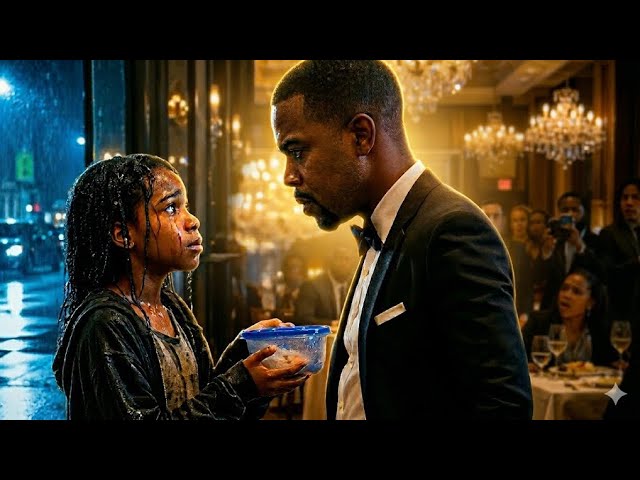
“Can I Wash the Dishes in Exchange for the Leftover Food?” The Millionaire’s Response Silenced the Entire Restaurant
The laughter started near the windows.
It moved across the dining room in small waves, passing from one white tablecloth to another until nearly everyone inside the Golden Oak had turned to look at the trembling girl standing beside the host’s podium.
She could not have been older than twelve.
Rainwater dripped from the ends of her braids. Her faded gray sweater clung to her narrow shoulders, and both of her sneakers made soft squeaking sounds against the polished marble floor.
In her hands, she held a small blue plastic container.
The lid was cracked at one corner. A single metal spoon rattled inside.
The girl swallowed hard, looked at the rows of half-finished steaks and untouched side dishes being carried toward the kitchen, and repeated the question that had made the first table laugh.
“Can I wash the dishes in exchange for the leftover food?”
The maître d’, Victor Hayes, stared at her as though she had walked in carrying garbage.
Behind him, a wall of amber glass reflected crystal chandeliers, expensive suits, diamond bracelets, and the kind of people who rarely had to ask what anything cost.
Outside, rain hammered Chicago’s sidewalks.
Inside, a jazz pianist continued playing for several uncomfortable seconds before his hands slowly stopped moving.
Victor tilted his head.
“You want to do what?”
The girl tightened her fingers around the container.
“I can wash dishes,” she said. “Or mop the kitchen. I can take out trash. I don’t need money. Just the food people didn’t finish.”
A man at a nearby table gave a short laugh.
His companion covered her mouth, but not quickly enough to hide her smile.
Victor looked around the room as though inviting the customers to share in the absurdity.
“This is a restaurant,” he said. “Not a shelter.”
“I know.”
“Then why are you here?”
The girl glanced toward a server carrying away two plates. One held almost an entire roasted chicken breast. On the other sat a mound of potatoes that had barely been touched.
“My little brother hasn’t eaten today,” she said. “I told him I would bring something home.”
The room changed for half a second.
A few smiles disappeared.
A woman wearing pearl earrings lowered her eyes to her plate.
But Victor’s expression hardened.
“Where are your parents?”
“My mother is working.”
“At this hour?”
“She works nights.”
“And she sends her child into restaurants to beg?”
“I’m not begging.”
The words came quickly.
The girl’s face burned with humiliation, but she lifted her chin.
“I said I would work.”
That answer should have ended the laughter.
Instead, it made one customer snort.
A silver-haired man seated with three business associates leaned back and said, loudly enough for the surrounding tables to hear, “That is how they do it now. They give you a sad story, and the moment you take out your wallet, ten more appear.”
The men around him chuckled.
A young server named Eli froze beside their table with a tray in his hands. He looked toward the girl, then toward Victor, but said nothing.
Victor smiled.
“You hear that?” he asked her. “People come here to enjoy dinner. They do not want to be manipulated.”
“I’m not trying to manipulate anyone.”
“Then leave.”
The girl did not move.
Victor stepped closer.
Up close, he could see that she was shivering badly. He could also see a bruise-colored shadow beneath each of her eyes and the way she kept pressing one arm against her stomach.
Still, his voice became colder.
“I said leave.”
She looked past him again.
A bus cart waited near the kitchen doors, crowded with plates containing more food than she and her brother had seen in days.
“I’ll work fast,” she whispered. “Please.”
Victor reached for the container.
She pulled it to her chest.
“Don’t touch it.”
The sharpness in her voice surprised everyone, including her.
Victor’s face darkened.
“Do you have any idea who you are speaking to?”
“No,” she said. “But please don’t take it. It’s my mother’s.”
The silver-haired customer laughed again.
“Apparently the container is a family heirloom.”
This time, more people laughed.
Not everyone.
The woman with pearl earrings looked deeply uncomfortable. A couple at the far end of the room whispered to each other. The pianist stared down at his keys.
But no one stood up.
No one asked Victor to stop.
No one called the girl over and offered her a chair.
That silence hurt more than the laughter.
The girl slowly removed the lid from the container, perhaps to prove that she was not carrying anything dangerous.
Inside was one spoon.
Nothing else.
She held the empty container out with both hands.
“I only need enough for two people.”
Victor’s eyes flicked toward the dining room.
He knew every customer was watching him now, and he seemed to enjoy it.
“You need to understand something,” he said. “The people in this room worked hard to be here. They made good decisions. They did not walk into places where they didn’t belong and demand what other people paid for.”
The girl stared at him.
Rainwater slid from her hair onto her cheek like tears, but she did not cry.
“My mother works hard,” she said.
Victor’s smile thinned.
“Not hard enough, apparently.”
The words landed with a cruelty so casual that several people visibly flinched.
Eli lowered his tray.
“Mr. Hayes,” he said softly.
Victor turned.
“Do you have something to say?”
Eli’s face went pale.
“No, sir.”
“That’s what I thought.”
Victor faced the girl again and pointed toward the revolving door.
“Out.”
The girl’s knees almost buckled.
She had walked nearly two miles in the storm because the bus fare in her pocket had been needed for milk. She had checked three bakeries and a grocery store before reaching the Golden Oak.
One manager had ignored her.
Another had threatened to call the police.
At the third place, an employee had given her a package of crackers, but she had eaten only one because her six-year-old brother, Kito, was waiting at home.
He had asked her the same question three times before she left.
“Will you bring enough for both of us?”
And each time, Naledi Mokwena had promised she would.
She looked at the restaurant door.
Then she looked at the plates disappearing into the kitchen.
Finally, she looked at Victor.
“I’ll wait outside until closing,” she said. “Maybe somebody will let me clean after the customers leave.”
“You will do no such thing.”
“I won’t bother anyone.”
“You are already bothering everyone.”
Victor reached toward her shoulder.
Before his hand touched her, a voice came from behind him.
“Take your hand away from the child.”
The voice was not loud.
It did not need to be.
Victor stopped so abruptly that his polished shoe slid half an inch across the marble.
Every employee near the entrance straightened.
The customers who had been laughing turned toward the door.
A tall man in a dark wool coat stood just inside the restaurant, rain shining across his shoulders. He looked to be in his late thirties, with a calm face, tired eyes, and the kind of stillness that made other people nervous.
Marcus Brooks, founder and owner of the Golden Oak restaurant group, had arrived without his usual assistant, without a driver waiting at the curb, and without telling the management team he was coming.
Victor’s expression changed instantly.
“Mr. Brooks.”
Marcus did not look at him.
His attention was fixed on the girl.
More specifically, it was fixed on the blue container in her hands.
For several seconds, Marcus seemed to forget that anyone else was in the room.
He stared at the cracked corner of the lid.
At the faded white mark shaped like a small oak leaf.
At the shallow line scratched across the side.
His face lost its color.
Victor stepped forward.
“Sir, I’m glad you’re here. We were handling a disturbance.”
Marcus still did not look at him.
“What is your name?” he asked the girl.
She hesitated.
“Naledi.”
“Naledi what?”
“Mokwena.”
A strange flicker passed through Marcus’s eyes.
“How old are you?”
“Twelve.”
“Who is the food for?”
“My brother and me.”
“Where is your brother?”
“At home.”
“Alone?”
“Our neighbor is checking on him. My mother is at work.”
Marcus nodded once, slowly.
Then he removed his coat and draped it around Naledi’s shoulders.
The coat nearly reached her ankles.
A murmur moved through the room.
Victor forced a smile.
“Mr. Brooks, I understand the situation looks unfortunate, but we have policies. If we begin allowing people from the street to enter the dining room—”
Marcus turned toward him.
“People from the street?”
Victor’s smile vanished.
“I meant individuals who are not customers.”
“She is a child.”
“Yes, but—”
“A wet, hungry child.”
Victor glanced at the customers.
“With respect, sir, we cannot verify her story. Several guests were concerned it might be a scam.”
The silver-haired man shifted in his chair.
Marcus looked toward him.
“Were you concerned?”
The man cleared his throat.
“I only said people should be cautious.”
“Did she ask you for money?”
“No.”
“Did she ask you to buy her dinner?”
“No.”
“What did she ask for?”
The man’s confidence weakened.
“To wash dishes, apparently.”
“In exchange for food you were going to throw away.”
The man looked down at his unfinished steak.
Marcus turned back to Victor.
“What exactly is the scam?”
Victor opened his mouth.
No words came out.
Naledi pulled the coat tighter around herself. It smelled faintly of cedar and rain.
Marcus crouched so that his eyes were level with hers.
“When did you last eat?”
“This morning.”
“What did you eat?”
She looked away.
“A cracker.”
“One cracker?”
She nodded.
“Why didn’t you eat the rest?”
“My brother is smaller.”
The woman with pearl earrings covered her mouth.
Someone near the bar whispered, “Oh, God.”
Marcus’s jaw tightened.
He looked toward Eli.
“Set the Oak Table.”
Eli blinked.
“Sir?”
“The Oak Table. Two places.”
The Oak Table was the most prestigious table in the restaurant, positioned beneath a hand-carved wooden canopy near the central fireplace. Celebrities had eaten there. Senators had eaten there. A technology executive had once paid thousands of dollars to reserve it for an anniversary.
Victor stepped between Marcus and the dining room.
“Sir, with all due respect, the table is booked in twenty minutes.”
“Cancel the booking.”
“The guests are major investors.”
“Then they can invest somewhere else.”
Victor lowered his voice.
“This could create the wrong impression.”
Marcus looked at him for a long moment.
“What impression would that be?”
Victor swallowed.
“That our standards are not being maintained.”
Marcus stood.
“She walked in asking to earn food. You humiliated her in front of a full dining room, and you are worried about standards?”
“I was protecting the atmosphere.”
Marcus looked around the restaurant.
Several customers quickly lowered their eyes.
“No,” he said. “You were revealing it.”
He motioned to Eli.
“Set the table.”
Eli moved immediately.
Naledi remained near the entrance.
“I can’t sit there,” she said.
Marcus turned back.
“Why not?”
“I didn’t wash anything yet.”
A few people looked at one another.
Marcus’s expression softened.
“You do not have to earn the right to eat.”
She shook her head.
“I said I would work.”
“You have already walked through a storm for your brother. You have done enough work for one night.”
Naledi stared toward the fireplace.
Her stomach twisted painfully at the smell of butter, roasted garlic, and warm bread.
But she did not move.
“My brother is still at home.”
“We will bring food to him.”
“He’ll be scared if I’m gone too long.”
“Then we will bring him here.”
Victor made a startled sound.
Marcus ignored him.
He took out his phone and called his operations director, Camille Reed, who lived four blocks away.
Within minutes, Camille arrived carrying a large umbrella and a pair of dry shoes from the emergency clothing kit the company kept for employees. She knelt beside Naledi while Marcus explained the situation.
“We will go together,” Camille told her. “You can show me where you live. We’ll bring your brother and your neighbor. No one will enter your home without your permission.”
Naledi studied her face.
“Why?”
Camille glanced at Marcus.
“Because he asked us to help.”
“That’s not what I mean.”
The girl looked around the room, at the chandeliers and white tablecloths and people who had been laughing minutes earlier.
“Why are you helping now?”
No one had an answer that did not sound shameful.
Marcus gave the only honest one.
“Because we should have helped before you had to ask.”
Naledi looked at him for several seconds.
Then she nodded.
Before leaving with Camille, she held the blue container out to Marcus.
“Can you keep this safe?”
Marcus stared at it.
His hand trembled when he took it.
“I will.”
Naledi did not notice.
Victor did.
And for the first time that evening, the manager looked afraid.
While Camille and Naledi traveled to the apartment, Marcus carried the container to the Oak Table and placed it beneath the warm light.
He ran his thumb over the faded oak-leaf mark.
Then he opened the lid.
The spoon slid sideways with a small metallic sound.
On the inside surface of the lid, nearly erased by years of washing, were two letters written in permanent marker.
T.M.
Marcus sat down.
The noise of the restaurant seemed to move far away.
Twenty years earlier, before the Golden Oak existed, before magazine covers called him a visionary, before investors competed for a chance to shake his hand, Marcus Brooks had been a fifteen-year-old boy sleeping in the storage room of a closed laundromat.
His mother had died after a long illness.
His father had disappeared years before that.
Marcus had spent months moving between relatives, shelters, bus stations, and abandoned buildings. He lied about his age to wash dishes at a diner. When the owner discovered the lie, he refused to pay him for the final week.
That night, Marcus had stood outside a restaurant only three blocks from where the Golden Oak would eventually open.
It had been raining.
He had asked whether he could clean the kitchen in exchange for food that was being thrown away.
A manager had laughed.
Customers had watched.
One man had told him that hunger was the natural result of laziness.
Marcus had left with an empty stomach and the certainty that no one in the world would notice if he disappeared.
At the bus station, he met a girl.
She was thirteen, thin as a rail, with a red knitted hat and a blue plastic container in her backpack. She was staying at a temporary family shelter with her mother and two younger cousins.
The girl had one serving of rice, chicken, and beans.
When she saw Marcus staring, she divided it in half.
He refused.
She pushed the container into his hands.
“You’re shaking,” she told him.
“So are you.”
“I shake when I’m angry.”
“What are you angry about?”
“That people can see someone is hungry and still keep eating.”
Marcus had never forgotten those words.
The girl’s name was Thandi Mokwena.
For three weeks, they met at the bus station whenever they could. They talked about school, work, and what they would do when they had enough money to stop being afraid.
Thandi wanted to become a nurse.
Marcus said he would open a restaurant where no child would ever be turned away for being hungry.
She laughed at him.
“Then don’t make it too fancy.”
“Why not?”
“Fancy places forget what food is for.”
One morning, Thandi and her family were transferred to another shelter.
Marcus never saw her again.
He searched for years.
The shelter records had been incomplete. The phone numbers he found were disconnected. Once he had enough money to hire investigators, the trail had already gone cold.
But he remembered the blue container.
He remembered the cracked corner.
He remembered how Thandi had scratched a line across the side to mark half the portion for him.
And he remembered the two letters inside the lid.
T.M.
Marcus had built his first restaurant around that memory.
He had named it the Golden Oak because of the white oak-leaf symbol printed on the container Thandi carried, part of an old community food program whose logo had long since disappeared.
The public believed the name represented strength and longevity.
Only Marcus knew it represented one meal shared beneath the leaking roof of a Chicago bus station.
Now that same container sat on his most expensive table.
And Thandi Mokwena’s daughter had just been laughed at for asking to earn the food his restaurant planned to throw away.
Marcus closed his eyes.
When he opened them, Victor was standing near the table.
“Sir,” the manager said carefully, “may I speak with you privately?”
“No.”
Victor glanced at the customers.
“This concerns the girl.”
“Then speak where everyone can hear.”
A few phones had appeared above tables. Some customers were recording now.
Victor lowered his voice anyway.
“I have seen situations like this before. Once people believe the owner has shown special treatment, they return. They bring relatives. They contact the press. It can damage the brand.”
Marcus looked at the blue container.
“Do you know what damaged the brand tonight?”
Victor’s throat moved.
“I handled the matter according to the procedures I was given.”
“Which procedure tells you to mock a hungry child?”
“I did not mock her.”
Eli, standing near the service station, looked up.
Victor noticed.
“Is there something you would like to add?” he asked sharply.
Eli glanced at Marcus.
Then he took a breath.
“You told her that her mother didn’t work hard enough.”
The room went completely still.
Victor’s eyes narrowed.
“You should be very certain before accusing a supervisor.”
“I am certain.”
“So am I,” said the woman with pearl earrings.
Victor turned.
She placed her napkin beside her plate.
“You said it clearly.”
Another customer raised his hand slightly.
“I heard it too.”
Then the pianist spoke from across the room.
“So did I.”
Victor’s face reddened.
Marcus watched him.
The shift in power was small but unmistakable.
Ten minutes earlier, Victor had controlled the room because everyone else had chosen comfort over courage.
Now that one person had spoken, others remembered that silence was also a decision.
Marcus reached into his pocket and placed his phone on the table.
“Camille is bringing Naledi’s brother,” he said. “Until they arrive, no plates are to be cleared into the waste bins.”
Victor frowned.
“Sir, health regulations—”
“I did not say we would serve food from customers’ plates. I said we would stop throwing everything away until I understand how much untouched food this kitchen wastes.”
“Our disposal process is compliant.”
“I didn’t ask whether it was compliant.”
Victor’s hand moved toward his tie.
“Our numbers are within corporate expectations.”
“Are they?”
The question was quiet.
Victor’s eyes flicked toward the kitchen doors.
Marcus noticed.
“So that is why you are here,” Victor said.
“Why do you think I am here?”
“You came for an inspection.”
Marcus did not answer.
Victor’s fear deepened.
Three days earlier, Marcus had received an anonymous envelope at company headquarters.
Inside were copies of waste logs, staff schedules, payroll deductions, supplier invoices, and photographs of prepared food being soaked in cleaning liquid before disposal.
A handwritten note had been clipped to the front page.
You built this place because you knew hunger. Someone here is using your name to punish people for being hungry. Come without warning. Watch what happens when no one thinks you are looking.
Marcus had planned to arrive at eight o’clock.
The storm slowed traffic, and he reached the Golden Oak eleven minutes late.
Eleven minutes late had been enough to hear a room full of wealthy adults laugh at a starving child.
He had not told Victor about the envelope.
He had not told anyone except the company’s general counsel and Camille.
Now, watching the manager’s face, Marcus understood that Victor knew there was something to find.
But he still did not know who had sent the evidence.
At 8:37, Camille returned.
Naledi entered first, wearing dry shoes and still wrapped in Marcus’s coat.
Beside her walked a small boy in an oversized green jacket. He held her hand with both of his and stared at the restaurant as though it were a palace from a storybook.
Their neighbor, Mrs. Alvarez, followed behind them.
Kito had a round face, enormous brown eyes, and the cautious expression of a child who had learned not to ask for things he might not receive.
He looked at Naledi.
“Did they let you work?”
The question broke something in the room.
Naledi crouched and fixed the zipper on his jacket.
“No.”
His face fell.
“But they’re going to feed us.”
“Both of us?”
“Both of us.”
He looked toward Marcus.
“Do we have to pay tomorrow?”
Marcus shook his head.
“No.”
Kito considered this.
“Do we have to wash dishes?”
“No.”
The boy leaned closer to his sister and whispered something.
Naledi’s eyes filled with tears.
“What did he say?” Camille asked gently.
Naledi wiped her cheek with the sleeve of Marcus’s coat.
“He said maybe we shouldn’t eat too much because people get angry when you owe them.”
Marcus turned away for a moment.
When he faced them again, his voice was steady.
“Bring the food.”
The executive chef, Elena Ruiz, came from the kitchen herself.
She carried warm bread, vegetable soup, roasted chicken, rice, and two glasses of milk. Instead of placing everything on the table at once, she knelt beside the children.
“Is there anything you can’t eat?”
Naledi shook her head.
Kito stared at the bread.
“Can I touch it?”
Chef Elena smiled, though her eyes were wet.
“It’s yours.”
He reached for one roll, then stopped.
“Can I put it in the blue box?”
Naledi looked toward Marcus.
He brought the container to the table.
Kito held the roll with both hands and placed it inside as carefully as if it were made of glass.
“For Mama,” he explained.
Marcus sat across from him.
“Your mother’s name is Thandi?”
Naledi’s eyes sharpened.
“How do you know that?”
He turned the lid so she could see the faded initials.
“Was this hers when she was young?”
“I think so.”
“Did she ever tell you where she got it?”
“She said it came from a food program.”
“Did she ever talk about a boy named Marcus?”
Naledi stared at him.
Kito had already begun tearing tiny pieces from his second roll.
“My mother tells a story about a boy at a bus station,” Naledi said.
The restaurant seemed to hold its breath.
“What story?”
“She said he was hungry, but he kept pretending he wasn’t. She gave him half her dinner, and he promised he would open a restaurant someday.”
Marcus’s eyes glistened.
“What else did she say?”
“That he talked too much.”
A small, startled laugh escaped him.
Naledi continued.
“She said he was stubborn. And that he carried a notebook with drawings of kitchens.”
Marcus leaned back.
For twenty years, he had wondered whether Thandi remembered him at all.
“Where is your mother working tonight?”
Naledi looked down.
“At a cleaning job.”
“Where?”
She hesitated.
Mrs. Alvarez placed a hand on her shoulder.
“You can tell him.”
Naledi looked toward Victor.
The manager’s face had become perfectly still.
“She cleans offices near the river,” Naledi said.
Victor exhaled.
Then Naledi added, “That’s what she started doing after she lost her job here.”
Every eye in the room turned toward Victor.
Marcus stood.
“Your mother worked at the Golden Oak?”
Naledi nodded.
“In the kitchen. At night.”
Victor stepped forward.
“She was employed through a temporary staffing agency. I would not characterize her as one of our employees.”
“Why did she lose her job?”
“She violated food handling rules.”
Naledi’s head snapped up.
“No, she didn’t.”
Victor gave her a warning look.
“She removed company property.”
“She took bread from the trash.”
“Naledi,” Mrs. Alvarez whispered.
But the girl was no longer trembling.
Her fear had burned into something harder.
“My mother said they threw away trays of food every night,” she said. “She asked if the workers could take some home. He told her no. Then she found sealed bread in a black bag, and she took it out. He said she was stealing.”
Victor’s voice became sharp.
“That is not the full story.”
“Then tell me the full story,” Marcus said.
Victor’s confidence returned in fragments.
“Ms. Mokwena had a history of insubordination. She questioned supervisors, disrupted disposal procedures, and made accusations about payroll. The agency decided to end her placement.”
“Which accusations?”
Victor glanced toward Camille.
“That employees were being charged for meals they did not receive.”
Marcus’s expression did not change.
“Were they?”
“No.”
Chef Elena stepped forward.
“Yes.”
Victor turned slowly.
The chef’s face was pale, but her voice did not shake.
“The deductions appeared on the overnight staff pay statements. They were listed as meal benefits. Most of those workers were never given meals.”
“You do not have access to payroll,” Victor said.
“I saw the statements when Thandi brought them to me.”
“And did you report this?”
“I reported it to you.”
A murmur rolled across the dining room.
Victor’s lips parted.
Chef Elena continued.
“You said temporary workers should be grateful they were being paid at all.”
“That is a lie.”
“No,” Eli said. “It isn’t.”
Victor spun toward him.
Eli removed his apron.
“My mother works overnight prep. You deducted meal charges from her checks too.”
Victor’s face twisted.
“You are finished here.”
Marcus stepped between them.
“No. You are.”
The words struck the room like a glass breaking.
Victor stared at him.
“Sir, you cannot make an employment decision based on emotional accusations made in front of customers.”
“I am not.”
Marcus took his phone and called the company’s general counsel.
“Bring in the audit team,” he said. “Lock administrative access to this location. Preserve security footage, payroll data, supplier records, waste reports, and management email accounts.”
Victor’s face drained of color.
Marcus continued.
“No files leave the building. No equipment is removed. Notify the staffing agency that we are investigating wage deductions and retaliation.”
He ended the call.
Victor laughed once, but there was no humor in it.
“This is insane. You are allowing a child’s story to override business judgment.”
Marcus looked toward the entrance.
“No,” he said. “I am waiting for her mother.”
Victor’s eyes moved to the door.
For the first time, he looked ready to run.
Thandi Mokwena arrived at 9:12.
She wore navy cleaning scrubs beneath a thrift-store raincoat. Her shoes were soaked. Her face carried the exhaustion of someone who had worked too many hours for too little money and still believed she had failed because her children were hungry.
When she stepped inside, she saw Naledi and Kito seated at the Oak Table.
She stopped.
Kito lifted the blue container.
“We saved you bread!”
Thandi covered her mouth.
Naledi ran to her.
“I’m sorry,” she said. “I didn’t tell you I left the building. I just wanted to get food.”
Thandi wrapped both arms around her daughter.
“You never apologize for trying to feed your brother.”
Then she looked across the room and saw Marcus.
Neither of them moved.
Twenty years disappeared.
For a moment, he was not the owner of fourteen restaurants.
She was not a cleaner struggling to support two children.
They were teenagers in a bus station, sharing one meal beneath a leaking roof.
“Marcus?” she whispered.
He nodded.
Thandi’s knees weakened.
Marcus crossed the room, but stopped a respectful distance away.
“I looked for you.”
She gave a stunned, almost disbelieving laugh.
“I looked for you too.”
“You found me.”
“No,” she said.
Her eyes shifted toward the blue container.
“My daughter did.”
Victor began moving toward the office corridor.
Camille stepped into his path.
“Where are you going?”
“To retrieve documents that will clarify this situation.”
“You can remain here.”
“I am still the general manager.”
Marcus looked at him.
“No, Victor. You are not.”
The manager’s hand tightened around his key ring.
A set of brass keys slipped from his fingers and struck the floor.
The sound was small.
His reaction was not.
He stared at Thandi, then at Marcus, then at the customers holding up phones.
His mouth opened, but no words came.
That was the moment everyone saw it.
Not guilt in the abstract.
Not regret.
Recognition.
Victor finally understood that the woman he had dismissed as a disposable night worker was the person whose kindness had inspired the entire company.
He understood that the hungry girl he had mocked was not going to disappear into the rain.
He understood that the owner he had spent years flattering was looking at him not as an employee who had made a mistake, but as a man who had turned someone else’s suffering into a management style.
Victor’s shoulders dropped.
The arrogance left his face first.
Then the color.
Then the certainty.
The silver-haired customer who had accused Naledi of running a scam slowly placed his phone facedown on the table.
Marcus turned to Thandi.
“Did you send me the envelope?”
Victor’s eyes closed.
Thandi looked at her children.
“Yes.”
The room erupted in whispers.
Marcus had expected many answers.
That was not one of them.
“You knew I owned the Golden Oak?”
“Not at first,” she said. “I knew your name from the website, but there are many people named Marcus Brooks. Then I saw an interview where you talked about sleeping in a laundromat.”
“Why didn’t you contact me directly?”
“I tried.”
Victor looked toward the floor.
Thandi removed a folded stack of papers from her bag.
“I sent three emails to the company address listed for employees. Two came back with automated replies. The third was forwarded to management here.”
Marcus looked at Victor.
“What happened to it?”
Victor remained silent.
Thandi answered for him.
“He called me into the office.”
The customers who had resumed eating stopped again.
“He asked why I was trying to embarrass the restaurant,” she said. “I told him workers were being charged for meals they never received, and food that could have been donated was being destroyed.”
Marcus’s voice was barely audible.
“Destroyed how?”
Chef Elena answered.
“Bleach. Soap. Sometimes glass.”
Several customers gasped.
Marcus’s eyes hardened.
“Why?”
Thandi looked at Victor.
“He said if people knew food was available, they would gather near the building. He said hungry people were bad for the image.”
Victor finally spoke.
“That policy existed before I became manager.”
Marcus turned to him.
“No, it did not.”
“It was verbally communicated.”
“By whom?”
Victor said nothing.
Marcus looked toward Camille.
“Play the footage.”
Camille connected a company tablet to the private dining-room screen.
The wall behind the bar lit up.
The first video showed the rear service corridor six weeks earlier.
A kitchen worker carried two untouched trays of packaged bread toward a donation refrigerator.
Victor stopped him.
There was no sound at first, but the video was clear.
Victor pointed toward a dumpster.
The worker hesitated.
Victor grabbed one of the trays, tore open the wrapping, and emptied cleaning liquid across the bread.
The dining room reacted with disgust.
The next clip included audio.
Thandi stood near the kitchen office holding a pay statement.
“You charged me for fourteen staff meals,” she said. “I did not receive fourteen meals.”
Victor did not look up from his computer.
“It is part of the staffing arrangement.”
“The agency says it came from the restaurant.”
“Then ask the agency.”
“I did. They said you submitted the deductions.”
Victor leaned back.
“Thandi, you are turning a small administrative issue into a problem.”
“It is not small when you earn what we earn.”
He smiled.
“Then perhaps you should earn more.”
The screen went black.
A customer whispered, “Unbelievable.”
Camille played another clip.
This one was from two weeks earlier.
Thandi pulled a sealed loaf of bread from a disposal bag.
Victor entered the corridor.
“What are you doing?”
“This is unopened.”
“Put it back.”
“It expires tomorrow.”
“Put it back.”
“My children haven’t eaten since yesterday.”
Victor looked directly at her.
“That is not the restaurant’s responsibility.”
Thandi placed the loaf on a counter.
“I will pay for it when my check comes.”
Victor took out his phone.
“You are stealing company property.”
“Property you are throwing away?”
“Security is on the way.”
The video ended.
Naledi gripped her mother’s hand.
Marcus stood without moving.
His face showed no anger now.
Anger would have been easier to look at.
What remained was colder.
“How many employees were charged for meals they never received?” he asked.
Camille checked the preliminary audit.
“At least twenty-seven in this location. Possibly more.”
“How much money?”
“We do not know yet.”
“And the supplier invoices?”
“Several disposal and sanitation invoices appear inflated.”
Victor raised both hands.
“I did not create those invoices.”
“No,” Camille said. “Your brother-in-law’s company did.”
The silver-haired customer whispered something under his breath.
Marcus turned toward Victor.
“You humiliated a twelve-year-old to protect a scheme.”
“That is not true.”
“You saw her name.”
Victor’s eyes widened.
Marcus stepped closer.
“She told you her name was Naledi Mokwena. You had fired Thandi Mokwena two weeks earlier. You knew exactly who that child was.”
Victor’s lips trembled.
“I did not make the connection.”
Chef Elena spoke.
“She came here last week too.”
Naledi looked at her.
Victor’s head snapped around.
Chef Elena continued.
“She waited near the back entrance. Victor saw her and told security to move her away.”
Marcus stared at Naledi.
“Why didn’t you say you had been here before?”
The girl lowered her eyes.
“Because the security guard was kind. He gave me his lunch. I didn’t want him to get in trouble.”
Victor’s last defense collapsed.
He had not simply failed to recognize a hungry child.
He had recognized her.
He had known whose daughter she was.
And he had chosen to make an example of her in front of the dining room.
Marcus’s voice was calm.
“Your employment is terminated effective immediately. Your access to every Golden Oak property is revoked. You will communicate only through legal counsel regarding the audit.”
Victor looked around as though expecting someone to defend him.
No one did.
The people who had laughed earlier now avoided his eyes.
The staff who had once straightened whenever he entered stood motionless.
Even the pianist watched him without sympathy.
Victor bent to collect his keys.
Camille stopped him.
“Leave them.”
He slowly stood again.
For a second, he looked at Naledi.
Perhaps he intended to apologize.
Perhaps he intended to blame her.
Whatever words rose in his throat died when he saw Kito placing another piece of bread into the blue container for his mother.
Victor walked toward the exit.
The revolving door carried him into the storm.
No one held an umbrella over his head.
The investigation that followed lasted nearly four months.
It found that Victor had arranged contracts with a sanitation supplier connected to his brother-in-law. The company billed the restaurant for special disposal services that were rarely performed.
The more food the Golden Oak reported as unusable, the larger the invoices became.
Staff meals were deducted from temporary workers’ paychecks, but the money never reached the kitchen budget. Complaints were redirected to Victor’s office, where they disappeared.
Employees who questioned the system lost shifts.
Those who asked to take discarded food home were threatened with termination.
Thandi had documented everything.
Dates.
Photographs.
Pay statements.
Names of workers.
Copies of emails.
She had not done it to become famous.
She had done it because she was tired of watching people with full refrigerators tell hungry workers to be grateful.
The evidence was referred to the appropriate authorities and labor agencies. The affected employees received back pay, reimbursed deductions, and additional compensation from the company.
Victor’s supplier contract was terminated.
Several managers who had ignored complaints were dismissed or disciplined.
Marcus did not protect the Golden Oak’s reputation by hiding what had happened.
He protected it by telling the truth.
The morning after the confrontation, a twenty-three-second video appeared online.
It had been recorded by the woman with pearl earrings.
The clip began with Naledi standing near the entrance, soaked and shaking, holding out her empty blue container.
It captured Victor saying, “The people in this room worked hard to be here.”
Then it captured Marcus entering and asking, “What exactly is the scam?”
By noon, the video had been viewed more than three million times.
By evening, reporters were outside the restaurant.
Many people praised Marcus.
He refused the praise.
“Do not turn this into a story about a millionaire feeding a child,” he told one reporter. “A room full of people saw her before I arrived. The question is not why I helped. The question is why everyone else believed they needed permission.”
When another reporter called his actions generous, Marcus corrected her.
“Generosity is giving something that belongs to you. Dignity already belonged to Naledi. We were the ones behaving as though it didn’t.”
He also refused every interview request involving the children until Thandi had legal advice and time to decide what was best for them.
The family was not turned into advertising.
Naledi’s face did not appear on billboards.
Her hunger did not become a slogan printed beneath the restaurant logo.
Instead, Marcus closed the Golden Oak for three days.
Every employee, from executives to hosts, attended paid training led by food-rescue organizations, labor advocates, and people who had experienced homelessness.
The company created a surplus-food program called the Blue Container Initiative.
The name was Naledi’s idea.
Each Golden Oak location installed commercial refrigeration specifically for untouched, safely handled surplus food. Local shelters and neighborhood organizations collected prepared meals every night.
No food was served from customers’ plates.
No safety rule was ignored.
But sealed bread, untouched banquet trays, excess soup, cooked rice, vegetables, and meals prepared beyond demand no longer went into dumpsters simply because saving them required effort.
Marcus also introduced a policy that no person asking for food would be mocked, interrogated in public, or forced to perform labor in exchange for an emergency meal.
Some executives warned him that people would exploit the rule.
Marcus answered, “Then we will solve exploitation when it happens. We will not use the possibility of dishonesty as an excuse for guaranteed cruelty.”
The program expanded.
Within one year, the Golden Oak restaurants and their partner organizations had redistributed hundreds of thousands of meals.
Other restaurants joined.
Hotels called.
Catering companies asked for the procedures.
A citywide network formed, coordinating kitchens with shelters, schools, churches, community centers, and families experiencing temporary crises.
The blue container became a symbol, but only because the meaning behind it was never forgotten.
Food was not proof that someone had succeeded.
Hunger was not proof that someone had failed.
Thandi received every dollar she was owed.
Marcus offered her several jobs.
She rejected the first two.
“I don’t want a position because you feel guilty,” she told him.
“I don’t.”
“You should.”
“I do,” he admitted. “But that is not why I’m asking.”
He placed her records from the investigation on the table.
“You documented a financial scheme while working overnight shifts, raising two children, and being threatened by a manager. I have executives who could not have organized this evidence with a full staff.”
Thandi studied him.
“What is the job?”
“Community compliance director.”
“That sounds like a title you just invented.”
“It is.”
“What does it mean?”
“It means you visit every location, talk directly to workers, review food practices, and report to me and the board. No local manager can block you.”
Thandi shook her head.
“I wanted to be a nurse.”
“I remember.”
“I never finished school.”
“Then work part-time and finish.”
She looked suspicious.
“Are you always this pushy?”
“Only when I’m right.”
“You still talk too much.”
Marcus smiled.
“So I’ve been told.”
Thandi accepted the job on three conditions.
She would be paid according to the role, not treated as a charity case.
Her education would be scheduled around her responsibilities as a mother.
And the company would create an independent channel for temporary workers to report abuse without complaints being sent back to the same managers they were reporting.
Marcus agreed to all three.
Naledi and Kito’s lives did not become perfect overnight.
Real life rarely changes that neatly.
Kito still hid bread in his pockets for months.
Even after the refrigerator at home stayed full, he asked whether the food would be taken away if he ate too much.
Naledi kept checking prices whenever anyone bought her school supplies.
She refused a new winter coat until Thandi showed her the receipt and proved it had been purchased during a sale.
At school, some students recognized her from the video.
A few called her famous.
Others called her “the leftover girl.”
Naledi hated both names.
She did not want to be remembered as the child who stood hungry in a restaurant.
She wanted to be known as the girl who had walked through a storm, asked to work, endured a room full of laughter, and still refused to let anyone take the container meant to feed her brother.
With counseling, stability, and time, the fear slowly loosened its grip.
Kito learned that he could finish a meal without saving half.
Naledi joined the school debate team.
Thandi began evening classes.
Marcus became a regular presence in their lives, but he was careful not to replace one form of hardship with another kind of control.
He did not make decisions for the family.
He did not treat gratitude as payment.
He showed up when invited.
He helped when asked.
And every year, on the anniversary of the night at the Golden Oak, the four of them ate dinner at the Oak Table.
Not the restaurant’s most expensive meal.
Thandi refused that.
They ate chicken, rice, beans, warm bread, and vegetable soup.
The same kind of food she had once shared with Marcus at the bus station.
The original blue container remained in the center of the table.
Its crack was never repaired.
Marcus said the damage was part of the truth.
Two years after the video went viral, the Golden Oak held a public event announcing that the food-rescue network had delivered its one-millionth meal.
Reporters filled the dining room.
Restaurant owners, volunteers, employees, city officials, and families from across Chicago stood beneath the chandeliers.
Victor’s old position was now held by Chef Elena, who had become the location’s general manager.
Eli, the server who had first dared to speak, had received a company scholarship and was studying hospitality management.
The security guard who once gave Naledi his lunch was promoted after investigators learned he had repeatedly helped hungry people despite Victor’s threats.
The woman with pearl earrings attended too.
Before the ceremony, she found Naledi near the fireplace.
“I owe you an apology,” she said.
Naledi looked at her.
The woman’s eyes filled.
“I watched. I knew what was happening was wrong, and I waited for someone more powerful to stop it.”
Naledi glanced around the restaurant.
“Why?”
The woman took a long breath.
“Because speaking would have made dinner uncomfortable.”
Naledi nodded.
It was not forgiveness.
Not yet.
But it was the truth, and truth was where responsibility began.
The silver-haired man who had called Naledi’s story a scam sent a written apology and a large donation to the food-rescue network.
Marcus returned the donation.
He enclosed a note.
Do not pay to erase your discomfort. Volunteer long enough to understand it.
The man began serving meals twice a month at a neighborhood center.
He never posted photographs.
During the ceremony, Marcus stood at the Oak Table with Thandi on one side and Naledi on the other.
Kito, now eight, held the blue container.
A reporter asked Marcus what he had seen in Naledi that night.
People expected him to say courage.
Or determination.
Or a reflection of himself.
Marcus looked at Naledi before answering.
“I saw a child doing everything adults tell poor people they should do,” he said. “She was polite. She offered to work. She asked for what others were discarding. She protected her younger brother. And she was still humiliated.”
The room was silent.
“That night taught me something painful. We often claim that we respect hard work, honesty, and responsibility. But when those qualities appear in someone wearing wet clothes and carrying an empty container, we suddenly pretend we cannot see them.”
He turned toward the restaurant staff.
“Naledi did not need to prove that she deserved food. She needed the rest of us to prove we still deserved to call ourselves human.”
Kito tugged on Marcus’s sleeve.
“Are you going to do the other speech?”
Marcus smiled.
“What other speech?”
“The short one.”
Laughter moved through the room, but this time no one was being diminished by it.
Marcus lifted the blue container.
“The poorest person is not always the one who is hungry,” he said. “Sometimes it is the person who has everything except the ability to care.”
Across the dining room, several people lowered their phones.
They stopped recording.
They simply listened.
Naledi looked toward the entrance where she had stood two years earlier, soaked by rain, holding an empty container while strangers laughed.
The marble was the same.
The chandeliers were the same.
The Oak Table still stood beneath its wooden canopy.
But the power in the room had changed.
That night, people had seen a poor child and asked whether she belonged in the restaurant.
Now they understood that the real question had always been whether compassion belonged there.
And the answer had never depended on how much anyone could afford to order.
It depended on what they were willing to do when a hungry child stood in front of them.
Because character is not revealed by how we treat the powerful people who can reward us.
It is revealed by how we treat the person holding an empty container, asking only for the chance to carry something home.