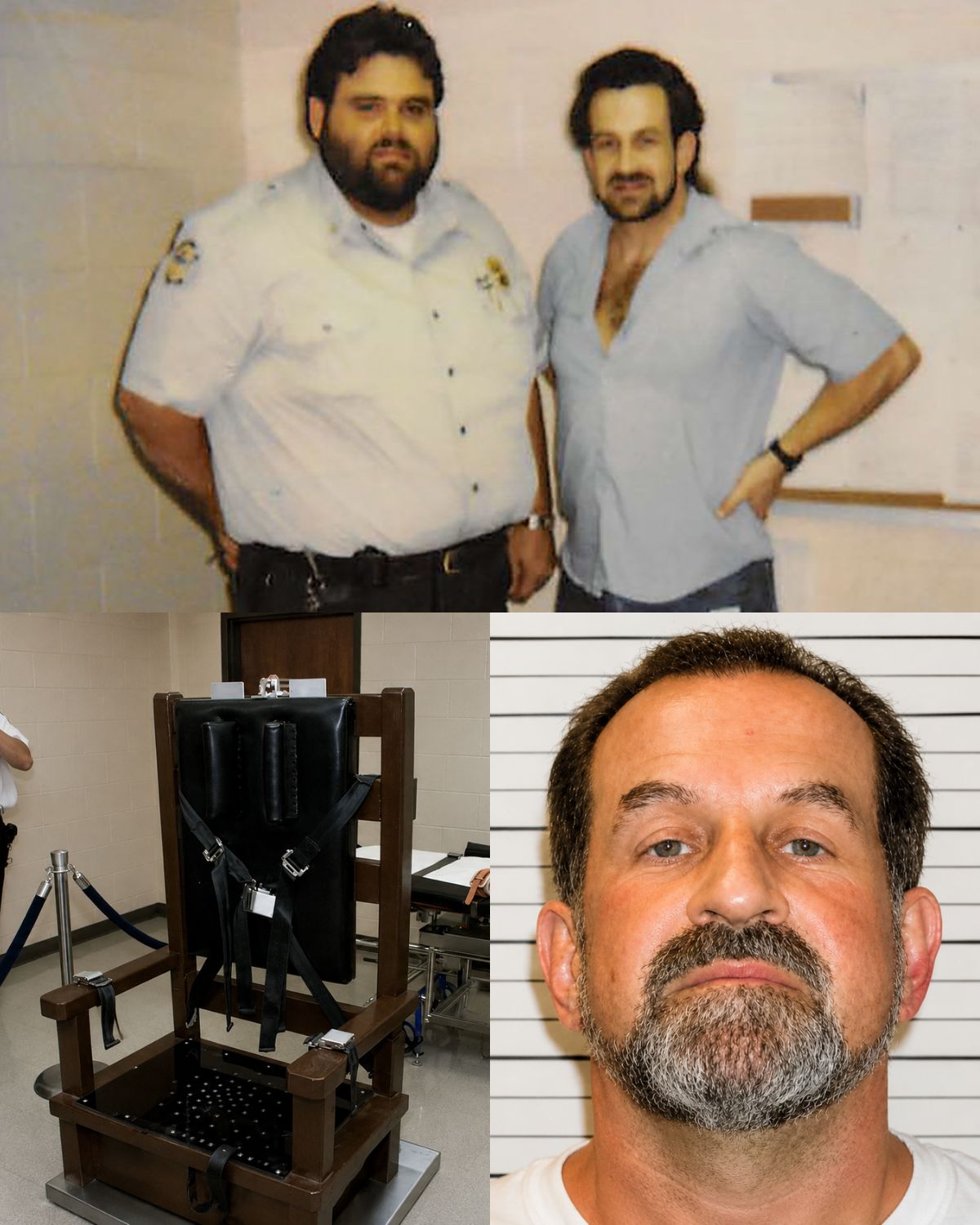
The state of Tennessee carried out the execution of Byron Lewis Black on August 5th, 2025, ending a 35-year wait on death row for a man convicted of murdering his girlfriend and her two young daughters in a brutal 1988 shooting spree. He was pronounced dead at 10:43 a. m.
local time after receiving a lethal injection at the state penitentiary. He was 69 years old.
 Witnesses described a harrowing final scene inside the execution chamber, one that raised immediate questions about whether Black understood what was happening to him as the drugs entered his system. He appeared restless, breathing heavily, and showed visible signs of confusion before he was declared dead, according to those who observed the procedure.
Black’s final words were minimal. When asked if he had anything to say, he simply responded, “No, sir.” He offered no apology and made no acknowledgment of the family members of his victims, Angela Clay and her daughters, Latoya and Lakesha, who sat just feet away watching the culmination of a legal battle that spanned more than three decades.
The execution almost did not happen as scheduled. Just months before his date with death, Black received an implantable defibrillator to manage end-stage heart failure, a medical device that his legal team argued would trigger painful electric shocks as the lethal injection drugs slowed his heart. A lower court judge agreed and ordered the device deactivated before the execution.
The Tennessee Supreme Court overturned that order, ruling that deactivating the device would constitute an unauthorized delay of justice. They determined that even if the defibrillator fired during the procedure, Black would likely be unable to feel the shocks. The execution proceeded with the device still active, intact, and potentially operational.
The crimes that put Black on death row began on the weekend of March 25th, 1988, when he left a workhouse on a routine furlough. He had been serving time for shooting Angela Clay’s estranged husband, Benny Clay, in a violent confrontation more than a year earlier, a crime for which he received a remarkably lenient sentence.
Byron Black walked back into the workhouse on Monday evening as if nothing had happened, but during those three days away, he had systematically executed three people. The bodies had not yet been discovered when he calmly returned to custody, checked in on time, and resumed his routine as though the weekend had been entirely unremarkable.
The first victim was Angela Clay, a 29-year-old nurse who had just finished a long shift at Vanderbilt Hospital. She had been trying to move on from her troubled relationship with Black, who had reportedly told her, “If I can’t have you, nobody will.” She was found dead in her bed, shot once through the top of her head.
The second victim was nine-year-old Latoya, who had been sleeping next to her mother when she stirred slightly in her sleep. Black turned and fired into her chest and neck, and an autopsy later revealed she survived for up to 10 agonizing minutes before dying, her body twitching as blood filled her lungs.
The third victim was six-year-old Lakesha, who had been woken by the gunshots and gotten out of bed. She apparently trusted Black, seeing him as a familiar and friendly face. He raised his gun and fired two shots into her small body, then watched as she dragged herself from the bed to the floor, leaving blood streaks behind.
Lakesha did not die quickly. She lived for between five and thirty agonizing minutes after being shot, her small hands smearing blood across the carpet as she tried to move and grip anything within reach. She eventually collapsed face down beside her bed, where officers found her body the next evening.
Black left the apartment that night, locked the door behind him, and disappeared into the darkness. He did not call for help, he did not contact authorities, and he did not attempt to distance himself from the scene. He simply returned to the workhouse and reported for duty like a man with nothing to hide.
 The crime scene was discovered the following evening when Angela’s mother, Amelia Bell, sent relatives to check on her after she failed to return a borrowed iron. When no one answered the door despite Angela’s car being parked outside, police were called. Officers pried open a bedroom window and made the gruesome discovery.
Inside the apartment, investigators found a scene of unimaginable horror. Angela was dead in her bed, and Latoya was wedged between the mattress and a dresser. Lakesha lay face down in her own blood in the second bedroom.
The kitchen phone receiver had been moved to the master bedroom, a detail that would prove crucial.
Three fingerprints were recovered from the phone equipment, and all of them belonged to Byron Black. Even more damning, ballistics evidence matched the bullets used in the killings to the gun that had wounded Benny Clay the previous year. That bullet had remained lodged in his shoulder until investigators asked him to undergo surgery to retrieve it.
A lead detective later described the evidence recovery as unprecedented, noting it was the first time key evidence had been extracted from inside a living person to help solve a murder case. The bullet removed from Benny Clay’s shoulder was a perfect match to the weapon used to kill Angela and her daughters.
When detectives first questioned Black, he broke down crying, appearing visibly shaken by the news of the murders. But officers noted a chilling transformation the moment more personnel entered the room. The tears dried quickly, his face went blank, and he became composed, almost detached from the gravity of what he was being told.
Black initially claimed he had dinner at a friend’s house on the night of the murders, then went to his mother’s home and slept on the couch. But that alibi collapsed when the woman he claimed to have eaten with said he had stayed for barely an hour and left by 9:30 p. m.
, never returning that night.
Confronted with this discrepancy, Black’s story changed. He admitted he had gone to Angela’s apartment, claiming he found the front door open and discovered all three bodies inside. He said he panicked, locked the door behind him, and walked away without calling police or telling anyone what he had seen.
The jury did not believe his shifting accounts. On March 8th, 1989, which happened to be Lakesha’s birthday, a Davidson County jury returned guilty verdicts on all three counts of first-degree murder. The following day, they unanimously recommended the death sentence for the murder of six-year-old Lakesha.
 For the murders of Angela and Latoya, the jury could not reach a unanimous agreement on the death penalty, so Black received two consecutive life terms in addition to the death sentence for Lakesha’s murder. He also received extra time for weapons charges and burglary related to the crime spree.
Black spent the next 35 years appealing his sentence, with his attorneys arguing that he was intellectually disabled and mentally incompetent to be executed. They presented evidence that Black had been exposed to alcohol in the womb and lead in the environment as a child, causing lasting damage to his brain’s frontal and temporal lobes.
Multiple experts evaluated Black over the years, and half a dozen reached the same conclusion: he was intellectually disabled. Even the state’s own expert, who initially testified otherwise, later changed her opinion under modern diagnostic standards. By the time of his execution, doctors said his cognitive functioning was lower than 99.
99 percent of the population.
Black’s attorneys argued that he could not make change for a five-dollar bill, could not do basic math, and had never lived independently as an adult. He remained in his parents’ home until his arrest at age 32. They argued this profound intellectual disability made his execution unconstitutional under federal law.
The courts rejected those arguments. In March 2022, a judge ruled Black was still competent for execution, and in June 2023, the Tennessee Court of Criminal Appeals upheld the sentence. The execution date was rescheduled multiple times due to the pandemic, moratoriums, and technical delays before being set for August 5th, 2025.
The defibrillator dispute became the final legal battle in the weeks before his death. Black’s lawyers warned that the implanted device could deliver agonizing shocks described as being “kicked in the chest by a horse” as the lethal injection drugs slowed his heart, potentially turning his execution into a prolonged and brutal struggle.
The Tennessee Supreme Court overruled the lower court’s order to deactivate the device, and the execution proceeded as scheduled. Black’s final meal was a pizza topped with mushrooms and sausage, donuts, and butter pecan ice cream, a modest request for a man facing his final morning on earth.
On the morning of August 5th, Black was strapped to a gurney when the curtain rose at 10:31 a. m. A sheet was pulled unusually high over his body, even covering his hands.
When asked for last words, he declined to speak, offering only “No, sir” in response to the standard question.
 Witnesses described Black showing clear signs of distress as the procedure began. His spiritual adviser stood nearby, touching his cheek and praying, telling him to focus on his breathing. Black began sighing and panting, apparently overcome by fear and confusion about what was happening to him.
As the drugs began flowing, Black raised his head and looked around, moving more than expected during the procedure. At 10:33 a. m.
, he groaned and told his spiritual adviser, “I can’t do this. This is hurting so bad.” The adviser responded softly, “I’m so sorry,” before continuing her prayers.
Black raised his hand one final time before going still at 10:36 a. m. The full dose of lethal drugs had been administered, and a mandatory five-minute waiting period followed before he was pronounced dead at 10:43 a.
m. The entire execution process took barely twelve minutes from start to finish.
The family of Angela Clay and her daughters waited 37 years for this moment. They watched silently as the man who took three generations of their family was put to death by the state. Black never acknowledged them, never offered a final word of remorse, and according to witnesses, appeared not to fully grasp the gravity of his final moments.
The execution of Byron Lewis Black closes a painful chapter in Tennessee’s criminal justice history, but it leaves behind lingering questions. Was justice served by executing a 69-year-old man with profound intellectual disabilities, dementia, and end-stage heart failure, or did the state simply complete a process that had long since lost its moral clarity?
What remains undisputed is the horror of what happened on that March night in 1988. Two young girls who should have grown up, celebrated birthdays, and built lives of their own were denied everything by a man who chose violence over acceptance. Their mother, a dedicated nurse who spent her career caring for others, was denied the chance to watch her daughters become women.
Byron Lewis Black was buried the same week he was executed, nearly four decades after he took the lives of Angela, Latoya, and Lakesha. The families of the victims can finally close this chapter, even as the debate over capital punishment and intellectual disability continues to divide the nation.