The prison gates at Werl opened on a gray morning in 1953.
A black government car rolled through.
Inside sat Konrad Adenauer, Chancellor of West Germany, one of the men responsible for building a new democratic state from the wreckage Hitler had left behind.
Behind the walls was Kurt Meyer.
Nine years earlier, Meyer had been a senior officer in the Waffen-SS.
After the war, a Canadian military court convicted him in connection with the killing of Canadian prisoners in Normandy. The judges sentenced him to death. That sentence was later commuted to life imprisonment.
Now the chancellor of the new Germany had come to the prison where Meyer was being held.
The visit was brief.
There was no dramatic reconciliation. No public pardon. No declaration that the past had been erased.
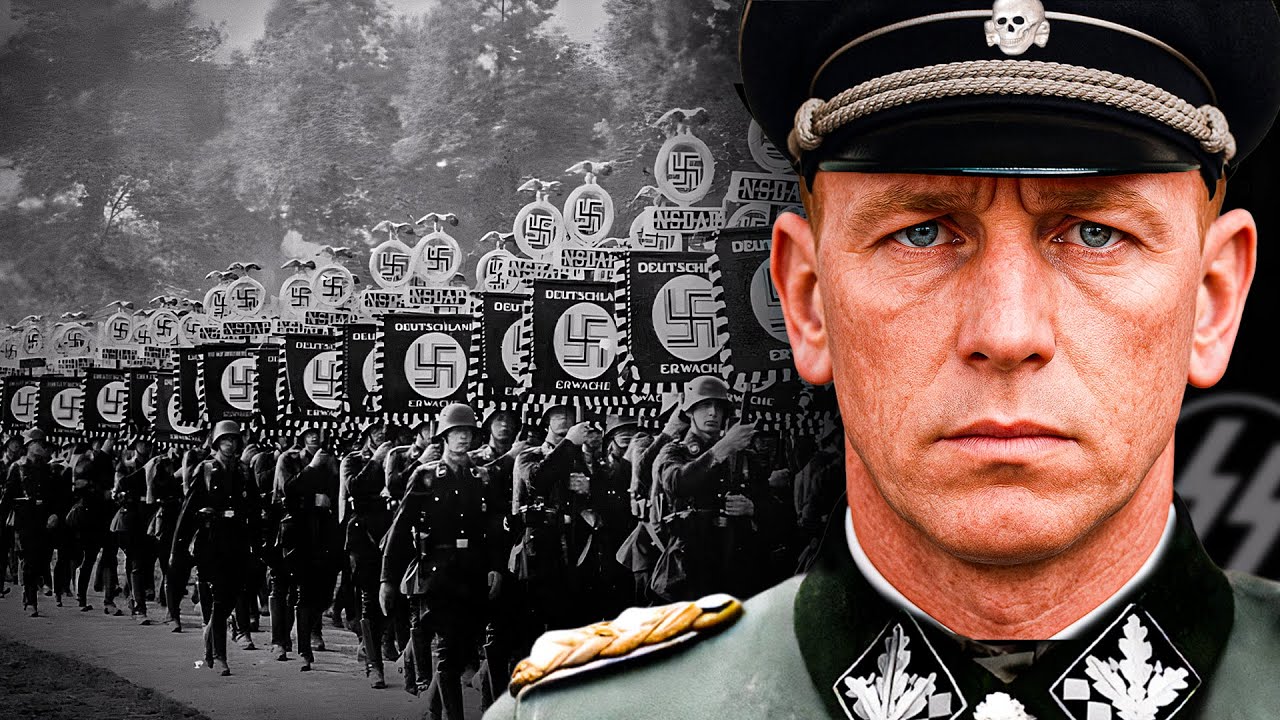
But the symbolism was impossible to miss.
Only eight years had passed since Allied soldiers entered concentration camps and found bodies stacked behind barbed wire. Only seven years had passed since judges at Nuremberg declared the SS a criminal organization.
And already, the political atmosphere was changing.
The Waffen-SS had lost the war.
But another battle had begun.
This time, the battlefield was not Normandy, Kharkov, Warsaw, or the Ardennes.
It was memory.
And the question was no longer whether the Waffen-SS had survived militarily.
It was whether its former members could survive historically.
Because after 1945, the Waffen-SS did not simply vanish.
Some were imprisoned.
Some were executed.
Some disappeared under false names.
Some fled across borders.
Some spent years in Soviet captivity.
But hundreds of thousands of former SS men remained in, or eventually returned to, German society.
They became workers.
Shopkeepers.
Mechanics.
Civil servants.
Fathers.
Neighbors.
Pensioners.
And some of them began quietly constructing a new version of their past.
A version in which the most feared military arm of Hitler’s SS was no longer remembered as part of a criminal system.
A version in which its members were simply soldiers.
That campaign would last far longer than the Third Reich itself.
And in some ways, it proved far more successful than anyone in 1945 would have imagined.
I. THE UNIFORMS CAME OFF
In May 1945, Germany collapsed with astonishing speed.
Cities were ruins.
Railway stations were blackened shells.
Bridges lay twisted in rivers.
Families pushed carts through streets where entire apartment blocks had vanished.
The Reich that Hitler had promised would last a thousand years had survived twelve.
For members of the SS, defeat created an immediate problem.
Their uniforms had once opened doors.
Now they could open prison cells.
Rank insignia that had commanded fear became evidence.
Membership cards became dangerous possessions.
Tattoos could betray identity.
Documents were burned.
Insignia disappeared into ditches, fireplaces, attics, and fields.
Men who had once moved through Europe with the authority of the Nazi state suddenly became anonymous figures in columns of prisoners.
Some tried to look like ordinary Wehrmacht soldiers.
Others tried to look like civilians.
Heinrich Himmler himself attempted to disappear under a false identity before British forces captured him.
He never reached a courtroom.
He crushed a hidden cyanide capsule between his teeth and died.
But the organization he had helped build left behind hundreds of thousands of living members.
Among them were the men of the Waffen-SS.
During the war, Nazi propaganda had sold them as an elite.
They were supposed to represent racial purity, ideological loyalty, physical toughness, and absolute obedience.
The reality became far messier as the war expanded.
By 1944 and 1945, the Waffen-SS included volunteers, conscripts, ethnic Germans from outside Germany, and large numbers of foreign recruits.
Some joined enthusiastically.
Some were drafted.
Some were deeply ideological.
Others were young men pushed into a collapsing military machine.
This difference would matter enormously after the war.
Because the Allies faced a question that sounds simple until individual lives are placed inside it.
What does justice look like when an organization is criminal, but not every person inside it committed the same crime?
At Nuremberg, the judges confronted exactly that problem.
Their answer would shape the next half-century.
The SS was declared a criminal organization.
The judgment included the Waffen-SS.
But the tribunal did not say that every man who had ever worn an SS uniform was automatically guilty of a crime.
Those forced into membership without genuine choice, and who had not personally committed crimes, were treated differently.
That distinction was essential to any serious system of justice.
You punish conduct.
Knowledge.
Participation.
Intent.
You do not simply erase individual responsibility and replace it with collective vengeance.
But hidden inside that legal distinction was a weakness.
Not a weakness in the law.
A weakness in memory.
Because years later, Waffen-SS veterans would take a narrow principle about individual guilt and turn it into a far broader argument about the organization itself.
Not every Waffen-SS soldier was a war criminal.
True.
Therefore, the Waffen-SS was simply another military force.
False.
The distance between those two sentences is enormous.
But after 1945, a determined group of veterans spent decades trying to make that distance disappear.
II. FOR A MOMENT, JUSTICE SEEMED INEVITABLE
In the first years after the war, there was little reason to believe such a rehabilitation campaign could ever succeed.
The evidence was too fresh.
In December 1944, during the Battle of the Bulge, soldiers belonging to Kampfgruppe Peiper captured American troops near the Belgian village of Malmedy.
The prisoners were gathered in a field near the Baugnez crossroads.
Then gunfire began.
By the time it ended, dozens of American prisoners lay dead in the snow.
Some survivors escaped by lying motionless among bodies.
The killings became one of the most infamous atrocities committed against American troops on the Western Front.
After Germany surrendered, investigators went hunting for the men responsible.
Former Waffen-SS personnel were interrogated.
Documents were collected.
Witnesses were questioned.
Eventually, more than seventy defendants went before an American military tribunal.
Every one of them was convicted.
Dozens were sentenced to death.
Others received life imprisonment.
If someone had stood outside that courtroom in 1946 and asked what the future held for the Waffen-SS, the answer would have seemed obvious.
Disgrace.
Prison.
Possibly execution.
Permanent exclusion from respectable society.
The camps had been opened.
The films existed.
The photographs existed.
Witnesses were alive.
Europe was still filled with displaced people who carried the evidence of Nazi occupation on their bodies.
Nothing seemed capable of changing the moral equation.
Then the world changed.
Not slowly.
Almost violently.
The alliance that had defeated Hitler began to fracture.
The Soviet Union consolidated control over Eastern Europe.
The Iron Curtain descended.
Berlin became a pressure point.
Communist and Western governments looked at each other across a continent filled with ruins and weapons.
Washington’s strategic map shifted.
Yesterday’s defeated Germany sat directly on tomorrow’s front line.
The United States and its allies still wanted accountability.
But they also wanted stability.
They wanted an economically functioning West Germany.
They wanted political legitimacy.
Eventually, they wanted German soldiers contributing to Western defense.
And the closer the Cold War came, the more complicated the unfinished business of the Second World War became.
The Malmedy case became controversial.
Defendants and lawyers accused American investigators of coercive interrogation methods.
Investigations followed.
The most sensational accusations did not overturn the core reality of the massacre.
But politically, the case became a symbol.
German church leaders appealed for clemency.
Politicians intervened.
Campaigns developed around imprisoned war criminals.
Death sentences were reduced.
Life sentences were shortened.
Men who had once seemed destined never to leave prison began walking through the gates.
By 1956, all of the defendants convicted in the Malmedy trial had been released.
Kurt Meyer followed the same postwar current.
He had been sentenced to death.
The sentence became life imprisonment.
Then imprisonment itself became temporary.
In September 1954, Meyer left Werl prison.
He was forty-three years old.
He had been a condemned war criminal.
Now he was a free man entering a West Germany that was experiencing one of the fastest economic recoveries in modern European history.
Factories were hiring.
Cities were rebuilding.
Households were buying radios, refrigerators, and eventually automobiles.
The country was moving forward.
And the faster it moved, the more uncomfortable one question became.
How much of the past was it willing to carry with it?
III. THE REAL MYSTERY
This is where most popular stories about former Nazis take a dramatic turn.
The camera moves to a port.
A man changes his name.
A ship leaves Europe under darkness.
The trail continues through Genoa, Madrid, Damascus, Buenos Aires, or some anonymous South American town.
There were such stories.
Some Nazi criminals escaped Europe.
Networks helped fugitives move across borders.
False documents were used.
Men who deserved courtrooms sometimes found new lives thousands of miles away.
Those stories are naturally addictive.
There is a criminal.
There is a hunt.
There is an escape route.
There is a secret identity.
But if you focus too closely on those men, you can miss the far larger story.
The most important destination for former Waffen-SS members was not Argentina.
It was home.
West Germany contained hundreds of thousands of former members of the broader SS world in the postwar years.
Many of them reintegrated without headlines.
No jungle hideout.
No forged passport.
No international manhunt.
A man returned to his town.
He found work.
He married.
He raised children.
He joined a local club.
He went to church on Sunday.
He stood in line at government offices.
He applied for benefits.
He spoke about the war when he wanted to.
Or he did not speak about it at all.
That silence is difficult to understand from the distance of several generations.
But postwar Germany was not populated by a small number of visibly guilty people surrounded by millions of innocent observers.
The society was entangled with the regime in countless ways.
Millions had belonged to Nazi organizations.
Millions of men had served in the armed forces.
Business owners had profited.
Civil servants had implemented policy.
Teachers had taught racial doctrine.
Judges had enforced dictatorship.
Families had benefited when Jewish neighbors were dispossessed.
Others had resisted.
Others had suffered.
Others had done both honorable and shameful things at different moments.
The moral map was complicated because human lives were complicated.
So when former soldiers returned, families often wanted one thing above all.
Normality.
A kitchen table.
A job.
A roof.
A future in which children did not ask too many questions about what their fathers had done between 1939 and 1945.
At first, that silence helped society survive.
Then it began helping certain stories survive.
Because people who do not want to examine the past become vulnerable to those willing to explain it for them.
And former Waffen-SS leaders were preparing an explanation.
IV. THE SECOND CAMPAIGN
It did not begin with tanks.
It began with meetings.
Small groups of former Waffen-SS members formed associations after the war.
The language sounded harmless.
Mutual aid.
Comradeship.
Support for veterans.
Help for wounded men.
Help for widows.
Help for families.
Eventually, these groups became associated with a name that would appear again and again in the postwar battle over the Waffen-SS:
HIAG.
On paper, many of its demands looked understandable.
Disabled veterans needed assistance.
Families had lost fathers and sons.
Former soldiers struggled with employment.
Men released from captivity returned to a country they barely recognized.
Some had spent years behind barbed wire.
But beneath the welfare demands was another objective.
Respectability.
Former Waffen-SS commanders became prominent in veterans’ organizations.
Men who had once held senior rank now entered a very different kind of campaign.
They wrote.
They spoke.
They organized reunions.
They contacted politicians.
They cultivated journalists.
They published memoirs.
They argued over pension laws.
And again and again, they pushed the same central idea.
The Waffen-SS, they insisted, had been a military organization.
Its soldiers had fought like soldiers.
The crimes of the concentration camps belonged elsewhere.
The extermination machinery belonged elsewhere.
The political terror belonged elsewhere.
The Waffen-SS had simply been the fighting arm.
This argument was emotionally powerful because it attached itself to individual experience.
A former soldier could look at his own life and say:
I never guarded Auschwitz.
I never shot civilians.
I was seventeen.
I was drafted.
I fought the Red Army.
My friends died next to me.
I lost my leg.
Am I a criminal because of the uniform I was ordered to wear?
For some individuals, those were legitimate questions.
HIAG’s brilliance was turning legitimate individual questions into a defense of an institution.
The difference was subtle enough to disappear in conversation.
A man might not have been guilty of a war crime.
That did not mean his organization was innocent.
A man might have fought bravely in battle.
That did not mean the political structure around him was merely military.
A man might deserve a pension for a disabling battlefield injury.
That did not mean history owed his former organization a clean reputation.
But political narratives rarely win by explaining complexity.
They win by repeating something simple.
And the former Waffen-SS had found their sentence.
We were soldiers like everyone else.
V. POLITICIANS BEGIN TO LISTEN
West German leaders faced an ugly reality.
They were building a democracy inside a population that had recently lived under dictatorship.
They could not deport millions of compromised people.
They could not permanently imprison every former Nazi Party member.
They could not build a state without using people who had received their professional training under the old regime.
Teachers had Nazi pasts.
Lawyers had Nazi pasts.
Doctors had Nazi pasts.
Administrators had Nazi pasts.
Police officers had Nazi pasts.
The question was no longer whether former participants in the Third Reich would enter the new society.
They already lived inside it.
The question was where the new Germany would draw its lines.
For Waffen-SS veterans, one of the most important moments came when Chancellor Adenauer publicly extended language of military honor toward men who had served in Waffen-SS formations but had personally fought honorably.
To veterans, it sounded like recognition.
To critics, it sounded dangerously close to rehabilitation.
The distinction became political dynamite.
Because Adenauer was not an obscure sympathizer.
He was the leader of democratic West Germany.
His priority was stability.
Integration.
Western alliance.
Rearmament.
Economic recovery.
He understood that millions of former soldiers and their families were voters.
He also understood that a democracy surrounded by Soviet power could not afford to keep enormous segments of its male population permanently alienated.
So pragmatism moved into territory where morality had once seemed absolute.
The shift was rarely dramatic.
That is what made it effective.
There was no ceremony announcing that former Waffen-SS members had been forgiven.
No government decree washed the organization clean.
Instead, language softened.
Rules were adjusted.
Cases were reconsidered.
Political contacts became possible.
Veterans who had once been treated as members of an outlawed organization increasingly appeared in public debate as another constituency.
They wanted recognition.
They wanted benefits.
They wanted service credit.
They wanted access to careers.
And above all, they wanted separation from the criminal identity of the SS.
Every administrative decision seemed small.
Together, they were changing the story.
VI. THE BATTLE OVER PENSIONS
Nothing reveals the transformation more clearly than money.
Memory is abstract until it enters a government ledger.
For a wounded veteran, a legal classification could determine whether there was enough money for rent.
For a widow, the difference between one category of service and another could change the household budget.
For the state, pension law became an unexpected battlefield over what the Waffen-SS had been.
Should military service in the Waffen-SS be treated like military service in the Wehrmacht?
If the answer was no, veterans could argue that ordinary front-line soldiers were being punished collectively.
If the answer was yes, critics could argue that the democratic state was normalizing an organization condemned at Nuremberg.
There was no painless answer.
West Germany gradually allowed certain benefits to former Waffen-SS men, especially in areas connected to wartime injury and hardship.
But veterans’ organizations wanted broader equality.
They wanted career service recognized.
They wanted the institutional distinction erased.
Government officials sometimes resisted.
Internal assessments returned to an uncomfortable fact that no amount of veterans’ rhetoric could remove.
The Waffen-SS had not been an independent army accidentally attached to Nazi Germany.
It was part of the SS structure.
That mattered.
Its ideological roots mattered.
Its administrative connections mattered.
The crimes committed by its formations mattered.
The relationship between military operations and racial occupation policy mattered.
So full institutional equality remained politically and historically dangerous.
Yet even without complete legal victory, the veterans achieved something significant.
In practical terms, many former Waffen-SS members gained access to forms of social support and reintegration.
The state could avoid saying the organization had been rehabilitated while still providing benefits to individuals.
Administratively, that distinction was sensible.
Psychologically, it created a softer boundary.
The former Waffen-SS man standing at a government counter was no longer necessarily treated as a representative of a criminal organization.
He was a citizen with a file.
An injury.
A service record.
A family.
A claim.
The transformation was almost invisible.
That was precisely why it mattered.
VII. THEN GERMANY NEEDED SOLDIERS AGAIN
Less than ten years after Hitler’s defeat, West Germany confronted a sentence that would have seemed impossible in 1945.
Germany needed an army.
Again.
The Soviet Union had nuclear weapons.
The Korean War had intensified fears of communist expansion.
NATO needed manpower.
West Germany sat on the front line of a potential European war.
The new armed forces would be called the Bundeswehr.
Its creators insisted it must not simply resurrect the military culture of the Third Reich.
The soldier of a democracy was supposed to be a citizen in uniform.
Obedience had limits.
Law mattered.
Conscience mattered.
Political responsibility mattered.
But a practical problem remained.
Where do you find experienced officers in a country whose previous officer corps served under Hitler?
Former Wehrmacht officers entered the new military after screening.
Then came the more difficult applications.
Former Waffen-SS men.
Some wanted to serve.
The government could have imposed a blanket prohibition.
It did not.
Nor did it simply open the doors.
Applications from former SS personnel were subjected to special scrutiny.
Backgrounds were examined.
Ranks mattered.
Units mattered.
Individual histories mattered.
Some were rejected.
Some were accepted.
The numbers never approached the frightening takeover imagined by communist propaganda.
Former Waffen-SS personnel remained a very small fraction of the Bundeswehr.
But that is not the important point.
The important point is that the door existed.
A man could have served in the Waffen-SS and later, under certain conditions, wear the uniform of democratic West Germany.
Think about what had changed.
In 1945, Allied officers were separating SS men from ordinary prisoners.
A decade later, West German officials were deciding which former SS men were acceptable candidates for a NATO army.
No single document could capture the moral distance between those two scenes.
The Cold War had compressed it.
VIII. THE MEN WHO WANTED THEIR HONOR BACK
By the 1950s, Waffen-SS veterans’ gatherings were no longer necessarily secretive affairs.
Some attracted thousands.
Old comrades found one another.
Families attended.
Speeches were delivered.
Memorial services were held.
Men who had once crossed Europe in armored columns now arrived in civilian clothes.
The insignia had changed.
The emotion had not.
These gatherings offered something that courtrooms never could.
A private moral universe.
Inside that universe, the veteran did not need to think of himself as a former member of an organization associated with atrocities.
He could think of himself as a young soldier who survived impossible battles.
He could remember dead friends.
Hunger.
Frostbite.
Artillery.
Fear.
The Russian winter.
Normandy hedgerows.
Retreat.
Captivity.
He could remember himself as a victim of history rather than as part of a system that victimized others.
Memory is rarely neutral.
Human beings naturally place themselves near the center of their own suffering.
A soldier remembers the shell that killed his friend more vividly than a policy drafted hundreds of miles away.
A widow remembers the telegram.
A child remembers a father who never returned.
Those memories were real.
The danger came when personal suffering replaced historical responsibility.
The veterans’ movement understood this instinctively.
The more the public discussion focused on individual sacrifice, the less space remained for the institutional record.
The organization disappeared behind the veteran.
The veteran disappeared behind the widow.
The widow disappeared behind the child.
And suddenly, criticism of the Waffen-SS could be presented not as historical accountability, but as cruelty toward families who had already suffered enough.
That was the emotional mechanism.
It was extraordinarily effective.
IX. THE TWIST WAS HIDING IN PLAIN SIGHT
For decades, people have asked the wrong question.
Where did the Waffen-SS go?
The question sounds like a manhunt.
It makes us imagine fugitives.
Secret trains.
Ratlines.
False passports.
South American villas.
Men changing their names before boarding ships.
And yes, some perpetrators escaped.
Some hid.
Some built new lives abroad.
But that answer is too cinematic.
The darker answer is quieter.
Most did not need to disappear forever.
They came home.
They entered civilian life.
They aged inside the societies that had defeated Nazism.
They raised families whose neighbors sometimes knew exactly where they had served.
Some stayed silent.
Some felt shame.
Some defended themselves only privately.
Others joined organizations specifically designed to influence how the Waffen-SS would be remembered.
That is the real twist.
The most important postwar operation conducted by former Waffen-SS leaders was not an escape operation.
It was a reputational one.
They could not undo Nuremberg.
So they narrowed Nuremberg.
They could not deny that the SS committed enormous crimes.
So they separated themselves from “the other SS.”
They could not claim no Waffen-SS unit had ever committed atrocities.
So they described crimes as isolated deviations.
They could not prove the organization had been politically neutral.
So they emphasized battlefield performance.
And slowly, the vocabulary changed.
Not everywhere.
Not completely.
But enough.
The Waffen-SS became, in sympathetic accounts, an elite fighting force tragically contaminated by its connection to Hitler.
That formulation was more dangerous than simple denial because it sounded reasonable.
It acknowledged Nazism.
It acknowledged crimes.
Then it pushed both to the edge of the frame.
At the center stood military professionalism.
Camaraderie.
Sacrifice.
Tactical skill.
Honor.
The veteran became the protagonist.
The victims became context.
That reversal was the real postwar victory.
X. MEMORY HAS A BODY LANGUAGE
There was never one great public scene in which the architects of this rehabilitation suddenly realized they had gone too far.
History rarely gives us a villain standing beneath a spotlight while the crowd gasps.
Recognition came in smaller moments.
A municipality refused to host a reunion.
A politician decided not to appear.
A newspaper questioned the veterans’ version of events.
A government ministry rejected the claim that the Waffen-SS had simply been another branch of the armed forces.
A younger generation asked fathers what they had actually done during the war.
The room changed.
You can almost feel the silence.
For years, veterans could speak primarily about comradeship, captivity, military sacrifice, and the unfairness of collective suspicion.
Then Auschwitz moved back into the German public consciousness.
Adolf Eichmann was captured and placed on trial in Jerusalem.
Witness after witness described the machinery of deportation and murder.
In West Germany, prosecutors brought Auschwitz personnel before a Frankfurt court.
The proceedings forced ordinary Germans to hear details that had often been buried beneath the urgency of reconstruction.
The war was no longer only something German soldiers had suffered through.
It was something Nazi Germany had done to millions of other people.
That shift changed the temperature of the room.
The old vocabulary did not disappear.
But it no longer went unchallenged.
The question was becoming sharper.
If your organization was merely military, why was it institutionally part of the SS?
If it was merely military, why did some of its units participate in massacres?
If the crimes were only the work of a few bad men, why did the ideological structure matter so much?
If you demand that every individual be judged separately, why do you insist that the entire organization be remembered collectively as honorable?
Those questions were harder to answer.
Because they exposed the contradiction at the center of the veterans’ campaign.
They wanted individual innocence when discussing guilt.
But collective honor when discussing reputation.
XI. NOT EVERY MAN WAS THE SAME
Any serious investigation must resist the temptation to turn history into a morality play.
The Waffen-SS contained perpetrators.
It also contained conscripts.
It contained ideological zealots.
It contained teenagers.
It contained men involved in atrocities.
It contained men who never personally participated in a known war crime.
Those differences matter.
Without them, history becomes propaganda in the opposite direction.
But acknowledging complexity does not require erasing structure.
An organization can be criminal in its purpose and conduct without every individual member being equally guilty.
That was precisely the distinction postwar justice struggled to preserve.
The difficult part is holding both ideas in your head at once.
A seventeen-year-old conscript did not carry the same responsibility as a commander ordering prisoners executed.
But the existence of that seventeen-year-old did not transform the Waffen-SS into a normal army.
An individual veteran might deserve compassion.
The institution did not deserve mythology.
That distinction is the moral center of the entire story.
And it is exactly the distinction that postwar memory repeatedly blurred.
XII. THE WAR OVER THE PAST OUTLIVED THE WARRIORS
The veterans grew older.
Hair turned white.
Military posture softened.
The young men in wartime photographs became grandfathers.
Some commanders published memoirs.
Some books presented the Waffen-SS almost entirely through the language of battlefield experience.
Maps.
Tank battles.
Unit movements.
Courage.
Encirclement.
Retreat.
The politics faded into the background.
Then the ideology.
Then the victims.
A new generation of readers encountered the Waffen-SS as military history first and Nazi history second.
That imbalance would influence popular culture for decades.
The fascination was understandable.
The formations fought in some of the most dramatic battles of the Second World War.
They used powerful armored units.
Their commanders became subjects of military biographies.
Their uniforms and insignia were visually distinctive.
For audiences interested in weapons, tactics, and combat performance, the story was compelling.
But there is a danger when military history becomes detached from the political system that created the military.
A tank has no ideology.
The organization operating it does.
A battle map has no victims.
The occupation behind the arrows might.
A tactical victory can be real while the cause being served remains criminal.
Once again, two truths can coexist.
The Waffen-SS could contain militarily effective units.
It could also be part of a criminal political and racial system.
Admiring tactical skill does not require moral blindness.
But postwar veteran literature often depended on separating the two.
The battlefield became cleaner when the civilians disappeared from the page.
XIII. HIAG’S LONG SHADOW
HIAG did not disappear after a few frustrated meetings in the 1950s.
It survived for decades.
That fact alone should make us reconsider how long the postwar struggle lasted.
The Third Reich existed for twelve years.
The institutional battle over how some of its most notorious soldiers would be remembered continued for generations.
By the time HIAG’s national organization dissolved in the early 1990s, Germany itself had changed beyond recognition.
The Berlin Wall had fallen.
The Cold War that once encouraged political pragmatism toward former soldiers was over.
East and West Germany had reunited.
Many of the men who had built the veterans’ movement were dead.
But their central argument had traveled far beyond them.
You can still find its echoes whenever the Waffen-SS is discussed as though it existed in a vacuum.
Whenever someone says:
Forget the politics. Look only at their fighting ability.
Whenever atrocities are treated as unfortunate exceptions disconnected from organizational identity.
Whenever the word “elite” swallows every other fact.
Whenever photographs of tanks replace photographs of occupied villages.
That is how memory laundering works.
Rarely through complete denial.
Usually through selection.
You do not have to erase the crime.
You only have to move it far enough toward the edge of the picture.
XIV. WHAT HAPPENED TO THE MEN?
So where did they actually go?
There is no single answer.
Some Waffen-SS members died in the final battles of 1945.
Some surrendered to British or American troops.
Some fell into Soviet hands and spent years in captivity.
Some were investigated.
Some became defendants.
Some were convicted of war crimes.
Some were executed.
Some received sentences that were later reduced.
Some escaped prosecution.
Some hid behind false identities.
Some left Europe.
Some simply went home.
They returned to farms.
Factories.
Workshops.
Offices.
Families.
Some never spoke publicly about their service again.
Some likely wanted nothing more to do with politics.
Some carried guilt.
Some carried bitterness.
Some believed they had been unfairly condemned.
Some genuinely saw themselves primarily as soldiers.
Others transformed those feelings into organized political pressure.
A small number later entered the Bundeswehr after screening.
Others received forms of veterans’ support.
Some became active in associations.
Some attended reunions.
Some wrote books.
Some spent the rest of their lives insisting that history had misunderstood them.
There was no secret destination.
The answer was Germany.
And Europe.
And ordinary life.
That is what makes the story more disturbing than a tale of fugitives.
A fugitive remains visibly separate from society.
A neighbor does not.
XV. THE FINAL CRIME SCENE WAS MEMORY
When police investigate a murder, they protect the scene.
They photograph it.
They mark evidence.
They prevent contamination.
History does not receive the same protection.
The crime scene remains open for decades.
Politicians walk through it.
Veterans walk through it.
Victims walk through it.
Children walk through it.
Journalists.
Filmmakers.
Publishers.
Historians.
Every generation moves something.
A photograph.
A sentence.
A label.
A name.
Eventually, people begin arguing over where everything originally stood.
That is what happened to the memory of the Waffen-SS.
In 1945, the evidence seemed overwhelming enough to speak for itself.
But evidence never speaks alone.
People interpret it.
Select it.
Frame it.
Repeat it.
Ignore it.
The Waffen-SS veterans who organized after the war understood something profound about public memory.
If you cannot change what happened, change which part people look at first.
Show them the soldier before the ideology.
The battlefield before the occupied village.
The dead comrade before the dead prisoner.
The widow before the victim.
The pension file before the Nuremberg judgment.
Do it often enough, and history begins to feel different without a single fact technically being denied.
That is the unsettling brilliance of the strategy.
And it is why this story matters beyond Germany.
The question “Where did the Waffen-SS go after 1945?” sounds as though the answer should involve geography.
It does not.
The real answer is about transformation.
A military formation became a veterans’ community.
A veterans’ community became a political constituency.
A political constituency became a memory campaign.
The black uniforms disappeared.
The argument survived.
The men grew old.
The photographs faded.
The organization formally vanished.
But the fight over what its name meant continued.
And perhaps that is the darkest lesson of all.
Dictatorships do not disappear when their headquarters are occupied.
Their soldiers do not vanish when they remove their uniforms.
Their ideas do not die when their leaders die.
What survives next is often quieter.
A pension application.
A reunion.
A memoir.
A politician choosing a careful phrase.
A child hearing only one version of what his father did in the war.
A history book that spends ten pages on tank battles and one paragraph on victims.
That is how the past changes shape.
Not with a lie large enough for everyone to see.
But with a thousand small omissions that eventually begin to look like truth.
The Waffen-SS lost its final military battle in 1945.
Its struggle over memory lasted nearly half a century longer.
And that may be the warning worth remembering most:
The most dangerous version of history is not the one that denies the crime. It is the one that remembers everything around the crime—and quietly teaches you to stop looking at it.


