Florida executed Edward Thomas James tonight, a man who confessed to strangling an 8-year-old girl and stabbing her grandmother in a Casselberry home more than three decades ago, ending a case that began with a nationwide manhunt and culminated in a silent death chamber.
James, 63, was pronounced dead at 8:15 p. m. Thursday at Florida State Prison in Raiford after receiving a three-drug lethal injection.
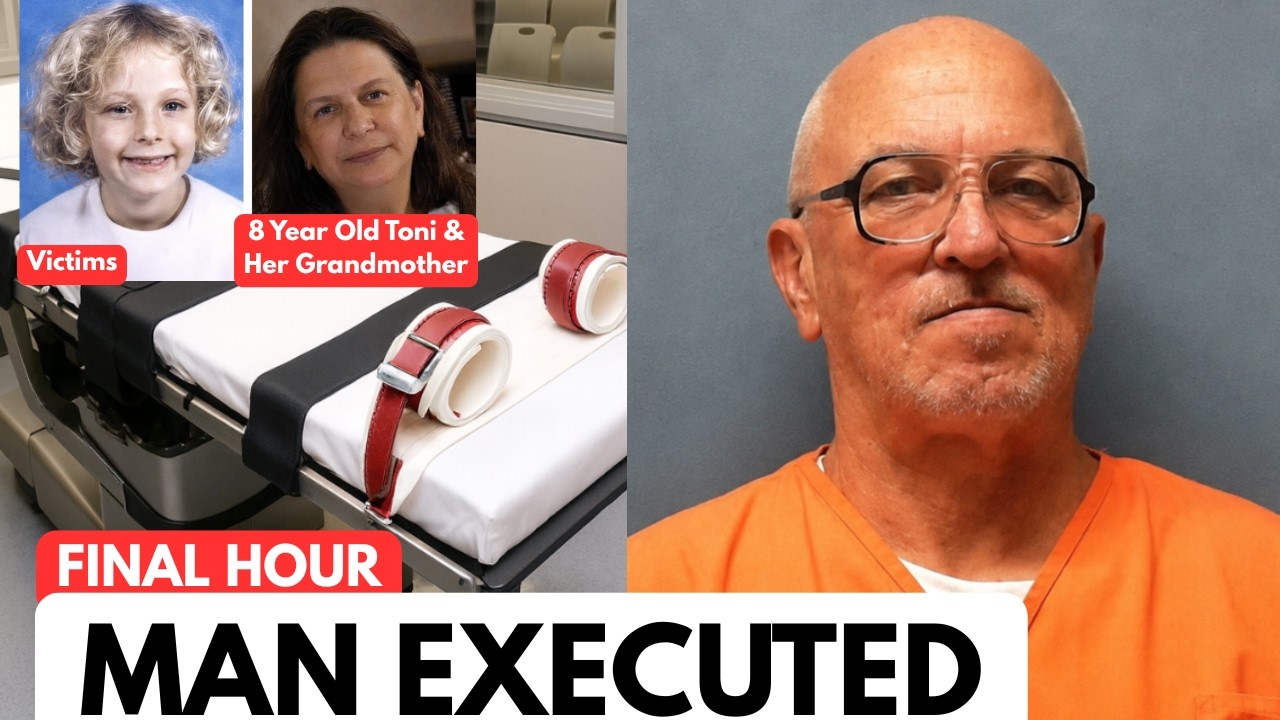 He offered no final statement, choosing silence over the words that had once detailed his crimes in chillingly casual terms.
The execution came roughly two hours behind schedule, with the Florida Department of Corrections offering no explanation for the delay. Witnesses reported James’s chest trembling about two minutes into the procedure, and he was declared dead shortly after.
The crimes that sent James to death row occurred on the night of September 20, 1993. He returned to the home of Betty Dick, 58, after drinking heavily and using drugs. Inside were four grandchildren, including 8-year-old Tonya Neuner.
James strangled Tonya and sexually assaulted her. He then used a candlestick to strike Betty, who had been sleeping, before stabbing her to death. A 9-year-old granddaughter, Wendy, witnessed the attack but was physically unharmed.
The two youngest children in the home, ages 2 and 4, were spared. After the murders, James showered, took jewelry, and drove away in Betty’s car. He fled across the country, triggering one of the most intensive manhunts of the early 1990s.
The case gained national attention when “America’s Most Wanted” broadcast James’s story on September 28, 1993. Hundreds of tips poured in, pointing investigators toward the West Coast. A follow-up segment aired just days later.
On October 6, 1993, a viewer in Bakersfield, California, recognized James standing in line at a state unemployment office. Police arrested him without incident. In two taped statements, he confessed to the murders, offering graphic details.
“I killed Tonya first,” James said in one of the statements, a transcript of which was later made public. “She was on the couch. I don’t know why I chose her.
 I just strangled her. They say I raped her. I remember we was talking and she was dead, and I figured what the hell.”
He described killing Betty next, saying she asked him why. “I told her don’t worry about it, just give up the ghost,” James recalled. His words were captured on tape and later played in court, leaving jurors and family members visibly shaken.
James pleaded guilty in April 1995 to two counts of first-degree murder, aggravated child abuse, attempted sexual battery, kidnapping, and grand theft. He entered no contest to two additional charges. No trial was needed; the only issue was punishment.
In August 1995, a jury recommended the death penalty by an 11-to-1 vote. The judge followed that recommendation. Florida law at the time did not require a unanimous vote for a death sentence, a practice that has drawn criticism for decades.
Governor Ron DeSantis signed James’s death warrant in early 2025, setting the stage for what would become one of the busiest weeks for executions in recent American history. James was one of four inmates scheduled to die across three days.
James’s legal team filed a series of last-minute appeals, arguing that three decades on death row had caused significant cognitive decline. They cited a history of substance abuse, mental illness, and possible early-onset dementia, calling his execution cruel and unconstitutional.
The courts rejected every appeal. The U. S.
 Supreme Court denied all three pending petitions at noon Thursday, with no dissent recorded. James’s attorneys had no further recourse.
For his last meal, James requested fried catfish, potato salad, hushpuppies, cookies, soda, and coffee. He had no visitors on his final day. The state offered him the chance to speak before the injection, but he remained silent.
In the viewing room, members of Betty Dick’s and Tonya Neuner’s families witnessed the execution. Afterward, Brenda Teed, Betty’s daughter, told reporters that the loss had “hit them in places you can’t imagine.” She said the family had been dealing with the trauma for 31 years.
Jerry Pierson Jr. , Tonya’s uncle, remembered Betty Dick as a rock for the family. “Because of what happened that night, we lost generations,” he said.
The children who survived have grown into adults, carrying the weight of that night every day.
Outside the prison, death penalty opponents issued statements criticizing the non-unanimous jury recommendation and the lethal injection protocol. They argued that James’s background—abuse, abandonment, and addiction introduced at age 11 by his biological father, a drug counselor—shaped the man who committed the crimes.
James was born in Bristol, Pennsylvania, in 1961. He learned at age 10 that the man who raised him was not his biological father. Within a year, he was using drugs, guided into addiction by his real father, who worked as a drug counselor.
 He dropped out of high school, joined the Army at 17, and was discharged for “failure to conform.” He returned to Florida with his struggles unresolved. Then, in 1993, Tim Dick, a friend, offered him a place to stay with his mother, Betty.
James spent nearly 30 years on death row for a crime that unfolded in less than an hour. The case remains a stark example of the long and often contentious path between a death sentence and its execution.
The execution of Edward James comes just hours after Oklahoma executed Wendell Grissom on the same day. Louisiana executed Jesse Hoffman Jr. earlier in the week, and Arizona carried out the death sentence of Aaron Gunches, all within a three-day period.
For the state of Florida, the sentence handed down in 1995 has now been fulfilled. The Department of Corrections confirmed that James was pronounced dead at 8:15 p. m.
, after a 15-minute procedure that began shortly after 8:00.
The families of Betty Dick and Tonya Neuner left the prison without speaking further to the media. They have spent three decades grieving, watching appeals, and waiting for a final resolution that many acknowledge cannot bring back what was lost.
The debate over capital punishment in America will continue, with James’s case serving as a lightning rod. Supporters of the sentence cite the brutality of the crime and the exhaustive legal process. Opponents point to the non-unanimous jury and the man’s long decline.
What remains, beyond the legal arguments and the political posturing, is the memory of an 8-year-old girl and her 58-year-old grandmother, killed in a home where they should have been safe. For their family, justice arrived tonight, 31 years late and silent.


