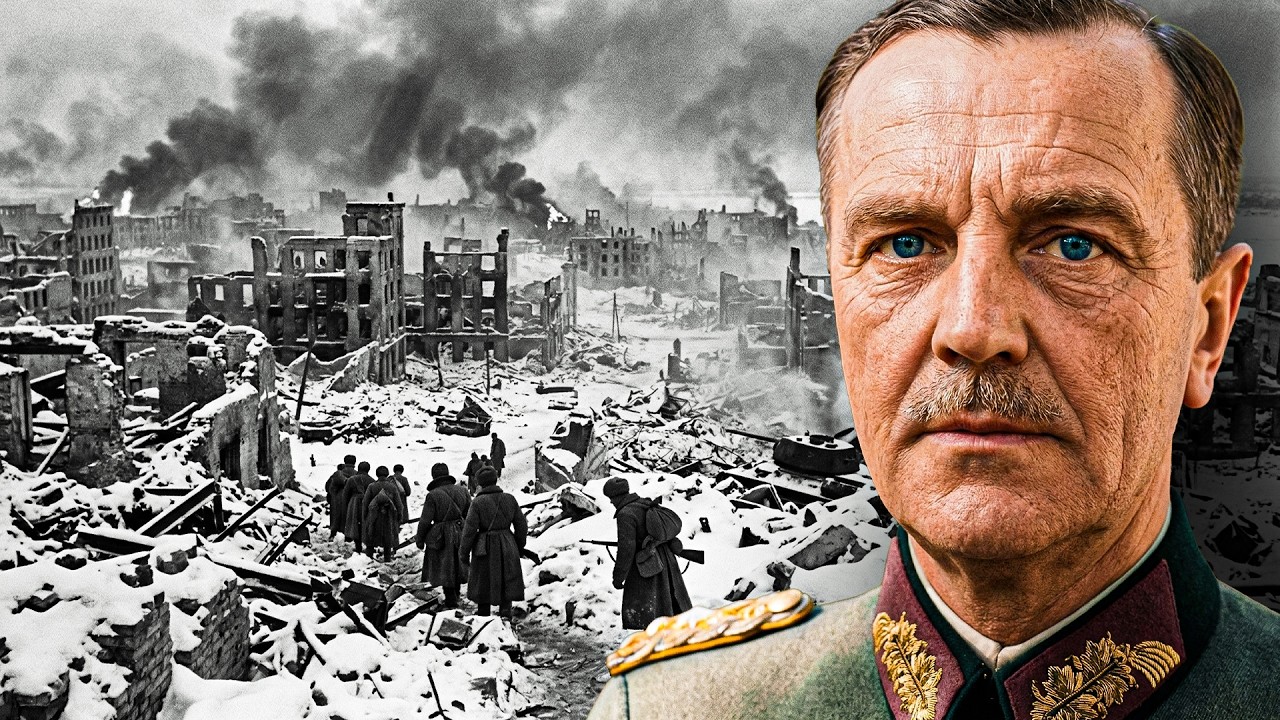
 On the night of January 30, 1943, Friedrich Paulus received what should have been the greatest honor of his military career.
Adolf Hitler had promoted him to Field Marshal.
Under any other circumstances, the announcement would have meant prestige, status, and a permanent place among Germany’s most celebrated commanders.
But Paulus was sitting beneath the ruins of Stalingrad.
His army was starving.
Thousands of his soldiers were wounded, frozen, sick, or dying.
Soviet troops were closing in from almost every direction.
And everyone around Paulus understood that Hitler’s promotion was not really a reward.
It was a message.
No German field marshal was supposed to allow himself to be captured alive. By elevating Paulus to the highest traditional rank in the German Army when escape was virtually impossible, Hitler was making his expectation unmistakable:
Paulus should die rather than surrender.
The next morning, Soviet soldiers entered the shattered center of Stalingrad.
And Friedrich Paulus did the one thing Hitler had tried to prevent.
He stayed alive.
He surrendered.
That decision began one of the strangest aftermaths of the Second World War—a story involving roughly two dozen captured generals, secret interrogations, propaganda broadcasts, political betrayal, death sentences, Soviet prisons, the Nuremberg courtroom, and men who entered Stalingrad as servants of Hitler only to emerge years later on opposite sides of a divided Germany.
And the most shocking part is that surrendering at Stalingrad was not the end of their story.
For many of them, it was only the beginning.
The Soviet victory announcement reported 24 generals and more than 2,500 officers among the prisoners. Some later accounts count 22 German general officers, depending on which officers and allied commanders are included, so historians do not always use exactly the same number. But the extraordinary fact remains: an unprecedented collection of senior German commanders fell into Soviet hands almost at once.
Only months earlier, such a scene would have seemed impossible.
In the summer of 1942, Hitler’s armies still appeared terrifyingly powerful.
The Wehrmacht was driving deep into the Soviet Union. German forces pushed toward the Caucasus and the Volga, and Stalingrad—an enormous industrial city carrying Stalin’s name—became both a strategic objective and a symbol.
Paulus commanded the German Sixth Army.
His troops fought their way into the city.
They took streets, factories, apartment buildings, railway yards and hills.
By autumn, German forces controlled most of Stalingrad.
But they had walked into a trap.
While German soldiers exhausted themselves fighting room by room inside the city, Soviet commanders were building enormous forces beyond their flanks.
Then, on November 19, 1942, the Red Army struck.
Operation Uranus did not primarily smash straight into the strongest German positions inside Stalingrad. Soviet forces attacked the weaker Romanian and Axis formations protecting the German flanks.
Within days, the Soviet pincers met.
The Sixth Army was trapped.
A force that had marched across Europe believing itself almost unstoppable suddenly found itself surrounded hundreds of kilometers inside Soviet territory. The German Historical Museum records that the Soviet offensive beginning on November 19 encircled the Sixth Army and other forces within days.
Paulus faced a brutal decision.
Attempt a breakout while his army still possessed enough fuel, vehicles, ammunition and physical strength to move—
or obey Hitler.
Hitler ordered Stalingrad held.
The Luftwaffe was supposed to supply the trapped army by air.
It could not deliver enough.
Every day that passed changed the calculation.
Fuel disappeared.
Food disappeared.
Medical supplies disappeared.
Horses were slaughtered for meat.
Bread portions shrank.
Soldiers weakened.
Frostbite spread.
Hospitals filled beyond capacity.
Men who might have been capable of breaking out in November were increasingly incapable of walking several kilometers by January.
Yet Hitler continued demanding resistance.
By January 1943, Stalingrad was no longer functioning as a conventional battlefield.
It had become an enormous graveyard that happened to contain living men.
Paulus repeatedly communicated the hopelessness of his position. Hitler refused surrender.
Then came the strange promotion.
January 30.
Field Marshal Friedrich Paulus.
Hitler did not need to send an explicit order telling him to put a pistol to his head.
The symbolism did the work.
A field marshal should not become a Soviet prisoner.
But Paulus had apparently reached a boundary beyond which loyalty no longer meant obedience.
He did not kill himself.
On January 31, Soviet forces reached his headquarters in the basement beneath Stalingrad’s ruined central department store.
There was no heroic last charge.
No dramatic escape.
No final bullet.
The commander of Hitler’s Sixth Army was taken alive.
Photographs from the surrender show Paulus and members of his staff after the collapse—men who only months earlier had commanded one of the most formidable armies in Europe now walking into Soviet custody. German historical records confirm that Paulus surrendered on January 31 against Hitler’s orders.
But even then, Stalingrad was not completely finished.
A northern pocket of German resistance remained.
General Karl Strecker and his men continued holding out.
Two days later, on February 2, the final organized German resistance ended.
The battle was over.
And now came the first horrifying reversal.
The men who had invaded the Soviet Union became prisoners of the Soviet Union.
Around 91,000 soldiers are traditionally said to have surrendered in the final catastrophe, while more recent German historical research places the number of German servicemen captured at Stalingrad at roughly 100,000.
Only about 6,000 eventually returned home.
Think about that number.
Imagine a football stadium filled with ninety thousand men.
Now imagine almost every seat becoming empty before those men ever saw Germany again.
The prisoners who stumbled out of Stalingrad were already in dreadful physical condition.
Many had been starving for weeks.
Some were wounded.
Some had frostbite.
Disease spread easily through bodies that no longer had the strength to resist it.
Then came marches, collection points, transports and Soviet prisoner-of-war camps.
Thousands died.
For ordinary soldiers, surrender had not necessarily meant salvation.
It had merely replaced one method of dying with another.
But the generals discovered something different.
And this was the first major twist in their captivity.
The Soviet authorities understood immediately that a German general was worth more alive than dead.
A starving infantryman might provide labor.
A captured field marshal could provide intelligence, prestige and propaganda.
So the senior officers were separated from much of the ordinary prisoner population and passed through special facilities including Krasnogorsk and other camps used for officers and high-ranking prisoners. Paulus and captured generals were brought to the NKVD camp system near Moscow; Krasnogorsk had a special officer zone and processed large numbers of senior Axis officers during the war.
This did not make them free.
They were watched.
Interrogated.
Analyzed.
Pressured.
Every conversation mattered.
Every political opinion mattered.
Soviet intelligence officers wanted to understand what was happening inside the German command structure.
But there was another question that quickly became even more valuable:
Could Hitler’s own generals be persuaded to speak against Hitler?
At first, that possibility must have seemed extraordinary.
These were not communist activists captured while distributing underground leaflets.
They were professional German officers.
Some came from old military families.
Some had spent decades inside institutions built around duty, hierarchy and obedience.
Many had personally participated in Germany’s campaigns.
Now their captors wanted them to tell German soldiers that the government they had served was destroying Germany.
One man moved faster than Paulus.
His name was Walther von Seydlitz-Kurzbach.
Seydlitz had commanded the LI Army Corps at Stalingrad.
Before the final collapse, he had already become convinced that blindly remaining in the pocket would lead to destruction.
After capture, his opposition to Hitler went dramatically further.
Seydlitz became one of the most prominent senior officers associated with the League of German Officers and the Soviet-backed National Committee for a Free Germany.
The message these organizations attempted to send was explosive:
Germany and Hitler were not the same thing.
German soldiers did not have to destroy themselves to preserve Hitler’s regime.
Ending the war could be presented not as treason against Germany, but as an attempt to save Germany from catastrophe.
Seven of the twelve officers involved in the founding of the National Committee had been captured in or around Stalingrad, illustrating just how deeply the disaster reshaped the political thinking of some prisoners.
Seydlitz went further than most.
He called on German officers and soldiers to turn against Hitler.
He wanted military resistance.
He became president of the League of German Officers.
To the Nazi state, there was no ambiguity about what this meant.
He was a traitor.
His actions produced consequences for his family and made his name synonymous, among loyal Nazis and many Wehrmacht officers, with betrayal. German sources record that he called on soldiers from Soviet captivity to abandon Hitler and that he faced hostility and exclusion even after returning to Germany years later.
Now look at the reversal.
Months earlier, Seydlitz had commanded German troops invading Soviet territory.
Now Soviet microphones were carrying his voice back toward German lines.
But Paulus?
Paulus hesitated.
The Soviets possessed Hitler’s field marshal.
What they wanted was Hitler’s field marshal denouncing Hitler.
Paulus initially refused to give them that prize.
This created a peculiar situation.
Seydlitz, subordinate to Paulus at Stalingrad, was now politically moving ahead of him.
The field marshal remained cautious.
Whatever Paulus thought of Hitler’s decisions, openly turning against the German government was another matter.
His entire identity had been built around military service.
There was also his family in Germany.
He knew that anything he did in Soviet captivity could place them in danger.
So months passed.
Then the war changed again.
Germany lost ground.
The Red Army pushed west.
Italy left the Axis.
The Western Allies returned to continental Europe.
And on July 20, 1944, German officers attempted to assassinate Hitler.
The bomb exploded.
Hitler survived.
What followed was a savage purge.
Conspirators were arrested.
Officers were executed.
Families were punished.
For men like Paulus sitting in Soviet captivity, July 20 destroyed another illusion.
Opposition to Hitler was no longer theoretical.
German officers themselves had decided that removing him was necessary.
Paulus finally crossed the line.
On August 8, 1944, he publicly appealed for Germany to remove Hitler and end the war.
The symbolism was enormous.
Hitler had made Paulus a field marshal because he expected him to die rather than surrender.
Paulus had surrendered.
Now that same field marshal was being used to tell German soldiers that continuing Hitler’s war would destroy their country.
German historical sources record that Paulus joined the National Committee for a Free Germany and participated in appeals urging German forces to abandon Hitler’s course.
The promotion intended to guarantee Paulus’s silence through death had instead increased the value of his voice.
That was the twist Hitler could never have intended.
But the captured generals did not all make the same choice.
There was no single “Stalingrad general” experience after surrender.
Some cooperated.
Some resisted cooperation.
Some became committed anti-Hitler activists.
Some remained deeply conservative.
Some waited.
Some simply tried to survive.
And some never returned home.
General Walter Heitz, one of the senior commanders captured in the catastrophe, remained hostile to anti-Hitler cooperation.
He had been known during the final stages of the battle for an uncompromising attitude toward surrender.
Now the reversal was complete: the commander who had demanded continued resistance was himself a Soviet prisoner.
He never saw Germany again.
He died in captivity in 1944.
General Werner Sanne, commander of the 100th Jäger Division, also surrendered at Stalingrad.
He survived the battle.
He survived the immediate catastrophe.
He survived years of imprisonment.
But he died in Soviet captivity in 1952.
He had been a prisoner for nearly a decade.
General Max Pfeffer survived Stalingrad as well.
His survival lasted almost until the great final releases of the German prisoners.
But not quite.
He died in Soviet captivity at the end of 1955.
Others took radically different paths.
General Otto Korfes, captured as a division commander at Stalingrad, joined the anti-Nazi movement in captivity.
He returned from the Soviet Union in 1948.
And then came another extraordinary reversal.
Korfes did not simply disappear into retirement.
In the Soviet occupation zone and later East Germany, he became involved in the administration of German archives and eventually held senior archival positions connected to the East German Interior Ministry.
A Wehrmacht general captured by the Red Army at Stalingrad had become an official in the emerging East German state.
Then there was Arno von Lenski.
Lenski had commanded the 24th Panzer Division in the Stalingrad pocket.
He became a Soviet prisoner on February 2, 1943.
After hesitation, he joined the National Committee and the League of German Officers.
Nazi Germany sentenced him to death in absentia.
He returned to Berlin in 1949.
And years later, the former Wehrmacht general became a general in the military establishment of communist East Germany.
A man who had commanded German armored troops invading the Soviet Union eventually served inside an East German armed force created with Soviet backing.
History had not merely changed direction.
It had turned itself inside out.
And yet even cooperation with Moscow did not guarantee safety.
Walther von Seydlitz was about to learn that lesson.
He had risked everything by becoming one of the most famous anti-Hitler officers in Soviet captivity.
He had broadcast against the Nazi regime.
Hitler’s Germany considered him a traitor.
Surely, once Hitler was dead and Germany had surrendered, the Soviets would reward him.
They did not.
After the war, the political value of the anti-Hitler German officer organizations declined.
Seydlitz’s usefulness changed.
And in 1950, a Soviet military tribunal sentenced him to a long prison term for alleged war crimes.
The man who had cooperated with Soviet efforts against Hitler became a prisoner of the same state he had cooperated with.
A historical study published by Wallstein notes that after the war Seydlitz ended his cooperation with the Red Army, was sentenced by the Soviet Union as a war criminal, and ultimately received a 25-year prison sentence.
That may be one of the darkest ironies of the entire story.
He had become a traitor in Nazi eyes.
That did not make him trusted in Soviet eyes.
He belonged nowhere.
Not fully.
The political labels had changed, but the prison door remained locked.
Paulus’s path was different.
His cooperation gave Moscow something uniquely valuable because of his rank and his connection to Stalingrad.
Then, in 1946, the story took another turn that would have been unimaginable on the night of his promotion.
Friedrich Paulus entered the courtroom at Nuremberg.
Not as one of the major defendants.
As a witness.
The International Military Tribunal was trying leading figures of the defeated Nazi regime.
The Soviet prosecution brought Paulus forward to testify about German military planning, including preparations connected to the invasion of the Soviet Union.
The former commander of the Sixth Army—Hitler’s newly created field marshal at Stalingrad—was now giving evidence in a courtroom where leaders of Hitler’s state sat accused.
The official Nuremberg transcript records Paulus appearing as a witness and being questioned before the tribunal in February 1946.
Consider the distance between those two rooms.
January 1943:
A freezing basement in Stalingrad.
Hitler expects Paulus to die.
February 1946:
A courtroom in Nuremberg.
Hitler is dead.
The Third Reich no longer exists.
Paulus is alive.
And his testimony is being used in the prosecution of the regime he once served.
That is not a fictional plot twist.
That is what three years of war did to Europe.
But even after Nuremberg, Paulus did not simply walk home.
The war had ended in May 1945.
Millions of soldiers across Europe began returning to civilian life.
Paulus remained in the Soviet Union.
Year after year passed.
Germany itself split into two states.
In the west stood the Federal Republic of Germany.
In the east stood the German Democratic Republic, backed by Moscow.
Some captured officers who had cooperated with the anti-Nazi organizations were allowed back earlier and built careers in the East.
Others remained prisoners.
Paulus remained under Soviet control until 1953.
Then, ten years after Stalingrad, he was finally permitted to settle in Dresden, East Germany.
He lived there until his death in 1957.
The field marshal who had once commanded one of Hitler’s most famous armies spent his final years in the communist half of a divided Germany.
Even that sounds strange.
But the strangest part was still happening elsewhere.
Across Germany, families were waiting.
For years after the war ended, mothers waited for sons.
Wives waited for husbands.
Children waited for fathers they barely remembered.
Some had received no reliable information since 1943.
Was he dead?
Was he alive?
Was he somewhere in Siberia?
Was he sick?
Would he suddenly appear at the door?
For the families of Stalingrad prisoners, hope itself became a kind of punishment.
Because a missing man could not be mourned properly.
As long as there was no grave and no confirmation, there was always one more possibility.
Maybe he was among the survivors.
The major turning point came in 1955.
West German Chancellor Konrad Adenauer traveled to Moscow.
The negotiations helped secure the release of roughly the last 10,000 German prisoners still being held by the Soviet Union.
Beginning in October, trains and buses brought men home.
At reception centers such as Friedland, families gathered.
Some carried photographs.
Some searched faces.
Some found the person they had been waiting for.
Others did not.
German historical records describe the 1955 homecoming of approximately 10,000 prisoners following Adenauer’s Moscow visit as a defining event in West Germany.
Among those returning was Walther von Seydlitz.
Twelve years after Stalingrad, he was finally back in Germany.
But “home” was complicated.
To some Germans he remained the officer who had betrayed his oath and spoken for a Soviet-backed organization.
To others he was a man who understood before many others that Hitler was leading Germany toward destruction.
He survived one dictatorship’s death sentence and another state’s prison sentence.
The argument over what he had done followed him home.
General Karl Strecker, commander of the final northern pocket at Stalingrad, also survived years of Soviet captivity and returned in 1955.
Others followed.
But thousands upon thousands did not.
And this is where the story of the generals can become misleading unless we look beyond their ranks.
Because senior commanders naturally dominate photographs and history books.
Paulus had a famous name.
Seydlitz had political importance.
Generals possessed information.
They could be interrogated.
They could be photographed.
They could sign proclamations.
They could appear at trials.
A nineteen-year-old infantryman from a village in Bavaria had none of those advantages.
Neither did a mechanic from Hamburg.
Or a farm boy from Saxony.
Or a father of three who had been drafted and sent east.
The overwhelming majority of the Stalingrad prisoners vanished into a catastrophe measured not in famous names but in anonymous graves.
Traditional accounts often speak of approximately 91,000 prisoners at the final surrender.
More recent German historical research estimates about 100,000 German servicemen captured in connection with the final collapse.
Only around 6,000 returned after the war.
Whatever precise total one uses, the scale of death is almost impossible to absorb.
And that creates the final, cruel reversal of Stalingrad.
The generals had spent their careers deciding where other men would fight.
Now ordinary soldiers and generals were trapped by decisions made above them.
Paulus had commanded an army, but Hitler controlled the decision about whether that army could withdraw.
Divisional commanders commanded thousands, yet they could not order Germany to end the battle.
Regimental officers could enforce discipline, but they could not manufacture food.
A soldier could obey every command he received and still freeze to death.
The system that promised order had created helplessness at every level.
That is why the most revealing moment of Stalingrad did not happen when a tank exploded.
It happened when command itself became meaningless.
Imagine the captured generals after the surrender.
Their uniforms still carried rank.
Their shoulders still displayed insignia.
Some had spent thirty or forty years learning how authority worked.
An order moved downward.
A subordinate obeyed.
A battalion moved.
An artillery unit fired.
A division attacked.
That structure had defined their lives.
Then, almost overnight, it disappeared.
A Soviet guard could tell them where to stand.
A Soviet lieutenant could decide when they moved.
Their maps were useless.
Their headquarters were gone.
Their telephones were silent.
Their armies no longer existed.
There was no need for a dramatic confession to understand the moment of recognition.
It was visible in the situation itself.
The men who had once moved tens of thousands of soldiers across maps now waited for someone else to open a door.
And somewhere hundreds of kilometers away, Hitler reacted with fury to Paulus’s capture.
He had tried to control the ending.
Paulus denied him that control.
That may have been the most significant decision Paulus made in the final hours—not because surrender suddenly made him heroic, and not because it erased his responsibility for serving Hitler’s war.
It did neither.
But by refusing to die on command, he unintentionally created a future Hitler had never planned for him.
A future in which Paulus could think.
Change.
Speak.
Testify.
And survive the regime that had expected his corpse.
The same contradiction followed the other generals.
Some never abandoned their old loyalties.
Some reinvented themselves.
Some turned against Hitler quickly.
Some did so reluctantly.
Some became useful to the Soviets and then discovered that usefulness was not the same thing as freedom.
Some returned to West Germany.
Some built new lives in East Germany.
Some became government officials.
One former Wehrmacht panzer commander eventually served in East Germany’s military establishment.
Others died behind Soviet fences long after the shooting stopped.
There is no neat answer to the question, “What happened to the 24 generals captured at Stalingrad?”
Because they did not share one fate.
That is exactly what makes their story so revealing.
Stalingrad destroyed more than an army.
It destroyed assumptions.
It destroyed the assumption that Hitler could not be defeated.
It destroyed the assumption that German generals would always obey.
It destroyed the assumption that surrender meant immediate safety.
It destroyed the assumption that cooperating with the Soviet Union guaranteed freedom.
It destroyed the assumption that the end of the war meant the end of captivity.
And for some of the men who survived long enough, it destroyed the political world in which they had spent their entire careers.
On January 30, 1943, Hitler believed rank could control Friedrich Paulus.
He gave him a field marshal’s baton and expected a corpse in return.
The next day, Paulus chose captivity.
Months later, other Stalingrad generals were calling on German soldiers to turn against Hitler.
In 1944, Paulus joined them.
In 1945, Hitler was dead.
In 1946, Paulus stood at Nuremberg as a witness.
In 1953, he returned to a Germany that no longer resembled the country he had left.
And in 1955, some of the remaining generals finally came home—walking back into towns where more than a decade had passed without them.
Many of their soldiers never walked through a German doorway again.
That is the part of Stalingrad that statistics can hide.
We remember the armies.
The arrows on maps.
The generals.
The offensives.
The speeches.
But history is lived one person at a time.
One hungry soldier.
One terrified family.
One officer staring at an order he knows cannot be carried out.
One prisoner wondering whether cooperation will save him.
One wife standing at a railway station studying the face of every returning man.
One field marshal discovering that the dictator demanding his death cannot actually pull the trigger for him.
Stalingrad is often described as a turning point of the Second World War.
Militarily, it was.
Psychologically, it may have been something even larger.
For years, Hitler had built power around the idea that obedience was strength.
Stalingrad exposed the terrifying weakness inside that idea.
Men obeyed until there was no food.
They obeyed until there was no fuel.
They obeyed while evacuation became impossible.
They obeyed while wounded soldiers filled cellars.
They obeyed until an entire army disappeared.
And when some of the survivors finally stopped obeying, Hitler called them traitors.
Yet the regime demanding their loyalty would itself disappear only two years later.
Paulus died in Dresden in 1957.
Seydlitz survived until 1976.
Lenski lived until 1986.
By then, Stalingrad belonged to another age.
Hitler was gone.
Stalin was gone.
The Third Reich was gone.
Germany had been divided.
A new generation had grown up.
But the question left behind in that frozen city never disappeared.
Because every society praises loyalty.
Every army requires obedience.
Every institution asks people to trust those above them.
Usually, that trust is necessary.
But Stalingrad showed what happens when loyalty is demanded after reason has collapsed—when admitting the truth becomes “betrayal,” when saving lives becomes “cowardice,” and when a leader would rather sacrifice thousands of people than admit that his decision was wrong.
Friedrich Paulus entered Stalingrad as one of Hitler’s generals.
He left it as Stalin’s prisoner.
He later became a voice against the regime he had served.
Walther von Seydlitz went even further—and discovered that turning against one dictator did not protect him from the power of another.
Some of their fellow generals survived.
Some died in captivity.
Some became builders of a new East German state.
Some returned to the West carrying reputations that would follow them for the rest of their lives.
And behind all their famous names stood tens of thousands of ordinary prisoners who never came home.
That is the uncomfortable truth behind the surrender at Stalingrad.
The battle did not end when the guns became silent on February 2, 1943.
For the prisoners, it continued in marches, camps, interrogation rooms, political organizations, courtrooms and years of waiting.
For their families, it continued at empty dinner tables.
For Germany, it continued as an argument about obedience, responsibility, guilt and survival.
And for the generals themselves, Stalingrad delivered a lesson no military academy had prepared them to learn:
A man can possess medals, rank, armies and authority—and still discover that the most important decision of his life begins at the exact moment he is no longer willing to obey.
So here is the question Stalingrad still leaves us with more than eighty years later: when obedience demands that you sacrifice everything for a leader who refuses to admit he is wrong, is loyalty still a virtue—or has it become the surrender of your conscience?