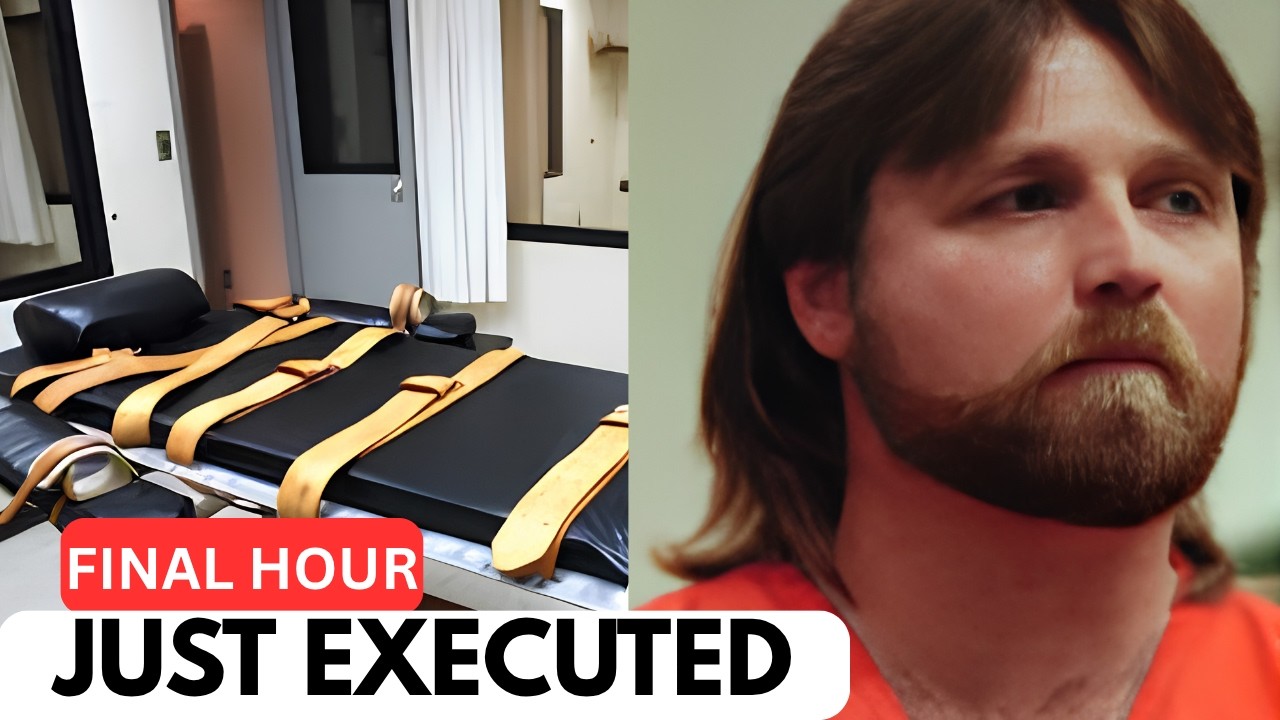
The state of Florida carried out the execution of Glen Edward Rogers on Thursday evening, ending a nearly three-decade wait for justice in a case that spanned the American continent and left a trail of dead women from California to the Sunshine State.
Rogers, 62, was pronounced dead at Florida State Prison following a lethal injection, closing the final chapter on one of the most urgent multi-state manhunts in American law enforcement history. His crimes, a volatile spree of strangulation and arson that began in 1995, had terrorized communities across four states before his own family finally turned him in.
 The execution brought to a close the agonizing ordeal for the families of his victims, women who crossed paths with a charming drifter and never came home. Among them was Tina Marie Cribbs, found dead in a Tampa motel room in November 1995, her belongings stolen, her car gone, her killer vanished into the vast American highway system without a trace.
That motel room discovery set off a chain of events that would expose the terrifying reality of a man who did not look like a monster. Rogers was described by those who encountered him as physically attractive, well-built, and effortlessly charming, a man who could make a stranger feel like the most interesting person in the room within moments of meeting them.
That charm, investigators later concluded, was his deadliest weapon. It allowed him to disarm the natural caution of his victims, to be welcomed into their lives, and to exploit their humanity with a chilling calmness that left forensic teams struggling to find coherence in the aftermath of his violence.
The Tampa case was not his first offense. Authorities would later connect Rogers to the murder of Sandra Gallagher in California, a woman he met at a bar and who was later found strangled and burned inside her own vehicle. The pattern was consistent, a casual encounter, a sudden eruption of violence, and a swift escape using the victim’s own car.
In Mississippi, Linda Price, a single mother, met Rogers at a fair. She was dead within a short time of that meeting. In Louisiana, Andy Lu Giles Sutton became another entry in his devastating itinerary.
Each victim, someone’s daughter, someone’s mother, someone’s world, reduced to a name in a rapidly growing case file.
What made Rogers so difficult to track was his relentless mobility. He had no permanent address, no fixed routine, no community to notice his absence. In 1995, before the advent of interconnected law enforcement databases, a man who kept moving was a man who kept disappearing, each new state a clean slate.
Psychologists who studied the case classified Rogers less as a traditional serial killer and more as a spree killer, someone whose violence was driven by bursts of rage rather than calculated, methodical hunting. Alcohol played a significant role, unlocking a volatility that sat just beneath that charming surface, waiting for the wrong moment to emerge.
 His background offered troubling warnings that went unheeded. Born July 15th, 1962, in Hamilton, Ohio, Rogers grew up in a large family marked by neglect and reported abuse. He reportedly showed behavioral problems from a very young age, including hyperactivity, emotional volatility, and an inability to regulate anger, flares going off in broad daylight that nobody stopped to address.
As an adult, he drifted from job to job, state to state, never settling, never anchoring himself to anything or anyone for long. That restlessness, investigators would later understand, was a rehearsal for the violence that would define his legacy.
The case took a staggering turn when his brother, Clay Rogers, came forward with a claim that briefly shook the foundations of one of the most publicized criminal cases in American history. Clay claimed that Glen had confessed to being responsible for the murders of Nicole Brown Simpson and Ron Goldman in Brentwood in June 1994.
Glen Rogers himself made statements that neither fully confirmed nor cleanly denied involvement in the Simpson-Goldman case, at one point claiming to have killed as many as 70 people, a number investigators found deeply unlikely. Authorities investigated the claim seriously but ultimately concluded that it did not hold up under scrutiny.
What the claim revealed about Rogers was his hunger for significance, for notoriety, for the world to understand that he was not ordinary. That desperate reach for infamy told investigators more about who he truly was than almost anything else in his psychological profile.
His downfall came not from a brilliant piece of detective work, but from his own family. In November 1995, a relative contacted authorities and disclosed Rogers’ whereabouts, making the decision that what he was doing could not continue. That call changed everything.
Law enforcement had already begun connecting the dots between the murders, the similar victim profiles, and the stolen vehicles moving steadily eastward. The moment his location was known, his advantage collapsed. Officers identified him behind the wheel of a vehicle belonging to one of his victims.
 A high-speed chase tore through Kentucky before Rogers was finally forced off the road and taken into custody. The man who had moved like smoke across an entire country, untouchable and invisible, was suddenly in handcuffs, his spree finally over.
Florida moved first in the prosecution, convicting Rogers in 1997 of the murder of Tina Marie Cribbs, the woman in that Tampa motel room whose stolen car had ultimately led law enforcement to his door. The jury deliberated and returned a verdict of death.
California followed in 1999, convicting Rogers of the murder of Sandra Gallagher. Again, the court looked at the evidence and reached the same conclusion. Two death sentences, two states, two families given the promise of justice that would take decades to fulfill.
The years on death row stretched on, filled with appeals and legal maneuvers. For the families of his victims, the waiting carried its own particular cruelty. Justice had been declared, but it had not yet been delivered, and every passing year was another year of carrying something that was never fully resolved.
On January 16th, 2025, the waiting ended. After every appeal had been filed and rejected, after every legal avenue had been walked to its dead end, the sentence handed down in 1997 was finally carried out.
In the hours before his execution, Rogers was granted a last meal, a tradition that has always sat uncomfortably within the American justice system. He requested a hamburger, french fries, and a Coca-Cola, an ordinary meal for a man whose crimes were anything but.
But it was his final statement that cut through everything else. Rather than addressing the families of his victims, rather than offering anything resembling accountability or remorse, Rogers directed his last words toward Donald Trump, who had recently returned to the presidency. He expressed support and admiration.
 A dying man spending his final breath not on the women whose lives he had taken, not on the families left behind to rebuild around an absence, but on a political figure, on relevance, on being heard one last time by the largest possible audience. It was the most revealing thing he ever did.
Even standing at the absolute threshold of death, what consumed Rogers was not guilt. It was significance, the need to matter, to be seen, to leave a mark on a world that he had spent his entire life taking from rather than contributing to. The curtain closed, and Glen Edward Rogers was gone.
The victims’ families, who waited nearly three decades for this moment, were left to carry forward the memory of the women they lost. Sandra, Linda, Tina, and every other woman whose name appears in this story, women who were not foolish, but simply human, responding to another human being the way healthy, trusting people do.
The execution serves as a reminder that danger does not always announce itself. Sometimes it buys you a drink first. The very qualities that should have been warning signs, the intensity, the speed with which Rogers built intimacy, the way he inserted himself into someone’s evening, read in the moment as charisma.
His crimes were not inevitable. They were enabled by mobility, by the gaps in law enforcement communication that existed in 1995, and by the way charm, when worn convincingly enough, can override the most fundamental protective instincts. The lesson buried inside his story is that trust should not be built in a single evening, and charm is not the same as character.
With his death, the state of Florida has closed its case against Glen Edward Rogers. But the questions his life raised, about how monsters hide in plain sight, about how the people we trust can become the people who destroy us, will linger long after the final report is filed.