SpaceX employees joined a recent company-wide meeting expecting to hear about rockets, Starship, Starlink, or the enormous engineering challenge of putting more hardware into orbit.
Instead, Elon Musk told them something that could completely change how the world thinks about SpaceX.
Within five years, he said, almost all of the company’s value could come from something that doesn’t fly at all.
Artificial intelligence.
Musk’s prediction was extraordinary even by his standards.
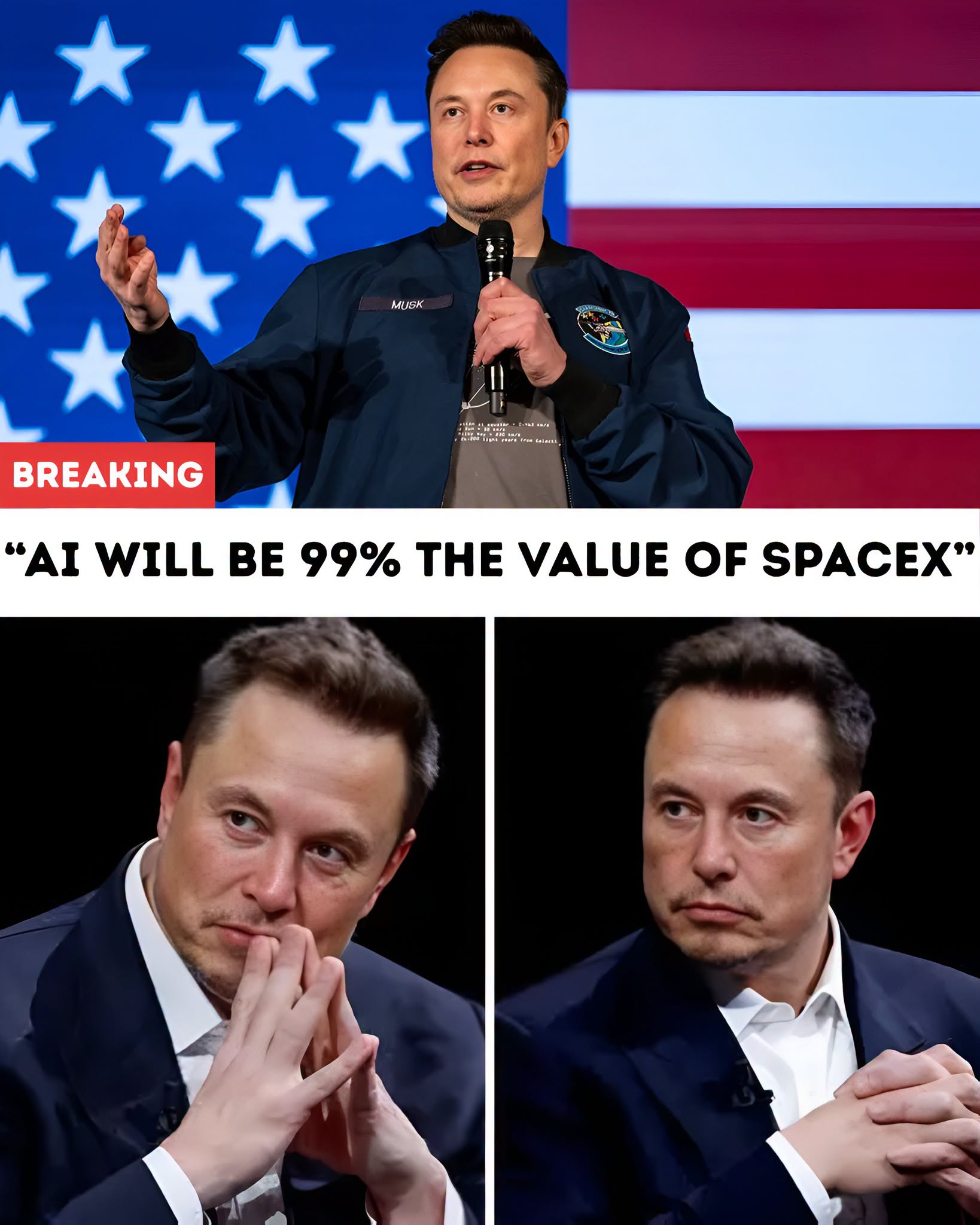
“Long-term, probably in four or five years, AI will be 99% of the value of SpaceX,” he told employees.
Then he removed almost all ambiguity from the timeline.
“Five years for sure.”
And he added one more prediction:
SpaceX itself could eventually be worth what he called an “astronomical number.”
It would be easy to dismiss that as another enormous Musk forecast about a distant future.
Except the second thing he told employees made that difficult.
According to Musk, they may not have to wait five years to see the shift begin.
They may not even have to wait five months.
He expects SpaceX’s AI revenue to surpass the revenue generated by all of its space businesses combined as soon as September 2026.

That is next month.
And by the fourth quarter, Musk said, AI revenue could be significantly larger than the company’s traditional space revenue.
Think about what that means.
This is SpaceX.
The company that made reusable orbital rockets routine.
The company behind Falcon 9.
The company developing Starship.
The company that built Starlink into a satellite internet network serving millions of customers.
For almost its entire existence, the equation seemed obvious:
SpaceX was a space company that increasingly used software and AI.
Musk is now describing almost the reverse.
A future in which rockets, satellites and launch infrastructure become part of the machinery supporting an AI company.
And the numbers emerging from SpaceX’s first public earnings report suggest this transformation is no longer theoretical.
In the second quarter of 2026, SpaceX reported total revenue of approximately $7.8 billion, up 92% from the same period a year earlier.
Starlink and the broader connectivity operation remained enormous, generating about $4.29 billion.
The traditional space business contributed roughly $962 million.
But AI?
Approximately $2.56 billion.
That segment had already more than tripled from the prior-year level, driven by cloud-service agreements and revenue associated with SpaceX’s expanding AI operations.
Suddenly, Musk’s September prediction doesn’t sound like a company imagining an entirely new business.
It sounds like a company watching one business overtake another in real time.
And that is where the story becomes much bigger than Grok.
Because behind the AI revenue sits an infrastructure buildout so enormous that SpaceX is beginning to resemble something very different from the aerospace company most people know.
The clue appeared during SpaceX’s first earnings call after going public.
Musk spent part of that call talking not about engines or orbital payloads, but about gigawatts of computing capacity.
Gigawatts.
The same unit normally used to describe power stations.
SpaceX ended the second quarter with roughly 1.4 gigawatts of nameplate AI compute capacity, up sharply from the year before.
The company expects that figure to exceed 2 gigawatts by the end of 2026.
Its ambitions for 2027 are far larger still.
Musk has described a path toward approximately 10 gigawatts of AI compute capacity by the end of 2027.
For perspective, this isn’t simply buying a few more racks of GPUs.
At that scale, you’re talking about infrastructure involving enormous quantities of processors, networking hardware, cooling systems, electrical substations, land, transmission capacity and power generation.
The AI model people see on a screen is only the final layer.
Underneath it is an industrial system.
And SpaceX is spending like a company determined to build that system quickly.
Its second-quarter capital expenditure jumped to approximately $18.4 billion.
About $15.8 billion of that was attributed to the AI segment, according to its reported results.
That number reveals something important.
Musk isn’t telling employees AI might become 99% of SpaceX’s value while quietly running a small experimental division in the background.
The company is already committing massive amounts of physical capital to the bet.
But there was still one enormous question.
Where would all the computing power come from?
Musk answered that too.
NVIDIA.
SpaceX has committed its future AI infrastructure to NVIDIA’s Vera Rubin architecture, and Musk said the company expects to receive a significant share of NVIDIA’s GPU output.
During the earnings call, he described NVIDIA’s technology as the best option available and indicated SpaceX intends to rely exclusively on NVIDIA GPUs for its AI expansion.
That commitment matters because the scale being discussed is enormous.
NVIDIA’s Vera Rubin generation is specifically designed for giant AI factories—the kind of systems intended to train and operate increasingly capable AI agents at tremendous scale.
NVIDIA says Vera Rubin is now moving into full production, supported by a global manufacturing network spanning hundreds of factories and suppliers.
For NVIDIA, a customer attempting to build several gigawatts of AI capacity is not simply another buyer.
It can become one of the defining customers of an entire hardware generation.
For SpaceX, securing enough GPUs becomes almost as strategically important as securing rocket engines once was.
And this is where Musk’s statement to employees starts to reveal its deeper meaning.
For years, SpaceX’s competitive advantage came from mastering something brutally physical.
Rockets.
It learned how to manufacture them faster.
Reuse them.
Land boosters.
Launch more frequently.
Lower the cost of reaching orbit.
Then Starlink turned that launch capability into another advantage.
SpaceX didn’t merely launch satellites for customers.
It launched thousands of its own.
Rockets helped create the network.
The network generated recurring revenue.
That revenue helped finance more infrastructure.
The infrastructure strengthened the company.
It became a loop.
Now Musk appears to be trying to construct another loop around AI.
Only this one may eventually be much larger.
SpaceX now includes xAI, the artificial-intelligence company Musk founded in 2023 and that SpaceX acquired earlier in 2026.
In its own public-market filings, SpaceX describes xAI as an integral part of the combined company and says it is building AI compute infrastructure on Earth with the ultimate goal of extending that infrastructure into space.
That sentence should change how people interpret everything else.
SpaceX isn’t simply adding a chatbot business to a rocket company.
The ambition is to connect:
AI models.
Massive GPU clusters.
Ground-based data centers.
Satellites.
Launch capability.
And eventually, potentially, computing infrastructure in orbit.
Suddenly the strange combination of rockets and AI begins making more sense.
Most AI companies face the same basic infrastructure problem.
They need chips.
They need electricity.
They need data centers.
They need cooling.
They need networks.
And every time their models become larger or more widely used, they need more of all five.
SpaceX already possesses something almost none of them have.
The ability to put huge quantities of its own hardware into orbit.
Musk has repeatedly discussed the possibility of orbital AI computing.
The concept is extraordinarily difficult.
Computers in space face challenges involving radiation, communications, maintenance and heat rejection.
But if the economics eventually work, SpaceX would begin with an advantage that is nearly impossible to replicate quickly:
it owns the rockets.
It operates the satellite network.
It controls launch scheduling.
It builds spacecraft.
And now it owns an AI operation whose appetite for compute is exploding.
That is why the merger between xAI and SpaceX matters.
From the outside, combining an artificial-intelligence startup with a rocket manufacturer once seemed strange.
From inside Musk’s strategy, it may have been the point.
SpaceX’s IPO filings already warned investors that AI would require enormous and continuing investment in specialized computing hardware, energy infrastructure and technical talent.
The company also acknowledged something Musk’s public optimism sometimes obscures:
There is no guarantee those investments will pay off.
SpaceX said its AI operation has generated substantial operating losses and warned that the commercial value of frontier AI remains uncertain.
That is an important counterweight to the excitement.
Musk is talking about AI becoming 99% of SpaceX’s value.
But SpaceX itself is telling investors that reaching that future could cost staggering sums before profitability arrives.
Both things can be true.
AI can represent the company’s greatest opportunity.
And its greatest financial risk.
Employees sitting in that all-hands meeting were essentially hearing the founder tell them that the organization they joined may be entering the most expensive transformation in its history.
Imagine working for SpaceX ten years ago.
The mission was difficult but understandable.
Make humanity multiplanetary.
Improve rockets.
Get Falcon flying reliably.
Develop Starship.
Build Starlink.
Launch more.
Then imagine hearing the CEO say that five years from now, all of those achievements together might represent only a tiny fraction of the company’s total value.
That isn’t a new product announcement.
It’s an identity change.
And Musk reinforced that transformation with something even more personal.
He told employees that Grok would increasingly learn from SpaceX’s internal knowledge and encouraged workers to interact with the AI system.
According to reports from the all-hands meeting, Musk said Grok would be trained using information generated across SpaceX—including the work and contributions of employees.
The idea immediately creates difficult questions.
What internal information will be used?
How will employee data be handled?
What safeguards will exist around proprietary engineering information?
SpaceX has not publicly provided detailed answers to all of those questions.
But strategically, Musk’s goal is easy to see.
He doesn’t want Grok learning only from the public internet.
He wants the model to absorb knowledge from inside one of the world’s most technically ambitious engineering organizations.
Thousands of engineers have spent years solving problems involving propulsion, materials science, orbital mechanics, telecommunications, manufacturing, electronics and software.
Musk appears to see that accumulated knowledge as something AI can learn from.
That turns SpaceX itself into more than a customer for Grok.
It becomes training material.
And here comes the deeper twist.
For most of its history, people assumed AI would help SpaceX build better rockets.
Musk now seems to be describing a future where SpaceX’s rockets, engineers, satellites, data centers and accumulated technical knowledge help build better AI.
The direction of value has reversed.
The rockets were once the destination.
They may eventually become infrastructure.
Starlink was once primarily a satellite internet business.
It can also become a global communications layer for AI services.
SpaceX’s engineers once existed primarily to solve aerospace problems.
Their collective knowledge could also help train internal AI systems.
Launch capability once existed to put spacecraft into orbit.
It might eventually put computing infrastructure there too.
One asset strengthens another.
And at the center sits Grok.
This is why looking at SpaceX only as a rocket company may increasingly produce the wrong picture.
The most visible part of SpaceX will probably remain physical for years.
People can photograph a Starship launch.
They can watch boosters land.
They can see Starlink satellites crossing the night sky.
AI infrastructure is harder to see.
It sits behind walls.
Inside data centers.
Inside GPUs.
Inside models.
Inside contracts.
But financial statements don’t care which business produces the best photographs.
They reveal where the money is moving.
And SpaceX’s financials are already showing that movement.
$2.56 billion of quarterly AI revenue.
A company prediction that AI revenue could surpass all traditional space revenue as soon as September.
Billions committed to computing infrastructure.
Gigawatts of planned capacity.
A deepening NVIDIA relationship.
And a CEO telling employees that within five years AI could account for essentially the entire economic value of the company.
That’s the moment of recognition.
SpaceX may still launch rockets.
It may launch more rockets than ever.
Starship may eventually fly to Mars.
Starlink may continue adding millions of users.
None of those things have to become less important operationally.
But economic importance works differently.
If AI grows fast enough, everything else can become smaller relative to it even while those businesses continue expanding.
A division generating $10 billion doesn’t look small.
Until another division generates $100 billion.
A business worth $500 billion doesn’t look secondary.
Until another part of the same company becomes worth several trillion.
That is the future Musk appears to be imagining.
And if he’s right, one of the strangest corporate transformations in technology history is already underway.
A company founded in 2002 to lower the cost of spaceflight could become, by the early 2030s, primarily an artificial-intelligence company that happens to own one of the world’s most powerful space infrastructures.
The rocket company could become an AI company.
The satellite network could become AI infrastructure.
The launch fleet could become a delivery mechanism for computing.
And the engineers building machines for space could help train the intelligence operating them.
There is no guarantee Musk’s prediction comes true.
Five-year forecasts in frontier technology should never be treated as certainty.
Gigawatt-scale computing projects can face power shortages, construction delays, hardware constraints and massive costs.
AI competitors are spending aggressively too.
And SpaceX’s own regulatory filings explicitly acknowledge that AI demand and profitability may not develop as expected.
But the consequences of Musk being even partially right are enormous.
Because the key announcement wasn’t that SpaceX believes AI will matter.
Every major technology company believes AI will matter.
It was the magnitude.
99%.
Not 20%.
Not half.
Not one important segment alongside rockets and Starlink.
Almost the entire value of SpaceX.
And the timeline wasn’t 20 years.
It was five.
The first evidence of that transition may arrive even sooner.
September.
If AI revenue actually overtakes SpaceX’s traditional space businesses next month, Musk’s five-year prediction will suddenly look less like an outrageous leap and more like an extrapolation of something already happening.
That may also explain why SpaceX is willing to pour billions into GPUs, data centers and electricity before the AI operation becomes comfortably profitable.
Musk isn’t treating AI as another SpaceX product.
He’s treating it as the business everything else may eventually serve.
For two decades, SpaceX built machines powerful enough to escape Earth’s gravity.
Now Elon Musk is betting that the most valuable thing those machines may ever help build won’t be on Mars.
It will be intelligence.
And if AI really becomes 99% of SpaceX’s value within five years, history may remember the rockets not as Musk’s final business—but as the infrastructure he built to reach the one he believed would dwarf everything else.