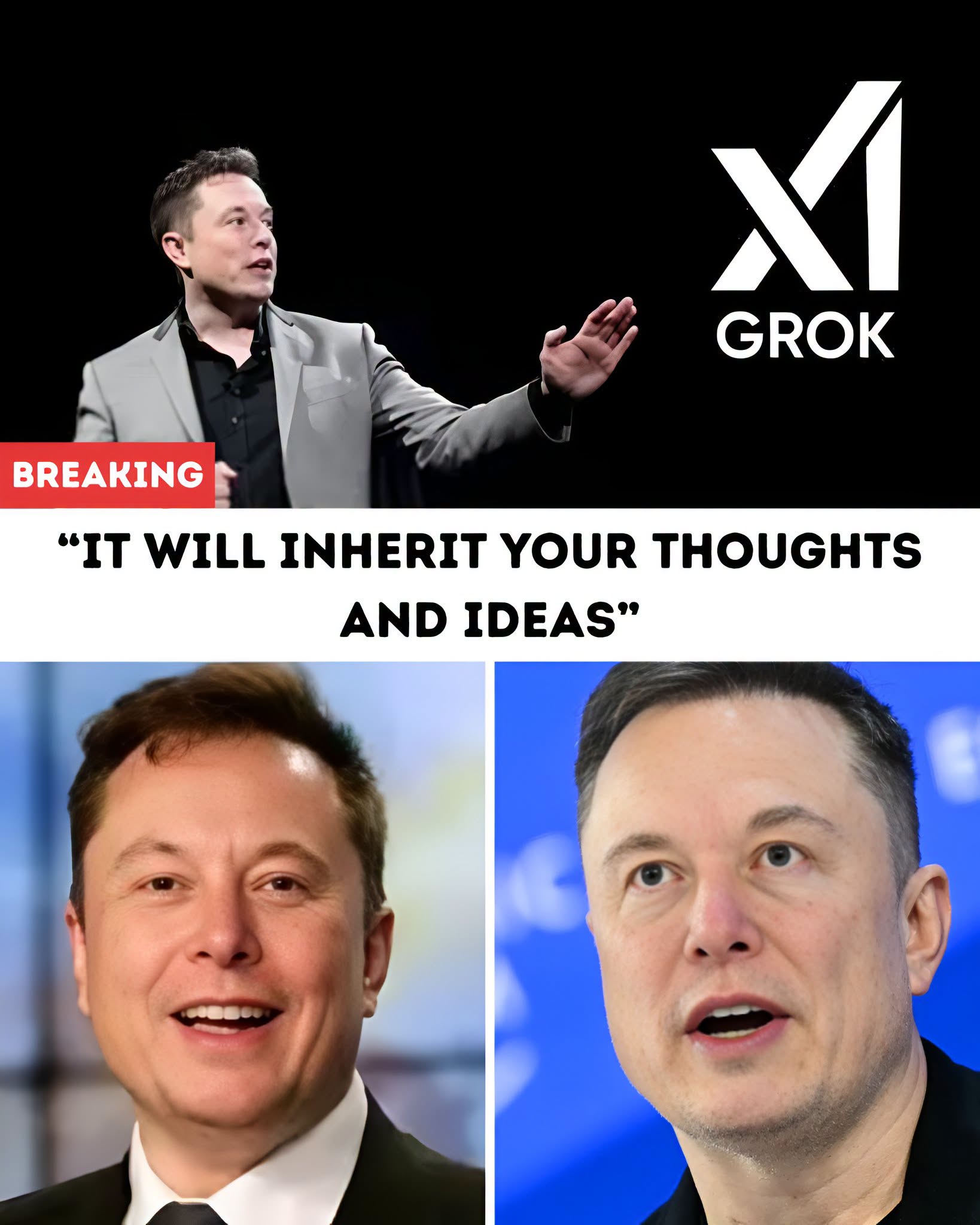
The room went quiet when Elon Musk said something that made thousands of SpaceX employees stop and listen.
“We’re going to be training Grok on the sum total of all SpaceX information.”
Then he added a sentence that changed the way many people looked at the future of artificial intelligence.
“So in a way, it will be trained on you.”
For a moment, it was not about rockets.
It was not about Mars.
It was not about the next launch schedule.
It was about something far more personal: the knowledge, decisions, mistakes, creativity, and problem-solving instincts of the people building one of the most ambitious companies on Earth.
Because behind every successful rocket launch is not just metal, fuel, and software.
It is human judgment.
A technician noticing something unusual before a machine detects it.
An engineer finding a solution after weeks of failed experiments.
A team making thousands of invisible decisions that never appear in the final launch video.
And Musk was saying that all of those experiences could become part of an artificial intelligence system.

The idea immediately raised a difficult question:
When a company teaches AI using the minds of its employees, who does that knowledge belong to?
SpaceX has always been built around the idea that speed comes from learning faster than everyone else.
The company was created with an almost impossible mission: reduce the cost of space travel and eventually make life multiplanetary.
To achieve that, SpaceX developed a culture where engineers are expected to move quickly, solve problems directly, and challenge assumptions.
That culture produced reusable rockets, rapid testing cycles, and some of the most dramatic achievements in modern aerospace.
But it also created something less visible.
A massive collection of human knowledge.
Every design decision.
Every engineering discussion.
Every technical document.
Every solution discovered after failure.
Over years, that information became one of SpaceX’s most valuable assets.
And now, that asset may become fuel for artificial intelligence.
During a company all-hands meeting, Musk explained that future versions of Grok would learn from SpaceX’s accumulated information.
He described SpaceX employees as “some of the very best humans on Earth” and suggested that their ideas and values could shape the AI.
“You will effectively be the parents of the AI,” Musk told employees.
“It will inherit your thoughts and ideas and beliefs.”
For supporters, the vision sounds like something from science fiction.
Imagine an AI assistant that understands decades of rocket engineering knowledge.
An AI that can help engineers design faster.
An AI that remembers every previous test, every failure, every breakthrough.
A digital partner carrying the collective intelligence of thousands of talented people.
But for others, the statement immediately created uncomfortable questions.
Because the most valuable thing employees bring to a company is not only their time.
It is their expertise.
Their creativity.
Their experience.
Their ability to think.
And when that becomes part of an AI model, the relationship between human workers and technology becomes much more complicated.

The race for AI has changed.
A few years ago, companies competed by collecting information from the internet.
Books.
Web pages.
Public documents.
Online conversations.
But as AI systems become more advanced, companies are searching for something more valuable.
Real-world knowledge.
The kind of information created by people doing difficult jobs.
Factory workers operating machines.
Engineers designing products.
Employees solving problems inside complex organizations.
Because the next generation of AI is not only expected to answer questions.
It is expected to act.
To use computers.
To complete tasks.
To make decisions.
To operate in the real world.
And training those systems requires examples of how humans actually work.
This is why employee knowledge has become one of the most valuable resources in the AI industry.
SpaceX is not alone in pursuing this direction.
Other technology companies have explored ways to collect workplace data to improve AI systems.
But the SpaceX announcement attracted attention because of the company’s unique position.
The knowledge being considered is not ordinary business information.
It comes from a company building spacecraft, rockets, and technology designed for missions beyond Earth.
The stakes feel different.
Inside SpaceX, the reaction was likely complicated.
For some employees, the idea may represent an incredible opportunity.
Their work could continue influencing technology long after they complete a project.
Their discoveries could become part of an intelligence system helping future engineers.
A solution found by one person today could help thousands of people tomorrow.
But others may wonder where the boundary exists.
If an engineer spends years developing expertise at SpaceX, and that expertise becomes part of an AI system, how should that contribution be recognized?
Should employees have control over how their work is used?
Should there be limits?
Should there be transparency about what information is included?
Those questions do not have easy answers.
The technology is moving faster than many workplace rules can keep up.
The biggest surprise, however, was not simply that SpaceX wants to train AI on company data.
The bigger realization was what this means for the future of work.
For decades, companies stored information in databases.
Now, they are trying to transform that information into intelligence.
A company’s documents are no longer just records.
They can become the foundation of an AI system.
A company’s experience is no longer only something passed from senior employees to younger workers.
It can potentially be captured, organized, and amplified by machines.
That changes the value of human knowledge forever.
The employee who solves a difficult problem today may not just improve a product.
They may help create an AI system that solves similar problems for years.
There was also another layer to Musk’s announcement.
For years, he has warned about the risks of advanced artificial intelligence.
His concern has been that powerful AI systems must develop goals aligned with humanity.
From his perspective, training AI on the knowledge and judgment of exceptional people could help guide it.
Instead of creating a machine disconnected from human values, the goal would be to create one shaped by human experience.
That vision is appealing.
But it also depends on a critical assumption:
That human knowledge can be transferred into AI without losing the most important parts.
Because intelligence is not only information.
It is context.
It is responsibility.
It is understanding consequences.
It is knowing when not to act.
A document can explain how to build a rocket.
But it cannot fully capture the instinct of an engineer who knows something feels wrong before the numbers reveal the problem.
That human element is what makes the conversation so important.
The moment that stood out most from Musk’s comments was not the technology itself.
It was the idea that employees could become the “parents” of an AI.
That phrase revealed something much larger.
The future of AI may not be created only by programmers.
It may be shaped by millions of workers whose everyday decisions become training material.
Engineers.
Doctors.
Designers.
Teachers.
Scientists.
Creators.
Every person who contributes knowledge may eventually influence the intelligence systems of the future.
The question is no longer just:
“What can AI learn?”
The question is:
“Who gets to decide what AI learns from us?”
For SpaceX, this may become one of the company’s biggest experiments yet.
Not a rocket launch.
Not a Mars mission.
But a test of whether human experience can be transformed into something greater without losing the people behind it.
The world has always built tools to extend human ability.
The wheel extended movement.
The computer extended calculation.
The internet extended communication.
Now AI may extend knowledge itself.
But every powerful tool carries the values of the people who create it.
And perhaps the most important lesson from SpaceX’s AI ambitions is this:
The future will not only belong to those who build smarter machines.
It will belong to those who understand that every machine is ultimately shaped by the human minds behind it.


/origin-imgresizer.eurosport.com/2025/07/04/image-66e39940-555b-4ded-9fe4-4d20ed37f659.jpeg)