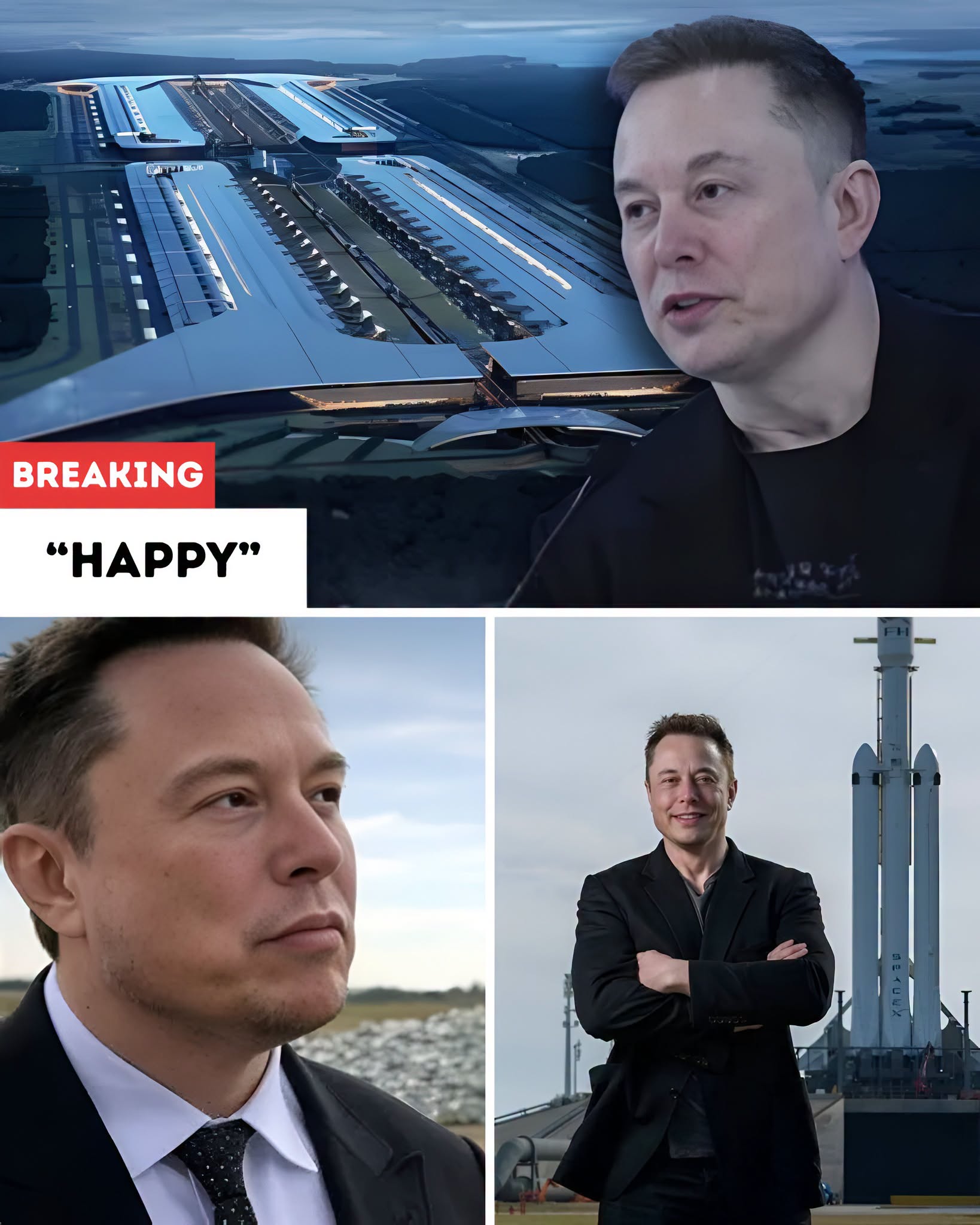
When Elon Musk announced his newest mega-project, the reaction from the world was exactly what you would expect.
People were amazed.
A building so massive it would dwarf almost every industrial facility ever created.
A factory so large that, if completed, it would become the biggest building on Earth.
Musk called it “the largest and most valuable building on Earth by far.”
But hundreds of miles away from the headlines, in a quiet Texas county with roughly 30,000 residents, the reaction was very different.
There was no celebration.
There were questions.
Because for the people living in Grimes County, Texas, this was not just another billion-dollar technology project.
It was coming to their backyard.
And suddenly, a peaceful rural community found itself standing in the path of one of the most powerful entrepreneurs in human history.
For decades, Elon Musk has built his reputation by attempting things most people considered impossible.
Electric vehicles when the world doubted Tesla.
Reusable rockets when the industry said it could not be done.
Private space exploration when governments dominated the field.
Now, his next challenge is not in space.
It is on the ground.
Terafab.

The name itself suggests the scale of Musk’s ambition.
The planned semiconductor manufacturing facility is designed to produce advanced chips needed for some of his biggest future projects, including Tesla’s self-driving technology and Optimus humanoid robots.
But Musk’s vision goes far beyond a normal factory.
The planned complex would include semiconductor manufacturing, artificial intelligence facilities, and power infrastructure needed to support the enormous operation.
The proposed size?
Approximately 100 million square feet.
To understand that number, imagine a typical large retail store.
A Target or Costco location might cover the equivalent of several football fields.
Terafab would be closer to 2,300 football fields.
It would not simply be a building.
It would be its own industrial city.
And that was exactly what worried the people who already called the area home.
Grimes County was not known as a place where the world’s biggest companies competed for land.
It was known for something else.
Quiet roads.
Open spaces.
A slower pace of life.
For residents like Marie Egyed, that was the entire reason they moved there.
Eight years earlier, she left Houston hoping to escape the constant expansion and pressure of a major city.
She wanted something simpler.
A peaceful rural community where neighbors knew each other and life moved at a different speed.
Then, during a local council meeting, she heard something that changed everything.
Officials were discussing a possible major development project in the area.
At first, residents did not know exactly what it would become.
Then, less than two months later, Musk revealed his plan.
The quiet Texas county was suddenly connected to one of the largest industrial projects ever proposed.
The news spread quickly.
And so did the concerns.
The residents were not simply angry about development.
That was the part many outsiders misunderstood.
They knew growth was coming.
They knew Texas was expanding.
They knew new companies brought opportunities.
But they feared that a project of this scale could transform their community before anyone had fully considered the consequences.

Where would all the workers live?
Would roads handle the traffic?
How much water and electricity would the facility require?
What would happen to property values?
Would the small-town identity disappear?
Those questions led residents to create the Grimes County Citizens for Responsible Development.
Their goal was not to stop every project.
Their goal was to make sure the community had a voice.
They wanted transparency.
They wanted oversight.
And most importantly, they wanted a seat at the table.
Meanwhile, supporters of Terafab pointed to the enormous economic benefits.
Texas Governor Greg Abbott praised the project as a major expansion of Musk’s technology ambitions in the state.
The facility is expected to bring thousands of jobs to the region.
For local officials, that represents opportunity.
New employment.
New investment.
More economic activity.
For a county that has never hosted a project of this magnitude, the potential transformation is enormous.
But history has shown that massive corporate projects often create complicated trade-offs.
A company can bring jobs and innovation while also changing the community around it forever.
And that tension is exactly what Grimes County residents are trying to navigate.
This is not the first time Musk’s companies have faced resistance from communities near major developments.
At SpaceX’s Boca Chica facility in South Texas, some residents have raised concerns about rocket launches, environmental impacts, and changes to the area.
The debates around Musk’s projects often follow a similar pattern.
Supporters see the future arriving.
Critics see a community trying to protect itself.
Both sides believe they are fighting for something important.
The question is who gets to decide what progress should look like.
The most revealing moment came when Marie Egyed explained that she understood the project was probably too large to simply stop.
The reality was clear.
A company as powerful as Musk’s does not casually walk away from a project of this size.
The battle was no longer about preventing Terafab.
It was about making sure the community was not ignored.
“We’re not going to stop it,” Egyed said.
“But maybe we can minimize the negative impact.”
Those words showed the real conflict.
This was not a fight between people who hated technology and people who loved innovation.
It was a fight over balance.
How much power should a corporation have over a community?
How much responsibility comes with building something unprecedented?
And when the world’s most ambitious companies move into small towns, who gets to decide the future?
The irony is that Terafab represents exactly the kind of future Musk has always promised.
A world built around artificial intelligence.
Advanced robotics.
Self-driving machines.
Next-generation technology.
But before those technologies can change the world, they need somewhere to be built.
And that somewhere is often a real place filled with real people.
People who have homes.
Families.
Memories.
And expectations about what their community should become.
For Elon Musk, Terafab is another step toward controlling the technology stack of the future.
For Texas leaders, it is a symbol of economic growth.
For investors, it could become one of the most important industrial projects of the century.
But for the people of Grimes County, it is something much more personal.
It is the moment when a small rural community discovered that the future was not coming someday.
It was already arriving.
And it was asking them to make room.
Because the biggest buildings in the world are not only measured by their size.
They are measured by the lives they change.