“I won’t be stepping on that stage with you. ”
Six careless words. My biological father said them exactly three days before my Purple Heart pinning ceremony, without a single ounce of pity for the scars still throbbing on my arm. He refused because my older sister — a politician’s wife — thought seeing me in the headlines would be an eyesore.

Ten minutes later my mother finished the job. “Just get the metal by yourself. Don’t make a big deal out of it. It’s just a piece of metal.
”
Something I traded my life for. I sat on the bathroom floor with black polish on my fingers, listening to the line go dead. I didn’t scream. I didn’t throw the phone.
My heartbeat stayed slow and steady, the way it had to be if you wanted to survive mortar fire. She called back. “Chloe has Julian’s fundraising gala the same weekend. We can’t have them running photos of you dragging attention away from the campaign.
People will ask questions about your injury. It’s bad optics. ”
Bad optics. She talked about the blood I spilled in the sand like I was whining for a toy.
I hung up without saying a word. I should have known better. I’d learned exactly where I stood in that family long before the bullet. When I was fourteen, I built a seven-foot tactical bunker out of scrap plywood and rusted nails for a county engineering competition.
Three weeks of hauling lumber and dragging sandbags. It won first place in the tri-state bracket. A heavy brass cup with my name on it. My father showed up forty minutes late to the award ceremony.
He walked across the empty gym, glanced at the cup, muttered “Good job,” and told me to hurry because Chloe was waiting in the car for dinner reservations. That night my mother stood on the patio pointing at my bunker. “It’s an eyesore, Arthur. It makes us look like we live in a trailer park.
Get someone to tear it down tomorrow. ”
My father didn’t defend me. He called the landscapers in the morning. I crawled into the bunker and sat in the dirt, pressing the splinter deeper under my thumb until the pain drowned out the sound of their voices.
They didn’t see me. They never would. By the time I graduated high school, Chloe was engaged to Julian, a slick D. C.
lobbyist. My parents canceled my graduation celebration to book a steakhouse for her engagement party. I sat by the kitchen doors in my blue gown while fifty strangers toasted her. No one mentioned my diploma.
I was a blue-collar ghost in the middle of a country club mixer. When I enlisted, my mother sneered at the Army acceptance paper. “Crawling around in the mud with a bunch of grunts. It’s humiliating, Sarah.
”
I left for basic training alone. The house was empty when I walked out. I didn’t look back. I spent years clearing IEDs in Afghanistan as a combat engineer.
A local Connecticut paper ran a short story about my unit. My father called on a crackling satellite line, not to ask if I was safe, but to demand I keep my name out of the press. “Chloe is very upset. It’s causing issues for Julian’s campaign.
”
“You want me to hide? ” I asked. “Don’t make this difficult. ”
He was more afraid of losing access to his grandkids than of losing me.
The worst place on earth introduced me to the best people. I was bleeding in the dirt with my arm torn apart by a . 50 caliber round while my unit tried to secure a pontoon bridge under fire. A medevac Blackhawk dropped out of the sky, and David Vance hauled me onto the metal floor.
“Hold on tight, sergeant. I’m not going back empty. ”
When I was sent stateside, David drove me to his father’s woodshop. Thomas Vance was a retired command sergeant major with forearms like tree trunks and hands calloused from decades of hard labor.
He ran a shop for combat veterans. He didn’t ask about my trauma. He handed me a block of sandpaper and pointed at a stack of rough-cut cedar. “Start sanding, warrior.
With the grain, not against it. ”
I went back three days a week. My right hand still shook from nerve damage. One afternoon I dropped a mallet and cursed at my own scarred arm.
Thomas walked over and wrapped his rough hand around the purple tissue, holding it until the shaking stopped. A week later he pushed a custom walnut shadow box across the workbench. Behind the glass, a space for medals. In the corner, a brass plate engraved with my initials.
“These scars,” Thomas said, “mean you stood your ground when the rest of the world folded. I am damn proud of you. ”
Thirty-two years alive, and no one with the last name Marsh had ever said that. When the Army approved my Purple Heart, I called Connecticut.
My mother’s first question wasn’t about my arm. “Is this a major event? Are there going to be large press outlets there? Any high-ranking politicians?
”
She was already calculating whether my blood could be used for Julian’s campaign. I hung up. I already knew why my father had backed out. The weekend before, I’d been at the house packing up the last of my things.
Past midnight, I heard Chloe’s voice hissing through the speaker of his phone. “If you put on a suit and go to that filthy military base to take pictures honoring her, I am done. Julian and I refuse to be associated with her kind of violence. ”
I stood in the dark, my back against the refrigerator, waiting for Arthur to defend me.
Instead, a wet wheeze. “Okay, Chloe. I won’t go. Just promise you’ll bring the kids on Thursday.
”
He traded me again. I told David. He set his coffee down. “Then you won’t walk alone.
You have an army. ”
I went to the woodshop. “My father backed out,” I said. “He won’t stand with me at the ceremony.
”
Thomas didn’t ask why. He turned around and locked his eyes on mine. “When do you need me standing there? ”
The day before the ceremony, Martha Hayes — my late grandmother’s best friend — brought me a yellowed envelope.
Inside was a letter written years earlier. “Do not wait for their approval,” it read. “They are hollow. Family isn’t blood.
Family is the people willing to stand in the trench with you when the bullets start flying. ”
I folded it into my breast pocket. Saturday, 1300 hours. The base auditorium was full.
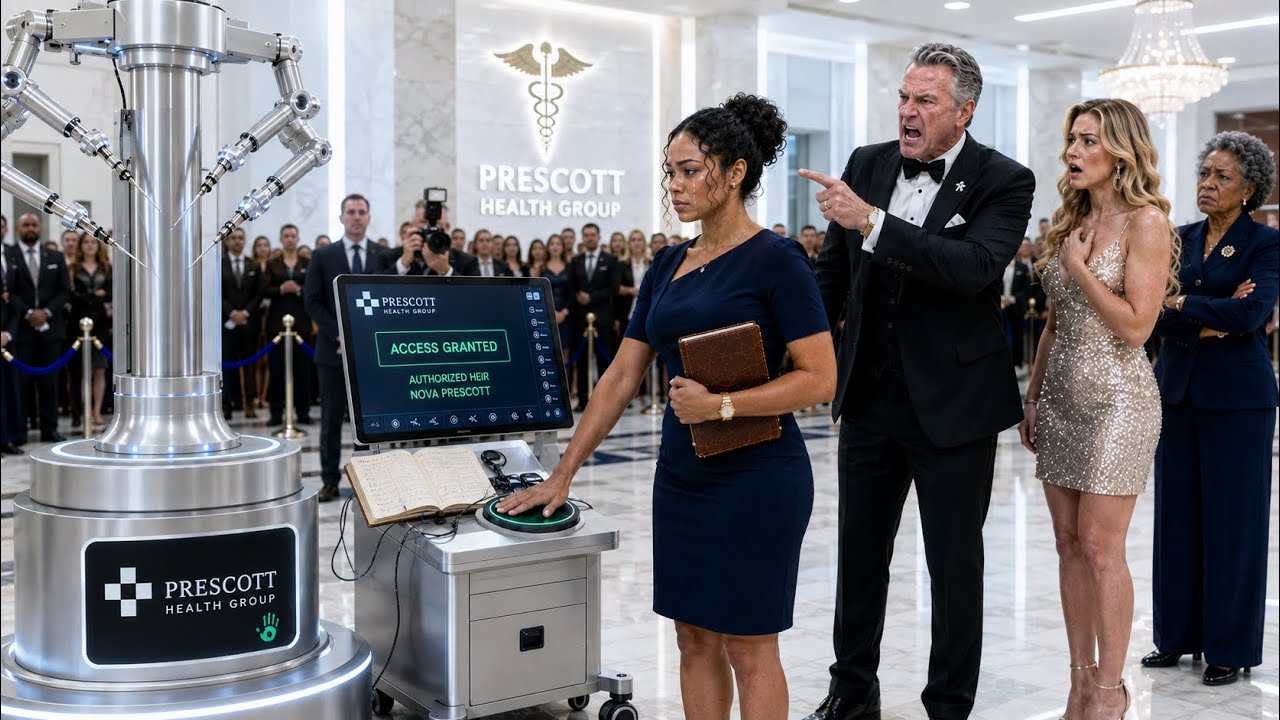
Two hundred enlisted soldiers sat in the front rows in perfect dress blues. The Marsh family sat in the back, huddled in a corner like tourists who had wandered into the wrong building. My mother wore a sparkly cocktail dress. Chloe had her arms crossed, checking her watch.
When my name was called, I stepped onto the stage alone. Then the general asked, “Who will stand as the family representative for Staff Sergeant Sarah Marsh? ”
The silence was absolute. In the back row, Evelyn smiled.
Then heavy boots marched out of the front row. Command Sergeant Major Thomas Vance, covered in ribbons and medals, climbed the stairs. He didn’t need a microphone. He turned to the room and roared:
“Her family is every single soldier standing in this room.
”
It hit the back row like a mortar shell. Two hundred uniforms snapped to attention. My mother’s face went white. Chloe’s jaw hung open.
Arthur stared at his shoes. The general pinned the Purple Heart over my heart. I returned his salute. Two hundred boots slammed together.
Two hundred hands snapped up in salute. I looked at the people who shared my blood, and I looked right through them. At the reception, Thomas spoke again. “This woman built a bridge under active mortar fire.
She bled in the dirt so the rest of us could cross. Anyone who mocks her mud-stained hands is spitting on the exact peace they are enjoying right now. ”
The room erupted. Boots stomped.
Men and women cheered. Arthur found me afterward. He was sweating through his expensive cologne. “Sarah, that was a very nice speech Thomas gave.
”
“It’s a shame you didn’t have the spine to stand up there,” I said. He flinched. Before he could answer, Evelyn materialized and dragged him away. “Stop embarrassing me, Arthur.
” She didn’t look at me. Chloe tried to slip out the side exit. Martha Hayes blocked her path. “Eleanor would be proud of Sarah today,” Martha said.
“She built a legacy with her bare hands, not a cheap PR stunt designed to cover up a rotting marriage. ”
Chloe dropped her wine glass, stained her blouse, and ran into the bathroom. We heard her sobbing through the door. They left through the side exit like deserters.
Two weeks later, Chloe called. Julian had walked out. The donors pulled their funding. Her marriage and her status were gone.
She was sobbing, begging me to come to DC. “I need my sister. ”
“I’m a combat engineer, Chloe. Not your emotional sandbag.
”
I hung up and blocked her number. Three days later, a letter from Arthur arrived. “Thomas overstepped. He stole my moment up on that stage.
Please call me. ”
It wasn’t an apology. It was an excuse. I tore it in half and dropped it in the trash.
The sun dropped long and gold through my apartment window. It caught the walnut shadow box on my shelf, the brass plate, the Purple Heart pinned behind the glass. I pulled a new schematic onto my drafting table. I am Sarah Marsh.
I am a builder. The cowards were in my rearview mirror, and I had new ground to break.