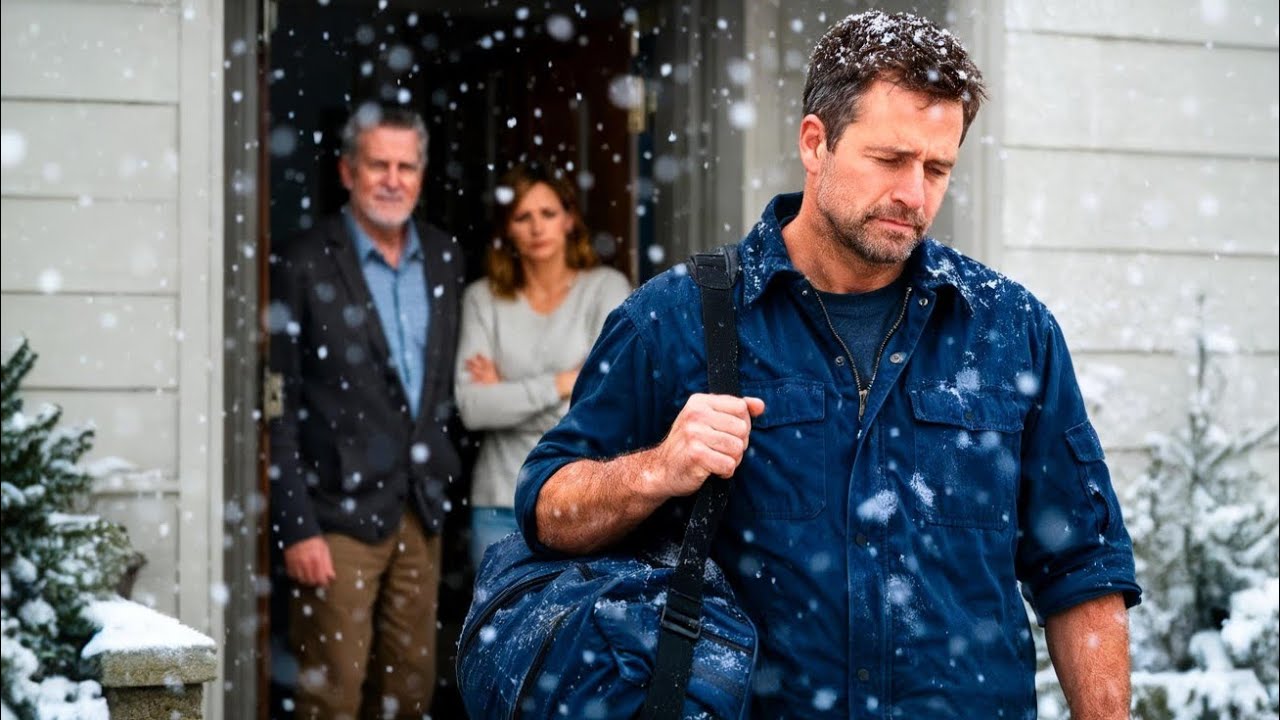
The morning Marcus Hale walked into the Brood Horizon Cafe on the 32nd floor of the Callaway Tower, the espresso machine had just run its last working cycle before a mandatory cool-down reset. The barista, a young woman with tired eyes and a kind smile, looked at the man ahead of him and explained that the last brewed cup was already in his hands. No more coffee for twenty minutes. Marcus had fourteen.

He had exactly eleven dollars in his wallet, a crayon drawing of a dinosaur folded in his breast pocket, and the kind of exhaustion no amount of sleep could fix. He hadn’t slept more than three hours. His five-year-old son, Theo, had woken at two in the morning crying from a nightmare. By the time Marcus sang the lullaby four times, rubbed small circles on a small back, and whispered into the dark, dawn was already seeping through the curtains of their apartment.
The coffee wasn’t about caffeine. It was armor. He had read somewhere that walking into an interview holding a cup of coffee made you look composed, like someone who belonged. He needed to look like he belonged.
His only good blazer, navy, with a fraying left cuff he kept carefully folded inward, had been ironed that morning before he dropped Theo at the neighbor’s. The eleven dollars represented everything. Theo’s school fees. The overdue electricity bill.
The inhaler prescription waiting at the pharmacy. He had been laid off from his logistics coordinator job eight months ago, when the company folded overnight. Since then, he had patched together deliveries, warehouse weekends, days with a moving company. And he had done it alone.
His wife, Serena, had died from a sudden cardiac event two years ago. He didn’t talk about that much. He carried it the way a man carries something too heavy to put down and too precious to drop. He joined the short queue.
Three people ahead of him. It moved quickly. Two. One.
Then the barista gave her news, and Marcus stood there for a moment. He thanked her quietly, stepped aside, and checked his watch. Fourteen minutes until his interview on the 40th floor. Twenty minutes was a lifetime.
He stood near the tall glass windows overlooking the gray sprawl of the city. For one unguarded second, his shoulders fell. Just slightly. Enough for someone paying attention to notice.
That someone was Valentina Cruz. She had come in behind him. She was the kind of woman whose presence rearranged a room without trying. Dark hair falling in loose waves, a pale blue dress that caught the light, the quiet authority of someone who had fought very hard to be exactly where she was.
At 38, she was the CEO of Callaway Industries, the company that occupied sixteen floors of this building. She had started as an intern at 22 with $200 in her account and a scholarship that barely covered her textbooks. She knew what exhaustion looked like behind a person’s eyes. She had worn it herself for years.
She heard everything. She watched the man in the navy blazer receive a small disappointment and absorb it without complaint. And when his shoulders fell, that brief, honest moment of a man at the edge of his reserves, something in her chest turned over. Then she laughed.
Not cruelly. Not dismissively. It was the laugh of someone who recognized something so achingly familiar that the only response was a helpless, fond amusement at the universe’s timing. She had been in that exact position.
Not with coffee, but with a hundred small things that go wrong when everything is already hard. She had stood in queues that moved too slowly. She had stood in rooms that closed too quickly. She had learned to laugh at the architecture of bad luck, because the alternative was to crumble.
Marcus turned at the sound. She was smiling at him, not with pity, but with something that looked almost like recognition. “I’m Valentina,” she said. No title.
“I overheard. I’m sorry about the coffee. I have an extra cup. I ordered two out of habit.
”
She paused. “A habit from when I had a business partner who moved to another city. ”
She held it out. He looked at it the way a proud man looks at something he needs but doesn’t know how to accept.
“I have a meeting in four minutes,” she said. “I can’t drink both. You’d be doing me a favor. ”
He took it.
“Thank you. ”
She nodded and walked toward the elevator. As far as Marcus was concerned, that was the end of it. He went upstairs.
He sat in the glass-walled waiting room, held the warm cup in both hands, and breathed. It gave his hands something to do. When they called his name, he walked into the conference room steady. He answered every question with the clarity of a man who had nothing to hide and everything to offer.
He talked about eight years in logistics. His eye for inefficiency. His ability to manage chaos with calm. Skills built in a warehouse and honed as a single father.
He did not mention Theo by name. But when they asked what drove him, he told the truth. “I have a five-year-old son who deserves a father who shows up,” he said. “Showing up, in every sense, is the thing I do best.
”
They thanked him. He took the elevator back down. He stepped out into the thin March sunlight, stood on the pavement, and let out a breath so long it felt like it had been held for months. Three days later, he got a call.
Senior operations coordinator. A salary that would cover the pharmacy, the school fees, the electricity. Maybe, just maybe, a small savings account for Theo’s future. He sat down on the kitchen floor when he heard it, right there on the linoleum, and pressed his forehead to his knees.
The relief was enormous and devastating. The relief of a door finally opening. He didn’t know that the woman who had handed him a cup of coffee in the cafe was Valentina Cruz, the CEO of the company that had just hired him. He learned that weeks later at orientation, when the executives were briefly introduced.
She had not arranged his hiring. She had not interfered. The decision was made entirely by the talent acquisition team, on the merit of his interview. When she saw his face at orientation, she smiled.
He understood. The understanding passed between them without a word. He found her afterward in the corridor outside the main hall. “I need to tell you something,” he said.
She listened. He told her about the eleven dollars. About the two buses. About the frayed cuff.
About the son at home who had nightmares and drew dinosaurs and was the reason for every hard thing Marcus had ever done. He told her that the cup of coffee she had handed him that morning had settled something in him. Reminded him, in the smallest possible way, that strangers can be generous. That kindness still exists in lobbies and queues and unremarkable Tuesday mornings.
That sometimes the thing that saves you isn’t grand or dramatic. Sometimes it is simply warm and offered freely and accepted with grace. Valentina listened. When he finished, she told him something she had never told anyone in that building.
“Fifteen years ago, I walked into my first real job interview. It started to rain. I was standing in a parking lot in a new blouse, looking at the sky like it had personally betrayed me. A stranger gave me his umbrella.
I never found out who he was. ”
She paused. “I’ve spent fifteen years paying that moment forward. Because the thread of human decency is only as strong as the people willing to keep it going.
”
That night, Marcus watched Theo sleep in his small bed, the dinosaur drawing pinned above the headboard. He thought about Serena, who would have found the whole story wonderful. He thought about the strange, invisible web of moments and people and small decisions that had carried him from the worst two years of his life to a Tuesday morning that felt, for the first time in a long time, like the beginning of something. He reached into his breast pocket and touched the folded crayon drawing.
Theo had given it to him that morning before he left. On the back, in the unsteady letters of a five-year-old still learning to write, were the words “Daddy come back. ”
He always did.
He always would.