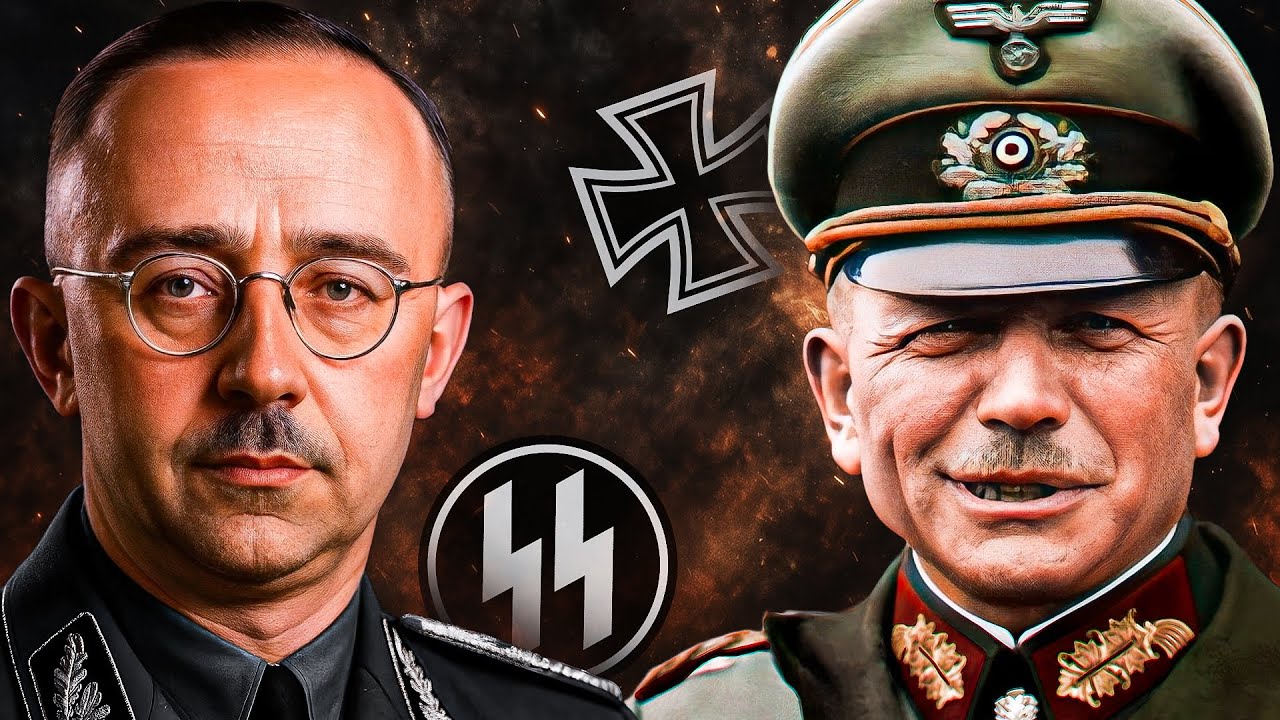
What Did the German Army Really Think of the SS?
The strangest part of the rivalry between the German Army and the SS was not that they hated each other.
It was why.
Years after the Second World War, a comforting story began to spread. According to that version, Germany had possessed two very different armed forces under Adolf Hitler.
There was the Wehrmacht—the professional Army of old soldiers, aristocratic officers, military tradition, polished boots, maps, regulations, and supposedly honorable warfare.
And then there was the SS—the fanatical political force, loyal to Hitler, steeped in Nazi ideology, responsible for terror, mass murder, concentration camps, and crimes that stained Europe.
It was an attractive division.
One side had fought.
The other side had committed atrocities.
And there was just enough truth inside that story to make the lie difficult to see.
Because many German Army officers really did dislike the SS.
Some despised them.
Some mocked them.
Some considered them amateurs in uniforms they had not earned.
Some watched the growing power of Heinrich Himmler’s organization with something close to alarm.
And on battlefields from Poland to France to the Soviet Union, Army officers sometimes found themselves arguing with SS commanders over roads, supplies, prisoners, authority, promotions, equipment, discipline, and who exactly had the right to give orders.
But beneath those quarrels was a question far more dangerous than simple rivalry.
What happened when the traditional German military discovered that Hitler was building another armed force beside it?
And what happened when those two forces realized that, however much they distrusted one another, they were serving the same war?
The answer begins before the first shots were fired.
Long before the Waffen-SS became famous for armored divisions and battlefield propaganda, Germany’s professional officer corps already had a strong sense of who belonged inside the military establishment.
The Army had traditions stretching back through the Reichswehr and the Imperial German Army. Its officers were trained inside a rigid hierarchy. Rank mattered. Education mattered. lineage sometimes mattered. Staff work mattered enormously.
A young officer could spend years learning how to move men, ammunition, horses, trucks, artillery, fuel, food, and communications across a battlefield.
The Army saw itself not merely as an organization.
It saw itself as an institution.
Then the Nazis came to power.
And beside the Army appeared men wearing black.
The SS had begun as Hitler’s personal protection formation. Under Heinrich Himmler, however, it expanded into something far larger and more ambitious.
It developed its own hierarchy.
Its own intelligence structures.
Its own police power.
Its own ideological standards.
Its own armed formations.
And most threatening of all, its loyalty did not run through the traditional military chain of command.
It ran upward toward Hitler.
To a professional officer, that mattered.
An Army general might disagree with another general, but both men belonged to the same institutional world.
The SS belonged to something different.
It was political.
It was ideological.
And it was growing.
At first, some Army officers looked at the armed SS formations with condescension rather than fear.
They had reasons.
The early SS military units lacked the long institutional experience of the Army. Some regular officers considered their training uneven. Their political education seemed excessive. Their commanders were sometimes regarded as men promoted faster than professional standards would normally permit.
The Army had staff colleges.
The SS had ideological loyalty.
The Army had centuries of military mythology behind it.
The SS had Hitler.
Many traditional officers assumed they knew which system would prove superior when real war came.
Then Poland was invaded in September 1939.
And the rivalry left the parade ground.
German forces moved rapidly across the Polish frontier. Mechanized columns pushed forward. Aircraft struck communications and troop concentrations. Roads filled with soldiers, refugees, wagons, prisoners, smoke, horses, and shattered vehicles.
SS formations entered the campaign alongside the Army.
Now regular officers could judge them under fire.
Their conclusions were mixed.
SS troops could display extraordinary aggression.
That impressed some observers.
But aggression was not the same thing as professional competence.
Several Army commanders criticized elements of the SS for tactical mistakes, excessive casualties, inadequate training, or reckless behavior.
To an experienced officer, losing men unnecessarily was not evidence of courage.
It could be evidence of poor leadership.
This became one of the earliest sources of contempt.
The SS presented itself as an elite.
Many Army professionals were not convinced.
Imagine the resentment that created.
A lieutenant who had studied fieldcraft, logistics, artillery coordination, communications, and staff procedure could watch politically favored formations receive attention far beyond their actual experience.
A colonel who had spent decades building a military career could suddenly find men from Himmler’s organization presenting themselves as the ideological future of Germany.
And SS propaganda did not help.
Its members were not merely supposed to be soldiers.
They were presented as a racial and political vanguard.
The implication was obvious.
The Army might be necessary.
The SS was supposedly special.
But then came the first twist.
The Army’s complaints about the SS were not necessarily complaints about Nazi brutality.
That distinction matters.
An officer could condemn an SS unit for poor discipline while accepting the invasion itself.
He could despise political interference while sharing nationalist or antisemitic beliefs.
He could object to unauthorized shootings because they disrupted military order, frightened local populations, endangered discipline, or complicated occupation policy—not because he rejected the Nazi worldview.
The same officer might complain about an atrocity in one village and cooperate with a criminal policy somewhere else.
The boundaries were not clean.
They were constantly shifting.
And in Poland, German soldiers were already operating inside a war that was becoming something more than a conventional conflict between armies.
Behind the front came SS and police formations carrying out political terror and mass killing.
Army officers sometimes protested actions they considered uncontrolled or harmful to discipline.
There were objections.
There were arguments.
There was disgust in some cases.
But there was no institutional break.
The Wehrmacht did not turn its weapons on the SS.
It did not refuse Hitler’s war.
The machine continued moving east.
That fact would become more important with every passing year.
Then, in 1940, Hitler struck west.
France fell with astonishing speed.
The victory transformed the atmosphere inside Germany.
Suddenly, many doubts seemed to disappear beneath triumph.
The German Army had humiliated one of Europe’s great powers.
Hitler’s prestige exploded.
And the armed SS had been part of the campaign.
It had also paid heavily for its aggressiveness.
Once again, Army officers could point to SS casualties and question its tactics.
But something else was changing.
The SS was learning.
Its battlefield formations were gaining experience.
Its commanders were adapting.
Its political influence gave it access to recruitment, publicity, and eventually increasingly valuable equipment.
The organization the Army had once viewed as an ideological sideshow was becoming a genuine military competitor.
That was when contempt began turning into something more dangerous.
Jealousy.
A German officer could tolerate a political formation if it remained small.
It was harder to ignore an organization acquiring artillery, armor, foreign recruits, manpower, and prestige while Germany’s manpower demands were becoming enormous.
The Army needed replacements.
The SS needed replacements.
The Army wanted equipment.
The SS wanted equipment.
The Army wanted the best young men.
The SS wanted them too.
Every expansion of the Waffen-SS raised a question the officer corps could not avoid:
Why did Hitler need another army?
The official answer was never simply military.
The SS represented political reliability.
And political reliability had become extremely valuable in Hitler’s Germany.
Traditional generals carried something dangerous inside their institutions: a memory of Germany before Nazism.
The SS did not.
Its identity was built inside the Nazi system.
Its oath and culture bound it personally and ideologically to Hitler.
If the old military elite ever became unreliable, Hitler possessed another armed pillar.
That possibility hung in the background long before it became obvious.
In June 1941, Germany invaded the Soviet Union.
Operation Barbarossa changed everything.
The war in the East was not planned as an ordinary campaign.
It was presented and conducted as an ideological and racial war.
The Soviet state was to be destroyed.
Political enemies were to be eliminated.
Territories were to be conquered and reorganized.
Millions of people were treated not simply as civilians living behind enemy lines, but through the racial categories of Nazi ideology.
And this is where the popular story of the Wehrmacht and the SS begins to collapse.
At dawn, German soldiers crossed the frontier believing the Soviet Union might fall within months.
Columns advanced through enormous clouds of dust.
Tanks raced past abandoned positions.
Prisoners appeared by the thousands, then tens of thousands, then hundreds of thousands.
Maps that had seemed enormous in headquarters became inadequate for the distances troops were actually traveling.
For a time, victory appeared almost limitless.
Then the killings expanded.
SS Einsatzgruppen followed German armies into Soviet territory.
Their mission was not conventional combat.
They carried out mass shootings of Jews, Communist officials, and others identified as enemies by Nazi policy.
The scale escalated rapidly.
Victims were gathered from homes.
They were marched or driven to execution sites.
Graves were prepared.
Shots echoed from forests, ravines, quarries, and fields.
And the Army was not standing on another continent while this happened.
It was there.
Army commands controlled territory.
Army vehicles moved along the same roads.
Army officers issued orders about security.
Army units guarded areas, handed over prisoners, provided logistical assistance in some cases, and cooperated with SS and police forces in the occupied East.
The relationship varied by commander, place, and circumstance.
There were disagreements.
There were individuals who objected to particular crimes.
But the idea that the Wehrmacht simply fought at the front while the SS committed crimes somewhere behind it does not survive contact with the history.
The two systems overlapped.
That overlap produced one of the darkest paradoxes of the war.
Army officers could still look down on the SS.
They could still call them reckless.
They could still resent their privileges.
They could still criticize their professionalism.
And then the same Army could help create the conditions in which SS murder operations functioned.
Personal dislike did not prevent institutional cooperation.
Rivalry did not create innocence.
The uniforms were different.
The war was the same.
As the campaign continued, another change appeared.
The SS formations fighting at the front became harder for Army commanders to dismiss.
Some Waffen-SS divisions gained reputations for determination under extreme conditions. Their willingness to continue fighting while suffering heavy casualties could be militarily useful, particularly as the war turned against Germany.
Army officers who once saw them as political amateurs began encountering SS units with years of combat experience.
That did not end the rivalry.
It complicated it.
A Wehrmacht commander could simultaneously believe that an SS division was ideologically fanatical, politically privileged, and useful in combat.
He could resent its favored status while requesting its support.
He could criticize an SS commander in private and praise the unit’s resistance during a crisis.
The relationship was no longer simply contempt.
It had become dependence mixed with distrust.
And Hitler encouraged the competition.
The Führer’s political system often worked by creating overlapping authorities.
Different institutions competed for influence.
The Army had one chain of command.
The SS possessed another source of power.
Nazi Party officials had their own interests.
Police structures overlapped with civilian occupation authorities.
Instead of a clean administrative pyramid, the Third Reich often resembled a collection of rival empires trying to anticipate Hitler’s wishes.
For the Army, this could be maddening.
For Hitler, it could be useful.
No institution became secure enough to stand completely independent of him.
And the SS kept growing.
By the middle years of the war, its military arm had expanded far beyond the small prewar formations.
New divisions appeared.
Foreign volunteers and conscripts entered its ranks.
Its propaganda machine celebrated battlefield sacrifice.
Its commanders competed for resources and recognition.
The Army could no longer pretend the SS was temporary.
It had become part of Germany’s military reality.
Then came Stalingrad.
The name changed the psychological temperature of the war.
Until then, setbacks could be described as temporary.
After Stalingrad, the possibility of catastrophe entered German military thinking.
Entire formations disappeared.
Letters stopped arriving.
Families waited for men who would never return.
The Soviet armies that Germany had expected to destroy were advancing west.
Every tank mattered.
Every trained soldier mattered.
Every division mattered.
And this gave the SS even greater leverage.
When a Waffen-SS armored formation arrived in a threatened sector, an Army commander did not have the luxury of rejecting it because he disliked Himmler.
He needed the guns.
He needed the tanks.
He needed men willing to fight.
The rivalry remained.
But survival was stronger.
That did not mean the Army suddenly admired everything about the SS.
In professional military circles, there remained criticism of fanaticism that produced needless casualties. Some officers considered certain SS commanders tactically crude. Others resented what they believed to be preferential access to modern weapons or replacements.
There were arguments over credit for victories.
Arguments over who had failed.
Arguments over orders.
Arguments over prestige.
A battlefield defeat has a way of exposing rivalries that victory can hide.
As Germany retreated, those tensions became sharper.
But so did cooperation.
This is where the story produces its second reversal.
The closer Germany came to defeat, the more politically valuable the SS became to Hitler.
The Army had once viewed it as an intrusion into military affairs.
Now Hitler increasingly viewed traditional military officers with suspicion.
The relationship between the Führer and his generals had been deteriorating for years.
He accused them of lacking faith.
They accused him, usually behind closed doors, of strategic interference.
He demanded that positions be held when commanders wanted to withdraw.
He dismissed senior officers.
He brought others back.
He changed command arrangements.
He increasingly valued ideological obedience alongside military ability.
Every retreat became more than a battlefield movement.
It could be treated as a test of loyalty.
Every request to withdraw risked appearing defeatist.
Every disagreement with Hitler carried political danger.
The SS thrived inside that atmosphere because loyalty was its central claim.
Then, on July 20, 1944, a bomb exploded at Hitler’s military headquarters.
Colonel Claus von Stauffenberg and fellow conspirators attempted to kill him and overthrow the Nazi regime.
The blast failed to kill Hitler.
The consequences were immediate.
Arrests spread.
Trials followed.
Executions followed the trials.
The officer corps, already damaged by years of political interference, now came under a level of suspicion that transformed the relationship between the regime and the military establishment.
For Hitler, the assassination attempt confirmed his deepest fears.
Traditional officers had betrayed him.
And who could be trusted?
The SS.
The organization many Army professionals had once regarded as an arrogant political rival suddenly stood even closer to the center of power.
Imagine the recognition inside a German headquarters in the final year of the war.
Years earlier, an officer might have laughed at the black-uniformed political soldiers.
He might have called them amateurs.
He might have believed the Army’s traditions made it indispensable.
Now officers were being arrested.
SS influence was everywhere.
The regime was collapsing, but the organization the Army had once treated as a junior rival had become one of Hitler’s most trusted instruments for maintaining control.
The sneer had vanished.
In its place was silence.
But the greatest twist was still ahead.
Because after Germany lost the war, the rivalry between the Wehrmacht and SS became useful again.
Very useful.
The Third Reich collapsed in 1945.
Cities were ruins.
German soldiers surrendered by the millions.
Concentration camps were opened.
The evidence of Nazi mass murder horrified the world.
SS leaders faced prosecution.
The SS was formally condemned as a criminal organization at Nuremberg, with legal qualifications concerning membership and knowledge.
For former German military officers, an enormous question now appeared.
What story would they tell about themselves?
Many had an answer.
They emphasized the differences.
The Army had been professional.
The SS had been political.
The Army had followed military orders.
The SS had carried out ideological crimes.
The Army had sometimes quarreled with Hitler.
The SS had worshiped him.
Every real disagreement between the two institutions could now become evidence in a postwar defense.
Every private insult aimed at the SS acquired a new meaning.
Every operational dispute could be retold as moral resistance.
Every distinction could be sharpened.
And the Cold War made parts of this story attractive outside Germany as well.
The Western Allies now faced the Soviet Union.
West Germany was becoming strategically important.
There was interest in understanding the Eastern Front, rebuilding German military capacity in a new form, and incorporating West Germany into the Western security system.
Former Wehrmacht officers wrote memoirs.
They advised historians and military analysts.
They explained battles.
They described Hitler’s disastrous interventions.
Again and again, a familiar picture emerged.
Germany’s soldiers had fought bravely.
Hitler had ruined their strategy.
The SS had committed the crimes.
The Army had been different.
It became known as the myth of the “clean Wehrmacht.”
And it worked because it contained fragments of reality.
Yes, the Wehrmacht and SS had different institutional cultures.
Yes, Army officers sometimes despised SS officers.
Yes, there were disputes over professionalism, authority, recruitment, equipment, and tactics.
Yes, some individual Army officers protested particular atrocities.
Yes, there were military conspirators who ultimately tried to kill Hitler.
All of those things could be true.
And yet the larger conclusion could still be false.
Because institutional rivalry is not the same thing as moral opposition.
That is the moment the entire story flips.
The German Army did not need to love the SS to participate in Hitler’s war.
It did not need to share every aspect of SS ideology.
It did not need to approve of every massacre.
It only needed to keep cooperating.
And it did.
The Wehrmacht helped wage a war of annihilation in the East.
Military authorities participated in brutal occupation policies.
Army units were involved in crimes against civilians and prisoners.
Orders targeting political commissars and other groups moved through military channels.
Soviet prisoners of war died on a catastrophic scale under German custody from starvation, disease, exposure, shootings, and deliberate neglect.
Anti-partisan operations could become massacres in which civilians were treated as enemies.
Jewish persecution and murder occurred in areas under military control and frequently required coordination between different German institutions.
The line separating Army from SS existed on organization charts.
On the ground, it could become frighteningly thin.
Consider what that means for the original question:
What did the German Army think of the SS?
There was never one answer.
Some officers thought SS troops were reckless.
Some thought they were brave.
Some considered them militarily inferior.
Others came to respect particular Waffen-SS formations.
Some resented their political influence.
Some envied their access to resources.
Some hated Himmler’s intrusion into traditional military authority.
Some despised Nazi Party functionaries while remaining loyal to Hitler.
Some objected to atrocities.
Some participated in atrocities.
Some did both at different times.
And many simply adapted.
That last group may be the most important.
History is often easiest to understand when villains announce themselves.
Reality is harder.
Institutions do not always enter criminal systems because everyone inside them becomes an ideological fanatic overnight.
Sometimes professionals convince themselves that politics is somebody else’s responsibility.
They focus on their assignments.
Their promotions.
Their units.
Their supply problems.
Their careers.
Their victories.
Their survival.
A staff officer does not need to love the government to move ammunition.
A railway official does not need to fire a rifle to make a criminal system function.
A commander does not need to personally dig a grave to create conditions in which others fill it.
That is how responsibility spreads.
Piece by piece.
Order by order.
Compromise by compromise.
By 1944 and 1945, even the distinction between professional soldiering and ideological warfare had become increasingly difficult to maintain.
German cities were being bombed.
Soviet forces were advancing into the Reich.
Western Allied armies were crossing Germany’s frontiers.
The regime called for total resistance.
Teenagers and elderly men entered improvised formations.
Deserters could be executed.
Military collapse mixed with political terror.
SS units remained among the forces Hitler considered particularly reliable, although the performance and behavior of Waffen-SS formations varied dramatically.
Some fought with determination.
Some committed atrocities during retreats and counteroffensives.
Some surrendered when defeat became undeniable.
Others continued fighting long after any strategic purpose had disappeared.
The Army was fragmenting at the same time.
Some commanders tried to save their troops by surrendering to Western forces.
Others continued obeying impossible orders.
Some officers hoped to prevent Soviet capture.
Some were still loyal to Hitler.
Some had stopped believing in victory but kept fighting anyway.
The two institutions that had spent years competing were now being crushed inside the same collapsing state.
And there was a bitter irony in that.
The Army had once feared that the SS was becoming too powerful.
But the SS could not save Hitler.
The SS had claimed ideological superiority.
But ideology could not create fuel.
Fanaticism could not rebuild destroyed railways.
Political loyalty could not replace lost air superiority.
Elite status could not reverse overwhelming material defeat.
In April 1945, Soviet forces entered Berlin.
The regime contracted into bunkers, shattered government buildings, underground rooms, and pockets of resistance.
Hitler issued commands to armies that barely existed.
Maps showed units with names larger than their remaining strength.
Telephone calls carried orders across a capital that was physically collapsing.
The system that had demanded absolute obedience reached its logical end: leaders commanding imaginary forces while real soldiers died in streets above them.
Hitler killed himself on April 30.
Germany surrendered days later.
The war was over.
But the battle over memory had just begun.
Former Wehrmacht officers had powerful incentives to place the SS on the other side of a moral wall.
The SS was easy to condemn.
Its symbolism was unmistakable.
Its direct association with racial ideology, concentration camps, police terror, and mass murder was overwhelming.
Its senior leaders had occupied central positions in Nazi criminal policy.
Against that background, an Army officer could point to his field-gray uniform and say, in effect:
We were different.
And there was the trap.
Different did not mean innocent.
A man can despise his accomplice and remain his accomplice.
Two organizations can fight over status while serving the same dictatorship.
They can compete for weapons while participating in the same invasion.
They can insult each other in officers’ clubs and cooperate the next morning.
They can disagree about methods without disagreeing about objectives.
They can even condemn one another’s excesses while committing different crimes themselves.
This is what makes the Wehrmacht-SS relationship so uncomfortable.
If the Army had simply adored the SS, the history would be easier.
If the Army had openly resisted the SS from the beginning, it would also be easier.
Instead, the record contains tension and cooperation at the same time.
Professional contempt existed beside operational dependence.
Institutional jealousy existed beside ideological overlap.
Moral objections from some individuals existed beside participation by others.
And all of it changed depending on the year, the front, the commander, and the situation.
There was no single German soldier looking at a single SS man and delivering history’s verdict.
There were millions of encounters.
A road checkpoint in occupied territory.
A headquarters argument over jurisdiction.
A divisional commander requesting armored support.
An Army officer watching SS police operations behind his front.
A soldier hearing rumors of shootings.
A staff officer signing paperwork.
A general complaining about Hitler.
A train carrying prisoners east.
A field kitchen feeding troops guarding an area where civilians had just disappeared.
A map being marked.
A report being filed.
A promotion being approved.
A village burning.
A photograph being taken.
A man deciding not to ask another question.
And another.
And another.
That is how the neat postwar story comes apart.
Not with one document.
With thousands.
Not with one confession.
With patterns.
For decades, many families preferred the cleaner version.
Grandfather had been in the Army, not the SS.
The sentence sounded like an acquittal.
Sometimes it was an important distinction. Membership in different organizations could mean very different experiences and degrees of responsibility. Millions of Wehrmacht personnel were not personally guilty of the same acts, and individual conduct varied enormously.
But the institutional history could not be reduced to the innocence of every individual soldier.
As historians examined military orders, occupation records, correspondence, photographs, trial evidence, and unit documents, the broader picture became impossible to ignore.
The Wehrmacht had not merely been standing beside Hitler’s criminal war.
It had helped make that war possible.
That does not erase the difference between the Army and the SS.
It makes the difference more disturbing.
Because the real lesson is not that everyone was identical.
The lesson is that people and institutions do not have to be identical to become partners.
The Army brought professional military expertise.
The SS brought ideological commitment and an expanding apparatus of political and racial violence.
At times they competed.
At times they obstructed one another.
At times they cooperated seamlessly.
And when German conquest opened enormous territories to Nazi rule, those capabilities could reinforce each other with catastrophic consequences.
The SS needed territory to operate.
The Army conquered territory.
The Army needed rear areas secured.
SS and police organizations operated in those rear areas.
The military needed transportation.
The state coordinated transportation.
Occupation authorities needed information.
Police and intelligence networks provided it.
One institution could always tell itself that another institution was responsible for the ugliest part.
That division of labor became a form of moral camouflage.
And perhaps that is the final plot twist.
The rivalry itself helped create the myth.
Because the Army and SS genuinely disliked each other in many circumstances, survivors could later present that dislike as proof of opposition.
But imagine two men robbing the same house.
They argue constantly.
One thinks the other is reckless.
The second thinks the first is arrogant.
They fight over the car.
They fight over the money.
They insult each other.
One even believes the other uses unnecessary violence.
But both entered the house.
Both benefited from the robbery.
Both helped one another escape.
Their hatred does not erase their cooperation.
In Nazi Germany, the stakes were infinitely greater.
By the time the Third Reich collapsed, millions of people had died across a continent transformed by invasion, occupation, starvation, forced labor, deportation, shooting, bombing, disease, and industrialized murder.
The Wehrmacht and SS did not carry equal responsibility for every crime.
They were not interchangeable organizations.
But neither can their rivalry be used to wash one side clean.
The traditional officer who sneered at the SS recruit in 1939 could believe he belonged to a superior military culture.
Five years later, he might find himself requesting help from an SS armored formation while retreating from an enemy his government had invaded.
Then, after the war, he might remember the original sneer.
Perhaps that memory became important.
Perhaps he remembered how crude the SS had seemed.
How political.
How fanatical.
How unlike the Army he had known.
Perhaps he remembered every argument.
Every insult.
Every moment of tension.
And perhaps those memories were all true.
But outside the window of memory lay the part that was harder to explain.
The shared roads.
The shared offensives.
The shared occupation.
The prisoners.
The orders.
The civilians.
The graves.
That is why the question “What did the German Army think of the SS?” cannot be answered with a simple word like hatred, admiration, rivalry, or fear.
The answer changed over time.
Before the war, many professional soldiers saw SS armed units as political intruders.
During the early victories, they often criticized their training and casualties while watching them gain prestige.
As the war expanded, resentment grew over manpower, weapons, authority, and Hitler’s favor.
On the Eastern Front, the relationship became inseparable from a war in which both military operations and ideological violence worked together.
As Germany began losing, battlefield necessity forced closer cooperation.
After the July 1944 assassination attempt, Hitler’s distrust of the traditional officer corps increased while the political importance of the SS became even clearer.
And after defeat, the old rivalry became a convenient foundation for a new story:
The SS had been criminals.
The Army had merely been soldiers.
For a while, much of the world accepted that distinction more easily than it should have.
Then the documents kept speaking.
Orders survived.
Reports survived.
Photographs survived.
Testimony survived.
The dead had left evidence behind.
Piece by piece, the comfortable wall between the two institutions cracked.
And behind it was a truth more frightening than the idea of one uniquely evil organization operating inside an otherwise normal state.
A modern dictatorship does not commit crimes on a continental scale through fanatics alone.
It needs professionals.
Administrators.
Drivers.
Engineers.
Officers.
Clerks.
Railway workers.
Quartermasters.
Judges.
Police.
Soldiers.
People who may dislike one another intensely but still perform their assigned role.
That is the historical warning hidden inside the Wehrmacht’s relationship with the SS.
The most dangerous sentence is not always:
“I believe in this.”
Sometimes it is:
“This is not my responsibility.”
A commander worries about the front.
A police officer worries about security.
A bureaucrat worries about paperwork.
A railway official worries about schedules.
A soldier worries about orders.
Everyone looks at the next institution and tells himself that the moral responsibility belongs there.
And when the system finally collapses, each person can point sideways.
That was them.
Not us.
But history eventually asks another question.
Who made it possible?
In the end, the German Army’s opinion of the SS mattered less than the decisions both institutions made when they were given power over other human beings.
Contempt did not stop cooperation.
Professional pride did not stop criminal orders.
Institutional rivalry did not stop conquest.
And private disagreement did not automatically become resistance.
The SS did not need the Army’s affection.
It needed roads, territory, logistics, prisoners, cooperation, silence, and a state willing to unleash violence.
The Army did not need to become the SS.
It only needed to keep fighting Hitler’s war.
And for almost six years, despite jealousy, distrust, arguments, and occasional open hostility between individuals and organizations, that is exactly what happened.
The final image is not two German uniforms facing one another.
It is two uniforms facing outward.
Toward occupied Europe.
Toward the people trapped beneath their power.
That is the detail the postwar myth tried hardest to push out of the frame.
And once you put it back, the entire photograph changes.
Because history’s most unsettling accomplices are not always friends.
Sometimes they despise each other.
Sometimes they compete.
Sometimes they privately insist they are nothing alike.
And then, when the order comes, they move in the same direction.
That is why the real question is not whether the Wehrmacht hated the SS—it is how much evil can be accomplished when people who hate each other still agree to serve the same machine.


