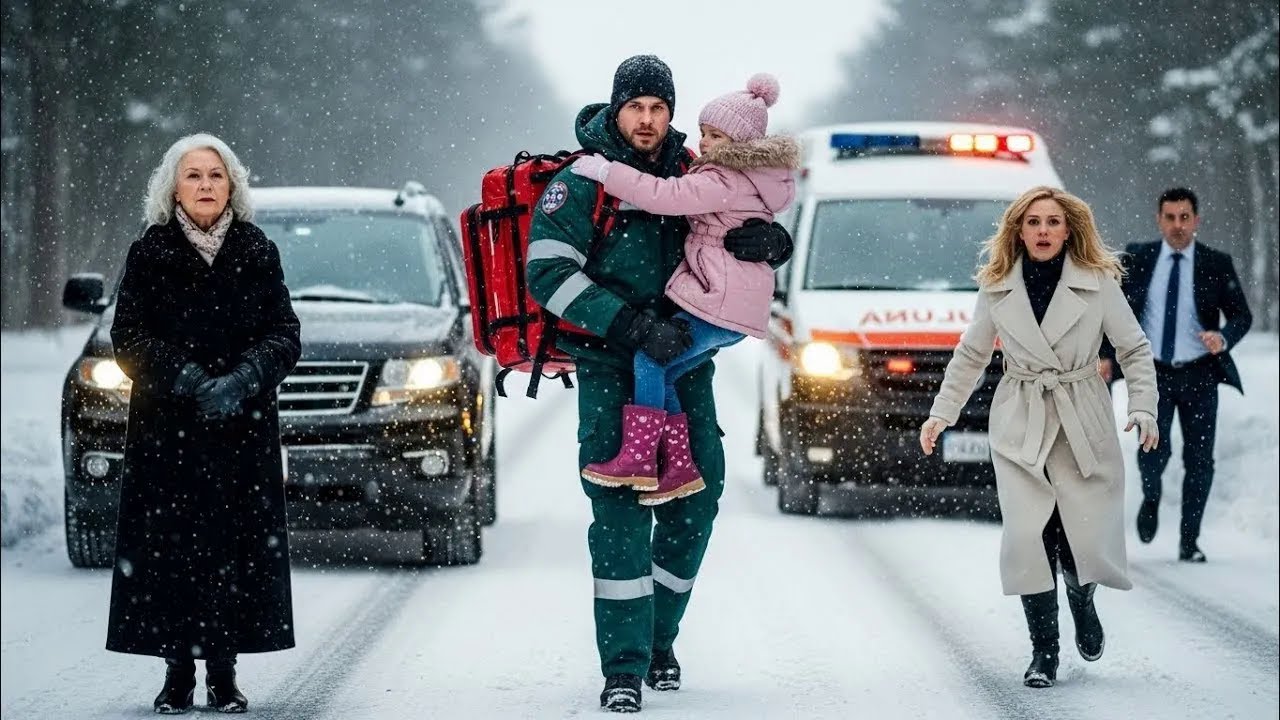
The third vibration reached Marcus Webb’s chest before his brain caught up. He was mid-serve, three plates balanced along his forearm, and the phone in his apron pocket was buzzing like it knew something he didn’t. He set the plates down at table seven, forced a smile, and slipped into the back hallway near the supply closet. Three missed calls from Bright Futures Daycare.

He was already dialing when the door swung shut. “Marcus. ” Ms. Patterson’s voice was tight.
“Eli collapsed during quiet time. He’s running a fever of 104. We’ve tried your mother four times and can’t reach her. You’re listed as the secondary contact.
”
“Is he conscious? ”
“Yes, but he’s asking for you, and with his history—”
“I’m coming,” Marcus said. “Right now. ”
He hung up and stood still for three seconds.
The diner washed over him—dishes clattering, someone laughing at the counter, the cook calling an order number. He thought about the lunch rush with forty minutes left, about his three open tables, about the manager who had no patience for exceptions. Then he thought about Eli. He untied his apron, hung it on the hook, and walked out into the rain.
Eli Webb was six years old and had never had an easy day in his body. A congenital heart defect had required surgery before his first birthday. At three, he was diagnosed with moderate asthma. For Eli, a fever wasn’t just a fever.
It was a door that could open into something much darker fast. Marcus had learned that the hard way. He’d been the one at every doctor’s appointment their mother couldn’t make, the one who stayed up all night with a hand on Eli’s chest just to feel it rise and fall. He ran four blocks to the daycare.
Eli sat on a plastic chair near the front desk, small and pale, his dark eyes glassy with fever, his small hands folded in his lap like he was trying hard to be brave. When he saw Marcus, his whole face crumpled with relief. “You came,” Eli said, his voice hoarse. “I always come,” Marcus said.
He crouched, pressed the back of his hand to Eli’s forehead, and checked his breathing. His chest was moving unevenly. Marcus signed the release form, grabbed Eli’s emergency medical bag from Ms. Patterson, and pulled the boy up against his chest.
Eli’s arms locked around his neck. His head dropped onto Marcus’s shoulder with the full weight of exhaustion. Marcus curved his body forward to shield the boy from the rain and started walking. The nearest urgent care that accepted their insurance was six blocks away.
The bus wouldn’t come for another forty minutes. Marcus had no car and had never had a car. He had $112 in his checking account and a terminated job he didn’t know about yet. He walked, head down, rain pouring off his shoulders.
Two blocks from the clinic, his phone rang. Derek Simmons had managed Carver’s Diner for nine years. He wasn’t a cruel man—he was something worse: a man who’d confused rigidity with fairness for so long he could no longer tell the difference. “Marcus.
” His voice was flat and clipped. “You walked off my floor in the middle of a lunch rush. ”
“My brother collapsed, Derek. He has a heart condition.
I’m taking him to urgent care. ”
“You don’t walk off a shift without authorization. That’s in the handbook. ”
“I didn’t have time to—”
“You’re done, Marcus.
Don’t come back for your next shift. I’ll mail your last check. ”
The line went dead. Marcus stood on the wet sidewalk, rain hitting the back of his neck, Eli breathing in shallow, uneven rhythms against his shoulder.
He put the phone in his pocket and kept walking. Eleanor Voss had not planned to be in Augusta that afternoon. At seventy-one, she was the founder and controlling shareholder of Voss Capital Group, a private equity firm managing roughly $4 billion. She’d grown up forty miles outside Augusta, the daughter of a tobacco farmer who lost the farm to a flood when she was twelve.
She’d built her fortune over four decades through a particular talent: finding people whose character revealed itself in the quiet, costly moments when no one was watching and doing the right thing had a real price attached to it. She’d stopped at the strip mall to take a call. When the rain intensified, she walked into Carver’s Diner, took the corner booth, and ordered black coffee. She was on her second cup when Derek Simmons came out of the back office and announced that Marcus Webb had been terminated.
He said some people thought having a family was an excuse to treat their job like an option. He said he ran a business, not a daycare. He said it with the satisfied expression of a man who believed he’d just made a principled stand. Eleanor wrapped her hands around her coffee cup and said nothing.
Then she looked out the window. Through the rain-blurred glass, she saw a young man in a soaked blue apron, moving with urgent purpose along the sidewalk outside. He was carrying a small child pressed against his chest. His whole upper body curved forward like a shield, trying to keep the rain off the boy’s face.
His clothes were drenched, his shoes dark with water, but his steps were even and deliberate. He didn’t look like someone who had given up. He looked like someone who had already decided. Eleanor watched until they disappeared around the corner.
Then she set down her coffee cup, took out her phone, and made two calls. The urgent care clinic on Broad Street saw Eli within twenty minutes. The diagnosis was a severe respiratory infection compounded by a fever spike—dangerous for any child, particularly serious given Eli’s cardiac history. The attending physician told Marcus he’d made the right call.
Another hour, and they’d have been looking at a hospital admission. Eli got a breathing treatment, two medications, and a juice box. He fell asleep on the exam cot with Marcus sitting beside him, one hand resting lightly on the boy’s back. The bill was $340.
Marcus stared at it for a long time. He did the math three different ways, hoping one of them would come out differently. None of them did. He had $112.
His next paycheck was no longer coming. He thought about calling his mother, then decided against it. She was already at work, with no way to get to him and no money to spare. He folded the bill and put it in his pocket.
He was still sitting there, staring at the waiting room wall, when the door opened and a woman walked in. Early seventies, silver hair pulled back, a gray coat that looked expensive without announcing itself. She scanned the room once and sat down directly across from him. “Your name is Marcus Webb?
”
“Yeah. ” He straightened slightly. “Do I know you? ”
“No.
I was at the diner when your manager announced he’d fired you. ” She paused. “I was also at the window when you walked past carrying your brother. ”
Marcus looked away.
His jaw tightened. “I don’t need anybody feeling sorry for me. ”
“I’m not here because I feel sorry for you,” she said. “I’m here because I’ve spent fifty years trying to find people who make the right decision when it’s expensive—and I watched you do that today.
”
He looked back at her. “I have a regional office here in Augusta,” she continued. “I need people who show up, not people who follow handbooks. ”
She placed a business card on the chair beside him.
“Come in on Thursday at nine. Ask for Sandra at the front desk. ”
She stood. She looked once toward the exam room where Eli was sleeping.
“How is he? ”
“He’ll be okay,” Marcus said. “Thanks to—” He stopped. “Thanks.
”
Eleanor nodded once and walked back out into the rain. Marcus showed up on Thursday at 8:47 in a pressed dress shirt and the only pair of slacks he owned. He sat across from three senior managers and answered every question directly. He talked about Eli, about his mother, about what it meant to be responsible for people who depended on you.
He was offered the position of operations coordinator trainee before the week was out. The salary was more than four times what Carver’s Diner had paid him. Derek Simmons lasted eleven more days as manager of Carver’s Diner. The property group that handled the restaurant’s lease renewal—quietly connected to Voss Capital’s real estate holdings—initiated an unscheduled compliance review.
Derek resigned before it concluded. Nobody who’d been in that diner was surprised. Six months later, Marcus sat across from Eleanor Voss in her fourteenth-floor office overlooking the Savannah River. The Georgia sky outside was enormous and impossibly blue.
“Why did you really do it? ” he asked. “You could have just kept drinking your coffee. ”
Eleanor was quiet for a moment.
“When I was twelve years old,” she said, “my father carried me on his back through two miles of floodwater to get me to dry ground. We lost the farm that year. We lost almost everything. ”
She looked out the window.
“But he put me on his back first—before he tried to save anything else. ”
She paused. “I’ve been looking for people like that my whole career. People who carry others first.
”
Marcus didn’t say anything for a long moment. He looked down at his hands. Those hands had carried Eli through the rain, through the fear, through the cost of doing what was right. It wasn’t a weakness.
It had never been a weakness. Eli started second grade that September. He wore a brand-new backpack covered in rocket ships, a gift left anonymously at their door. He walked into school with his chest out and his chin up, the way his brother had taught him.
Marcus watched him through the school gate and thought about rain, and about the people who carry others first.