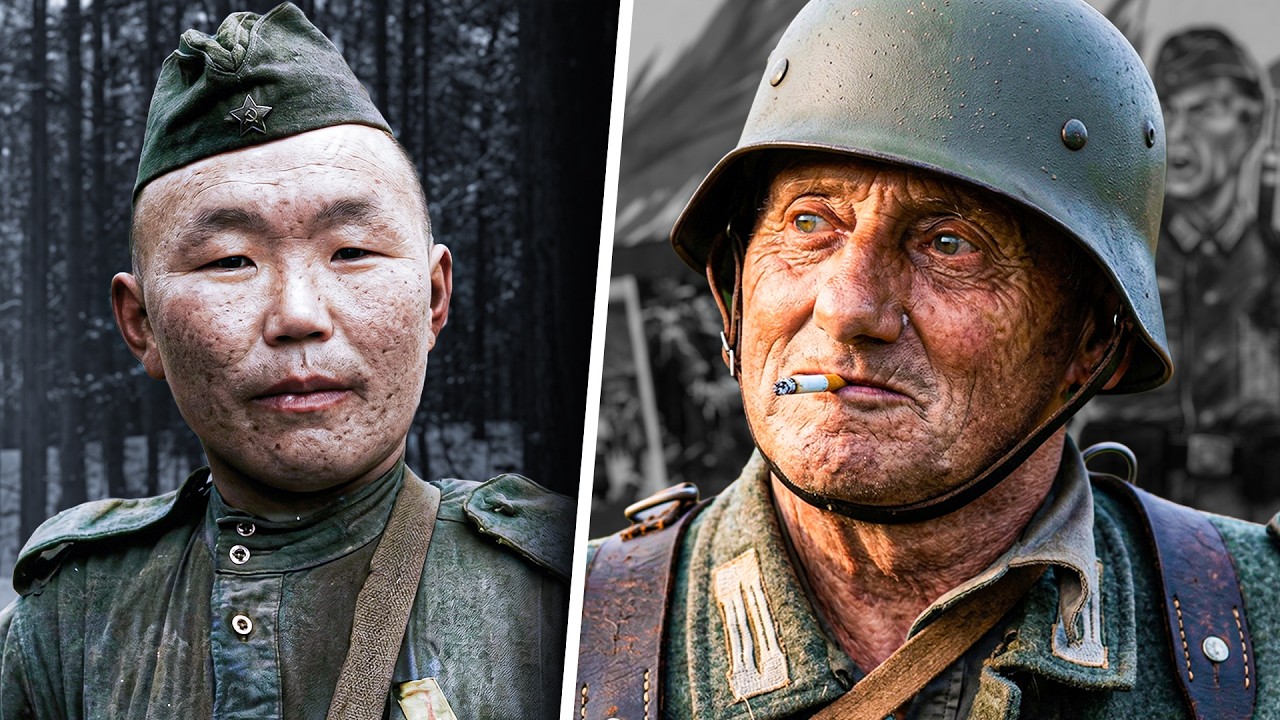
What Did German Soldiers Really Think of Soviet Soldiers?
On the morning of June 22, 1941, thousands of German soldiers crossed the Soviet border with a confidence that would later haunt their memories for the rest of their lives.
They marched beneath clear skies.
Their tanks rolled forward in endless columns.
Their officers carried maps showing a war that, according to Berlin, would be finished within weeks.
The name of the operation was Barbarossa.
And almost everyone wearing a German uniform had been told the same thing:
The Red Army was a broken force.
The Soviet soldier was poorly trained.
The Soviet command structure was weak.
The Soviet people were exhausted by Stalin’s rule and would collapse under the pressure of a powerful German offensive.
Many German soldiers believed they were not entering a difficult war.
They believed they were walking into the final chapter of a victory already written.
But somewhere on the dusty roads of Eastern Europe, inside abandoned villages, frozen forests, and burning cities, something unexpected began to happen.
The German soldiers started discovering that the enemy they had been taught to underestimate did not exist.
The Soviet soldier they met on the battlefield was not the helpless figure described in propaganda.
He was stubborn.
Creative.
Capable of extraordinary endurance.
And sometimes terrifyingly determined.
The first shock came only days after the invasion began.
A German infantry officer named Otto remembered seeing Soviet troops retreating in disorder. At first, he thought the predictions were coming true.
The Red Army was collapsing.
Then his unit approached a small Soviet defensive position.
There were only a handful of Soviet soldiers left.
The Germans expected surrender.
Instead, the soldiers fought until the position was completely destroyed.
They had no hope of escape.
No possibility of reinforcement.
No chance of survival.
Yet they continued firing.
When German troops finally reached the position, they found wounded Soviet soldiers still holding weapons.
The scene confused them.
These men were supposed to be defeated.
They were supposed to run.
But they had chosen to fight until the end.
That was the first crack in the illusion.
The German Army had entered the Soviet Union expecting a short campaign.
Instead, they encountered an enemy who refused to disappear.
At the beginning of Operation Barbarossa, the German military machine was considered one of the most powerful forces in the world.
The Wehrmacht had crushed Poland.
It had defeated France in an astonishingly short campaign.
German generals believed they had perfected modern warfare.
The strategy was simple:
Break the enemy quickly.
Destroy their command.
Capture their major cities.
Force surrender.
And at first, everything appeared to confirm their beliefs.
German forces advanced hundreds of kilometers.
Entire Soviet armies were surrounded.
Thousands of Soviet soldiers were captured.
German newspapers celebrated enormous victories.
Inside the German ranks, confidence grew.
Some soldiers wrote home describing the Soviet Union as a chaotic and primitive country.
They described Soviet equipment as outdated.
They mocked Soviet officers.
They believed the war would be over before winter arrived.
But they had misunderstood one critical thing.
The Soviet Union was not only an army.
It was a massive country with millions of people who had nowhere left to retreat.
Behind every destroyed Soviet unit was another formation.
Behind every captured city was another defensive line.
The deeper German troops moved, the more they realized they were not fighting a collapsing enemy.
They were fighting a nation absorbing unimaginable damage and continuing to fight.
The first major surprise was the Soviet tank force.
German soldiers had been told that Soviet technology was inferior.
Then they encountered the T-34 tank.
When German tank crews first saw it, many were shocked.
The vehicle was fast.
Its armor was difficult to penetrate.
Its design allowed it to move through mud and snow where German vehicles struggled.
German commanders who had expected easy victories suddenly found themselves facing machines they could not easily destroy.
One German officer described the experience as a “technical awakening.”
The enemy they had been laughing at possessed weapons that could challenge them.
But the real surprise was not the equipment.
It was the people operating it.
German soldiers began noticing something uncomfortable.
The Soviet Army was adapting.
Quickly.
Every time German forces developed a successful tactic, Soviet commanders learned from it.
Every defeat produced a new response.
The Red Army was not the frozen, incompetent force described in Nazi propaganda.
It was changing in front of them.
Then came the battle for Moscow.
German troops reached the outskirts of the Soviet capital believing victory was close.
They could see the towers of Moscow in the distance.
Some soldiers packed souvenirs, expecting to enter the city soon.
Others wrote letters home saying the war was almost finished.
Then the weather changed.
The temperature dropped.
And the battlefield transformed into something German soldiers had never experienced.
Engines froze.
Weapons malfunctioned.
Vehicles became useless.
Men who had defeated entire European armies found themselves fighting not only Soviet troops but also a brutal environment.
The Germans had prepared for victory.
They had not prepared for a Russian winter.
But the Soviet soldiers had.
Many had winter clothing.
They knew the terrain.
They had adapted their tactics.
They moved through forests and snow with a confidence that surprised German troops.
Suddenly, the army that had seemed unstoppable was forced into survival.
German soldiers who once mocked Soviet forces began writing different letters home.
The enemy was no longer described as weak.
The words changed.
“Determined.”
“Relentless.”
“Dangerous.”
The image of the Soviet soldier was being rewritten.
But perhaps the biggest psychological transformation came in the cities.
Especially in Stalingrad.
Before the battle, German commanders believed urban warfare would favor them.
They had experienced victories across Europe.
They had superior training.
They had experienced officers.
But Stalingrad became something completely different.
It was not a traditional battle.
It was a fight for every building.
Every staircase.
Every room.
Every meter of destroyed ground.
German soldiers entered buildings believing they had captured them.
Then they discovered Soviet troops hiding in basements.
They secured streets.
Then Soviet snipers appeared from ruins.
They destroyed defensive positions.
Then another group of Soviet soldiers emerged from the rubble.
The city itself became a weapon.
German soldiers began describing Soviet defenders with a mixture of frustration and admiration.
They hated fighting them.
But they could not deny their ability.
A German infantryman wrote that the Russians were “like ghosts.”
They appeared where nobody expected.
They disappeared before they could be destroyed.
The Soviet soldier was no longer the enemy from propaganda posters.
He was a professional survivor.
Then came another surprise.
German soldiers discovered that the Soviet Union was not only sending men to fight.
It was also sending women.
At first, many German soldiers dismissed reports of female Soviet fighters.
They assumed it was propaganda.
Then they encountered them.
Female snipers.
Female pilots.
Female soldiers operating alongside men.
The most famous examples were Soviet women who flew night bombing missions in outdated aircraft, attacking German positions under the cover of darkness.
German troops called them the “Night Witches.”
The nickname was not created from respect.
It came from fear.
The sound of their aircraft approaching at night became a psychological weapon.
German soldiers could not understand how these pilots continued attacking despite the danger.
The idea that women could become such effective combatants challenged many assumptions they had carried into the war.
The enemy was becoming harder to categorize.
Every belief they had brought with them was being tested.
But the greatest transformation happened quietly.
Not on battlefields.
Inside the minds of ordinary soldiers.
Private letters.
Personal diaries.
And later recordings captured a dramatic change.
The soldiers who once described Soviet troops with arrogance began describing them with caution.
The enemy had become human.
This was perhaps the most powerful defeat of Nazi ideology.
Because propaganda depended on creating a simple image.
The Soviet soldier was supposed to be inferior.
Less capable.
Less disciplined.
Less human.
But war placed German soldiers face-to-face with reality.
They saw courage.
They saw sacrifice.
They saw intelligence.
They saw ordinary people fighting under extraordinary circumstances.
The battlefield destroyed the distance created by propaganda.
Yet there was one more twist.
The German military leadership had also underestimated something else.
The Soviet Union was willing to endure losses on a scale Germany considered impossible.
German commanders often measured victory through immediate military results.
They captured territory.
They destroyed formations.
They counted prisoners.
But they failed to understand the deeper reality.
The Soviet Union could replace losses.
Factories were moved thousands of kilometers away.
New armies were formed.
New commanders emerged.
The longer the war continued, the stronger the Soviet response became.
The German Army had entered believing it was racing against time.
Instead, time became its enemy.
Every month strengthened the Soviet ability to fight.
Every battle taught the Red Army something new.
Every German victory brought them closer to exhaustion.
The soldiers on the ground began realizing something their leaders refused to accept.
This was not the quick campaign they had been promised.
This was a war of survival.
By 1943 and 1944, the balance of power had completely changed.
German soldiers who once marched east with confidence were now retreating west.
The same roads that had carried victorious armies were filled with exhausted troops trying to survive.
The Soviet soldier they once mocked was now advancing toward them.
And many German soldiers had developed a complicated feeling.
They still considered themselves enemies.
They still fought each other.
But the old contempt had disappeared.
In its place was something different.
Recognition.
The Soviet soldier had earned their respect through years of brutal combat.
Not through speeches.
Not through propaganda.
Through action.
Near the end of the war, a captured German officer reportedly sat across from Soviet soldiers who had defeated his unit.
Years earlier, he would have imagined them as primitive and incapable.
Now he looked at them differently.
The men sitting across from him were not the stereotypes he had been taught to believe.
They were soldiers who had survived battles that destroyed entire armies.
They had endured hunger, freezing temperatures, and unimaginable losses.
They had fought because they believed they had no other choice.
The officer’s expression changed.
The confidence was gone.
The certainty had disappeared.
In that silent moment, the reality of the war became impossible to ignore.
The people he had underestimated had become the force that defeated him.
History often remembers armies through numbers.
Tank counts.
Division sizes.
Territory gained.
Territory lost.
But wars are also fought inside human minds.
The German soldiers who invaded the Soviet Union in 1941 carried with them an image of their enemy created by ideology.
Within four years, that image had been shattered by experience.
They learned that courage does not belong to one nation.
Discipline is not determined by propaganda.
And the strength of an army is not always visible before the battle begins.
The Soviet soldier was not the enemy Germany expected.
He was something far more dangerous:
An enemy who refused to surrender.
And perhaps the most important lesson from the Eastern Front was not about weapons, generals, or strategies.
It was about arrogance.
Because the most dangerous mistake any army can make is believing it already understands the people standing against it.
The German soldiers crossed into the Soviet Union believing they were marching toward an easy victory.
Four years later, they were leaving behind a battlefield that had destroyed their confidence, their assumptions, and their understanding of what an enemy could truly be.
History proved something they learned too late:
The soldiers you underestimate today may be the ones who decide your fate tomorrow.


