The garage smelled like motor oil and coffee that had gone cold somewhere around noon. Jake Carlo didn’t notice anymore. He’d stopped years ago. Three bays, two lifts, a parts wall he’d organized twice, and Donna Marsh at the front desk—sixty-three, seen everything twice, running the whole operation with quiet authority.
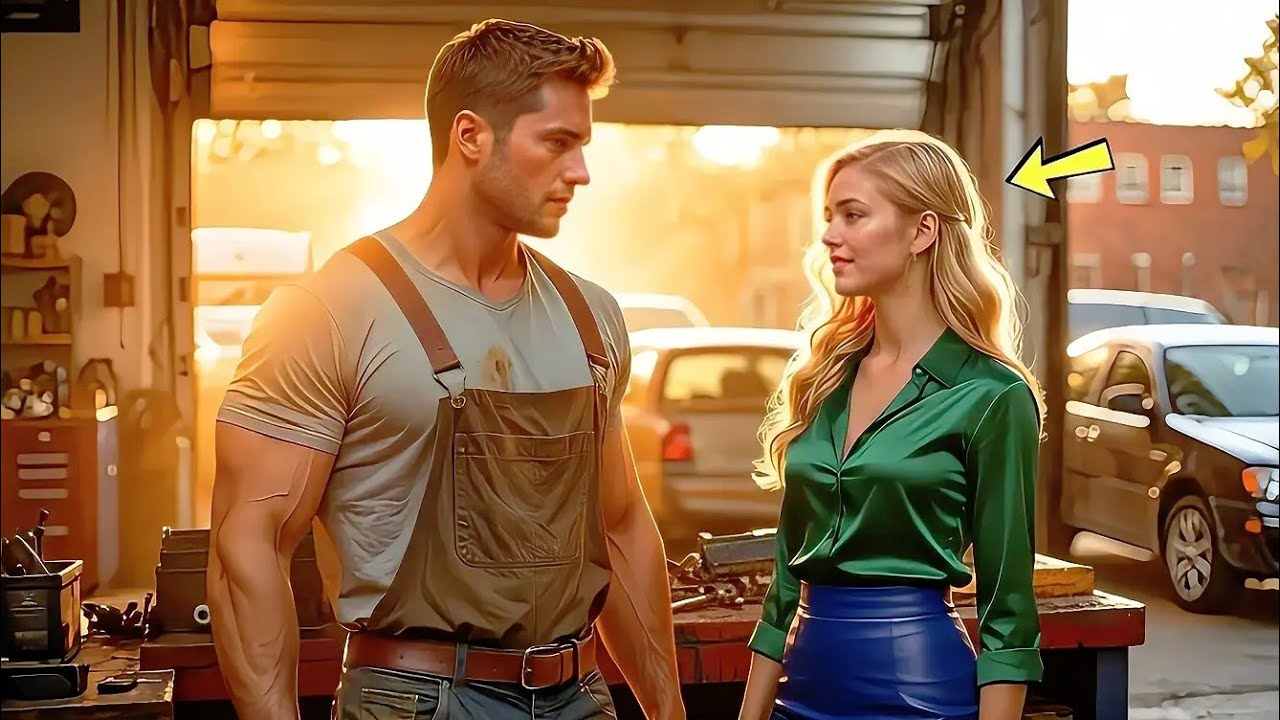
He was elbow-deep under a Ford pickup on a Tuesday afternoon in October when he heard the heels. Click. Click. Click.
Sharp and deliberate on the concrete. Maplewood, Ohio wasn’t a town where people wore heels on Tuesday. Population twelve thousand, best apple butter in the state, and the loudest thing on Main Street was usually football practice two blocks over. Jake slid out from under the truck.
She walked through the open bay door like she owned the building and was deciding whether to keep it. Blonde hair catching the late sunlight. A white silk blouse that probably cost more than his monthly insurance payment. Deep crimson skirt.
Heels with no business within fifty miles of a garage floor. She stopped in front of the black Mercedes in Bay Three. “Is this fixable? ”
No greeting.
No preamble. Jake stood, wiped his hands on his rag. “Everything’s fixable. Real question is whether it’s worth it.
”
She turned and looked at him directly. Light gray eyes. Extremely alert. “That’s a philosophical answer for a mechanic.
”
“And that’s a condescending observation for someone whose rear axle is destroyed. ”
Something moved across her face. Not anger—more like she’d run a quick internal calculation and come out surprised. “Fair.
I’m Natalie. ”
“Jake. ” He nodded toward the Mercedes. “Rear axle’s your main problem.
Also brake line issues, and your transmission fluid looks like someone poured chocolate milk in there. This car’s been ignored for a long time. ”
“I’ve been busy. ”
“Busy enough to drive around with brake lines that could’ve given out at highway speed.
”
She held his gaze. Then he printed the quote and handed it across. She looked at it for three seconds. No wince, no sharp breath, no haggling.
She just nodded and reached for her phone. Two calls later, the picture cleared. Her assistant was in Chicago. Her driver was stranded with the car.
No ride shares within forty minutes. She hung up and stood in his garage with the particular stillness of someone who was used to problems solving themselves. “Is there a decent hotel in this town? ” she asked.
“Riverside Inn. Mile down Main Street. Clean, good breakfast. ” He leaned against the workbench.
“You also picked an interesting weekend. Town does the harvest festival starting Friday. Live music, food, vendors. Pretty big deal around here.
”
“A harvest festival. ”
“Haven’t been to anything like that since I was maybe eight. ”
“Then you’re overdue. ” He kept his voice easy.
“You’re going to be here two days minimum. Might as well see what the town looks like when it’s alive. ”
She tilted her head. “Is that an invitation?
”
“Practical observation. Garage will still be here if you’d rather stand in it. ”
Something that was almost a smile appeared at the corner of her mouth. “What time?
”
“Friday. ”
Jake spent Wednesday and Thursday telling himself firmly that it was not a date. He was being a decent human being toward someone stranded in an unfamiliar town. Community.
Basic decency. That was all. Donna watched him reorganize the socket wrench display Thursday morning, then reorganize it again twenty minutes later. She said absolutely nothing, just drank her coffee with the tranquil expression of someone who had waited out many things and would wait out many more.
“Don’t,” Jake said without looking at her. “I haven’t said a word. ”
“You’re thinking entire paragraphs. ”
“She called this morning to check on the repair timeline.
Asked very specific questions about the axle replacement. She knows what she’s talking about. ”
Lots of people know about cars. Lots of people pretend to know about cars.
“She actually does. ”
Donna picked up the phone. “I told her you’d have it done by Sunday morning. She said that was fine.
” A pause. “She asked what your favorite spot in town was. I told her about the lake. ”
Friday evening, Natalie arrived at six exactly.
Dark jeans, soft camel-colored jacket, hair down. The corporate precision was still there, but the hard surface was gone. She looked like a person who had decided to put down whatever she carried, at least for one evening. They walked into the festival together.
String lights between lampposts. Kettle corn and wood smoke. A bluegrass band setting up near the square. Children running between adults’ legs.
Old couples moving slow, nowhere to be and no intention to hurry. She didn’t pull out her phone. She didn’t comment. She just looked.
He bought her a caramel apple from the Miller farm stand. She ate the whole thing, unhurried. They stopped at a woodworking stall, where she asked the craftsman three questions about his joinery technique that were better informed than his usual customers managed. She bought a small hand-carved bowl and carried it under her arm the rest of the evening like she’d owned it for years.
They settled on a bench near the music stage with hot apple cider. “You’re different than I expected,” she said. “How so? ”
“I expected someone quieter.
More closed off. ” She wrapped both hands around her cup. “Men who do physical work all day and don’t talk about it much—in my experience, they tend to keep everything else locked up too. ”
“Maybe around people who make them feel like they should be.
”
She looked at him sideways. “Is that about me? ”
“General observation. ”
“It felt specific.
”
“Most true things do. ”
She was quiet for a moment. The banjo rang out bright and clean. A few couples moved onto the open area in front of the stage.
“People are usually either intimidated by me or performing for me,” she said, not complaining, just stating a fact. “You’ve done neither. ”
“Should I be doing one of them? ”
“God, no.
It’s the most refreshing thing that’s happened to me in months. ”
They stayed until the music ended at ten. She laughed twice. Real laughs, unguarded, the kind that arrived before she could decide whether to let them.
Once at a story about Cody and the wrong car. Once at herself, when she caught her heel in a cobblestone gap, grabbed his arm, and stood there half a second longer than the situation required. He walked her to the Riverside Inn. They stood on the front porch in the quiet.
“Tomorrow? ” he asked. “Tomorrow. ”
Saturday morning, he drove her to Crescent Lake in his truck with the windows cracked, a thermos of coffee, the radio low.
The trees along the county road had gone full October, burning orange and red, gold that seemed lit from inside. She sat with her arm resting on the door, watching the landscape move past, no need to fill the silence. At the lake, they sat on the tailgate and talked for three hours. He told her about the army, four years as a vehicle mechanic, two deployments.
Coming home to a country that had continued without him. The divorce—not the details, just the shape of it, the way it had quietly taken apart something he’d thought was solid. How the garage had given him back something he hadn’t known he was missing: the simple, reliable satisfaction of a problem with a real solution. She told him about starting her company at twenty-six with two clients, a borrowed office, a business plan rewritten eleven times.
The hundred-hour weeks. The deals that fell through and the ones that didn’t. Board meetings where she was the youngest and the only woman, having to be twice as precise just to be taken equally seriously. The slow accumulation of success that gave her everything she’d aimed for and left her with the feeling that something was still missing.
“Are you happy? ” he asked, direct, no softening. She thought about it genuinely. “I’m proud.
I’m proud of what I built. And I’m very, very tired. I’m not sure those two things are supposed to coexist the way they do in my life. ”
“They can.
But you have to build in the rest. It doesn’t come by itself. ”
“Is that what this weekend is? Rest?
”
He looked at the lake. A heron stood motionless at the far edge, waiting. “I don’t know what this weekend is. But whatever it is, it seems like you needed it.
”
She was quiet for a long time. “Yes. I really did. ”
The thermos went cold.
Neither of them noticed until the drive home. Sunday morning, eight a. m. , the car was ready.
She came at nine, back in the silk blouse and leather skirt, armor reassembled, ready to return to her world. He walked her through everything: new axle, replaced brake lines, full transmission service, a cracked serpentine belt he’d caught on deep inspection. She listened carefully, asked three questions, understood the answers without needing them translated. He held out the keys.
She didn’t take them right away. “I should tell you who I am. ”
“You told me Natalie. ”
“Natalie Reed.
Founder and CEO of Reed Capital Group. We manage around four billion dollars across twelve states. I have a driver, a personal assistant, a private chef, and an apartment in Manhattan that costs more per month than most people make in a year. ” She watched his face.
“I came to Ohio for a meeting in Columbus and drove myself because I wanted an hour alone. I didn’t tell you any of that because I needed—genuinely needed—a weekend where someone talked to me like a regular person. I’m sorry I wasn’t honest about it. ”
Jake absorbed this.
He thought about the caramel apple. The lake. The way she’d listened, really listened, like what he said was worth her full attention. None of it felt different now.
“I figured something was off when you didn’t react to the quote,” he said. She almost smiled. “That obvious? ”
“You held the paper differently.
” He shrugged. “Didn’t change anything. ”
She looked at him with an expression that was quiet and certain and something else he didn’t have a word for yet. “Reed Capital invests in small businesses.
Strong fundamentals, clear leadership, real growth potential. We’ve scaled three auto service companies in the last four years. ” She looked around the garage: the organized bays, the clean equipment, the hand-updated whiteboard. “This operation qualifies.
You qualify. I’d like to have a real conversation about what a partnership could look like. ”
“You want to invest in my garage? ”
“I want to invest in you.
The garage is where we start. ”
He looked at her for a long moment. Then he looked at the garage. His garage, built from another man’s bones and his own stubborn refusal to settle for someone else’s version of his life.
“Call Donna,” he said. “She runs my schedule. ”
Natalie smiled. Full, unhurried, real.
“She already gave me her direct number. ”
“Of course she did. ”
She got in the car. The Mercedes started smooth and quiet, the way it was always supposed to.
She pulled out of Bay Three and onto the street. At the end of the driveway, she stopped, window down. “Jake. ”
He looked up.
“Thank you for all of it. For talking to me like a person. ” A beat. “I didn’t know how much I needed that until it was happening.
”
“Drive careful. Rain’s coming in from the west. Brake lines are new, but take it easy anyway. ”
One last smile.
Then she was gone. Down Main Street, past the quiet post-festival calm, past the Riverside Inn and the bench where they’d sat with apple cider while the banjo played, and out onto the highway, back toward the four-billion-dollar world waiting for her. Jake stood in the garage doorway until the car disappeared over the long flat hill at the edge of town. Then he picked up his shop rag and went back to work.
But something had shifted. Something quiet and stubborn and real, like a gear that had finally found its proper alignment. The future felt less like something he was enduring and more like something he was moving toward. Donna appeared beside him with a fresh coffee.
Said nothing, just handed it over. He took it. “Thursday,” she said after a moment. “For the meeting.
I already blocked the afternoon. ”
He nodded slowly, drank his coffee, watched the October light fall golden across the garage floor. “Thursday’s good. ”
Some weekends arrive disguised as inconveniences.
A broken axle. A missed ride share. A small town you never meant to stop in. But sometimes the breakdown is the whole point.
Sometimes the detour is the road.


