General Heinrich Kreipe left his headquarters in Heraklion, Crete, on the night of April 26th, 1944, and vanished. No explosion. No gunfire. No alarms.
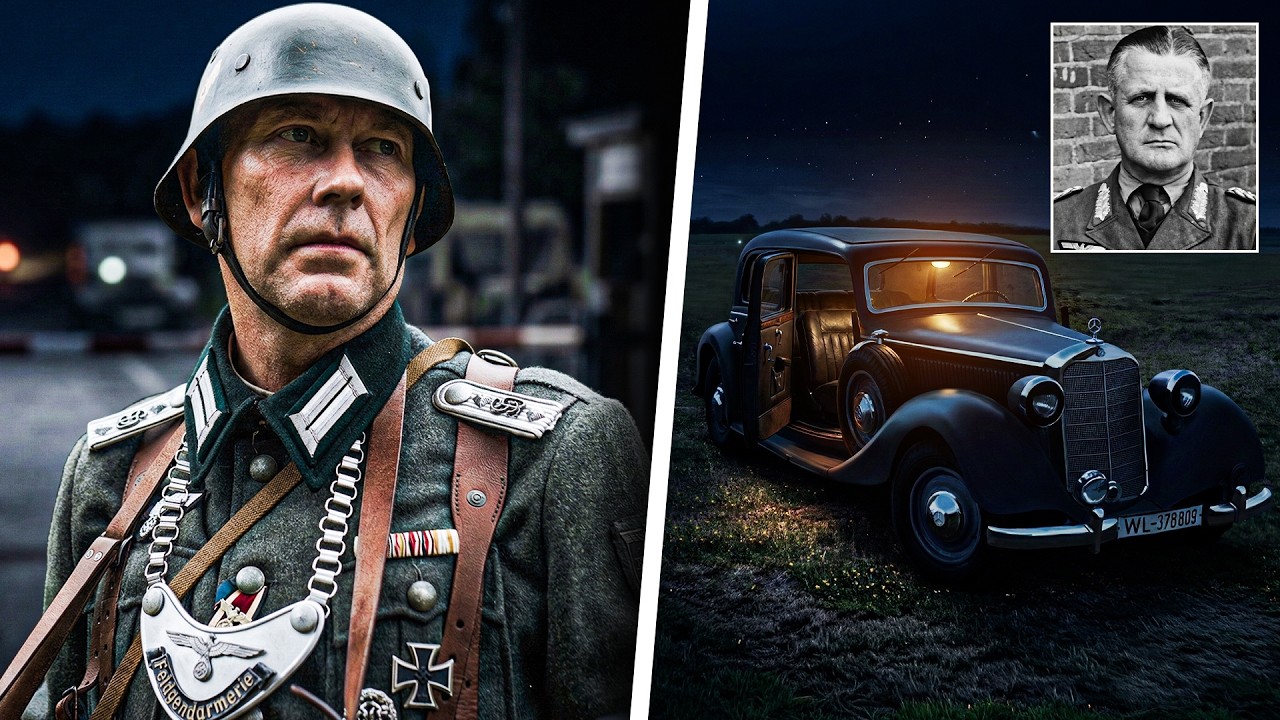
He was stopped at what looked like a routine checkpoint, by men in German uniforms who were not German at all. Within seconds, the general was gone, pulled out of his staff car and into the mountains. It was a calculated act of humiliation, designed to prove that Nazi authority on Crete could be broken at the very top. When German forces invaded Crete in May 1941, they expected a decisive victory.
Instead, Operation Mercury became one of the costliest airborne assaults of the war. German paratroopers suffered devastating losses in the first days, and civilians fought alongside Allied troops against the invasion. Berlin secured the island, but never truly subdued it. From 1941 onward, Crete’s strategic value grew.
Airfields at Maleme, Heraklion, and Rethymno projected German power across the eastern Mediterranean, and supply routes to North Africa ran within reach. But the island was never quiet. Local resistance networks worked hand in hand with British intelligence, hiding weapons and moving messengers through the mountain passes at night. German patrols controlled the roads.
The interior remained hostile territory. The arrival of Friedrich Wilhelm Müller in August 1942 turned that hostility into open hatred. As commander of the 22nd Air Landing Infantry Division, Müller answered to Luftwaffe General Bruno Bräuer, but it was Müller who carried out the island’s most brutal counterinsurgency tactics. Mass arrests.
Village burnings. Executions. In September 1943, over 500 civilians were killed at Viannos under his command. German records called it a security operation.
Post-war courts would call it a massacre. Rather than breaking the resistance, Müller made it harder. In March 1944, Müller was reassigned. His replacement was Heinrich Kreipe, a decorated veteran of the Eastern Front.
Kreipe was disciplined, predictable, and not considered lenient, but he was not Müller. That distinction would prove crucial. The plan to kidnap a senior German commander did not come from London. By 1943, the SOE officers embedded with the resistance had unusual autonomy.
They made decisions on the ground, shaped by the terrain and the people who knew it intimately. At the center was Major Patrick Leigh Fermor, an officer who had lived on Crete before the war. He spoke fluent Greek, understood local customs, and moved between villages like he belonged there. To the resistance, he was not a foreign agent; he was family.
German intelligence knew his name, but they could not find him. Working alongside him was Captain William Stanley Moss, younger and more methodical. Moss handled the planning. He studied patrol schedules, road layouts, command routines.
There would be no second chance. Any mistake would bring reprisals that could wipe out entire villages. The original target was Müller. His brutality made him a symbolic prize, removing him would send an unmistakable message.
But by the time the team landed on Crete in early April 1944, Müller was already gone. Kreipe had taken command. Leigh Fermor and Moss made the call to proceed anyway. They adjusted quickly.
Kreipe’s routines were predictable. He traveled between headquarters and residence at regular times, and his staff relied on habit rather than caution. The resistance fighters who joined the operation understood the risks. If the mission failed, or even if it succeeded, German reprisals were certain.
They accepted that cost. The disguises were simple. German military police uniforms, complete with white gorgets and correct insignia, were obtained. The roadblock scenario was rehearsed again and again.
Timing was everything. The car had to be stopped cleanly. The driver neutralized quietly. Kreipe controlled before he could shout.
There was no extraction plan until after the kidnapping. First, they had to disappear into the mountains. Only then would Cairo be contacted. On the evening of April 26th, 1944, the team took position at a narrow stretch of road outside Heraklion.
Leigh Fermor and Moss wore their Feldgendarmerie uniforms and stood in the open, looking utterly routine. Shortly after 9:30 p. m. , Kreipe’s official staff car appeared.
The driver saluted as he approached. Kreipe sat in the back. Moss stepped forward, opened the driver’s door, and pulled the chauffeur out of the seat with one sharp strike. Leigh Fermor reached the rear door and seized Kreipe before he could react.
The general resisted briefly, but he was subdued without a single shot fired. To anyone looking on, it would have seemed like nothing more than military police handling an officer’s vehicle. Kreipe was forced into the back seat of his own car. Moss took the wheel.
Leigh Fermor sat beside the general, a pistol pressed discreetly into his ribs. The car drove on, passing more than twenty German checkpoints without challenge. Occupied forces assumed their own cars moved freely. That assumption carried the operation through the city and out into the night.
Once clear of Heraklion, the team abandoned the vehicle. The chauffeur was left bound but alive, ensuring hours would pass before anyone raised an alarm. Kreipe’s cap and documents were removed. A note was left in the car, signed by British officers, stating that the general had been taken by Allied forces, not by Cretan civilians.
The intention was to reduce reprisals, though whether it worked remains a matter of debate. On foot, the pace changed. Speed gave way to endurance. The kidnappers moved inland toward the White Mountains, following routes known only to local guides.
Kreipe was told plainly that he was now a prisoner of war. Resistance, they warned him, would only make things worse. By dawn on April 27th, the kidnapping was a full-scale crisis. German command sealed roads, searched villages, and issued orders to recover Kreipe at any cost.
The kidnappers were already climbing. Their route led south, away from Heraklion, into the mountains. Progress was slow. Kreipe was forced to walk, often at night, along narrow paths used for centuries by shepherds and smugglers.
During the day, the group hid in caves or remote farm buildings. Villagers appeared quietly with food and fresh guides. They treated blistered feet without complaint. Every helper understood the stakes.
German doctrine on Crete linked any resistance activity to collective punishment. Search operations tightened. At times, patrols passed within meters of the hidden group. Once, a German unit camped directly below a cave where the group was sheltering.
Kreipe remained calm throughout. He spoke occasionally with Leigh Fermor, and at one point, resting on a mountain ridge, the two men recited lines from Horace in Latin, a strange moment of shared humanity between captor and captive. The escape took nearly three weeks. The terrain did much of the work.
German troops were trained for roads and towns, not Highland movement. Radio coordination faltered. The resistance moved with instinctive knowledge of every ridge and ravine. That balance proved decisive.
By May 13th, 1944, the group reached the southern coast near Rodas. Contact had been made with British command. A motor launch approached under cover of darkness. On May 14th, Kreipe was transferred aboard and taken to Egypt.
For the SOE, the mission was a success. No territory had been gained. No units destroyed. But a German general had been taken from under occupation command.
The message was unmistakable. The reprisals were severe. Villages like Anogeia were razed to the ground in the months that followed. Kreipe was moved to Canada, where he remained a prisoner of war until 1947.
He was never tried for war crimes, and unlike his predecessor, he returned quietly to civilian life in West Germany. In 1972, he appeared on Greek television alongside the men who had captured him, a strange reunion between men who had shared horrors on a mountainside nearly three decades earlier. The raid remains controversial. For Allied planners, it was a psychological victory.
For Crete, the cost was paid in blood. But the operation became legend, not for what it destroyed, but for what it proved: that Nazi authority could be broken, even at the very top.