The Men Who Stood Behind Hitler: What Happened to His Bodyguards After the Fall of the Third Reich?
On the morning of April 30, 1945, beneath the burning ruins of Berlin, four men knew that the world they had protected was collapsing.
For years, they had stood closer to Adolf Hitler than almost anyone alive.
They had walked beside him through military headquarters, hidden bunkers, and private meetings where the fate of millions was decided. They had heard his orders, witnessed his rage, and watched the final days of a dictator who had brought Europe into the bloodiest war in human history.
But now the war was lost.
The streets above them were filled with Soviet artillery. The Nazi regime that had promised a thousand-year empire was disappearing hour by hour. Hitler was trapped underground inside the Führerbunker, surrounded by smoke, fear, and desperate men searching for a way to escape history.
The guards who had spent years protecting the most powerful and feared man in Europe suddenly faced a terrifying question:
What happens to the men who protected a monster when the monster is gone?
Their names were not as famous as Hitler’s generals or ministers. They were not the architects of the Holocaust. They were not the men who signed the orders that sent millions to their deaths.
They were the men who stood in the shadows.
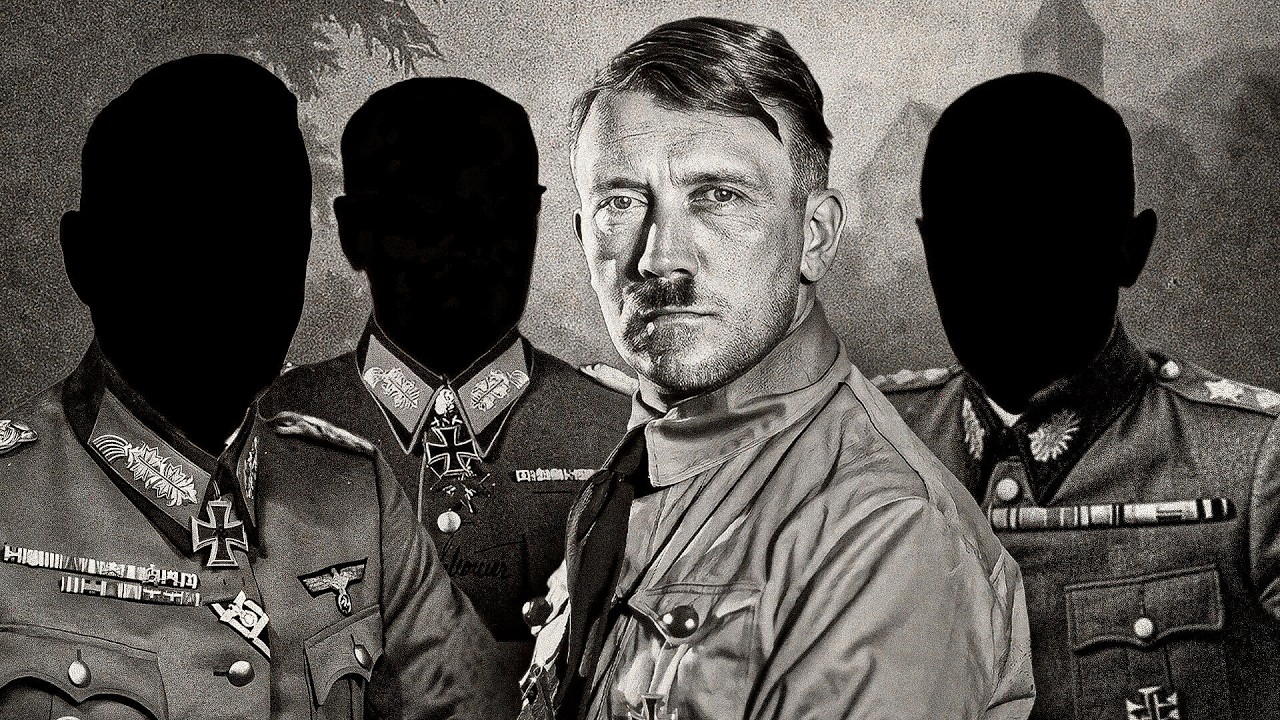
Rochus Misch, Otto Günsche, Johann Rattenhuber, and Heinz Linge.
Four men who saw Hitler not as a symbol on propaganda posters, but as a human being behind closed doors.
And after Germany surrendered, they would discover that knowing the secrets of Adolf Hitler came with a price.
Because the victorious Allies did not just want to capture soldiers.
They wanted answers.
They wanted to know what happened inside Hitler’s final hours.
They wanted to know who was with him when Berlin fell.
They wanted to know if the most hated man in the world had truly died.
And these four men were among the few who could tell them.
Before the collapse, their lives had been defined by loyalty, discipline, and secrecy.
Rochus Misch was not a powerful politician. He was not a battlefield commander. He was a quiet man who became one of Hitler’s personal bodyguards and later served as a telephone operator inside the Führerbunker.
His job placed him at the center of history.
Every day, he answered calls that connected Hitler’s underground headquarters with the collapsing Nazi government. He heard the panic spreading through the regime. He listened as officials demanded impossible military victories from armies that no longer existed.
But despite being surrounded by chaos, Misch maintained the routine of a servant protecting his leader.
He opened doors.
He delivered messages.
He stood guard.
He waited.
Otto Günsche had a different role.
Tall, disciplined, and physically imposing, he became one of Hitler’s personal adjutants. He was responsible for managing access to the Führer and carrying out Hitler’s direct instructions.
Johann Rattenhuber commanded the Reich Security Service, the organization responsible for protecting Hitler’s physical safety.
He had spent years planning security routes, inspecting locations, and ensuring that every possible threat against the dictator was controlled.
Heinz Linge was perhaps one of the closest.
As Hitler’s personal valet, Linge saw the dictator during his most private moments.
He prepared his clothing.
He organized his daily schedule.
He entered rooms where even senior Nazi officials were rarely allowed.
He saw the ordinary habits of a man who had created extraordinary destruction.
That was the strange reality of Hitler’s inner circle.
Outside the bunker, the world saw a terrifying dictator.
Inside, these men saw a person who drank tea, followed routines, complained about food, and obsessed over military maps.
But beneath the ordinary details was a horrifying truth.
They were serving the man responsible for one of history’s greatest catastrophes.
And they would soon learn that history does not forget those standing closest to power.
By April 1945, Berlin was no longer a capital.
It was a battlefield.
Soviet forces surrounded the city. Buildings burned. Civilians searched for food and shelter. German soldiers fought a hopeless defense because Hitler refused to accept defeat.
Inside the Führerbunker, reality became increasingly distorted.
Maps on the walls showed imaginary victories.
Generals delivered reports that contradicted the explosions above them.
Officers whispered that the war was finished, but nobody wanted to say the words directly.
Hitler became more isolated.
Those around him watched his physical and mental condition deteriorate.
His hands shook.
His movements became slower.
His anger became more unpredictable.
Yet even as everything collapsed, he refused to abandon his belief that victory was still possible.
The men around him faced an impossible situation.
They had sworn loyalty.
But loyalty to a dying regime could become a death sentence.
Some officials escaped.
Some attempted negotiations.
Some prepared suicide.
The bunker became a place where fear controlled every decision.
Then came April 30.
The day the world was waiting for.
Hitler entered his private room with Eva Braun, whom he had married only the day before.
The door closed.
No one outside knew exactly what would happen next.
Minutes passed.
The silence became unbearable.
Then Linge and others entered.
What they saw changed their lives forever.
Hitler and Eva Braun were dead.
The dictator who had commanded armies across Europe was gone.
But the danger was not over.
Now came the most difficult task.
Removing the evidence.
Following Hitler’s instructions, his body was carried outside, covered with fuel, and burned in the garden of the Reich Chancellery.
The same man who had built an empire through propaganda now disappeared into smoke and ashes.
But the men who witnessed it remained.
And they knew the Soviets were coming.
The fall of Berlin was unlike anything they had imagined.
The city that had once celebrated Nazi power was now occupied by enemy soldiers.
The men who had guarded Hitler changed from protectors into prisoners.
Their uniforms no longer represented authority.
Their connections to Hitler became a burden.
When Soviet forces captured them, they immediately became valuable sources of information.
The Soviets had one obsession:
Find out the truth about Hitler’s death.
For weeks, rumors spread around the world.
Some believed Hitler had escaped.
Some claimed he had fled to another country.
Some believed the Nazi leader was hiding in secret.
The Soviet Union needed confirmation.
They needed witnesses.
And they had four men who had been there.
The interrogations began.
Again and again, Soviet officers questioned them.
What did Hitler say before he died?
Who entered the room?
Was the body really burned?
Where were the remains?
Did anyone help him escape?
The questions continued for hours.
Then days.
Then months.
The prisoners were pressured from every direction.
Some interrogators believed they were hiding information.
Others suspected that the witnesses knew more than they admitted.
The truth was valuable.
And the men who carried it became prisoners of history.
But the greatest surprise came after the interrogations.
Many people expected Hitler’s bodyguards to disappear forever.
They expected them to be executed immediately.
They expected them to face the same punishment as the highest-ranking Nazi criminals.
But their stories took unexpected turns.
Rochus Misch spent years in Soviet captivity before eventually returning to Germany.
When he returned, he faced another kind of prison.
Public judgment.
Many Germans struggled with how to view former members of Hitler’s inner circle.
Some saw them as criminals.
Others saw them as ordinary men trapped inside a criminal system.
Misch repeatedly insisted that he was only a soldier and guard who followed orders.
But critics asked a difficult question:
How responsible is a person who stands beside evil every day but claims he never participated in it?
That question followed him for the rest of his life.
Otto Günsche experienced a similar fate.
After capture, he became one of the Soviet Union’s important witnesses.
He was interrogated about Hitler’s final moments and later used as a source of information about the Führerbunker.
Eventually, he returned to Germany.
But his past followed him.
The world wanted to understand the psychology of Hitler’s final circle.
How did intelligent people continue serving a collapsing dictator?
How did they justify obedience when the consequences became impossible to ignore?
Günsche’s life became part of a larger debate about responsibility and loyalty.
Heinz Linge’s story also became connected to Hitler’s final days.
After the war, his testimony helped historians reconstruct what happened inside the bunker.
His memories provided details about Hitler’s routines, behavior, and final hours.
But they also created controversy.
Because every memory from the inner circle raised the same uncomfortable question:
Were these men simply witnesses?
Or were they willing participants who helped maintain the world Hitler created?
There was no simple answer.
History rarely provides one.
The biggest twist in their story is that the men closest to Hitler were not destroyed by the secrets they carried.
They were transformed into some of the most important witnesses of the Nazi collapse.
The people who once protected Hitler became the people who explained his downfall.
The guards became historians’ sources.
The servants became evidence.
The silent observers became voices from inside the darkness.
But there was another twist.
The more they revealed about Hitler, the more complicated their own stories became.
Because their testimonies showed something disturbing:
Hitler was not surrounded only by fanatics.
He was also surrounded by ordinary people.
People who worked.
People who followed routines.
People who convinced themselves that their role was small.
And that was perhaps the most frightening lesson.
Evil does not always survive because everyone around it is evil.
Sometimes it survives because ordinary people decide their responsibility is limited.
Years later, historians continued studying their accounts.
Their testimonies helped recreate the final hours of the Third Reich.
They described the atmosphere inside the bunker.
The fear.
The confusion.
The denial.
The collapse of a regime that had once seemed unstoppable.
But their stories also revealed something else.
Power creates a strange illusion.
The closer someone gets to a powerful person, the easier it becomes to believe that proximity equals importance.
Hitler’s bodyguards had stood only meters away from one of the most powerful men on Earth.
Yet when his empire collapsed, all that power disappeared overnight.
The uniforms meant nothing.
The titles meant nothing.
The protection they offered was meaningless.
They were left alone with their memories.
One of the most haunting moments came years later, when Rochus Misch reflected on the final day inside the bunker.
For decades, he carried the image of those last hours.
The locked doors.
The silence.
The realization that history had changed forever.
He had entered the bunker as a servant of a powerful leader.
He left it as one of the last witnesses to a fallen dictator.
The world wanted monsters.
But history gave them something more complicated.
Human beings making choices.
Some cruel.
Some loyal.
Some fearful.
Some ordinary.
And that complexity is what makes their stories so unsettling.
Because the question is not only:
“How did Hitler gain power?”
The deeper question is:
“How many people stood beside him while he used it?”
The men who guarded Hitler after World War II lived very different lives.
Some disappeared into private existence.
Some wrote memoirs.
Some became controversial figures because of their connection to history’s darkest chapter.
But none of them escaped the shadow of the bunker.
They carried it for the rest of their lives.
They had seen the final moments of a dictatorship built on hatred.
They had watched a dictator who promised domination end in isolation.
They had witnessed the moment when absolute power became helpless.
And perhaps the most powerful lesson from their stories is this:
History is not only written by the people who give the orders.
It is also shaped by the people who stand nearby, hear the commands, see the consequences, and decide what they will do next.
The men beside Hitler thought they were protecting a leader.
In the end, they became witnesses to his destruction.
And decades later, the world still asks the same question:
When you stand close enough to power to see everything…
what responsibility do you carry for what that power creates?