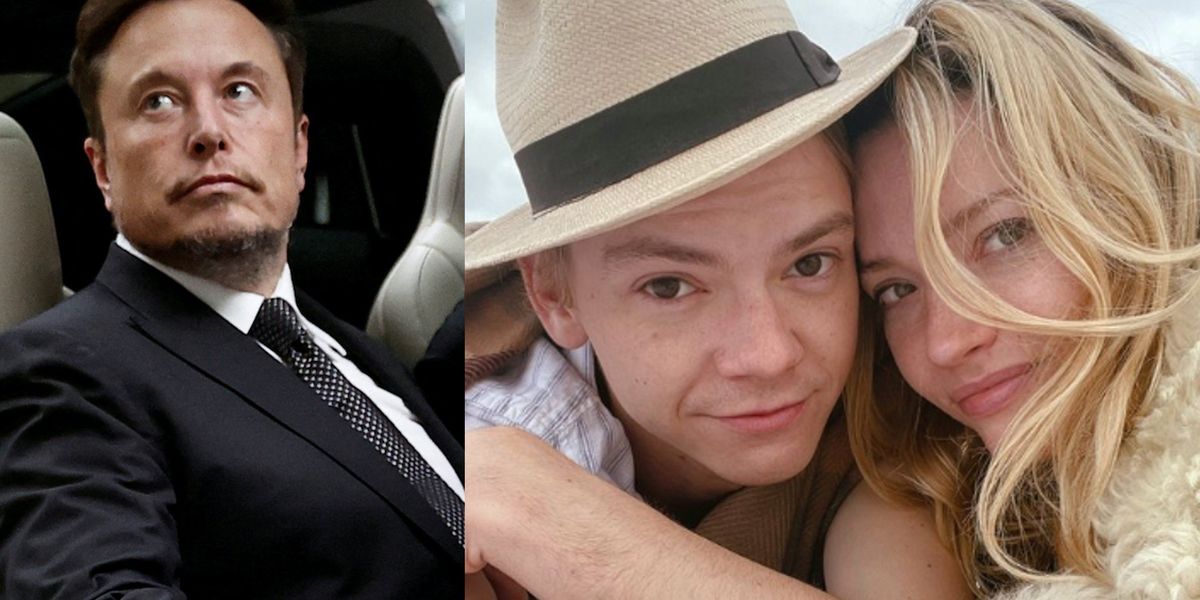
When Talulah Riley announced that she was engaged to Thomas Brodie-Sangster, the congratulations came quickly.
Friends celebrated. Fans shared the smiling photo. People who had watched Brodie-Sangster grow up on screen suddenly had to process the fact that the little boy from Love Actually was now preparing to get married.
Then one particular name appeared beneath the announcement.
Elon Musk.
Riley’s ex-husband.
Twice.
After two marriages, two divorce proceedings and one of the more unusual romantic histories in celebrity circles, Musk publicly congratulated the woman he had once married, divorced, remarried and divorced again.
And somehow, that simple gesture told a much bigger story than the engagement itself.
Because long before Riley found happiness with Brodie-Sangster, her romantic life had been tied to one of the most unpredictable men in the world.
And their relationship had been just as unpredictable.
Talulah Riley met Elon Musk in 2008.
She was a young British actress known for roles including St Trinian’s. Musk was already an entrepreneur with enormous ambitions and a personal life that was far more complicated than anything Riley had experienced.
Their relationship moved quickly.
Very quickly.
Two years after they began dating, Riley and Musk married in Scotland in 2010.
To outsiders, it was an unusual pairing.
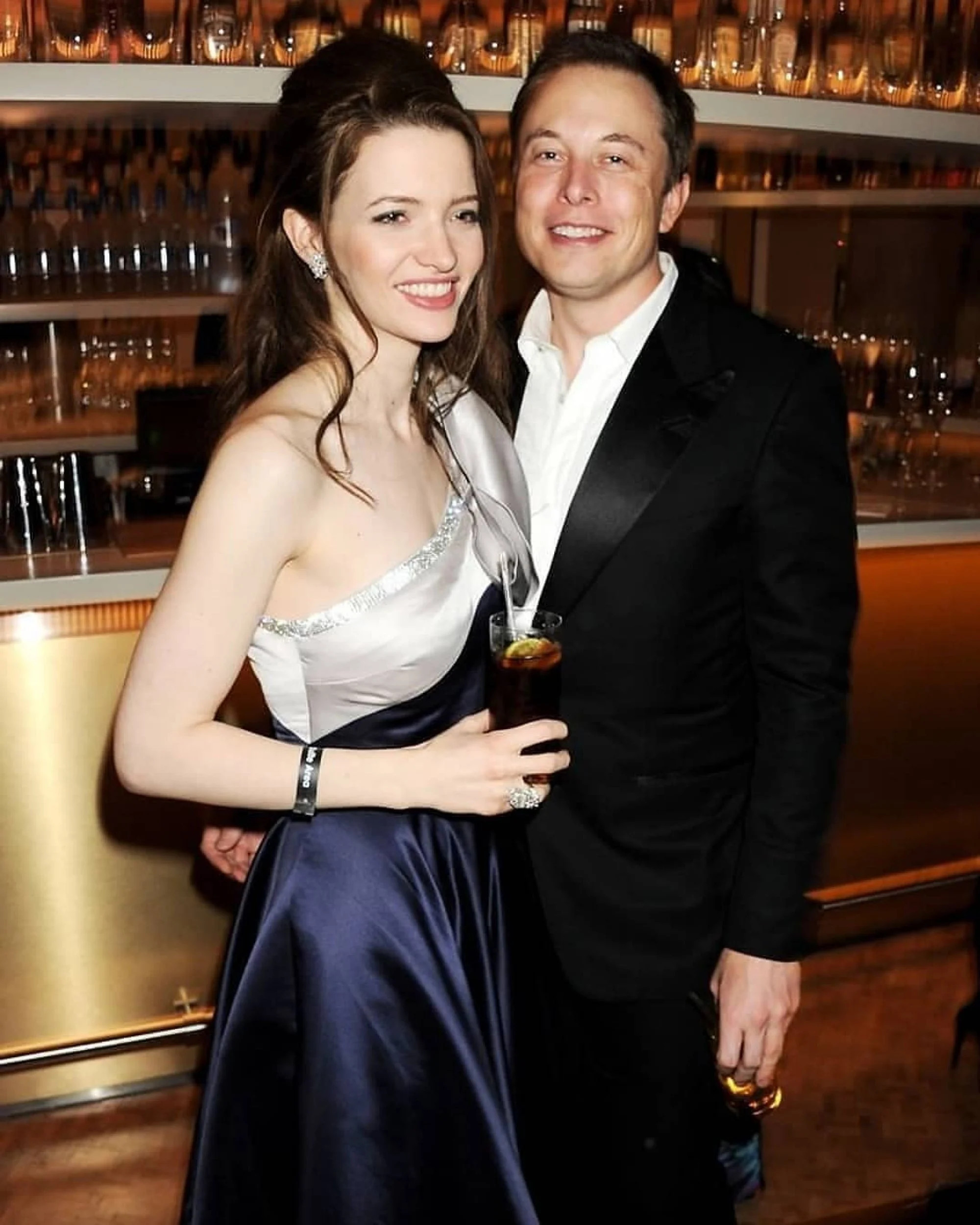
She came from the world of British film and television.
He was building companies, talking about electric cars and rockets, and developing the public persona that would eventually make him one of the most recognizable businessmen on the planet.
But for a time, it worked.
Then, in 2012, it didn’t.
Musk filed for divorce.
Their first marriage was over.
Most people would have assumed that was the end of the story.
It wasn’t even close.
After separating, Riley and Musk somehow found their way back to each other.
The relationship had already gone through marriage and divorce, yet whatever remained between them was strong enough for both of them to try again.
In July 2013, Talulah Riley married Elon Musk for the second time.
Same bride.
Same groom.
A second attempt at the same marriage.
For people watching from the outside, it looked almost impossible to understand.
Had the divorce been a mistake?
Had time apart made them realize they belonged together?
Had they solved whatever had broken the first marriage?
For a while, perhaps even Riley and Musk believed they had.
Then the instability returned.
By December 2014, Musk had filed for divorce again.
For the second time, their marriage appeared to be ending.
Then came another reversal.
Musk withdrew the filing.
They stayed married.
It was the kind of relationship where every apparent ending seemed capable of becoming another beginning.
Marriage became divorce.
Divorce became reconciliation.
Reconciliation became marriage.
Another divorce filing became another attempt to stay together.
Eventually, however, the cycle stopped.
After living separately for several months, Riley filed for divorce in 2016.
That October, their second divorce was finalized.
This time, there would be no third wedding.
For nearly eight years, Riley and Musk had repeatedly moved toward and away from one another.
By the time it ended, they had accumulated a relationship history most couples would struggle to explain in a sentence.
They had dated.
Married.
Divorced.
Reconciled.
Married again.
Nearly divorced again.
Stayed together.
Separated.
Then divorced for good.
And yet the most surprising part may have been what happened afterward.
There was no spectacular public feud.
No endless parade of accusations.
No obvious attempt by either person to erase the other from their life.
In fact, years after their divorce, there were signs that Riley and Musk could still communicate with the familiarity of two people who had once known each other extremely well.
In March 2022, Riley sent Musk a message about Twitter.
Her suggestion was memorable.
She asked whether he could buy the platform and either delete it or transform it into something committed to much broader free speech.
At the time, it could have sounded like an absurd request made to an unusually wealthy ex-husband.
Then Musk actually moved to buy Twitter.
Whatever else people thought about the acquisition, Riley’s old message suddenly looked remarkably prescient.
But there was something else visible in the exchange.
Their divorce had not apparently transformed them into enemies.
That mattered when Riley’s romantic life took another turn.
While Musk’s name continued appearing constantly in headlines around the world, Riley met someone from a completely different corner of fame.
Thomas Brodie-Sangster.
For an entire generation, his face was instantly recognizable.
Long before he became an adult actor, Brodie-Sangster had appeared in the 2003 Christmas film Love Actually.
He played Sam, the young boy struggling with grief while simultaneously becoming hopelessly smitten with a classmate.
One of the film’s most memorable storylines involved Sam’s determination to express his feelings before the girl left the country.
There were drums.
There was an airport chase.
There was an enormous amount of emotional effort from a child barely old enough to understand what romantic love actually meant.
The movie turned Brodie-Sangster into one of cinema’s most recognizable child actors.
He continued acting as he grew up, eventually appearing in projects including The Maze Runner, Game of Thrones and The Queen’s Gambit.
Years later, his professional life crossed paths with Riley’s.
The two worked together on the FX series Pistol, based around the story of the Sex Pistols.
They met as colleagues.
Then something changed.
A relationship developed.
By the time Riley announced their engagement, they had been together for approximately two years.
There was something striking about the contrast.
Riley’s most famous previous relationship had been with Musk, a businessman whose public life seemed permanently surrounded by intensity, controversy and enormous ambition.
Now she was sharing a quiet photograph with a fellow British actor she had met at work.
No extravagant announcement.
No dramatic reveal.
Just the two of them together.
Riley wrote that she was very happy to share that after two years of dating, she and Thomas Brodie-Sangster were engaged.
People immediately celebrated the news.
But there was also an unavoidable layer of internet disbelief.
Thomas Brodie-Sangster?
The boy from Love Actually?
Elon Musk’s ex-wife?
For anyone whose mental image of Brodie-Sangster had frozen somewhere around Christmas 2003, the announcement was almost disorienting.
The child actor they remembered running through an airport was now a grown man preparing for marriage.
And the woman he planned to marry happened to have one of the most unusual marital histories in the public eye.
Then came the moment that transformed a sweet celebrity engagement into something people couldn’t stop talking about.
Elon Musk showed up in the replies.
He congratulated them.
There was no bitterness.
No strange remark about the past.
No public attempt to make Riley’s moment about him.
Just congratulations.
Considering their history, the simplicity was almost shocking.
This was a woman Musk had married in 2010.
Divorced in 2012.
Married again in 2013.
Attempted to divorce again in 2014.
Then finally divorced in 2016 after Riley herself filed.
Years of emotional history compressed into a brief message beneath a photograph of her with another man.
And suddenly, the story was no longer simply about who Talulah Riley was marrying.
It was about what happens after a relationship that once seemed impossible to escape finally becomes something you can look back on without needing to destroy it.
People often imagine divorce as the moment two people become opponents.
Celebrity divorce makes that assumption even stronger.
The public waits for the interview.
The accusation.
The memoir.
The leaked messages.
The moment one person finally reveals what the other was “really like.”
But Riley and Musk’s post-divorce relationship appeared to resist that script.
Whatever had happened between them, they had eventually reached a point where Riley could jokingly urge her ex-husband to buy a social network — and Musk could later congratulate her when she chose to marry someone else.
That doesn’t mean their marriage had secretly been easy.
Two divorces strongly suggest otherwise.
It doesn’t mean every wound vanished.
Nobody outside the relationship could know that.
But it did suggest something much less dramatic and perhaps more difficult.
They had moved on.
Not the social-media version of moving on, where people loudly announce how unbothered they are.
Actual moving on.
The kind where another person’s happiness no longer feels like a personal loss.
And there was another detail that made the moment particularly satisfying.
For years, Riley could easily have been defined publicly by her connection to Musk.
“Elon Musk’s wife.”
Then “Elon Musk’s ex-wife.”
Then his wife again.
Then his ex-wife again.
Those labels are powerful because they reduce an entire person to their relationship with somebody more famous.
But the engagement photo quietly reversed that.
Riley was no longer standing beside Musk.
She was building an entirely different life.
Brodie-Sangster wasn’t a billionaire technology founder.
He wasn’t trying to put humanity on Mars.
He wasn’t buying social networks.
He was an actor Riley had met through her own work.
And after two years together, they wanted to get married.
There was no need for Riley to publicly condemn her past in order to celebrate her future.
There was no need for Musk to disappear from the conversation in embarrassment.
The past simply remained where it belonged.
Behind them.
That was the real twist.
After all the marriage-divorce-remarriage-divorce drama, the most surprising thing Riley and Musk eventually managed to create together was something completely ordinary.
Peace.
Imagine the scene from Musk’s side.
You open Twitter and see a woman who was once your wife announcing that she intends to marry another man.
Not just once your wife.
Twice your wife.
There are years of memories contained inside that photograph that nobody else scrolling through the replies can see.
Scotland.
The first marriage.
The first divorce.
The decision to try again.
The second wedding.
The second collapse.
The months apart.
The final paperwork.
Then nearly seven years after the last divorce, she is smiling beside someone new.
There are countless ways an ex-spouse could respond.
Silence would have been understandable.
Instead, Musk congratulated them.
And perhaps that is why the moment attracted so much attention.
It looked almost too emotionally mature for the internet.
There was no villain.
No winner.
No loser.
Just three adults standing at very different points in their lives.
Riley had found another partner.
Brodie-Sangster had found the woman he wanted to marry.
Musk, despite having once occupied the most important romantic role in Riley’s life, was no longer competing for that position.
The power of the moment wasn’t in what was said.
It was in what no longer needed to be said.
Riley didn’t need to explain why two marriages had failed.
Musk didn’t need to explain how he felt seeing his ex-wife engaged.
Brodie-Sangster didn’t need to compete with the extraordinary public profile of the man who came before him.
A photograph and a congratulations were enough.
And the story carried another piece of irony that fans were quick to notice.
Thomas Brodie-Sangster had become famous as a child playing perhaps one of the most determined young romantics in modern Christmas cinema.
His character believed love was worth embarrassing yourself for.
Worth learning an instrument for.
Worth racing through an airport for.
Twenty years later, the actor himself had ended up at the center of a real-life love story nobody could have written in 2003.
The Love Actually kid had grown up.
And he was engaged to Elon Musk’s twice-divorced ex-wife.
Sometimes reality produces combinations that would be rejected from a screenplay for being too unlikely.
But beneath the famous names was something much more relatable.
Most people carry evidence of the lives they almost had.
A relationship that once felt permanent.
A person they thought they would grow old beside.
A breakup they believed they would never fully recover from.
Sometimes there is even a second attempt.
And sometimes the second attempt fails too.
It is tempting to see those relationships as wasted years.
Riley’s story suggests another possibility.
A relationship can fail without making the entire relationship meaningless.
Someone can once be important to you without having to remain your future.
And an ex can eventually become exactly what the word is supposed to mean — someone from a completed chapter, not an enemy permanently occupying the next one.
Talulah Riley did not need Elon Musk’s permission to move forward.
Thomas Brodie-Sangster did not need Musk’s approval to propose.
And Musk’s congratulations did not create their happiness.
But the fact that he could offer it after everything they had been through revealed something rarely celebrated in stories about famous exes.
Sometimes the cleanest victory after a turbulent relationship is not revenge.
It is reaching the point where both people can watch the other build a new life — and genuinely wish them well.
Because moving on isn’t proven when you stop loving someone.
It’s proven when their happiness no longer threatens your own.