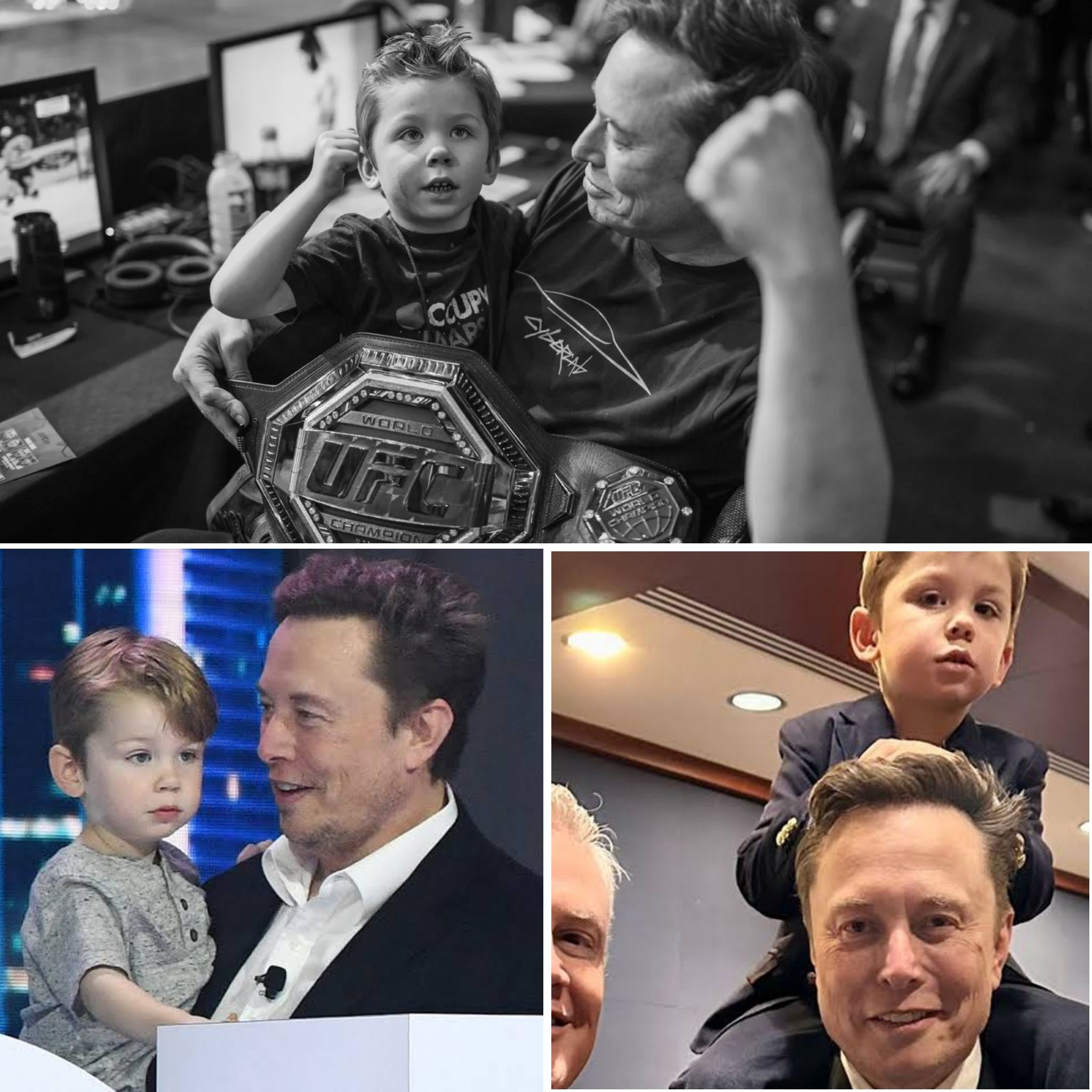
The championship belt looked almost comically large in his hands.
Around him sat some of the most powerful people in the United States: the president, Cabinet officials, the FBI director, one of the richest men alive.
And in the middle of them was a four-year-old boy.
Elon Musk’s son X Æ A-Xii—better known simply as “Little X”—was holding a UFC championship belt as his father looked toward him.

Then the official White House account posted the photograph.
Its caption was only a few words:
“Elon Musk and the Undisputed Champion Little X.”
Within hours, millions of people had seen it.
Some laughed at the absurdity of a preschooler posing with a championship belt.

Some thought it was an unexpectedly sweet father-son moment.
Others saw something much larger in the photograph: business, politics, celebrity and combat sports collapsing into one extraordinary image.
But almost nobody looking at it that weekend could have known what the picture would come to represent.
Because the most important detail wasn’t the belt.
It was the date.
It was April 12, 2025.
UFC 314 had taken over Miami’s Kaseya Center, where Alexander Volkanovski would reclaim the featherweight championship by defeating Diego Lopes.
Donald Trump arrived to an enormous reaction from the crowd.
According to the official presidential pool report, Trump entered the arena shortly before 10 p.m. as spectators roared and his image appeared on the giant screen. UFC chief Dana White accompanied him toward the Octagon.
But this wasn’t simply a president attending a fight.
Look at the people around him.
Secretary of State Marco Rubio was there.
FBI Director Kash Patel was there.
Director of National Intelligence Tulsi Gabbard was there.
Health Secretary Robert F. Kennedy Jr. attended with Cheryl Hines.
Senator Ted Cruz was also spotted.
And sitting beside Trump was Elon Musk.
At that moment, Musk wasn’t merely the Tesla and SpaceX billionaire who occasionally commented on politics from afar.
He was deeply embedded in Trump’s Washington.
Musk had become the most recognizable face associated with the Department of Government Efficiency, or DOGE, and was serving as a special government employee as the administration pursued aggressive reductions in federal spending and staffing.
And Musk had brought someone with him.
His young son.
Presidential pool reporters had already seen the pair earlier that night. When Trump arrived in Miami, Musk followed him off the plane carrying X on his shoulders.
Father and son then traveled to the arena with the presidential party.
For most four-year-olds, Saturday night might mean cartoons, toys or falling asleep in the back seat on the way home.
X’s Saturday night involved Air Force One’s traveling entourage, the president of the United States, Cabinet secretaries and cageside seats at one of the biggest UFC events of the year.
That contrast was difficult to miss.
X was born in May 2020 to Musk and musician Grimes. His unusual name initially became a global story in its own right, and his parents later adjusted its spelling from X Æ A-12 to X Æ A-Xii. He has generally been called X or Little X.
By 2025, however, something else had become noticeable.

The little boy was appearing beside his father in increasingly consequential places.
Not just family outings.
Not just sporting events.
Rooms where government decisions were being discussed.
Political gatherings.
Public appearances in Washington.
The Oval Office.
And now, cageside beside the president.
That night in Miami, he was still unmistakably a child.
Photographs showed him sitting close to his father as fighters battled only yards away.
Then came the belt.
The White House photograph captured X holding the UFC championship hardware while Musk sat beside him. The official account jokingly crowned the boy the “Undisputed Champion Little X.”
Musk reshared the post afterward and wrote:
“Such a great night!”
The Indian Express reported that the White House post accumulated more than 50 million views as reactions poured in.
One of the most striking things about the photo was how naturally the impossible-looking scene had assembled itself.
A technology billionaire.
His four-year-old son.
A UFC championship belt.
The president.
America’s senior political and national-security officials.
All sitting within a few seats of one another at a prizefight in Miami.
If someone had created the image as political satire ten years earlier, it might have seemed too exaggerated.
But there it was.
Real.
And the boy at the center of it appeared almost oblivious to how unusual his surroundings were.
That may have been part of why the photograph traveled so far.
Adults saw power.
A child saw a belt.
Adults saw an administration, a billionaire adviser, political symbolism and one of America’s most culturally significant sports organizations.
X was four.
Whatever meaning adults projected onto the photograph belonged largely to the adults.
And people projected plenty.
To supporters of Trump and Musk, the evening looked celebratory—a president and one of his highest-profile allies relaxing together after months of political battles.
To critics, the same photograph could raise uncomfortable questions about the extraordinary access enjoyed by a billionaire whose companies maintained major relationships with the federal government.
To UFC fans, it was simply another example of the sport’s transformation from a once-marginalized spectacle into an arena where presidents, tech executives and Cabinet officials wanted to be seen.
To parents, perhaps it looked simpler.
A father took his son somewhere exciting.
The boy got to hold the belt.
Someone took a picture.
That should have been the end of the story.
It wasn’t.
Because in April 2025, Musk and Trump looked almost inseparable.
Musk had thrown himself behind Trump’s return to the White House during the 2024 election cycle. After Trump’s victory, he became one of the administration’s most visible outside figures.
There were Oval Office appearances.
There were Cabinet-room appearances.
There were speeches.
There were DOGE announcements.
There was even a highly publicized February appearance in which X accompanied his father into the Oval Office while Musk answered reporters’ questions.
The boy had become such a familiar presence around his father’s political life that photographs of him beside senior government figures no longer seemed entirely surprising.
UFC 314 looked like another chapter in that relationship.
Trump entered to cheers.
Musk sat beside him.
Little X held the belt.
The White House itself amplified the photograph.
Everything about it suggested closeness.
Everything about it suggested permanence.
And that is where the story turns.
Because seven weeks later, the picture had become a time capsule.
By late May, Musk’s formal government service was ending.
On May 28, he announced that his scheduled period as a special government employee had concluded. Two days later, Trump and Musk appeared together in the Oval Office for what looked like an unusually warm farewell.
Trump praised him.
Musk thanked the president.
The scene seemed designed to show that, although Musk was stepping away from his official role, the relationship remained intact.
Then everything exploded.
Musk had already criticized the administration’s major tax-and-spending legislation, arguing that its cost undermined the deficit-reduction work DOGE was supposed to accomplish.
On June 3, his criticism became much harsher.
Then, on June 5, the disagreement between two of the world’s most powerful men erupted publicly.
Musk attacked Trump’s legislation and argued that Trump would not have won the election without his help.
Trump responded by expressing disappointment in Musk and suggesting that government subsidies and contracts involving Musk’s companies could come under scrutiny.
The argument escalated across their respective social-media platforms.
A relationship that had been displayed for months as one of the most consequential political alliances in America suddenly looked deeply fractured.
And that was when the UFC photograph became extraordinary in a completely different way.
Look at it again.
Trump and Musk together.
Little X between worlds.
The UFC belt.
The White House caption.
The celebration.
All of it happened less than two months before the alliance began publicly unraveling.
The people in the photograph couldn’t know how quickly the atmosphere would change.
Neither could the millions scrolling past it.
That is what makes old photographs of powerful people so fascinating.
At the moment they’re taken, they look like evidence of the present.
Later, they become evidence of how little the present knew about the future.
In April, the image said:
These people are together.
By June, it seemed to ask:
How did everything change so quickly?
There is an even stranger detail.
The least powerful person in the photograph may eventually be the person for whom the photograph matters most.
Little X.
Imagine being old enough one day to understand where you were.
Not merely at a UFC fight.
You were four years old, seated beside the president of the United States while your father occupied one of the strangest positions ever held by a private businessman in modern American political life.
The White House posted your picture.
Millions saw you holding a championship belt.
Senior government officials were sitting only feet away.
Then, before you were even old enough to understand political alliances, the alliance surrounding you had begun to fracture.
For the adults involved, April 12 was politics.
For X, it will eventually become childhood history.
That difference matters.
Children of immensely famous people rarely get ordinary photo albums.
Their childhood photographs have captions written by news organizations.
Their family outings become wire-service images.
Their interactions with their parents become political arguments.
Strangers debate what their presence means.
And sometimes an official government account posts their photograph to tens of millions of people.
X did not choose any of that.
He did not choose for his name to become international news when he was born.
He did not choose his father’s wealth.
He did not choose the proximity between Silicon Valley and Washington.
He did not choose DOGE.
He did not choose the Musk-Trump alliance.
He certainly did not choose its later turmoil.
He was simply the small boy holding the enormous belt.
That might be why the photograph is ultimately more human than political.
Strip away every famous surname for a moment.
A child went somewhere loud and exciting with his dad.
Someone handed him something shiny and important.
His father looked at him.
Someone took the photograph.
That part is ordinary.
Everything surrounding it is not.
The photograph also captured something people routinely misunderstand about power.
When powerful people are photographed together, the image can make their relationships look permanent.
They rarely are.
Companies change.
Administrations change.
Advisers leave.
Friendships fracture.
Political interests diverge.
People who once praised one another can become opponents with astonishing speed.
On April 12, 2025, the cameras captured proximity.
Seven weeks later, events demonstrated the limits of what proximity actually means.
The championship belt therefore became an accidental symbol.
In fighting, a belt represents something settled.
A champion has won.
The hierarchy is clear.
Someone stands at the top.
Politics is nothing like that.
Neither is business.
Neither are relationships.
There is no final bell after which power stops moving.
No belt guarantees the next victory.
No photograph guarantees the next friendship.
No seat beside the president guarantees you’ll still be beside him months later.
Perhaps that is why the White House’s playful nickname now feels almost prophetic in a way nobody intended.
“Undisputed Champion Little X.”
Of everyone in that photograph, the four-year-old was the only person who had nothing to prove.
He wasn’t trying to win an election.
He wasn’t trying to cut a federal budget.
He wasn’t running a company.
He wasn’t defending an administration.
He wasn’t fighting inside the Octagon.
He was holding a belt.
And smiling for a picture.
The adults around him were surrounded by power, titles, institutions, fortunes and public expectations.
Those things could change overnight.
His memory of the evening, whatever remains of it when he grows older, may be far simpler.
He went to the fights with his dad.
He sat beside the president.
Someone let him hold the championship belt.
And for one evening in Miami, the most powerful people in the room weren’t the ones everyone was looking at.
They were looking at the little boy who had already discovered something adults spend entire lives forgetting: you can be surrounded by power without needing to possess it.