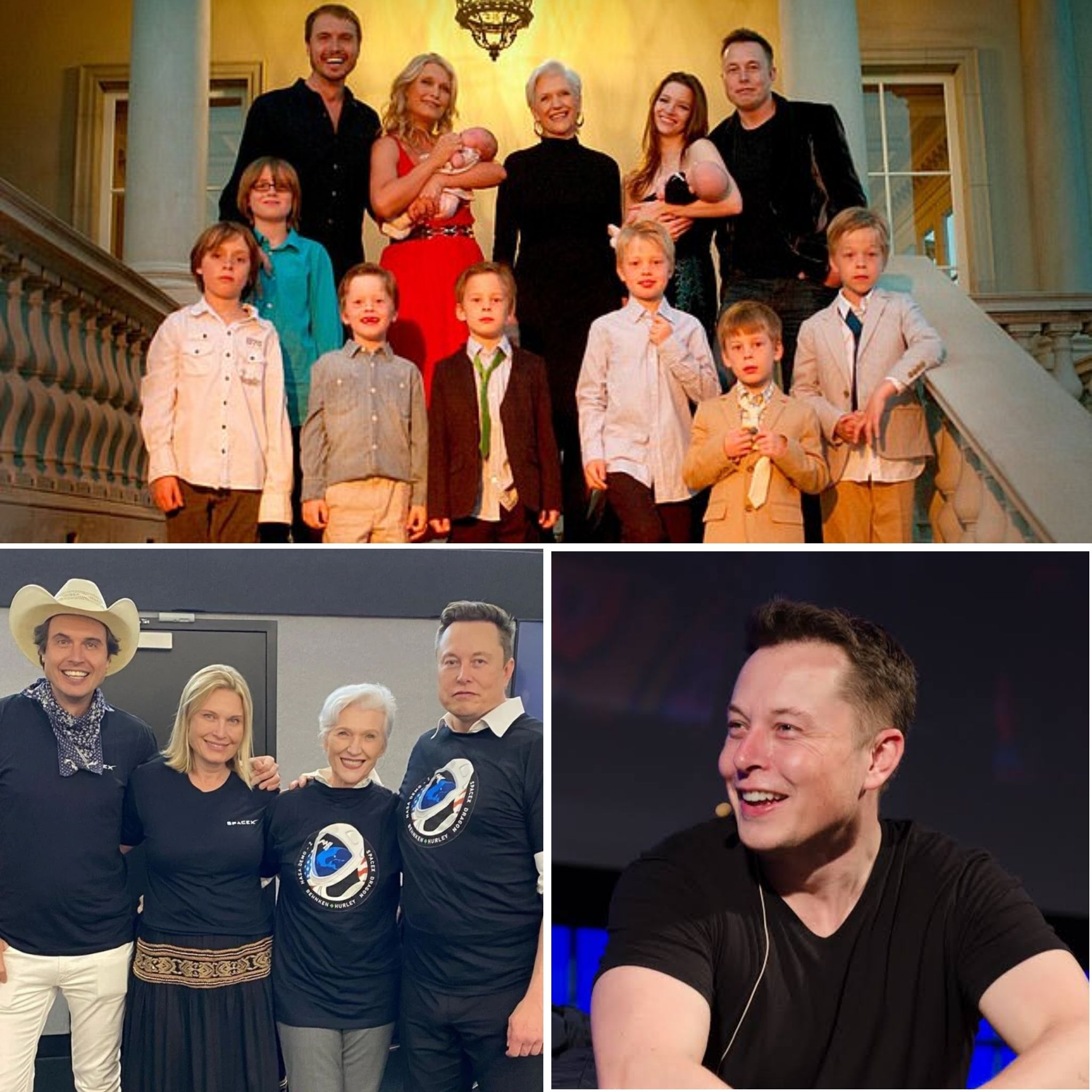
Long before Elon Musk was launching rockets, building electric cars or becoming one of the richest people on Earth, his mother was trying to solve a much more immediate problem:
How do you keep three children fed when your marriage has collapsed and you are suddenly responsible for making a life work?
There were no billions.
No Tesla.
No SpaceX.
No private jets waiting outside.
Maye Musk has described those years very differently from the comfortable childhood outsiders sometimes imagine when they hear the Musk name.
She worked.
Then she worked some more.
Modeling jobs. Nutrition clients. Running her own dietetics practice. Raising Elon, Kimbal and Tosca while trying to keep a roof over them and clothes on their backs.
Decades later, looking back at the life she had built, Maye summed up her approach in six words:
“I have no problem working day and night.”

It sounds almost like a billionaire’s productivity quote.
But when Maye said it, she wasn’t describing some trendy philosophy about “hustle.”
She was describing survival.
And according to her, her children were watching the entire time.
Maye was born in Canada in 1948, one of twins in a family where ordinary life was never quite ordinary.
Her father, Joshua Haldeman, was a chiropractor. Her mother, Winnifred, ran a dance school.
Both worked for themselves.
But what Maye remembered most wasn’t simply entrepreneurship.
It was adventure.
Her parents owned a small plane and flew their family astonishing distances in an era before GPS made navigation routine.
Canada.
The United States.
Europe.
Africa.
Asia.
Australia.
Some journeys involved a canvas-covered aircraft, careful calculations and little margin for error.
Then there were the family’s trips into the Kalahari Desert.
Every winter, Maye recalled, her parents would take their children into the desert searching for a legendary lost city.
They carried weeks of supplies.
They navigated with a compass.
Maye would later look back and recognize how dangerous it all sounded.
But her parents planned obsessively.
The family even had a motto:
“Live dangerously—carefully.”
It is difficult not to notice how much of the Musk family story seems contained inside those two words.
Dangerously.
Carefully.
Take the risk.

But do the work first.
Decades later, Elon’s companies would attempt reusable rockets and mass-market electric vehicles.
Kimbal would move into restaurants, food entrepreneurship and nonprofit work.
Tosca would build a streaming company around a genre major entertainment executives had often underestimated.
Different industries.
Different personalities.
But the instinct to look at something difficult and say, Why not try? seems to have existed long before any of them were born.
Maye carried it into adulthood.
She became a model while also pursuing nutrition and dietetics.
Then she married South African engineer Errol Musk in 1970.
They had three children.
Elon arrived first in 1971.
Kimbal followed in 1972.
Tosca came in 1974.
From the outside, their family could have looked successful.
But Maye has said the reality inside the marriage was very different.
In her memoir and later interviews, she described a relationship marked by fear and alleged physical and emotional abuse.
Errol Musk has denied allegations that he physically and emotionally abused her.
Maye, however, has been unequivocal about her own experience.
She described being insulted and humiliated and said she was frightened to tell other people what was happening.
That matters because when people look backward at enormously successful families, history has a strange way of cleaning up the difficult years.
We see the ending.

The companies.
The wealth.
The magazine covers.
The red carpets.
Then we unconsciously rewrite the beginning to match.
Surely, we think, people who ended up there must have started somewhere close to it.
Maye’s account tells a much messier story.
The marriage ended in divorce in 1979.
Elon was still a child.
Kimbal was still a child.
Tosca was even younger.
And Maye had to build a working life while raising them.
There was no motivational speech in the kitchen announcing that adversity would someday make everyone stronger.
There rarely is.
There were bills.
Food.
School.
Clothing.
Work.
And then more work.
Maye later wrote that her children saw her working simply to put a roof over their heads and food in their stomachs.
Their clothes, she recalled, could be secondhand.
She was modeling, but modeling did not mean every day was glamorous.
She also built a career as a dietitian and ran her own practice.
That meant the children weren’t raised around some abstract concept of entrepreneurship.
They watched it happening inside the house.
Tosca later remembered that her mother’s work was always visible.
Maye worked from home much of the time.
The children saw clients come and go.
They saw their mother handle the responsibilities of running a business.
And when they were old enough, Maye didn’t always give them traditional children’s chores.
Sometimes, they helped with work.
Business tasks.
Letters.
Questions.
Real responsibilities.
Years before Elon would manage thousands of employees, he was watching his mother manage the practical details of keeping a professional life operating.
Years before Tosca would raise investment for Passionflix, she had watched a woman create income from her own skills.
Years before Kimbal would run restaurants and food-related ventures, he had lived in a household where work and survival were closely connected.
Maye’s parenting philosophy was unusually simple.
She wanted her children to become independent.
She didn’t hover over their homework.
She didn’t dictate what they were supposed to become.
She expected responsibility.
If they chose something, it was increasingly theirs to handle.
Years later she wrote that she had tried to raise them to be independent, kind, honest, considerate and hardworking.
That doesn’t mean childhood was some perfect entrepreneurial training camp.
It wasn’t.
The family continued to go through upheaval.
At different points, the children lived with different parents.
The relationship with Errol became deeply complicated. Elon would later publicly describe choosing to live with his father as a mistake.
Eventually, the family’s story shifted continents.
Elon left South Africa for Canada.
Then Maye, Kimbal and Tosca followed.
And once again, the glamorous version of the Musk story disappears when you look at the details.
Tosca has recalled living in a rent-controlled apartment and buying clothes from discount racks after the move.
There was no billionaire brother waiting to finance everyone.
There was no family empire.
Elon hadn’t built one yet.
In fact, that is the part people often get backward.
The wealth came later.
Much later.
What already existed was the habit of working.
And this is where the family’s story takes its most revealing turn.
Years later, when Elon became extraordinarily wealthy, people could easily look at Kimbal and Tosca and make the laziest assumption possible:
Of course they’re successful.
Look who their brother is.
But Kimbal and Tosca didn’t begin their careers as the siblings of “billionaire Elon Musk.”
Because billionaire Elon Musk did not exist yet.
They were three siblings from a complicated household trying to establish themselves.
And all three eventually built businesses.
Elon and Kimbal first worked together on Zip2, an early internet company. When it was sold, Elon continued down the path that would eventually take him through online payments, Tesla and SpaceX.
Kimbal chose a different direction.
Food.
Restaurants.
Urban farming.
Nutrition education.
He became a chef and entrepreneur, co-founding The Kitchen and becoming involved in initiatives designed to reconnect communities and children with food.
Tosca went another way entirely.
Entertainment.
She became a producer and filmmaker and later co-founded Passionflix, a streaming service focused on adapting romance novels for an audience she believed mainstream entertainment had underserved.
When she tried to build it, investors didn’t automatically fall at her feet because of her surname.
She has spoken about having to go out and persuade people to back a female-focused romance platform.
Three siblings.
Three industries.
Technology.
Food.
Entertainment.
That is unusual.
But perhaps the more remarkable part is that the person who modeled the pattern first was their mother.
Maye never became famous because her children had made her financially comfortable and she could finally stop working.
She kept working.
Her modeling career expanded rather than disappeared with age.
Silver hair became part of her public image.
She appeared in major campaigns and magazines at an age when much of the fashion industry historically treated women as though visibility had an expiration date.
She built an entirely new phase of her career at the same time most people assumed she should be winding one down.
That is why her comment—“I don’t stop”—means more when you understand what came before it.
For Maye, work wasn’t invented by success.
Success simply made the work more visible.
There is also an uncomfortable irony in how strangers talk about successful families.
When children fail, people often blame the parents.
When children succeed spectacularly, people sometimes erase the parents completely.
Elon became the headline.
Then the headline became so enormous it was easy to forget who had been standing behind the story long before anyone knew his name.
Maye didn’t build Tesla.
She didn’t design rockets for SpaceX.
She didn’t create Kimbal’s restaurants or Tosca’s films.
Those achievements belong to her children.
But she gave them something more difficult to measure.
An example.
They saw a woman with three children keep working after her marriage ended.
They saw her maintain multiple professional identities.
Mother.
Dietitian.
Business owner.
Model.
They saw that nobody was coming to hand her a perfect life.
And they saw what she did next.
That may be one reason Maye has resisted taking excessive credit for her children’s careers.
Her parenting wasn’t about engineering three successful adults according to some master plan.
She didn’t map out Elon’s future.
She didn’t tell Kimbal to become a food entrepreneur.
She didn’t order Tosca into filmmaking.
She expected them to take responsibility for their choices.
That’s a very different kind of parenting.
Not:
I will remove every obstacle from your life.
But:
You are capable of dealing with obstacles.
Not:
I will choose the safest path for you.
But:
Think, prepare, and then make your decision.
Live dangerously.
Carefully.
The phrase begins to sound less like an old family motto and more like a blueprint passed quietly from one generation to another.
And there is one more detail in Maye’s story that changes the picture.
For years, the person she described as the source of so much fear in her marriage remained part of the public discussion around the family.
Errol has denied Maye’s allegations of abuse.
But when discussing the failure of their marriage years later, he made an admission of his own.
“I screwed up the marriage,” he said, adding that he considered himself responsible for its failure.
It doesn’t settle every disputed claim about what happened inside their home.
But it is striking.
Because by the time those words were being discussed publicly, the woman who had once described herself as frightened and financially constrained no longer needed anyone else to define her story.
She had built one herself.
Her children were grown.
Her career was thriving.
Her photograph had appeared on major campaigns.
She had become recognizable around the world.
And the three children who once watched her work from home had become entrepreneurs themselves.
The power had shifted quietly, over decades.
Not through revenge.
Not through a dramatic confrontation.
Through independence.
That may be the most satisfying part of Maye Musk’s story.
She didn’t “win” because one of her children became unimaginably rich.
A parent’s life cannot be measured by a child’s bank account.
She won because the chapter that could have defined her became only one chapter.
The marriage ended.
The fear did not become the ending.
Financial struggle did not become the ending.
Secondhand clothes did not become the ending.
Starting over in another country did not become the ending.
At 71, when she told an interviewer she had no problem working day and night, she wasn’t asking anyone to feel sorry for the years when life had been harder.
She was still moving.
Today, when people see the Musk name, the first image is almost inevitably Elon.
The rockets.
The cars.
The billions.
But perhaps the more interesting photograph is the one from decades earlier that was never taken.
A working mother at home.
Three children nearby.
Clients to serve.
Bills waiting.
No evidence whatsoever that one son would someday become one of the world’s most famous businessmen, that another would build a career around food, or that her daughter would create a streaming company.
No guarantee of anything.
Only the next day’s work.
And maybe that is why the Musk family story resonates beyond wealth.
Most parents will never raise a billionaire.
That’s not the point.
Most children will never build global companies.
That’s not the point either.
The lesson isn’t that working hard guarantees extraordinary wealth.
It doesn’t.
The lesson is that children notice what adults repeatedly do long before they understand what adults repeatedly say.
They notice who gets up after a bad year.
Who solves the problem when money is tight.
Who keeps promises.
Who learns.
Who works.
Who refuses to let somebody else’s treatment determine the rest of their life.
Maye Musk couldn’t give three young children a guarantee that everything would turn out well.
What she could give them was a front-row seat to someone refusing to stop.
Years later, Elon, Kimbal and Tosca would each build something with their own names attached to it.
But before any of them became founders, they had already spent years watching one.
The most valuable inheritance Maye Musk gave her children wasn’t money—because at the moment they needed the lesson most, money was the one thing she didn’t have to spare.