The Dutch commander, Lieutenant General Spoor, had spent his entire career in the colonial army. He looked at General Sudirman’s forces and saw no army at all. To him, they were just a loose network of armed groups, poorly equipped, barely trained, and not worth taking seriously. That confidence would prove to be a costly mistake.
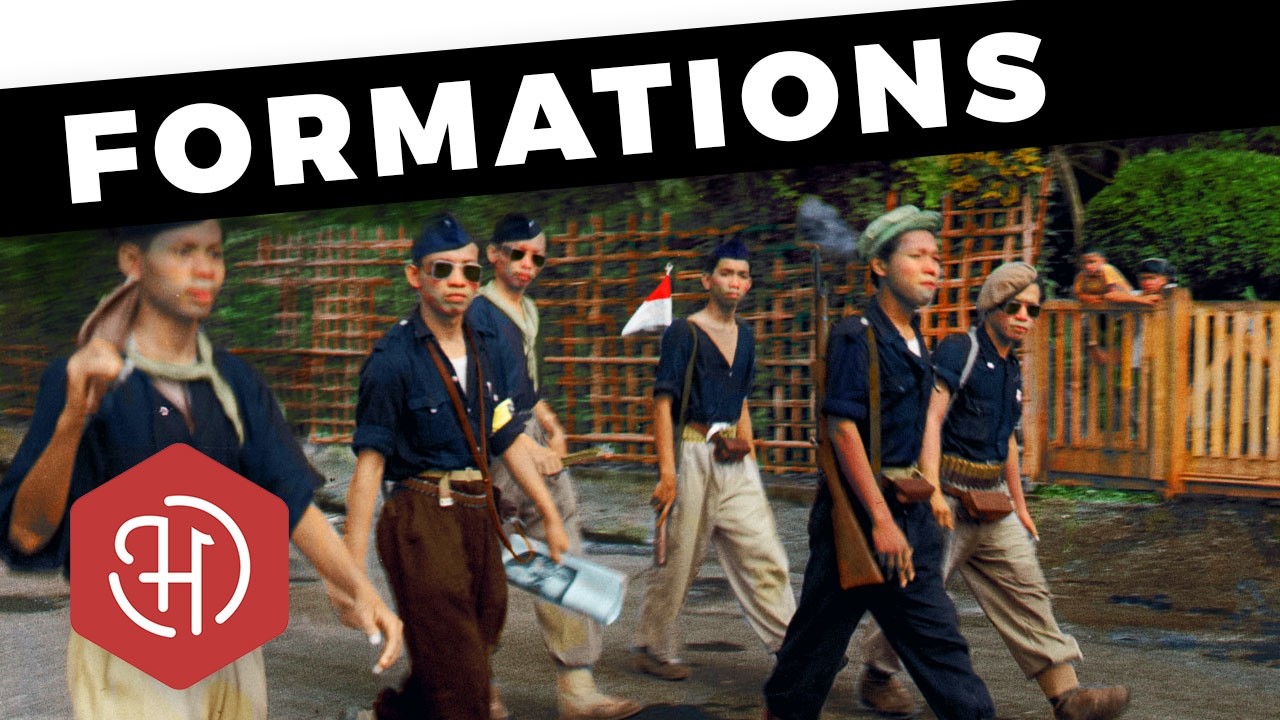
In August 1945, Japan surrendered. The Second World War in Asia was over, but for the people of the Indonesian archipelago, the fight was just beginning. The Dutch wanted their colony back, and the British were on their way to help them take it. The newly proclaimed Republic of Indonesia had no army, no weapons, and no centralized government.
All it had was a declaration of independence and a population willing to die for it. On August 17th, nationalist leaders declared the Republic. The new nation was vast, and the government in Jakarta had little real authority over its own territory. It needed soldiers.
It needed structure. It needed something that could hold back the return of colonial rule. So, on October 5th, 1945, the People’s Security Army, the TKR, was founded. In theory, it was a proper national army with a chain of command.
Java, the heart of the revolution, was divided into three territorial commands with ten divisions altogether. Sumatra had its own command with six divisions. In practice, it was chaos. The territorial commanders on Java were openly ignored by their own subordinates.
Centrally appointed division commanders were rejected by the men they were supposed to lead. The planned divisions never truly formed. Even the top of the chain was contested. On November 12th, 1945, a group of regional officers elected Raden Sudirman as supreme commander.
But not everyone accepted that choice, and the army remained deeply fragmented. On January 26th, 1946, the force was renamed the Army of the Republic of Indonesia, the TRI. The reorganization did little more than create two rival centers of power. One was under Defense Minister Syafruddin Prawiranegara, who believed the military should be subordinate to the civilian government.
The other was under General Sudirman, who saw himself as an equal partner, not a servant of politicians. He also rejected the government’s willingness to negotiate with the Dutch. The split between civilian leadership and military ambition would poison the republic for years. Then came the Dutch offensive.
In July 1947, the Dutch launched Operation Product and gained the upper hand. Under the Renville Agreement that followed, the TNI was forced to pull back from West and East Java into a much smaller area of Central Java. That territory could not sustain tens of thousands of soldiers. Food was scarce.
Weapons were scarcer. Something had to change. The man tasked with fixing the strategy was Colonel Abdul Haris Nasution, Sudirman’s deputy and a former officer trained by the Dutch colonial army. Nasution knew the republic could never win a conventional war.
So he proposed something else. He wanted a full guerrilla strategy, built on three phases. The first phase would be purely defensive, focused on survival and securing supplies. The second phase would see guerrilla units grow bolder, ambushing Dutch convoys and striking at their positions to capture weapons and equipment.
The third phase would only come once the Dutch were worn down to a stalemate, when the irregulars could evolve into a regular army and win a conventional victory. Nasution’s plan divided the TNI into two kinds of units. Territorial units would create pockets of resistance inside Dutch-occupied areas, relying on village networks and keeping the shadow Republican government alive behind enemy lines. Mobile units would hit economic and military targets, attacking supply lines and towns with hit-and-run tactics before dissolving back into the countryside.
The core of this army came from officers trained by the Japanese during the occupation. They were organized along territorial lines and knew small-unit operations, usually at company or battalion level. It was the former KNIL officers who held the higher command and advanced military education, which deepened the friction between headquarters and the men in the field. There were no standardized uniforms in the early days.
Fighters wore whatever they could get. Some wore Japanese boots. Others had ankle boots with puttees. Many walked barefoot.
As the war dragged on, captured Dutch uniforms began to appear, worn by men who were just as happy to take the clothes off a dead enemy as his rifle. Their weapons were as varied as their boots. Most came from Japanese stocks: Arisaka rifles, Nambu pistols, Type 89 machine guns, Type 92 heavy machine guns, and the traditional military swords, the guntō. There were also pre-war KNIL weapons that the Japanese had seized and then lost or abandoned when they surrendered.
At first, there were even some artillery pieces and light armored vehicles, though most of those were lost in 1945 and 1946. The republic had no reliable foreign supply line. They depended almost entirely on whatever they could capture from the Dutch, and those captures were rare. By December 1948, Dutch intelligence estimated that only 40 to 50 percent of TNI soldiers on Java were armed.
On Sumatra, the situation was worse. A battalion of eight to nine hundred men might have just one or two hundred rifles or carbines, four to six light machine guns, and one or two heavy machine guns and mortars. Artillery was limited to a single section of two pieces in one regiment. Ammunition ran low.
Communications depended on civilian telephones and messengers. Combat training was often rudimentary at best. The Dutch believed this made the Indonesian forces weak. Spoor saw no conventional army, just a scattered network of irregular fighters.
But that view underestimated what Nasution had built. Despite everything, the republic also had a small air force and navy. The air force began with a handful of captured Japanese aircraft, two fighters, three light bombers, four transports, and some trainers. It was officially established as a separate branch on April 9th, 1946.
It had almost no trained pilots, almost no mechanics, and almost no spare parts. During Operation Product in 1947, Dutch forces destroyed 24 aircraft while they were still on the ground. The navy was just as modest, a small number of small vessels and a few battalions used for land combat. Dutch estimates put its strength at around 15,000.
For years, the TNI fought a war of exhaustion. They lost ground. They lost men. They lost battles.
But they never stopped being a problem the Dutch could not solve. The Republicans hunkered down in the villages, kept their shadow government running, and waited. They ambushed convoys, raided towns, and kept the colonial army occupied in a fight that could not be won by occupation alone. In 1949, the Dutch finally transferred sovereignty to the Republic of Indonesia.
The colonizers left, and the ragtag force that had been too stubborn to die became the backbone of a new nation. Some people will tell you the Dutch could have won that war, that it was the politicians who lost it for them. There is an argument to be made for that, and there is an argument against it.
But the Indonesians did not win it on the battlefield alone, either.