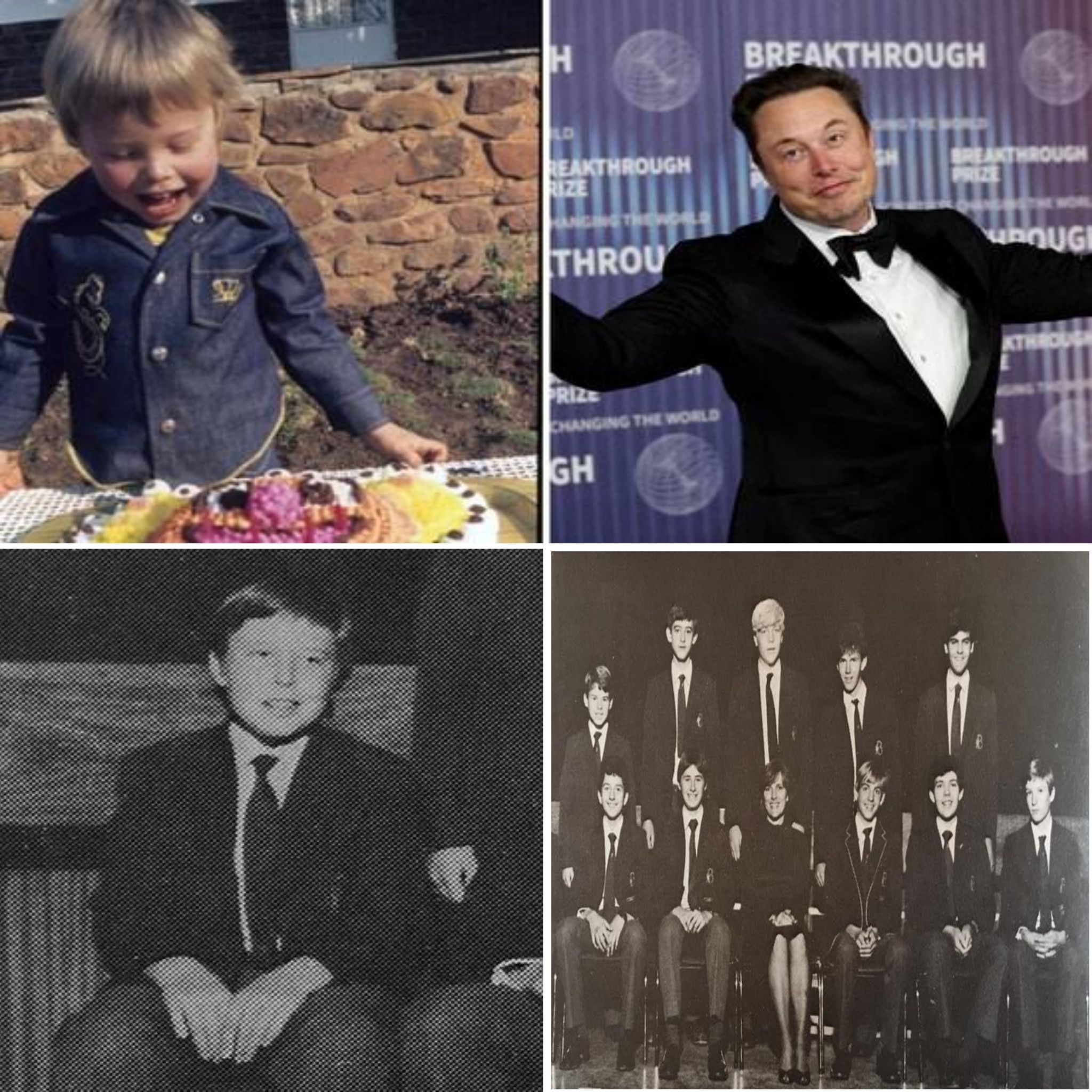
FACT-BASED NARRATIVE — built from historical records and reported accounts. Growing up under apartheid does not by itself establish Elon Musk’s personal racial beliefs; this story examines the environment in which he was raised and the contradictions inside it.
In 1988, Elon Musk was finishing high school in Pretoria.
He was 17 years old, bookish, interested in computers and preparing for a future far beyond South Africa.
But outside the world of his school, his neighborhood and the white communities in which he had grown up, the country was in crisis.
Black South Africans were living under a government that had spent decades deciding where they could live, which schools they could attend, what jobs they could pursue and even whether they could legally enter particular areas.
The extraordinary part was not that a white teenager in Pretoria could see all of this.
It was how easily he could avoid seeing much of it.
That was one of apartheid’s most effective features.
It didn’t merely oppress Black South Africans.
It constructed a different South Africa for many white South Africans.
And Elon Musk grew up inside it.
Musk was born in Pretoria in 1971, more than two decades after the National Party formally established apartheid.
By then, racial separation was not an informal social custom.

It was embedded in law.
South Africans were officially classified by race. Residential areas were divided racially. Public facilities were segregated. The education system for Black children had been deliberately structured around a lower economic and social position.
The Group Areas Act helped reserve valuable residential areas for white people while forcing millions of others from communities designated for different racial groups. The Bantu Education system, meanwhile, was explicitly designed around the apartheid government’s vision of limiting Black opportunity.
For a Black child born in South Africa in 1971, race could determine where the family was allowed to live before that child had learned to read.
For a white child, the machinery often operated very differently.
The privilege could feel almost invisible.
There did not need to be a government official standing beside a white teenager every morning explaining that apartheid was benefiting him.
The roads, schools, neighborhoods and opportunities had already been arranged.
That distinction matters when examining Musk’s childhood.
Because the most provocative question is not whether a boy personally designed the society into which he was born.
Obviously, he did not.
The harder question is what happens to children when an entire political system is designed to ensure that one group experiences security while another experiences coercion—and the two groups rarely encounter each other as equals.
Years later, people who attended school with Musk described precisely that insulation.
Terence Beney, who graduated with Musk from Pretoria Boys High School in 1988, told The New York Times that white children were largely protected from the harshest realities of the system.
Another former classmate described white South African teenagers of the period as remarkably unaware of what was happening around them.
That sounds almost impossible until you understand how apartheid worked.
Segregation wasn’t simply a line on a map.
It shaped what people saw.
And what they didn’t.
Consider what was happening in South Africa during Musk’s teenage years.
By the mid-1980s, resistance to apartheid had intensified dramatically. The government imposed states of emergency, detained opponents and placed severe restrictions on reporting. Authorities curtailed journalists’ ability to publish information about detainees and unrest, while images and recordings of political disturbances were restricted.
That meant the separation was not only physical.
It was informational.

A teenager could live in a country convulsed by racial conflict while receiving a filtered picture of that conflict.
Drive one direction and you could encounter manicured suburbs and elite schools.
Drive another and you entered communities where the state exercised a completely different kind of power.
Even education illustrated the divide.
In 1988, government figures cited at the time showed South Africa spending dramatically more per white student than per Black student.
White children and Black children were technically growing up in the same country.
But the country was investing in them as though their futures had entirely different value.
Musk’s own school experience was complicated.
He attended Pretoria Boys High School, an old and prestigious institution.
Accounts of his childhood describe him less as a confident beneficiary of his surroundings than as a socially isolated boy who read obsessively and endured severe bullying.
He has described being attacked so badly on one occasion that he ended up in a hospital.
At home, his family life was also difficult. His parents divorced when he was young, and both Musk and his brother have described a deeply troubled relationship with their father, though Errol Musk has disputed allegations about his parenting.
This is where simplistic versions of Musk’s childhood begin to fall apart.
Privilege does not mean a person never suffers.
A child can be racially privileged and still be bullied.
He can grow up with advantages created by the political system and still experience pain inside his own family.
He can benefit from structures he did not create without feeling that his own childhood was easy.
Those things can all be true at once.
And that is exactly why the story of Musk and apartheid is more uncomfortable than either his admirers or his critics sometimes make it.
Because there is another fact that complicates the picture.
At 17, Musk left South Africa for Canada.
Published accounts say one reason was compulsory military service.
White South African men faced conscription, and Musk has been described as wanting to avoid serving the apartheid state.
TIME reported that he left in part to escape the regime’s military draft.
That matters.
It does not erase the privileges of his childhood.
But neither does the fact that he grew up white under apartheid prove that he personally embraced apartheid ideology.
The evidence supports a more complicated conclusion.
Musk was raised inside a system built around white political and economic privilege.

He was substantially insulated from the suffering imposed on Black South Africans.
And he also left the country before apartheid ended, reportedly in part because he did not want to participate in the regime’s military system.
Those realities do not cancel each other.
They exist together.
By 1989, Musk was in Canada.
A few years later he moved to the United States.
Then came the story the world knows much better.
University.
Silicon Valley.
Zip2.
PayPal.
SpaceX.
Tesla.
Rockets landing themselves.
Electric cars becoming status symbols.
Factories.
Artificial intelligence.
Billions of dollars.
Eventually, Twitter.
By the time Musk agreed to buy Twitter in 2022, the quiet teenager from Pretoria had become one of the most powerful individuals in global communications.
And suddenly his childhood was no longer merely biographical trivia.
People wanted to know what had shaped the man preparing to control a platform used by governments, journalists, activists and hundreds of millions of ordinary people.
So they went searching backward.
Some critics looked at apartheid South Africa and drew a straight line to Musk’s later politics.
But history rarely offers lines that clean.
A person’s birthplace is not a confession.
Childhood privilege is not proof of adult ideology.
And guilt cannot reasonably be inherited merely from geography.
Yet the opposite mistake is just as misleading.
It would be equally wrong to treat apartheid as incidental background—a strange political system happening somewhere around Musk while he simply grew up.
Apartheid structured the society.
It influenced where people lived.
It influenced schools.
It influenced labor.
It influenced wealth.
It influenced whose suffering was visible and whose could remain comfortably distant.
The walls did not have to surround Musk personally to shape the world available to him.
That is the part of privilege people often misunderstand.
Privilege does not always feel like receiving something.
Sometimes it feels like not having something happen to you.
You don’t see your parents removed from their neighborhood.
You don’t carry the documents someone else must produce.
Your school receives resources another school doesn’t.
Police do not treat your presence in a particular neighborhood as a legal problem.
You grow up believing your environment is simply normal because nobody shows you the machinery required to make it normal for you.
For millions of white South Africans, that insulation was part of apartheid’s power.
The violence wasn’t only that Black people suffered.
It was that a white child could grow up surprisingly distant from the suffering being carried out in his name by the state.
Musk was hardly unique in this.
That is precisely the point.
If he had been the only sheltered white teenager in Pretoria, his biography might tell us something unusual about Elon Musk.
But former classmates have described something broader.
They were sheltered too.
A generation of young white South Africans could attend school, play sports, worry about exams and imagine their futures while only a relatively short distance away another population lived under laws specifically engineered to restrict those futures.
That was not an accident.
It was the design.
And then, at the end of the 1980s, the world Musk had grown up in began to collapse.
The apartheid government was under enormous internal and international pressure.
Resistance had made the system increasingly difficult to sustain.
Nelson Mandela would be released in February 1990 after 27 years in prison.
Four years later, South Africa would hold its first democratic election with universal adult suffrage.
Musk missed much of that transition.
By the time Mandela walked free, he was already building a new life in Canada.
By the time South Africans voted in the historic 1994 election, Musk was studying in the United States.
His future had moved thousands of miles away.
But South Africa never completely left the story.
Decades later, Musk would again speak publicly about race and politics in the country of his birth.
He has criticized South African racial policies and amplified concerns about violence and discrimination affecting white South Africans.
Some of those claims have generated fierce disputes.
In recent years, Musk has repeatedly attacked diversity and affirmative-action programs more broadly, while critics argue that his framing sometimes ignores the historical inequalities those policies were created to address.
South Africa remains one of the clearest examples of why those arguments are so difficult.
Apartheid officially ended.
Its economic geography did not magically disappear.
A law can be repealed in a day.
The distribution of land, wealth, education and opportunity created by decades of law cannot.
That is why debates over post-apartheid racial policies remain so bitter.
One side sees racial preferences in the present and asks why individuals should be treated differently according to race.
Another sees the accumulated consequences of generations of legally enforced racial preference and asks how equality can be achieved without confronting what was inherited.
Those questions deserve serious debate.
But any serious debate has to begin with what actually happened.
And what happened in the South Africa of Musk’s childhood was not vague “racial tension.”
It was government-enforced racial hierarchy.
The state classified human beings.
It separated neighborhoods.
It removed communities.
It segregated education.
It controlled movement.
It deliberately privileged one racial minority over the Black majority.
That history does not tell us automatically what Musk believes today.
But it tells us something important about the environment that produced him.
And perhaps the most revealing detail is not what young Elon Musk saw.
It is what he was able not to see.
Imagine being 16 years old.
You are worried about school.
You read constantly.
You experiment with computers.
You endure bullies.
You think about leaving home.
You dream about another country.
Meanwhile, your government is detaining opponents and censoring coverage of unrest.
Black teenagers your age are growing up inside an education system created by the same state but designed for radically different expectations.
You experience your problems as personal.
They experience theirs as personal and political, because the law itself has already placed them inside a racial category with fewer rights and opportunities.
And yet you could live only miles apart.
That was apartheid’s strange psychological achievement.
It made injustice enormous for the people suffering it while allowing many of its beneficiaries to experience it as distant background noise.
Years later, when the beneficiaries say, “I didn’t really know,” outsiders sometimes hear that as an excuse.
But in a system built around separation, ignorance can also be evidence of how successful the system was.
That does not absolve adults of responsibility for what they later choose to learn or believe.
It simply explains the architecture.
And there is one final irony.
The boy who grew up inside one of the most rigidly divided information environments of the late twentieth century eventually bought one of the world’s largest information platforms.
In 2022, the argument surrounding Musk and Twitter was ostensibly about free speech.
Who should be allowed to speak?
What should platforms suppress?
Who decides what counts as misinformation?
What happens when institutions control what citizens are permitted to see?
Those questions were deeply modern.
But Musk had been born into a country where control of information had consequences far beyond social media.
During apartheid’s emergency years, the government restricted coverage precisely because visibility mattered.
If people cannot see injustice clearly, they have fewer opportunities to challenge it.
If communities are physically separated and their information is filtered, radically different versions of the same country can exist at the same time.
One population can experience emergency.
Another can experience normality.
That may be the most important lesson in Musk’s South African childhood, and it is larger than Musk himself.
The story is not that a white boy was personally responsible for apartheid.
He wasn’t.
It is not that hardship in his own life was somehow fake because he was white.
It wasn’t.
And it is not intellectually serious to diagnose every political position he holds today by pointing to the country on his birth certificate.
The deeper story is about how systems shape perception long before children have language for politics.
Musk escaped South Africa before he was required to build his adult life inside apartheid.
Millions of Black South Africans could not simply board a plane and leave the consequences behind.
Their families lived through forced removals, inferior schooling, restricted movement, political exclusion and an economy engineered over generations.
That is the difference between experiencing hardship inside a privileged group and experiencing hardship because the law has decided your group should be subordinate.
Both can hurt.
Only one was government policy.
And perhaps that is why Terence Beney’s observation about white children being insulated carries more weight than any attempt to psychoanalyze Musk from afar.
The most powerful systems of privilege are not always the ones constantly reminding beneficiaries that they are privileged.
They are the ones that make privilege feel so ordinary that beneficiaries barely notice the alternative.
Elon Musk eventually left that world.
He became an immigrant.
Then an entrepreneur.
Then a billionaire.
Then one of the most influential people alive.
But understanding where someone came from does not require declaring him guilty of everything that happened there.
It requires something harder:
Holding two truths in your mind at once.
A child can be innocent of creating an unjust system.
And that same child can still benefit from it.
A teenager can dislike aspects of the country he grew up in.
And he can still fail to understand what people outside his protected environment endured.
A man can leave a system behind.
And questions about what that system taught—or failed to teach—can follow him decades later.
That isn’t uniquely an Elon Musk story.
It is a human one.
Because every generation inherits a world it did not build.
The moral test comes later, when we become old enough and powerful enough to decide whether we will examine what that world gave us, what it hid from us, and what it took from somebody else.
Privilege is not proven by having an easy life. Sometimes privilege is simply being allowed to believe that the suffering happening all around you has nothing to do with your life at all.


