The bombardment that began on the morning of June 2nd, 1942, was unlike anything the city had endured. For the defenders of Sevastopol, huddled in the limestone forts and underground bunkers, the continuous roar seemed to come from the earth itself, as if the peninsula was splitting open. For months, the German command under Erich von Manstein had gathered its strength for this moment. They had failed in their direct assault the previous November, so they had decided to throw metal and explosives at the fortress until nothing could stand against it.
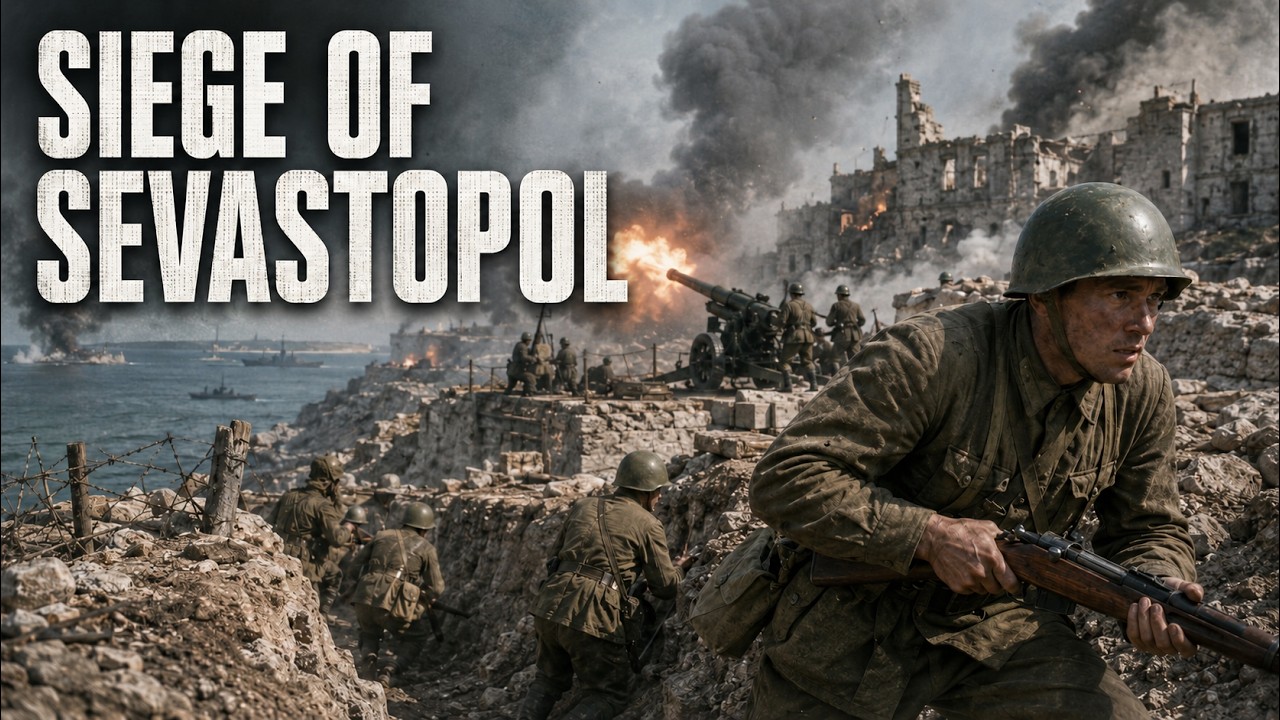
Among the weapons they brought forward was the Gustav gun, the largest artillery piece ever built. Its barrel alone was over thirty meters long, and the entire weapon weighed more than a thousand tons. Each shell it fired weighed nearly a ton, and it required fifteen hundred men to operate. When it fired, the report reshaped the very air, and wherever the shell landed, concrete and stone were simply removed.
A sister gun, Karl, arrived alongside it, smaller but no less devastating. Inside Sevastopol, the defenders knew what was coming. They had held through the autumn encirclement, through the brutal winter of short rations and bitter cold, through the failed German assaults. The city on the southwestern tip of the Crimean Peninsula had been under siege since October of 1941, and its garrison, a mix of Soviet sailors and soldiers, had refused to break.
The city’s defenses were formidable. Fort Maxim Gorky, with its massive twin 305-millimeter guns, dominated the northern approaches. The ridgelines and deep ravines that ringed the harbor created a natural fortress that favored the defender. Every approach had been registered for artillery fire, and the fortifications were layered in depth.
The German encirclement of the city had tightened through the winter, but the sea remained a lifeline. The Soviet Black Sea Fleet, though battered, still ran supply missions at night, threading through minefields and evading German aircraft to deliver food and ammunition. Submarines moved beneath the dark waters, carrying what they could. The siege settled into a rhythm of intermittent shelling, snipers, and patrols, until the spring, when the Germans prepared their final assault.
When the bombardment began in June, it was relentless. Day after day, the German guns fired, and the dust from pulverized stone hung in the air like a pale fog. The defenders could not see more than a few yards, and they breathed the dust with every exhausted breath. The Gustav fired its colossal shells at the forts, and the ground shook for miles.
The fortifications, though damaged, held. The defenders, though exhausted, endured. But the math of the siege was turning. The supply ships found it harder to break through.
Ammunition dwindled. The wounded filled the cellars, and there was almost no morphine left. By the end of June, it became clear that the end was near. The Soviet command in Moscow ordered an evacuation by sea.
On the nights of June 29th and 30th, destroyers and submarines moved toward the beaches at Cape Chersonesus, the last Soviet-held promontory. In the darkness, the wounded and the essential personnel were loaded aboard small boats. Not everyone could leave. There were never enough ships.
Officers made terrible choices about who would be taken and who would remain to cover the withdrawal. Some men waded into the black water, moving quietly to avoid attracting German fire. The Germans, aware of the activity, shelled the beaches. The evacuation was a salvage operation, not a triumph.
Many were left behind when the boats departed, watching the dark water swallow the only escape route they would ever be offered. By the time the first light of July 4th broke over Sevastopol, the evacuation was over. The remaining garrison, perhaps fifteen or twenty thousand soldiers, faced capture, surrender, or death. Some fought on in small pockets among the ruins.
The formal surrender came in the early afternoon of July 4th, 1942, after 250 days of siege. The human toll was staggering. An estimated one hundred to two hundred thousand Soviet soldiers died during the siege. The losses for the German 11th Army were steep as well.
The conquest of Sevastopol exhausted the German forces, leaving them unable to sustain further major offensives. The city itself lay in rubble. But even as the German occupation began, something remarkable started to happen. The survivors began the slow work of clearing rubble, identifying bodies, and rebuilding.
After the war, the Soviet Union poured resources into the reconstruction of Sevastopol. By the 1960s, the city was once again a functioning Black Sea port. The scars of the siege remained visible in the pockmarked walls and the gaps where buildings had been completely destroyed. The forts became memorials and museums, their massive guns still pointing outward toward the sea.
Today, the harbor at Sevastopol is quiet. The limestone cliffs still rise from the water as they did in 1941, wrapped in the salt smell of the Black Sea. But the thunder of the siege guns has dissolved into memory. Time transforms the individual sacrifice into collective weight.
The sailor who manned a gun in Fort Maxim Gorky, the teacher who tried to keep children calm in an underground shelter, the nurse who moved between the wounded in the darkness—these people become the symbol of the siege. The city remembers, even if the memory is encoded now in the physical rather than the lived. The defenders of Sevastopol endured not because they believed they would win. Many of them knew the city would fall.
They endured because endurance was what was required of them in that moment. And in the end, the city was rebuilt, and life continued. The harbor returned to its natural rhythm, and new people were born who had no direct memory of the siege.
But the choice to stay and rebuild, to live in a place that had been so wounded, was its own kind of victory.