On July 19th, 1940, Hitler walked into the Kroll Opera House in Berlin. Not to watch a performance, but to stage one. In a single afternoon, he promoted twelve generals to field marshal, the highest rank in the German military. Within five years, one of them would be hanged by the Allies.
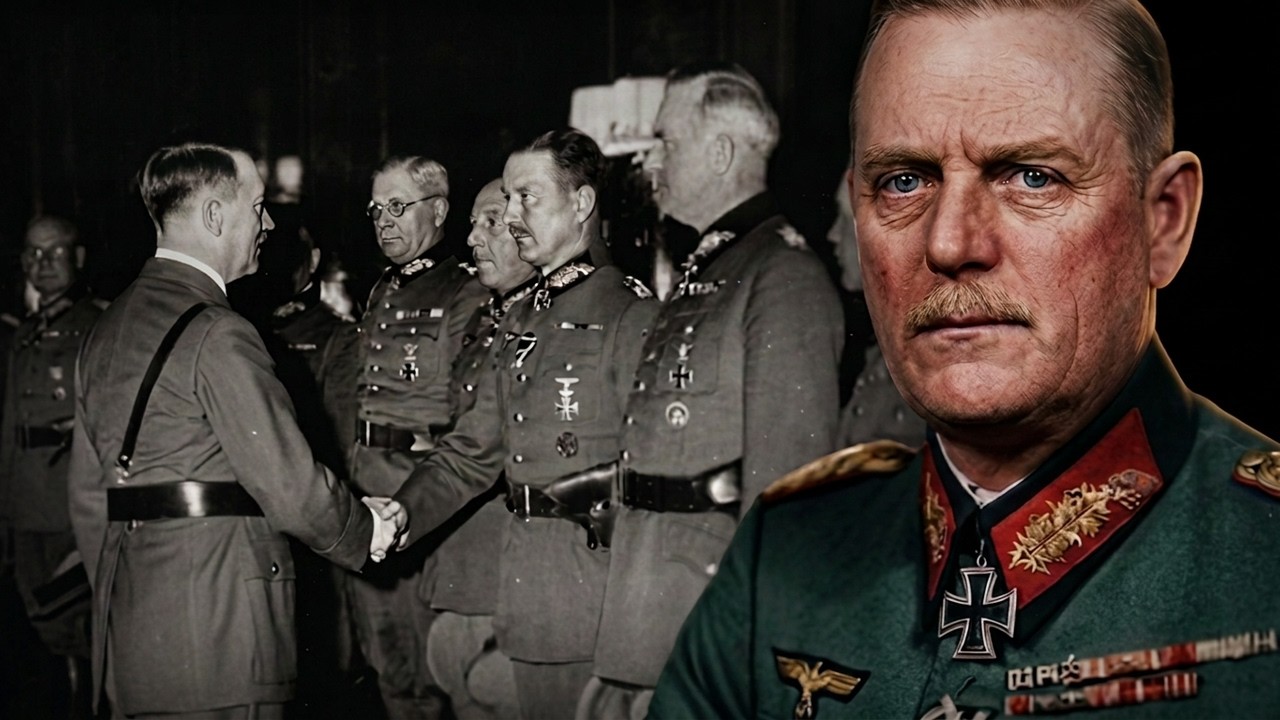
Another would be hanged on Hitler’s own orders. The rest faced trial, dismissal, or did not live to see the war end. Not one of them ended where the ceremony had promised. In the summer of 1940, Germany stood at the height of its power.
In a single campaign, the German army had overrun the Netherlands, Belgium, and France — a country widely considered to have the strongest army on the continent — and done it in six weeks. Poland had fallen the autumn before, Denmark and Norway that spring. To mark the victory, Hitler wanted a ceremony unlike any other. He summoned his senior commanders to the Kroll Opera House, the building that had housed the German Parliament since the fire of 1933, for a session of the Reichstag staged as a victory celebration.
After a long speech, he called the commanders forward and presented each with an ornately decorated baton. The newsreels carried the scene across Germany: rows of senior officers, Hitler moving down the line. The rank they received carried more than prestige. A German field marshal drew a salary of 36,000 Reichsmarks a year, free of tax, and was never formally retired.
Once promoted, he stayed on active duty for the rest of his life. Germany had abolished the rank after the defeat of 1918. Only under Hitler’s rearmament had it returned. Raising twelve commanders to field marshal in a single afternoon rewarded them.
But it also tightened Hitler’s grip on an officer class whose aristocratic traditions and distance from the Nazi Party he had never fully trusted. By the end of the ceremony, twelve officers who had entered the hall as generals had left it as field marshals. Nine were army commanders: Walther von Brauchitsch, Fedor von Bock, Wilhelm Keitel, Günther von Kluge, Wilhelm Ritter von Leeb, Wilhelm List, Walther von Reichenau, Gerd von Rundstedt, and Erwin von Witzleben. Three came from the air force: Albert Kesselring, Erhard Milch, and Hugo Sperrle.
One man stood even higher. Hermann Göring, already a field marshal, was raised that same day to a rank invented specifically for him: Reichsmarschall, Marshal of the Reich, placing him above every officer in the armed forces and confirming his position as Hitler’s chosen successor. The ceremony was meant to present them as the finest military elite in Europe. It was not the start of a long age of glory.
It was the high point before the fall. But the men standing on stage also revealed something about the kind of officer Hitler was prepared to reward — and about those he was prepared to leave behind. The collapse came slowly, one man at a time, across five years. Wilhelm Keitel had been the most senior of them on paper.
As chief of the Armed Forces High Command, he sat at the top of the military structure and put his signature to a series of orders that stripped legal protection from prisoners and civilians in the occupied territories. He stayed loyal to Hitler to the end. And on May 8th, 1945, it was Keitel who signed Germany’s unconditional surrender. At Nuremberg, the International Military Tribunal found him guilty on all four counts and rejected his defense that he had only followed orders.
He was hanged on October 16th, 1946. Erwin von Witzleben arrived there by the opposite road. He had turned against Hitler and was one of the central figures in the plot of July 20th, 1944. Had it succeeded, he was to have become commander-in-chief of the armed forces.
It failed. Von Witzleben was arrested, stripped of his rank, and expelled from the army so that he could be brought before the People’s Court, the political tribunal where Judge Roland Freisler presided over the trials of the conspirators. He was condemned and executed at Plötzensee Prison in Berlin on August 8th, 1944. Two of the twelve hanged within two years of each other.
One by the victors for serving Hitler. The other by Hitler for trying to remove him. Two more never lived to face any reckoning. Walther von Reichenau had been one of the most political of Hitler’s commanders and one of the most committed.
Leading the Sixth Army in the east, he issued an order to his troops in late 1941, later known as the Severity Order, that openly tied the army to crimes being carried out on the front. In January 1942, after running for miles in extreme cold, he collapsed from a stroke. The decision was made to fly him back to Germany for treatment, and he died during the journey on January 17th, 1942. Fedor von Bock lasted longer but ended more violently.
He had commanded an army group in the invasion of the Soviet Union before Hitler removed him in 1942, and he spent the rest of the war in enforced retirement, sidelined and unwanted. On May 3rd, 1945, with the war days from its end, a Royal New Zealand Air Force fighter strafed his car on a road in northern Germany. His wife and daughter were killed. Von Bock died of his wounds the next day.
He was the only one of the twelve to be killed by enemy fire. One of them was destroyed by neither the enemy nor a court. Günther von Kluge had known about the July 20th plot in advance and had given the conspirators quiet encouragement without ever committing himself. When the attempt failed, his own hesitation left him exposed.
By August 1944, his armies in France were collapsing in the pocket of Falaise, and Hitler, already suspicious, relieved him of command on August 17th and ordered him back to Berlin. Von Kluge never reached the city. On August 19th, 1944, on the road near Metz, he took cyanide. In a final letter to Hitler, he insisted he had done his duty to the last.
By then, the elite that had stood together on the opera house stage four years earlier had begun to consume itself. Five of the twelve lived to be tried by the Allies. This was where the promise of Nuremberg met the reality of the postwar world. These were the men who had commanded occupation armies and passed on criminal orders.
Not all of them disappeared into prison cells. Some did. Others walked out. Albert Kesselring had commanded German forces in Italy.
The gravest charge against him was the reprisal killing of more than 300 Italian civilians at the Ardeatine Caves outside Rome in 1944, carried out after a Partisan bombing killed German police — though none of those shot had any part in the attack. In 1947, a British military court in Venice sentenced him to death. The sentence was commuted to life imprisonment, and in October 1952, he was released on grounds of ill health. He died a free man in 1960.
Wilhelm List was the principal defendant in what came to be known as the Hostages Trial at Nuremberg, charged over reprisal policies in occupied southeastern Europe. He was sentenced to life imprisonment in 1948 and released, like Kesselring, in December 1952 for medical reasons. He lived until 1971. Erhard Milch had run aircraft production for the air force and was convicted at his own Nuremberg trial in 1947 for the use of forced labor.
He too received a life sentence. It was reduced to fifteen years, and he was released in 1954. Wilhelm Ritter von Leeb and Hugo Sperrle were tried together in the High Command Trial, the last of the Nuremberg proceedings. Leeb was convicted of passing on a criminal order and sentenced to time already served.
He walked out of the court a free man. Sperrle, whom Hitler had dismissed in 1944 after the failure to stop the Allied landings in Normandy, was acquitted of every charge. Five men who had served near the top of Hitler’s war machine. One death sentence commuted.
Two life sentences, both cut short. One sentence of time already served. One acquittal. Within a decade of those verdicts, all five surviving defendants were free.
The last two never reached a courtroom at all. Walther von Brauchitsch had been commander-in-chief of the army at the ceremony in 1940, the most senior soldier in Germany. A year later, after a heart attack in the failure of the drive on Moscow, Hitler blamed him for the defeat and dismissed him on December 19th, 1941. He was arrested at the end of the war and held in British custody, where the Allies intended to try him.
He died in a Hamburg military hospital on October 18th, 1948, before the trial could begin. Gerd von Rundstedt had been dismissed and recalled by Hitler so often that the pattern became a feature of his career. He had also chaired the Court of Military Honor, the panel that expelled the July 20th plotters from the army so the People’s Court could try them — among them, in effect, his fellow marshal Witzleben. Captured in 1945, Rundstedt was charged with war crimes, but the case against him was dropped on the grounds of his age and failing health.
He was released in 1949 and died in 1953, never having stood trial. The ceremony of July 1940 had been staged to prove that Hitler had built the greatest military elite in history. Within five years, that elite was dead, imprisoned, disgraced, or simply gone. One senior general was noticeably absent from the promotions on July 19th.
Johannes Blaskowitz had been placed in charge of the German army in Poland after the invasion. In the months that followed, he repeatedly reported the killing and mistreatment of Polish and Jewish civilians by SS and police units. His memoranda warned that these actions were strengthening resistance, damaging Germany’s reputation, and undermining discipline within the army itself. Hitler dismissed his objections as childish.
Brauchitsch declined to support him. Blaskowitz was removed from his command in May 1940. Two months later, he was the only colonel general not promoted to field marshal that summer. He would hold major commands again.
But he never received the baton. Blaskowitz had not rejected Hitler’s war. But he had protested the conduct of the SS and police in Poland. That was enough to leave him without a baton.
And the reckoning that followed was thinner than that July ceremony might suggest. Of the twelve men Hitler promoted that afternoon, only one was hanged by the Allies for what the regime had done. The rest were released, acquitted, or beyond the reach of any court by the time the trials came.


