The Battle of Berlin raged from April 20, 1945, when Soviet forces first reached the city’s eastern suburbs—ironically, Hitler’s 56th birthday. Ten days later, he was dead in his bunker beneath the Reich Chancellery garden, and two days after that, Berlin surrendered to Stalin’s army. That battle produced one of World War II’s most iconic images: a Soviet soldier raising the red flag above the Reichstag. But another photograph from those final days tells a quieter, stranger story—a lone Tiger I tank, wrecked and silent, sitting just a hundred meters in front of the battered Brandenburg Gate.
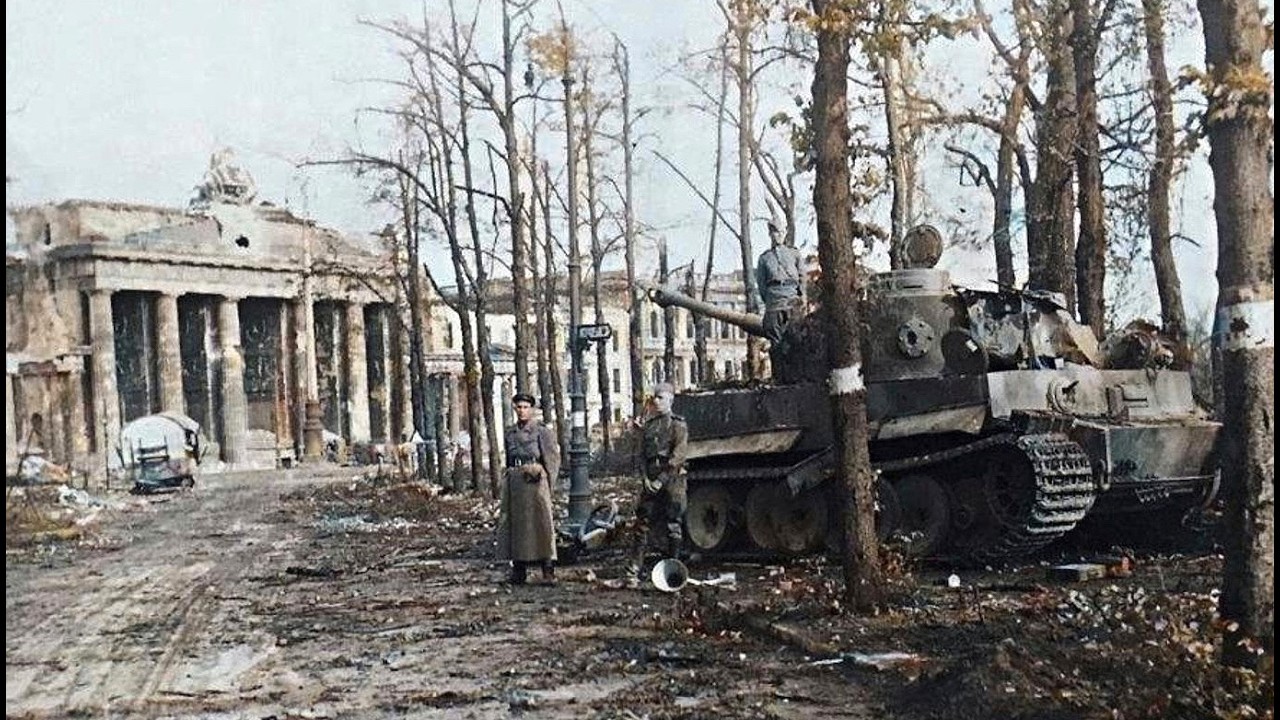
The tank epitomized German armored power. Now it lay destroyed before one of Germany’s greatest military monuments, itself a ruin. Propaganda aside, how that Tiger ended up there is a fascinating piece of the last stand of the Thousand-Year Reich. The fall of Berlin began with the failure of Germany’s last major defensive line east of the city—the Seelow Heights, about a hundred kilometers out.
The Soviets opened their massive offensive on April 16, 1945. German forces, exhausted and often outnumbered, fought desperately, inflicting enormous casualties, but by April 19 the Red Army broke through and poured onto the open ground before Berlin. What remained of the German forces fell back into the city and its three defensive rings, with the Soviets close behind. One of those units was an ad hoc formation called the Müncheberg Panzer Division.
It had been thrown together in late February 1945 from training and tank demonstration units at the Kummersdorf testing grounds, initially cobbled together from repaired tanks—four King Tigers, one Tiger I, and one Jagdtiger. In mid-March it was expanded with more armor, and it fought at Seelow Heights until pulled out on April 17 and withdrawn to Berlin. Its remaining heavy tanks were vital for defending the city center. By April 24, Müncheberg was fighting in the northeast sector, and on April 26 it joined the 11th SS Panzergrenadier Division Nordland in a counterattack to drive back Soviet spearheads at Tempelhof Airport and Neukölln.
Ten tanks took part. The counterattack failed. Müncheberg fell back to defense sector Z—Z for Zitadelle, the Citadel. This was the central government district, filled with massive ministry buildings and monuments.
Thousands of SS, army, navy, air force troops, Volkssturm home guards, and Hitler Youth fought to hold it, ultimately to protect Hitler in his bunker under the Chancellery garden. The Citadel was a tough nut to crack. Beyond the huge buildings like the Reichstag, massive flak towers mounted large-caliber guns that could fire down on Soviet tanks as they advanced. Müncheberg and its remaining handful of functioning heavy tanks were used to bolster the defenses of the Tiergarten, the large central park where the Germans had set up an emergency landing strip on Charlottenburger Chaussee, with prefabricated workshops hidden nearby.
The control tower was the repurposed Victory Column, one of Berlin’s most famous monuments. I recently climbed the many steps to the top. In 1945, Luftwaffe air traffic controllers directed flights from there with nothing more than a radio, managing what would be the last airbase in Berlin. The height gives you some idea of the views from a flak tower balcony—and how the now-demolished zoo flak tower’s guns dominated the entire area for miles around.
Red Army forces fought across the Moltke Bridge over the Spree River to assault first the Ministry of the Interior—which they called Himmler’s house, a massive edifice—and the adjacent diplomatic quarter. Then they launched head-on attacks against the Reichstag across the Königsplatz. The Reichstag’s defenses were brutal: an artificial water obstacle created by flooding an incomplete U-Bahn tunnel, anti-tank ditches, infantry trenches, 88-mm flat guns, and loophole firing positions in the Reichstag itself and on its roof. Supporting fire came from the zoo flak tower behind.
A Müncheberg Tiger I, numbered 323, was positioned beside the Reichstag, covering the top end of the Tiergarten in front of the Brandenburg Gate. Undoubtedly low on fuel, its job was to act as a blockhouse, taking on any Soviet tanks that approached the sector. A second Tiger I was probably stationed near the zoo flak tower at the other end of the Chaussee. Looking at the Soviet photographs, one point stands out: Tiger 323’s final position.
It was likely sitting in the road originally. In the photos, the gun faces rearward, as if ready for loading onto a tank transporter, and the vehicle sits among linden trees that would have impeded the traverse of its long barrel. I suspect that after the battle, Soviet engineers dragged the tank off the road to clear a path for military traffic—hence how it looks in the photographs taken shortly afterward. Generalmajor Werner Mummert, commanding the Müncheberg Panzer Division, set up his command post in the enormous zoo flak tower.
Near the Victory Column, an armored vehicle—sometimes misidentified as a StuG assault gun—was most likely a Müncheberg armored ammunition carrier based on the Panzer IV. It could well have been hauling ammunition the two kilometers to Tiger 323 from stores at the flak tower when it met its end. Tiger 323 fought until May 1, 1945, when its crew destroyed it and abandoned it, probably due to battle damage or lack of ammunition. Of its five crew members, only one survived the Battle of Berlin.
The Reichstag finally fell on May 2. Though the Soviets had first raised their red flag atop the building on April 30, fighting continued room-to-room, floor-to-floor for several days. When it finally ended, a second photograph was taken—the famous image of another red banner being planted on the roof. Tiger 323 remained in the Tiergarten for a while after the German surrender on May 2, becoming a popular backdrop for Red Army soldiers’ photographs.
Though often described as the last Tiger to fall in Berlin, that honor actually went to a Tiger II—turret number 314 of the 503rd SS Heavy Panzer Battalion—which made an extraordinary last stand outside Potsdamer Railway Station. That beast was credited with knocking out 39 Soviet tanks and assault guns, and was ironically knocked out itself when it tried to move and ran over a German mine. That happened several hours after Tiger 323 was destroyed at the Brandenburg Gate. In one photograph of 323, the Soviets have wound the turret back around, and a truck appears to have been driven right up to the tank.
The bow machine gun has been removed. Perhaps they were stripping it of ordnance and other movable items before hauling it away. By the time US and British forces arrived in Berlin in July 1945, Tiger 323 was gone—I can find no photographs of American or British soldiers climbing on it. It was hauled to a central collecting point, stripped, and eventually scrapped by the Soviets.
But if you want to see history for yourself, you can stand today at the exact point where Tiger 323 was destroyed. Even the surviving trees are exactly the same. None of the knocked-out German tanks were preserved by the Soviets in museums. But there are tanks from the Battle of Berlin preserved very close to where Tiger 323 was destroyed—a pair of Soviet T-34-76s at the Soviet War Memorial in the Tiergarten.
Behind the memorial lies a cemetery containing about two and a half thousand Soviet dead from the battle, just a small portion of the roughly eighty thousand who fell trying to take the city. The flag above the Reichstag became a symbol of victory. But for one Tiger crew, and for the men who fought around it, the end of Berlin came not with triumph, but with destruction, abandonment, and silence among the linden trees.


