The Vaseline jar was nearly empty. That was what Lieutenant Bayer noticed first, the last ration of thick grease that men smeared on their faces to keep the frost from claiming their cheeks and noses. The winter of 1944 had settled over the Ukrainian steppe with a brutality that made even the veterans of Russia pause, and inside what the men now called the pocket, the cold was not merely weather. It was a presence, a hungry thing that lived in the frozen mud and the thin canvas of the tents.
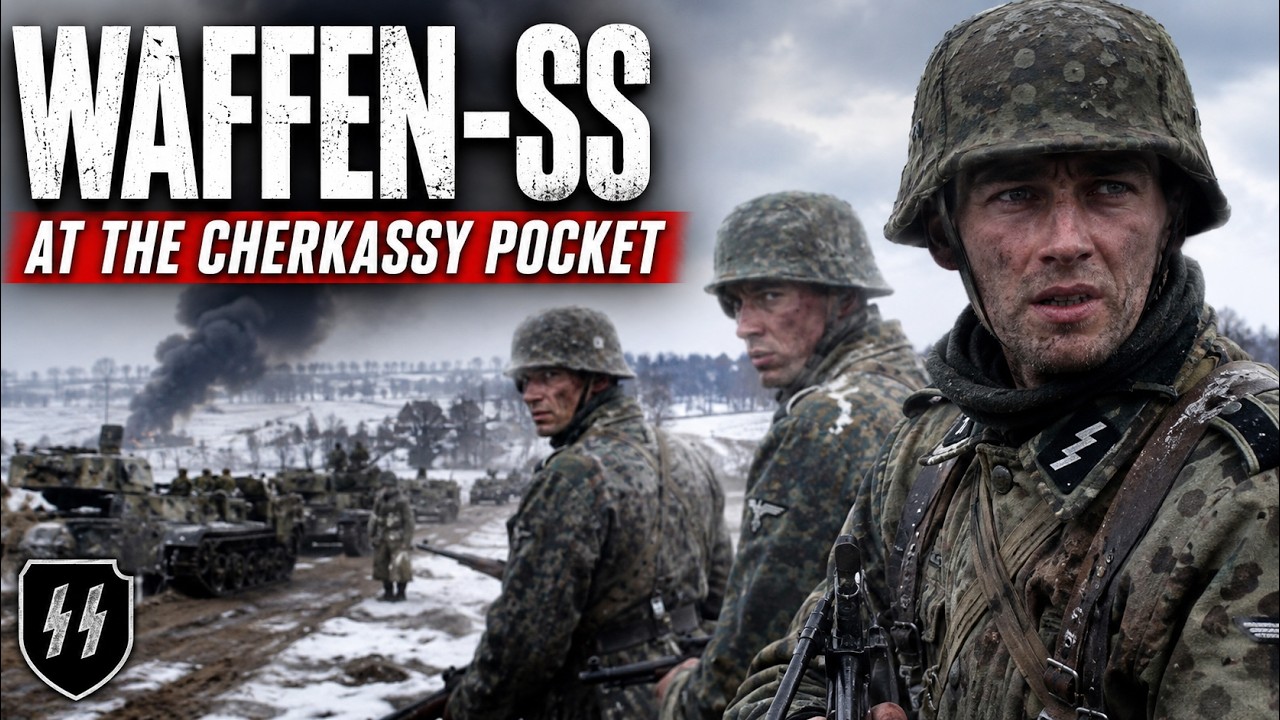
At the beginning of February, the reality of their situation pressed down on the trapped German forces with the weight of the snow itself. Nearly fifty thousand men, portions of two army corps, held a shrinking circle of frozen ground near the towns of Korsun and Cherkasy. German intelligence had failed them. The maps showed a relief column fighting its way south, but the rumble of distant guns had grown quieter over the past three days.
The men did not need a command briefing to understand what that silence meant. Inside a bunker dug deep into the frozen earth, General Wilhelm Stemmermann stared at the fuel gauge of a small portable radio. It was dead. A signaller with frozen fingers was attempting to rig a replacement, but the batteries lay in the snow like black bricks, drained of all life.
The order from Berlin had been absolute. Hold the pocket. Relief is coming. But if the relief column was coming, why had the artillery fire ceased?
Officers gathered in the dim light of a kerosene lamp, their faces gaunt and smeared with that last Vaseline. They spoke in low voices, aware that words carried in the frozen air. The supply situation was critical. Rations had been cut to a single piece of bread per man per day.
The horses, those loyal, suffering animals that had pulled the heavy guns through the Russian mud, were dying. Their frozen corpses lay in rows beyond the perimeter, waiting for a butcher who no longer had the strength to work. “We cannot stay here,” said Colonel von Liebenstein, commander of the Waffen-SS Viking Division’s Panzer regiment. His Nordic volunteers, the Norwegians and Danes and Swedes who had answered the call of ideology, had proven their fighting spirit.
But even their steely resolve was crumbling under the assault of hunger and frost. “They are not coming. You know this. ”
Stemmermann did not argue.
He had survived the mud of the Demyansk Pocket, the hell of Stalingrad’s outskirts. He knew the pattern. Berlin would sacrifice a corps to hold a line on a map, and he was not willing to sacrifice these men, not again. He spoke the words that had been forming in his mind for three days.
“We break out. Toward the sound of those guns we can no longer hear. We go before the thaw comes. ”
The decision felt like a surrender to the enemy within, a betrayal of orders.
But when he looked at the faces of his officers, he saw not mutiny but relief. Men who had been waiting for permission to hope. The breakout was planned for the night of February 5th. In the frozen twilight, the pocket began a strange, quiet transformation.
Men who had hoarded their strength in shallow dugouts rose and checked their weapons. Rifles were cleaned, magazines loaded. The wounded, those too far gone to walk, were carried to the field hospitals where a skeleton crew of medics and volunteers would remain behind. It was the hardest order Stemmermann had ever given.
The hospitals were to be given over to the Soviets, the wounded left in their care. No one spoke of what that would mean. A few men slipped away into the darkness to say goodbye to friends who would not see the dawn. Lieutenant Bayer looked at his Vaseline jar, now empty, and tossed it into the snow.
He was a young man, a supply officer with the Viking Division, not a combat soldier. His job had been to count crates and estimate rations. Now he traced the line of the horizon where the frozen tree line met the white sky, and he found himself calculating his own chance of survival. The officer in charge of his section, a stern Hauptsturmführer named Weber, had ordered all non-essential gear abandoned.
Bayer slipped his small camera, a precious gift from his mother, into the lining of his greatcoat. A foolish thing, perhaps, but it made him feel human. At midnight, the perimeter erupted. Soviet searchlights swept across the snow, and the steady rumble of artillery began anew.
But this time, the shells were aimed at their own positions. The breakout had been detected. The columns moved out into a world of screaming metal and blinding flashes. The plan was simple.
The SS Viking and the Walloon Brigade would spearhead the assault, punching a hole through the Soviet lines toward the Gniloy Tikich River, that narrow, frozen waterway that stood between the pocket and the German lines. Then the main infantry would follow, and the rear guard would hold the Soviet army back long enough for as many as possible to escape. The first hour was a chaos of close-quarter fighting. Moments of intense action, of bayonets and tracer fire, were followed by a strange, deafening silence.
In those silences, the men could hear other sounds: the groans of the wounded, the crunch of frozen snow underfoot as they moved. Lieutenant Bayer lost his section in the darkness. He followed a group of men he did not know, clinging to them as a point of stability, his heart pounding against his ribs. They reached the river by dawn, a churning expanse of ice choked with broken vehicles and the frozen dead.
The temperature had climbed to near freezing during the night, and the ice began to groan and shift under the weight of the retreating men. The crossing was a horror. The men pressed forward, the water seeping over their boots and up their legs, the cold stealing the breath from their lungs. Horses, panicked by the sound of cracking ice, were shot where they stood.
The Walloons, their discipline admirable even in calamity, used their machine guns to cover the crossing, their own casualties severe. On the far bank, Lieutenant Bayer was separated from his group again. He stumbled through the snow, alone, following a line of footprints that led toward a distant, burning village. He had lost his greatcoat somewhere in the river, and his boots were filled with icy water.
Walking beyond his physical limits, he was about to sit down in the snow and let the cold take him when a voice called out in German. A young soldier, a boy of perhaps seventeen, waved from behind a shattered tree. “This way! The supply trains are through here.
”
Bayer joined him, and together they entered the chaos of the German relief zone. The men arriving from the pocket were a sight to break any heart. They moved in a silent daze, their faces gaunt, their eyes hollow. Trucks were waiting to take them away, but many simply collapsed into the snow, too exhausted to move.
The field kitchens were working overtime, handing out hot soup and bread to men who could barely hold a spoon. Bayer found a corner of a barn and slumped against a wall. He was physically and emotionally drained. One of the medics, a tired-looking Obergefreiter, approached him and pressed a warm tin of soup into his hands.
“We made it,” the medic said, his voice flat with a survivor’s exhaustion. “We made it out. ”
The official count in the hours after the breakout was a hollow victory. Of the estimated fifty thousand men trapped in the pocket, perhaps forty thousand had reached the German lines.
But thousands had been left behind in the hospitals, had fallen in the river, or had been cut down by Soviet fire during the escape. The survivors gathered in the fields that night, their shoulders hunched against a cold that seemed even more brutal after the miracle of their deliverance. Lieutenant Bayer had lost his camera somewhere in the crossing of the Gniloy Tikich. He did not know the name of the young soldier who had saved him, or the name of the medic who had given him the soup.
The war would last another year, and many of those who had escaped the Cherkasy pocket would be sent back into combat, and many would die. But in that moment, in the gray light of that February dawn, the fact of simply being alive was enough.


