The photograph exists, grainy and sepia-toned, taken aboard a Japanese heavy cruiser in the vast blue Pacific in the spring of 1943. A man stands on the bridge in dress uniform, his face composed, his eyes fixed on something beyond the frame. His name was Mineichi Koga, and within days of that image being captured, he was appointed to command the entire Combined Fleet of Imperial Japan. Within a year, he would vanish into a storm, and within the decades that followed, nearly everyone would forget he had ever existed at all.
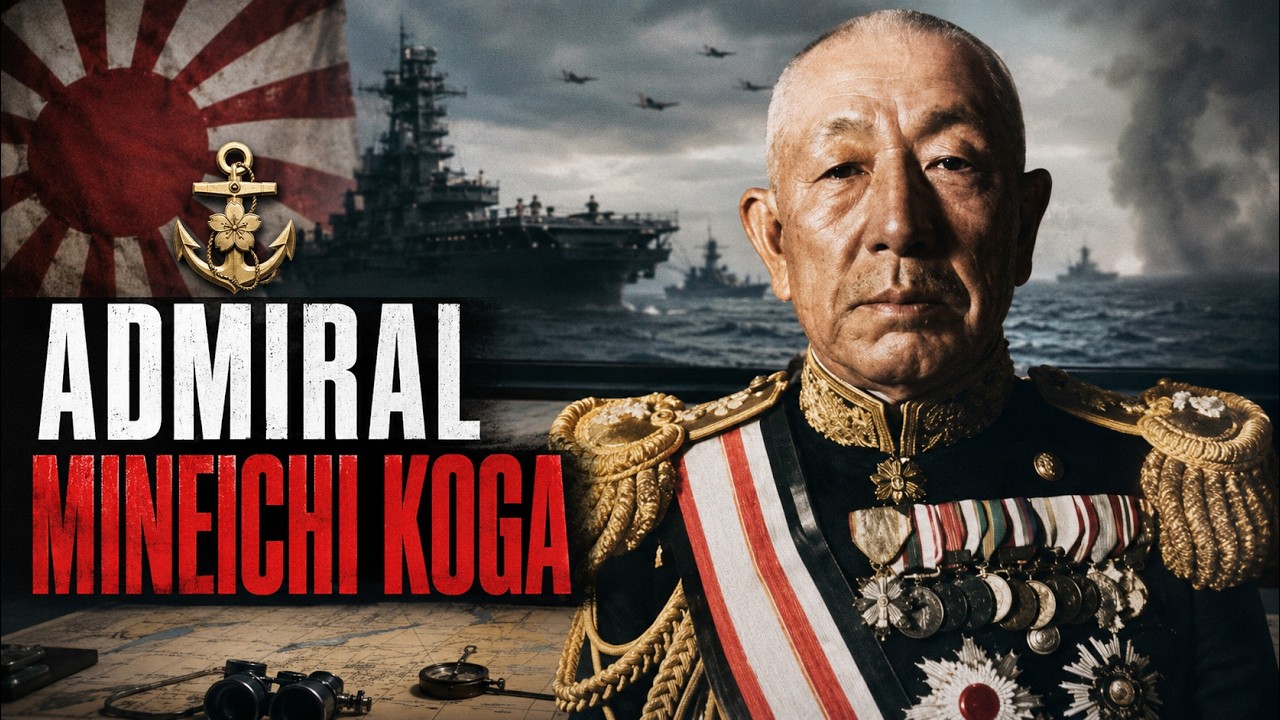
How does a man rise to such towering importance in the machinery of war and then get erased so thoroughly from memory? That question draws us across the dark water. To understand how a man becomes forgotten, we must trace backward into the quieter waters of his birth. Koga was born in 1885 in Saga Prefecture on the island of Kyushu, into a family of samurai descent.
The Meiji era was still young then. The samurai class had only recently been abolished, yet the values they embodied—duty, discipline, the subordination of personal desire to collective purpose—remained woven deep into the fabric of Japanese society. The air that hung over the countryside was the air of transformation. Railways cut across landscapes that had known only footpaths.
Telegraph wires reached toward the horizon. Japan was racing to catch up with the great powers of Europe and America. For a young man of such background, the Naval Academy at Etajima presented itself as the natural trajectory. The academy, built on an island in the Inland Sea, was isolated from the broader world, a monastic space devoted entirely to the making of officers.
The routine was methodical to a degree almost incomprehensible to modern understanding. Cadets rose before dawn, stood in formation while instructors examined uniforms for any deviation, and endured punishments ranging from written reprimands to forced exercises that left young men breathing heavily in the humid air. The curriculum blended two distinct worldviews. There was the classical military education inherited from samurai traditions—the study of strategy, the cultivation of moral character, the elevation of honor above personal ambition.
Running alongside this traditional stream was something newer and more relentlessly technical. Koga and his fellow cadets studied mathematics with rigor, gunnery calculations, navigation by the stars, the architecture of steel ships, and the emerging science of naval engineering. Koga seems to have taken both aspects seriously, seeing no contradiction between meditating on the virtues of the samurai and mastering the calculus required to aim a modern battleship’s guns. The discipline of the academy appealed to something in his temperament—the same quality that made him prefer steady competence to brilliant improvisation, careful planning rather than dramatic gambles.
After graduation, Koga stepped into the actual machinery of a growing fleet. His first posting came in 1907 aboard the cruiser Kasuga, a vessel that had already seen action in the Russo-Japanese War. Here began the true apprenticeship. He learned gunnery on her decks, standing before the massive guns, learning not only their mechanical operation but the mathematics that governed their firing—the calculations of distance, wind, the curvature of the earth itself.
Between 1907 and the early 1920s, Koga moved through a succession of cruisers and destroyers, each posting adding a layer to his accumulated knowledge. The gunnery specialization he developed became his distinguishing mark. In the Imperial Japanese Navy of the early 20th century, gunnery officers held a particular prestige. Koga’s meticulous temperament was well suited to this discipline.
Gunnery demanded exactitude, the accumulation of data, the patient refinement of technique. What emerges from this long apprenticeship is a portrait not of brilliance but of methodical competence that grew more pronounced with each passing year. Koga was not the sort of man who would draw attention at a social gathering or dazzle subordinates with rhetorical flourish. Instead, he accumulated competence the way a reef accumulates coral, layer upon layer, until something substantial had taken shape.
During the 1920s and into the early 1930s, Koga found himself assigned to positions that required him to observe and analyze. He spent time observing the British Royal Navy, whose institutional mastery and technical precision were still the standard by which all other navies measured themselves. He also observed the United States Navy, which was modernizing with remarkable speed and confidence. There was something in the American approach, a kind of deliberate, almost machine-like efficiency, that impressed upon Koga a certain respect and, perhaps, a quiet concern.
Can we match them, not just in ships, but in factories, in resources, in time? What distinguished Koga from some of his more aggressive contemporaries was precisely this habit of observation without immediate judgment, of gathering facts and turning them slowly in his mind before drawing conclusions. He was the man who asked questions, who wanted to understand not just what his own navy could do, but what others could do, and more importantly, what they might do in response. The years that followed Koga’s return from overseas observation were marked by a quieter kind of ascension through the naval ranks.
He served in various staff positions within the Navy Ministry, occupied himself with matters of logistics and supply, and undertook shore commands where his steady competence could be applied to training younger officers. By the mid-1930s, he had assumed command of significant naval installations and fleet units, rising to the rank of Rear Admiral in 1934. What distinguished Koga during this period was a certain reserve, a reluctance to embrace the increasingly heated factional disputes that were tearing at the fabric of the officer corps. The Imperial Japanese Navy of the 1930s was driven by deep divisions between the Fleet Faction and the Treaty Faction.
These were not merely disagreements about strategy. They represented fundamental conflicts about Japan’s future, about whether Japan should accept the constraints of international naval treaties or pursue a course of unlimited rearmament. These disputes were often bitter, personal, and sometimes erupted into violence as younger officers took matters into their own hands through assassination and attempted coups. Koga navigated this minefield with characteristic caution.
He was not a natural factional warrior. Neither did he align himself so completely with the Treaty Faction as to invite suspicion from nationalist elements. Instead, he occupied a middle position, respected by both sides, fully committed to neither, a man whose loyalty seemed directed toward the institution itself rather than toward any particular faction’s vision of Japan’s future. By the late 1930s, Koga occupied a position of considerable but unflashy influence within the Imperial Navy’s highest councils.
Unlike Yamamoto, who arrived at his famous conviction that Japan could win a swift victory but could not sustain a long war against America through direct observation and mathematical certainty, Koga’s doubts arose from a different soil. His skepticism was less the product of dramatic revelation and more the accumulation of a careful mind observing the trends of industrial capacity, the relentless expansion of American shipbuilding, the vast resource networks that fed the Western powers. What did Koga fear? The evidence suggests he feared above all the exhaustion of resources.
He had studied Western navies not merely to understand their tactics but to comprehend their industrial base, the seemingly inexhaustible wells of production that American factories could draw upon. He had come to understand that if Japan were to wage a long war against such an opponent, the outcome was never truly in doubt. Yet here he was, a senior officer in a nation hurtling toward precisely that conflict. What was he to do?
Resign on principle? Such a course would have been almost unthinkable. Speak out loudly in opposition to the war? This too would have resulted in his isolation.
So Koga, like many thoughtful people caught in the undertow of historical forces they cannot fully arrest, chose a different path—to remain in position, to offer such counsel as he could, to prepare for the conflict he believed inevitable while harboring the quiet hope that somehow the nation might yet pull back from the brink. When the Pacific War erupted in December 1941, Koga was commanding the China Area Fleet, a vast administrative apparatus stretched across occupied Chinese waters. It was not the position of the great sea battles. Yet it was in its own way as essential as anything that happened in those first hours of open war.
The early victories came with dreamlike speed. The American battleships at Pearl Harbor sat burning in the harbor while Japanese fleets pressed outward in every direction. Each victory seemed to confirm what the architects of Japanese strategy had promised. But Koga, commanding the China Area Fleet, was perhaps uniquely positioned to understand the fragility beneath these triumphs.
The waters he patrolled were contested space, where the machinery of occupation ground against the realities of resistance and supply. His fleet had to protect convoys carrying resources back to the home islands. It had to maintain security along China’s coast against forces who remained unconquered despite years of effort. In those months when the news from the fighting fronts continued to be favorable, there would have been quiet hours when officers in shore commands could feel a current moving beneath the surface.
The more territory Japan held, the more it had to defend. Every victory created new lines that had to be maintained, new garrisons that had to be supplied. Koga in those early months would have been orchestrating this enormous logistical dance with the methodical precision that characterized everything he did. Then came Midway.
In early June 1942, near a small atoll, the mathematical certainties that had guided Japanese naval planning underwent a profound reversal. Four Japanese aircraft carriers went to the bottom of the Pacific, taking with them not merely ships but thousands of experienced pilots whose knowledge and skill could never truly be replaced. The myth of Japanese naval invincibility had cracked. In the months that followed, the Japanese Navy faced a profound strategic dilemma.
The Americans, it seemed, could afford attrition. Japan could not. For officers like Koga, observing these developments from their shore commands, the implications were becoming increasingly difficult to ignore. The war would not end quickly.
The Americans would not be deterred by a single defeat. On the morning of April 18, 1943, a small flotilla of twin-engine bombers lifted away from the airfield at Rabaul. Inside the lead aircraft sat Admiral Isoroku Yamamoto, commander-in-chief of the Combined Fleet. American intelligence had been reading his movements with extraordinary precision.
The codebreakers had intercepted the radio traffic containing his flight plan. American P-38 fighter pilots were already climbing into their cockpits, their orders clear. Find Admiral Yamamoto, and destroy him. At around 9:35 in the morning, the American fighters struck.
Within moments, Yamamoto’s bomber was ablaze, spiraling downward through the tropical air. It crashed into the jungle below, and with it died one of Imperial Japan’s most celebrated commanders. The question that occupied the minds of Japan’s naval leadership was simple but devastating. Who would now command the Combined Fleet?
The answer, when it came, fell upon the shoulders of Admiral Mineichi Koga. It was a choice that made logical sense within the context of naval seniority and experience. Koga was by any measure a qualified commander. He had served the Navy for nearly 50 years.
Yet there was something about the transition that felt uncertain. Yamamoto had been irreplaceable in his charisma and his grasp of modern naval strategy. Koga was solid, capable, but in a quieter register altogether. Koga inherited a navy that was still numerous on paper but increasingly hollowed out by the losses it had sustained.
The pilots who had graduated from flight training in 1940 and 1941 were largely gone, replaced by younger men with less thorough preparation. Every material advantage Japan had possessed at the beginning of the war was now arrayed against it. From his headquarters at Truk, deep in the heart of the central Pacific, Koga inherited not the glittering navy of legend but a force consumed by the mathematics of attrition. He understood with crystalline clarity that his primary mission was no longer to win but to endure, to preserve, to stretch every remaining ounce of steel and fuel and human resolve across an ocean that seemed to grow wider with each passing month.
The work was unglamorous. There were no heroic charges, no decisive battles. Instead, there were fuel manifests and damage assessments, careful calculations about how many ships could be kept seaworthy with the resources trickling in from home. The islands of Truk itself presented a microcosm of the larger problem.
Thousands of sailors crowded into the anchorage, living in conditions that ranged from Spartan to squalid. The heat itself became almost a character in the story of daily life. The oppressive warmth pressed down from above, the reflective heat rose from the lagoon, the trapped heat within the steel corridors of the ships. Koga’s strategy, if it could be called that, was one of conservation and delay.
He issued orders to preserve the fleet in being, to avoid unnecessary engagement with superior American forces, to maintain the fleet’s cohesion for the moment when the Americans might become overextended and a final decisive battle could be fought. It was a strategy born of desperation and hope mingled together in equal measure. Yet Koga, having observed Western navies, having studied American industrial capacity, cannot have fully believed this himself. He was too honest, too clear-eyed.
But he carried out his duty because that was what officers did. By the autumn of 1943, the American naval machine had begun to coalesce into something far more formidable. Their strategy had become systematic, methodical. They were not trying to win one decisive battle but to accumulate advantages, to push forward yard by yard across vast stretches of ocean.
It was in response to this deteriorating situation that Koga and his planning staff began to formulate what became known as Plan Z, a naval strategy born not out of confident expectation but out of the recognition that Japan’s strategic options were narrowing with each passing week. The fundamental idea was to establish a series of defensive lines in the Pacific, each constituted by strong naval forces positioned so that an attacking American fleet would be forced to fight under less favorable conditions. The elegance of this approach lay in the hope that by carefully choosing the terrain, the declining Japanese fleet might yet achieve something approximating parity in a decisive engagement. But implementing such a plan required coordination across immense distances, communication between scattered squadrons, the movement of forces that had to be drawn from a hundred different stations.
The practical difficulties of simply keeping a fleet in fighting condition were staggering. Fuel oil had to be brought from the Dutch East Indies through waters that were growing progressively more dangerous. Replacement aircraft had to be transported across oceanic distances while facing American opposition. Fresh pilots trained to the standard that Japanese naval aviation demanded were harder and harder to produce.
The great irony was that Plan Z might have been workable in an earlier stage of the war when Japan still possessed the pilot talent, the ships, and the industrial capacity to execute such a complex maneuver. By the time Koga was attempting to put the plan into effect, the very preconditions for its success were already dissolving. Yet on the morning of March 31, 1944, the careful machinery of command that Koga had been rebuilding from Truk faced an interruption that would never be resolved. A storm had been gathering across the Pacific, and Koga made the decision to relocate his headquarters.
The Americans were pressing closer, and Truk had begun to feel increasingly exposed. He would fly to Palau, further south and west, to establish new command facilities there. Two flying boats were prepared for the journey. Koga would travel in one, his chief of staff in the other.
Their aircraft carried not only the Admiral himself but sensitive documents detailing Japanese naval strategy. Both planes lifted from the calm waters of Truk Lagoon in the early hours, heading southwest toward Palau. They had a journey of perhaps three hours ahead of them across open ocean. But the weather turned.
What witnesses would later describe as a sudden and violent storm materialized with little warning. The clouds darkened, rain swept across the wings. The pilots radioed back to Truk, reporting difficult conditions, but pressing forward. Koga’s aircraft, the lead plane, simply vanished from communication.
The trailing aircraft struggled through the turbulence and eventually broke through to clearer weather, managing to complete the journey to Palau. But Koga’s flying boat never arrived. Hours passed. Search vessels were dispatched from Truk, fanning out across the waters where the aircraft should have been flying.
The sea was empty. Day after day, the searches continued. Nothing surfaced. The storm, it seemed, had simply taken them.
News of the disappearance rippled through the Japanese fleet with a peculiar gravity. Yamamoto had been ambushed, targeted, his aircraft shot down by American fighters. A dramatic end befitting a man of his stature. But Koga vanished without drama, without enemy action, simply lost to the sea and the sky in a moment of weather that had seemed almost routine.
The question that has haunted historians for eight decades is whether Koga’s disappearance was truly an accident or whether something more deliberate lay beneath the official account. There were murmurs even then suggesting alternative possibilities. Some sources suggested the aircraft had been intercepted by American fighters. Others wondered quietly whether internal factional rivalries within the Japanese military had played a hand.
These theories have persisted, impossible to confirm, equally impossible to entirely dismiss. What we know with certainty is this. The storm was real. Weather reports from that day confirm that squalls did indeed sweep the area where the aircraft was flying.
The radio messages from the pilots reporting difficult conditions have been documented. The aircraft did not arrive at Palau. A man and his crew were lost that morning. The Japanese Navy officially recorded his death by drowning, lost at sea during an air journey.
His replacement was named within days. Koga’s papers were recovered eventually, washed up on beaches or found among the few pieces of wreckage that were located. They provided insights into his thinking in those final months—his growing awareness of the Navy’s deteriorating position, his attempts to construct some kind of unified strategy against an American offensive that seemed to gather strength with each passing month. But Koga himself remained suspended in that March morning, in that storm, in the moment when two flying boats lifted from Truk Lagoon and one of them simply failed to emerge into whatever sky might have lain beyond the clouds.
When we ask today who led Japan’s Combined Fleet during the final, desperate years of the Pacific War, most voices fall silent. Yamamoto lives in memory. The brilliant strategist, the man who warned against American industrial might, the admiral whose aircraft fell burning over Bougainville. His name carries weight.
But Mineichi Koga, the man who inherited his command, who guided what remained of the Imperial Navy through its darkest chapter, has become something closer to a shadow. This forgetting was not accidental. It was shaped by forces that had little to do with Koga’s actual competence and everything to do with how war gets remembered, how victors write history, and how propaganda calcifies into what we believe to be fact. Consider first the matter of timing.
Yamamoto died at the moment of Japan’s shift from hope to fear. His death was symbolically catastrophic. It felt like the moment something essential died. Koga inherited a navy that was already in mourning, already shaped by the certainty of decline.
There was no honeymoon period, no moment of strategic hope to cement his reputation. But perhaps more importantly, Koga died in obscurity, in a storm, in an aircraft that was never found with certainty. Yamamoto’s death was witnessed, recorded, avenged in the American narrative. His death became a story that could be told with clarity and closure.
Koga’s death was reported, investigated, but never truly confirmed with the satisfying finality that Western memory requires. And then there was the matter of American historiography. The American narrative of the Pacific War was built around certain key figures and turning points. Yamamoto was known to American intelligence.
He had been a military attaché in America. When he died, it meant something in that particular conversation. Koga was less known, less amenable to dramatic telling. Then there is the simple powerful fact that Koga left behind no great strategic innovation or memorable utterance to echo through time.
Yamamoto is remembered in part because of his famous line about waking a sleeping giant. Koga was methodical, conservative, competent. He did not issue prophecies. He did not leave behind the kind of aphorism that students of war like to repeat.
His value lay in his steadiness, his effort to preserve what could be preserved, his acceptance of an untenable position, and his attempt to manage it with dignity. These are admirable qualities, but they do not make for memorable history. And perhaps most importantly, there is the nature of loss itself. Yamamoto’s death came when Japan still had resources to deploy, still had strategic options to consider.
His passing could be mourned as a tragedy. Koga’s death came when Japan was already committed to endurance, already past the point of strategic pivot. His death changed nothing. The war continued without him, would have continued regardless.
There is no counterfactual in which Koga’s survival leads to a different outcome, and history does not linger long over deaths that alter nothing. Koga faded because he died at the moment when death had begun to seem ordinary, because his end was unclear, because he asked nothing of memory and the world has honored that request. Because he was steady and reasonable in an era remembered for its extremes. Because Yamamoto’s shadow, once cast, never truly lifted.
And there was room in the historical imagination for only one great Japanese admiral. But in fading, he has become something else entirely. Not a forgotten commander, but a kind of mirror, a reflection of all the capable, dedicated people who did their duty in losing causes, who managed collapse with quiet grace, who asked only to serve well in an age when service led to nothing but ash. The Pacific stretches on, much as it always has.
The waves that once carried the ships under Koga’s command continue to move and turn with ancient rhythms. The storms that swept his aircraft into the sea and into history’s margins still rise and fall according to laws that care nothing for human rank or achievement. And somewhere in the vast archipelago of forgotten events and forgotten figures, Mineichi Koga remains—not important perhaps by the standards that we usually apply to importance, but real. A man who lived and worked and died in service to something he believed in, even when the weight of evidence suggested that the cause he served was in its final declining hours.
He remained at his post. He did his duty. He accepted what came. In the end, there is a kind of nobility in this that requires no embellishment and no grand narrative.
It is the nobility of the ordinary professional, the person who masters their craft and performs their function without needing to be mythologized in order to matter. History may not remember his name. History in fact largely has not. But the work he did, the steadiness he brought to an impossible position, the decency he extended to those under his command—these things existed, they mattered to the people who lived through them.
And in their mattering, they leave a kind of echo that reverberates even now, even if only in the careful attention of those who take the time to listen.


