On the morning of May 5, 1945, an American captain, a German major, and a former SS officer stood shoulder to shoulder on the walls of an Austrian castle,firing at the same enemy. Inside Castle Itter were fourteen of France’s most important political prisoners,hmen the SS had been ordered to ensure never left alive. Outside,more than a hundred Waffen-SS troops were closing in,determined to kill every one of them before the war ended. But the war had only three days left to run.
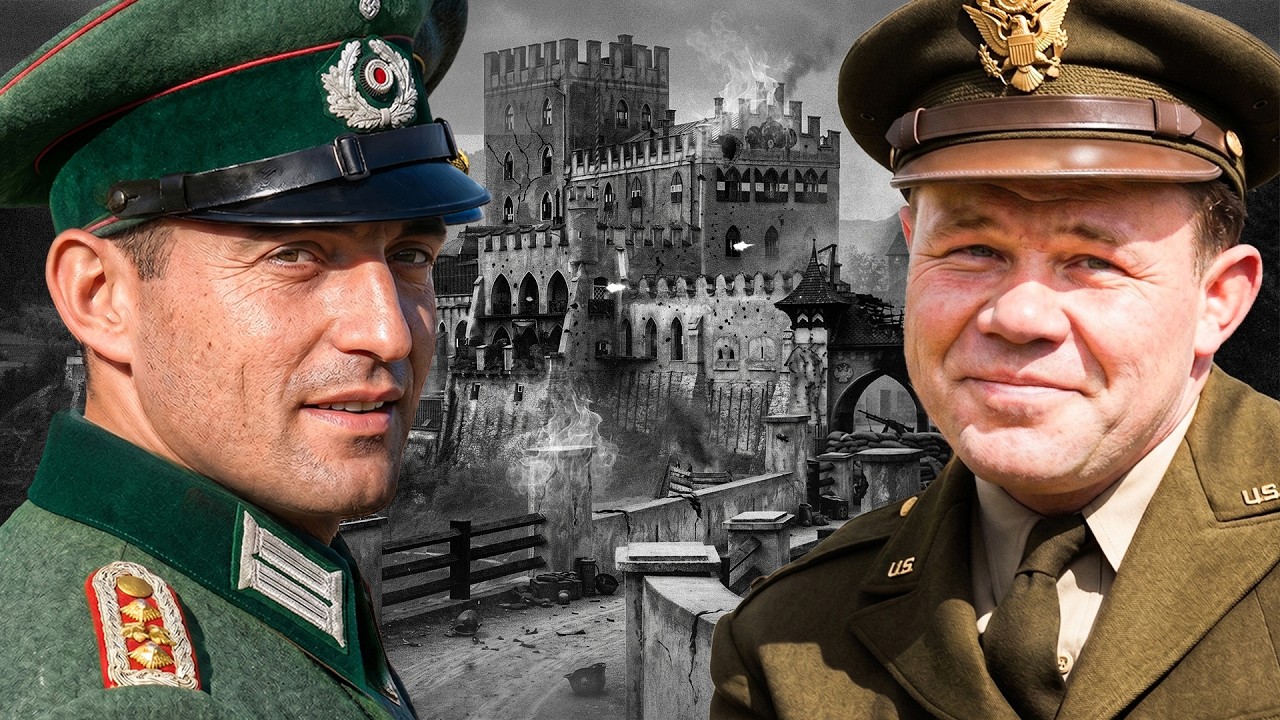
It was one of the only two battles in the entire Second World War where American and German soldiers fought on the same side. Castle Itter sat on a wooded hill in Austria’s Brixental Valley,overlooking the small village below. For centuries it had been a fortress,and then a hotel. In early 1943,Heinrich Himmler ordered SS-Obergruppenführer Oswald Pohl to seize the property.
By April,it had been converted into a prison under the administration of the Dachau camp system,built specifically to hold high-value French prisoners. Among those locked inside were Édouard Daladier,the former French prime minister who had signed the Munich Agreement with Hitler in 1938;Paul Reynaud,the man who had tried to keep France fighting before his government collapsed;General Maxime Weygand,who had commanded the French Army during the invasion;and General Maurice Gamelin,the commander Weygand had replaced after France’s defenses crumbled in six weeks. Trade union leader Léon Jouhaux,right-wing politician François de La Rocque,and Michel Clemenceau,son of the prime minister who had won the First World War,filled out the political ranks. Charles de Gaulle’s elder sister,Marie-Agnès Carriau,was also imprisoned there.
But the most unlikely captive was Jean Borotra,a Grand Slam tennis champion arrested after trying to flee Vichy France to join the Allies. These men and woman would never have shared the same room by choice. The prisoners divided themselves by political loyalty,eating at separate tables,and avoiding conversation whenever possible. Reynaud and Daladier,whose rivalry stretched back to pre-war cabinets of the Third Republic,barely spoke.
The Reich had managed what French politics never could:,it had put Daladier and Reynaud in the same room. Yet they shared one thing:all of them were worth more to the Reich alive than dead,and all of them knew it could change overnight. SS Totenkopf Verbände guards patrolled the grounds,while Eastern European prisoners transferred from Dachau performed forced labor. For two years,the routine held.
But in the final days of April 1945,everything unraveled. When Hitler took his own life on April 30th,the chain of command that had kept Castle Itter functioning disintegrated along with the Reich. On May 2nd,Eduard Weiter,a former commandant of Dachau who had fled to the castle,died under suspicious circumstances. The following morning,Zvonimir Čuković,a Yugoslav resistance member who had worked as a handyman inside the castle,escaped under the pretext of running an errand for prison commander Sebastian Wimmer.
The nearest town,Wörgl,lay eight kilometers down the mountain. When Čuković failed to return and word spread of Weiter’s death,Wimmer panicked. He abandoned his post,and the Totenkopf Verbände guards followed,vanishing into the surrounding countryside and leaving the gates unguarded for the first time since 1943. The prisoners moved quickly.
They gathered rifles,pistols,and ammunition the guards had left behind,and posted armed lookouts along the walls. ButWaffen-SS units still roamed the hills around Itter,and the nearest Allied forces were days away. The prisoners had weapons now,but no way out. Čuković had bypassed Wörgl entirely.
Waffen-SS patrols controlled its streets,and any man caught without papers risked being shot as a deserter. Instead,he pressed up the the Inn River Valley toward Innsbruck,64 kilometers to the west,moving on foot through territory still crawling with German troops. By nightfall on May 3rd,he had reached elements of the American 103rd Infantry Division and handed over a letter describing the prisoners trapped inside Castle Itter. A rescue column rolled out at dawn,but was recalled before reaching the castle.
Its commanders had been told the area fell within another division’s territory. Tschuikowitsch’s 64-kilometer gamble had succeeded,and then been undone by a line on a map. Back at the castle,no one knew whether he had made it. On the morning of May 4th,Czech cook Andreas Krobot volunteered to try a different route.
Armed with a note anda bicycle,he rode down the mountain toward Wörgl,pedaling past SS roadblocks and patrols. He reached the town and made contact with the Austrian resistance,who brought him to Major Josef Gangl. Gangl was a 34-year-old artillery officer from Bavaria who had fought across Europe with Werfer Regiment 83,from the Battle of the Bulge to the defense of Saarbrücken. By April 1945,his launchers had been destroyed,and fewer than 30 men remained under his command.
Ordered to withdraw to the Alps,Gangl refused. He stayed in Wörgl with 10 of his soldiers,joined the local resistance under Alois Meyer,and began shielding civilians from SS units that were executing men suspected of desertion,and firing on any window that displayed a white flag. When Krobot arrived with news of the prisoners,Gangl knew he lacked the numbers to take the castle alone. Driving under a white flag to Kufstein,13 kilometers north,he found Captain John C.
Jack Lee,Jr. of the 23rd Tank Battalion,12th Armored Division,waiting in the town square with four Sherman tanks. Lee,a 27-year-old from Norwich,New York,did not hesitate. After scouting the castle’s defenses with Gangl,he tried to bring tanks and infantry from the 142nd Infantry Regiment,but a bridge along the route could not bear the weight.
Lee crossed with a single Sherman nicknamed Besotten Jenny,14 American soldiers,and a truck carrying Gangl’s 10 artillerymen. Six kilometers from the castle,they scattered an SS roadblock with machine gun fire,and reached the gates at nightfall. The relief force was far smaller than anyone had hoped. But when Lee reached the castle that evening,he discovered the French prisoners had already found their own unlikely protector.
SS-Hauptsturmführer Kurt Siegfried Schrader,a 29-year-old combat veteran from Magdeburg who had once served in Hitler’s headquarters guard,had taken charge of the castle’s defenses days earlier. After being badly wounded in France,he had been sent to Itter to recover. During his convalescence,he befriended the French prisoners,and broke with the regime entirely. When the guards fled,Schrader moved his own wife and family into the castle alongside the men he had once been expected to help imprison.
Lee and Schrader organized the defense together. They posted men along the walls,and positioned Besotten Jenny at the main gate,where its machine guns could cover the approach road. Lee ordered the prisoners to stay inside. They refused.
Men who had spent two years locked behind those walls were not going to hide while others fought for them. Overnight,SS reconnaissance patrols probed the perimeter,testing for weak points. Gangl managed to reach Alois Mayr in Wörgl by telephone,and asked for reinforcements. Only two additional Wehrmacht soldiers,and a teenage Austrian resistance member named Hans Waltl,could be spared.
They drove through the darkness and reached the castle before dawn,bringing the total number of defenders to fewer than 40. At first light on May 5th,the assault began. Between 100 and 150 Waffen-SS troops from the 17th Panzergrenadier Division Götz von Berlichingen,commanded by SS-Oberführer Georg Bochmann,attacked from the wooded hills surroundingthe castle. Machine gun fire raked the walls,and 88-millimeter anti-aircraft shells struck the stone with enough force to crack masonry,and send debris flying across the courtyard.
The Sherman returned fire until an 88-millimeter round knocked it out. The radio man inside escaped without injury,but the garrison had just lost its heaviest weapon. The fighting continued through the morning. French generals,former prime ministers,and politicians fired from windows and doorways alongside American tankers,and German artillerymen.
Ammunition dropped with every exchange,and there was no resupply. Lee began pulling his men deeper into the castle’s interior,preparing for a last stand in the keep. Then Gangl spotted former Prime Minister Paul Reynaud exposed in the courtyard as SS fire intensified. He rushed forward,and pushed Reynaud out of the line of fire.
A sniper’s bullet struck him before he could reach cover. Gangl had disobeyed his commanders,surrendered to the enemy,and walked back into a fight he had no obligation to join. He died protecting a French politician he had known for less than a day. He was 34.
With ammunition nearly exhausted,and the SS pressing closer,Lee knew the castle could not hold. Jean Borotra,the 46-year-old tennis champion,volunteered to vault the castle wall,and sprint through the SS lines to reach the 142nd Infantry Regiment. Lee had no other option. Borotra climbed the castle wall,and dropped into open ground.
SS troops were positioned across the slopes below,but the former champion used the terrain,and tree cover to stay ahead of the gunfire behind him. He reached Wörgl,and found elements of the 142nd Infantry Regiment,which had already received word of the castle situation,but lacked a guide through the narrow mountain roads. Borotra asked for an American uniform,a rifle,and directions back to the fight. The 142nd dispatched a relief column with tanks,and infantry,and Borotra led them toward the castle.
Inside the walls,the remaining fighters were close to being overrun. Lee had concentrated his men in the castle’s inner rooms,and the SS had pushed close enough to bring a panzerfaust into position near the gatehouse. Then around 4:00 in the afternoon,the sound of heavy engines reached the valley. American armor appeared on the road below.
Machine gun fire tore into the SS positions from the south. The attackers broke. Faced with tanks,and fresh infantry,the Waffen SS troops scattered into the surrounding forest. Approximately 100 were captured in the aftermath.
The siege had lasted less than 24 hours. Every French prisoner survived. They were evacuated the same evening,and flown from Innsbruck to France,reaching Paris by May 10th. Daladier,and Reynaud both returned to political life.
Léon Jouhaux went on to receive the Nobel Peace Prize in 1951 for his decades of work in the trade union movement. Jean Borotra resumed competitive tennis,and lived until 1994,dying at the age of 95. Lee received the Distinguished Service Cross,the second highest American decoration for combat valor. After the war,he returned to civilian life in the United States,and died in 1973 at the age of 55.
Gangl was buried in Wörgl’s war cemetery. The inscription on his headstone describes a man who joined the local resistance,and died a heroic death during the liberation of the French prisoners at Castle Itter. A street in Wörgl bears his name,and Austria recognizes him as a national hero. Schrader,the SS officer who had fought beside him,was arrested after the battle,and sentenced to two years for his former party membership,a term later shortened in recognition of what he had done at the castle.
The battle lasted a single day,and cost one life among the defenders. It was one of only two confirmed instances in the Second World War where American,and German soldiers fought on the same side. It saved 14 people from a war that was already over.