The order came through in the first days of February 1944, crackling through the radio static from Berlin: hold the line, do not retreat, relief is coming. But on the frozen Ukrainian step near the towns of Korsun and Cherkasy, the men trapped inside the shrinking pocket had stopped believing Berlin. Nearly 60,000 German and allied soldiers were encircled there, surrounded by Soviet armies under Zhukov and Konev. The winter had already taken its toll.
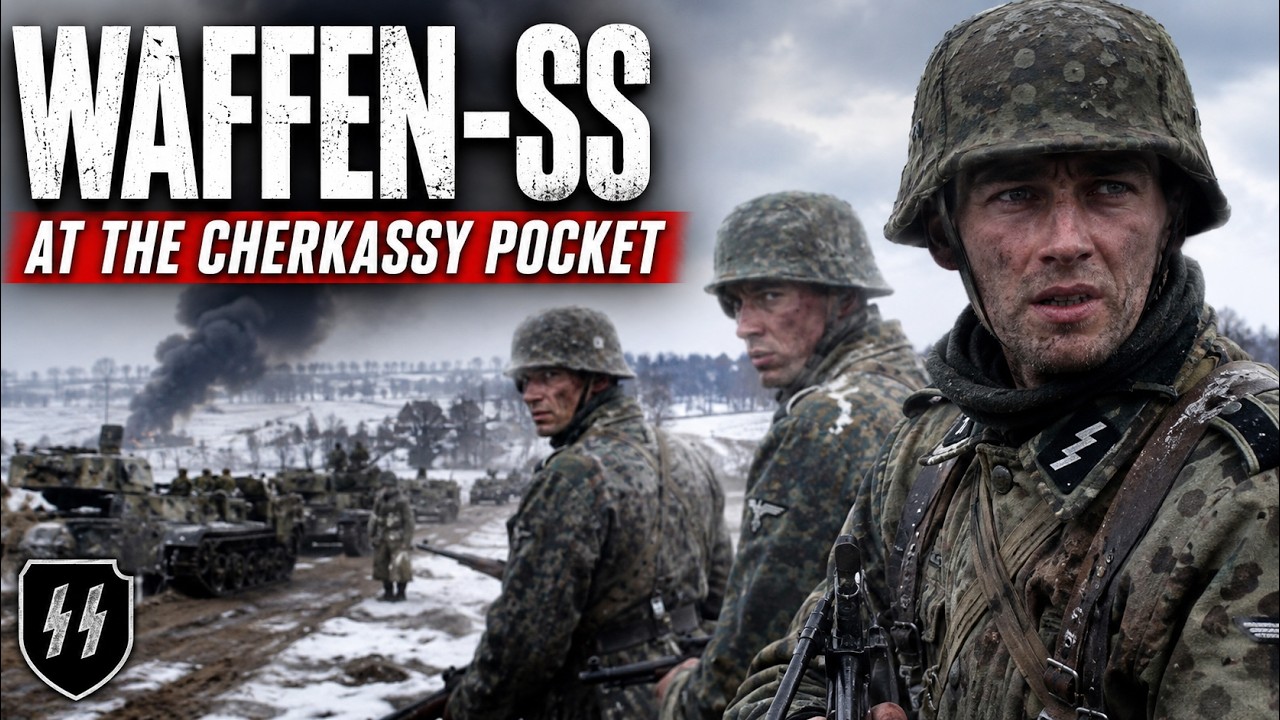
Temperatures dropped below minus 20 degrees, and the rations had dwindled to almost nothing. The horses, the army’s vital transport, were dying of starvation before the men’s eyes, their ribs pushing through dull coats, their eyes glassy with surrender. The men were freezing. Those who had not lost fingers or toes to frostbite were losing their minds to the waiting, to the silence between shell impacts, to the knowledge that the Soviet ring was tightening day by day.
Within the pocket stood the Wiking Division, a unit of Nordic volunteers who had answered Hitler’s call to defend Europe from Bolshevism. Norwegians, Swedes, Danes, and Flemish-speaking Belgians from the Walloon Brigade. They had come for ideology or adventure or simple circumstance, and now they stood shivering in identical trenches, their grand beliefs dissolving under the weight of cold and hunger. “Hold your ground,” the orders said.
“Trust in the Führer’s judgment. ”
The commanders in the pocket had watched the relief force under General Breith fail. His panzers had ground forward through snow and then mud when the thaw came, pushing toward them but never reaching them. The Soviet artillery had hammered every attempt to advance.
The window was closing. By the beginning of February, the decision had effectively been made, though no one would speak it aloud in the command posts until the last night: they would break out on their own. They had to. On the night of the breakout, a strange and terrible work began across the pocket.
Men drained fuel from vehicles and destroyed the engines so the Soviets could not use them. They spiked guns that could not be transported. They burned maps and codebooks in the freezing dark, careful to hide the flames from Soviet observers. The horses could not be moved across open ground, and they could not be left for the enemy.
In small groups, away from the main positions, this grim work was done. Some men shot their own animals rather than leave them. Others, too exhausted to feel anything, simply walked past them. The wounded presented the most agonizing calculation of all.
In the makeshift hospitals, in barns and schoolhouses across the perimeter, there were thousands of men who could not walk. They could not be carried across open snowfields under artillery fire. Medical officers made their rounds in the grey half-light, deciding who would receive the last of the morphine and who would be left behind with volunteers who chose to remain. The walking wounded were bandaged as best the supplies allowed and told to gather their strength for the march.
As the columns formed that night, the men moved into position with a quiet efficiency that spoke to their training and their desperation. The Wiking Division would be among the spearheads of the breakout. They would be first through the Soviet lines, which meant they would take the heaviest fire. Then the breakout began.
Columns of exhausted men moved across the open snow toward the west and northwest, where German lines lay somewhere beyond the Soviet cordon. The temperature had begun to climb again, threatening thaw, threatening to turn the frozen ground to mud. They had to move while the earth still held their weight. The Soviet artillery opened up almost immediately.
Shells fell in coordinated patterns, and the night filled with light and sound and the smell of cordite mixing with the frozen air. The flanking fire came as the columns stretched across the snowfields. The Soviets had positioned forces not only to their front but along the routes they had calculated the breakout would follow. Men fell in the snow.
Some were struck by shell fragments. Others simply collapsed, their legs refusing to continue, their bodies giving out from shock and exhaustion. The columns began to fragment within the first hour. Units lost visual contact as they spread out to avoid presenting a concentrated target.
Officers moved between groups on horseback or on foot, trying to maintain direction, trying to keep men moving toward an invisible line where safety existed. They were making progress. The pocket was breaking open, and men were flowing out of it like water through a crack in ice. But the cost was already staggering, and the worst passage lay ahead.
The river that stood between the escaping men and safety was called the Gniloy Tikich. In Ukrainian, the name suggests rot and corruption. And for the men who crossed it that night, it lived up to its name. The ice on the river had formed solidly during the weeks of deep freeze, but the recent thaw had weakened it.
Some stretches held firm. Others betrayed the men who trusted them. The columns converged on the crossing points under a constant bombardment. Soviet gunners positioned on the surrounding heights concentrated their fire on the dark masses of men and horses and vehicles moving through the snow.
The horses went first, driven into the water to test the strength of the ice. Many were already half-starved. Some stopped moving forward, as if some animal instinct told them the passage ahead was death. Soldiers drove them on with rifle butts, or shot them where they stood.
Their bodies became obstacles in the dark water that others had to navigate around. Then the men waded in. The shock of near-freezing water on a body already weakened by weeks of starvation and cold was a kind of sudden betrayal. Breath caught.
Limbs seemed to separate from conscious control. The crossing points were narrow, which meant men crowded together, pressed against one another, and when someone faltered or fell, those behind had nowhere to go but forward, or into deeper water. Vehicles tried to cross where the ice still seemed thick. Some made it.
Others felt the surface give way beneath them, the front wheels dropping into open water, the engines still running, diesel fumes rising in the frozen air. The men inside had minutes, at best, to scramble out before the cold took them. Men who emerged on the far bank found their uniforms freezing instantly in the wind. The wet cloth hardened into armor that transmitted the cold directly into the body.
They had to keep walking. They had no choice. A man who stopped to rest, who sat down in the snow, would never get up again. The Wiking Division was selected for the rear guard.
They held the southern bank of the Gniloy Tikich, creating a fragile dam of human bodies and disciplined fire that bought minutes for the hundreds still struggling through the water ahead. They rationed ammunition because they knew that when the bullets ended, so would their ability to hold even that narrow strip of frozen riverbank. They held their positions for as long as they could. Then they retreated, maintaining formation, covering each withdrawal with overlapping fields of fire.
When the final order came to cross the river themselves, they moved with the same precision they had maintained all night. Officers ensured no man was left behind, unless he was already beyond help. Then they too entered the water. On the far side of the river, the columns broke apart almost immediately.
The order and discipline that the command had tried to impose scattered into the white expanse. Small groups formed and reformed as soldiers found themselves separated from their units. Chance gatherings became temporary families, bound by proximity rather than command structure. There was no clear front line anymore.
Soviet positions were scattered across hills and ridges, and in the darkness it was impossible to know where safety lay. A group of thirty men moving west might suddenly encounter muzzle flashes from three directions and scatter into the night. Soldiers followed instinct rather than orders, seeking the next fold in the ground that might offer concealment. Men went mad quietly in that zone.
Some simply stopped moving and sat down in the snow, refusing to get up despite the urgings of their comrades. Others became convinced the Soviet lines were ahead and turned to run in the opposite direction, toward the danger. The cold itself affected perception, making distances impossible to gauge, making time move strangely. A fifteen-minute march felt like hours.
A half-hour of waiting felt like days. The first light of dawn was a pale, indifferent thing that fell across a landscape of dispersed figures moving with the deliberate slowness of men who had surrendered almost everything to forward motion. They were moving through country that belonged neither entirely to the encircled nor to the relief forces waiting beyond. Then came the first encounters with General Breith’s relief elements.
There was no jubilation. The survivors were too exhausted to feel anything as clear as joy. Men collapsed as soon as they reached what they perceived as safety, falling into the snow and simply remaining there, while medics and fellow soldiers tried to identify who was still alive and who might be revived with warmth or food. The Wiking Division, as a cohesive formation, had largely ceased to exist by the time its survivors reached the German lines.
It had gone into the pocket with a strength of approaching six thousand men. Perhaps two-thirds of that number emerged, but they were scattered among the general columns, indistinguishable from the exhausted Wehrmacht soldiers around them. The division’s command structure had fragmented. Divisional headquarters had been abandoned in the pocket, its files and records burned to prevent capture.
The officers who survived were often junior men, lieutenants and sergeants who had seen their companies collapse around them. The counting of survivors began in the hours after dawn. Estimates suggested that somewhere between 35,000 and 40,000 men had escaped the pocket, though no one was certain of the exact number. The German official count recorded approximately 35,000 rescued.
The Soviets claimed they had inflicted far heavier losses, that the enemy had suffered 20,000 casualties in the fighting and taken another 8,000 to 10,000 prisoners. The truth would remain contested for decades. But the suffering was not in question. The survivors themselves, in the hours after reaching German lines, were often too bewildered to contribute much to the arithmetic.
They had been given a meal, typically a thin soup and a piece of dark bread, their first hot food in days. Some of them sat in the back of trucks being driven toward the rear and found themselves overcome without warning by tears or by hysterical laughter as the accumulated fear and exhaustion found release. Others entered a kind of stupor from which they had to be roused to eat or to move. Thousands of men had been captured during the crossing or in the hours after, as stragglers were picked up by Soviet patrols.
They were marched into Soviet captivity, and half or more of them would not survive to see the war’s end. The story of the Cherkasy pocket, as it passed into history, became a contested thing. German accounts emphasized the successful breakout, the discipline maintained under fire, the audacious extraction of thirty-five thousand men from a trap intended as annihilation. Soviet accounts insisted on the completeness of the victory, the crushing of the trapped German forces.
The snow continued to fall across that step after the war, and the land itself did not care about the narratives. It covered everything equally, the buttons and cartridge casings, the frozen bodies of men and horses, the wreckage of vehicles that had tried to cross the ice. For the men who survived, the breakout did not end when they reached friendly lines. They carried the memory of that night with them into their remaining lives.
They carried the sound of ice cracking beneath thousands of feet, the image of the river filling with the dead, the faces of the men they had left behind on the south bank. The winter of 1944 had demanded a price from everyone it touched, German and Soviet alike. It had been an enemy as patient and merciless as any army, and in the end, it was the one adversary neither side could overcome.