In April 1945, Hitler handed two of his generals impossible orders. Walther Wenck was told to break through to Berlin with an army of schoolboys and exhausted reserves. Hasso von Manteuffel was ordered to hold the eastern front along the Oder River north of the Seelow Heights against a massive Soviet force. Both men knew success was unlikely, but the choices they made in those final days would define their legacies forever.
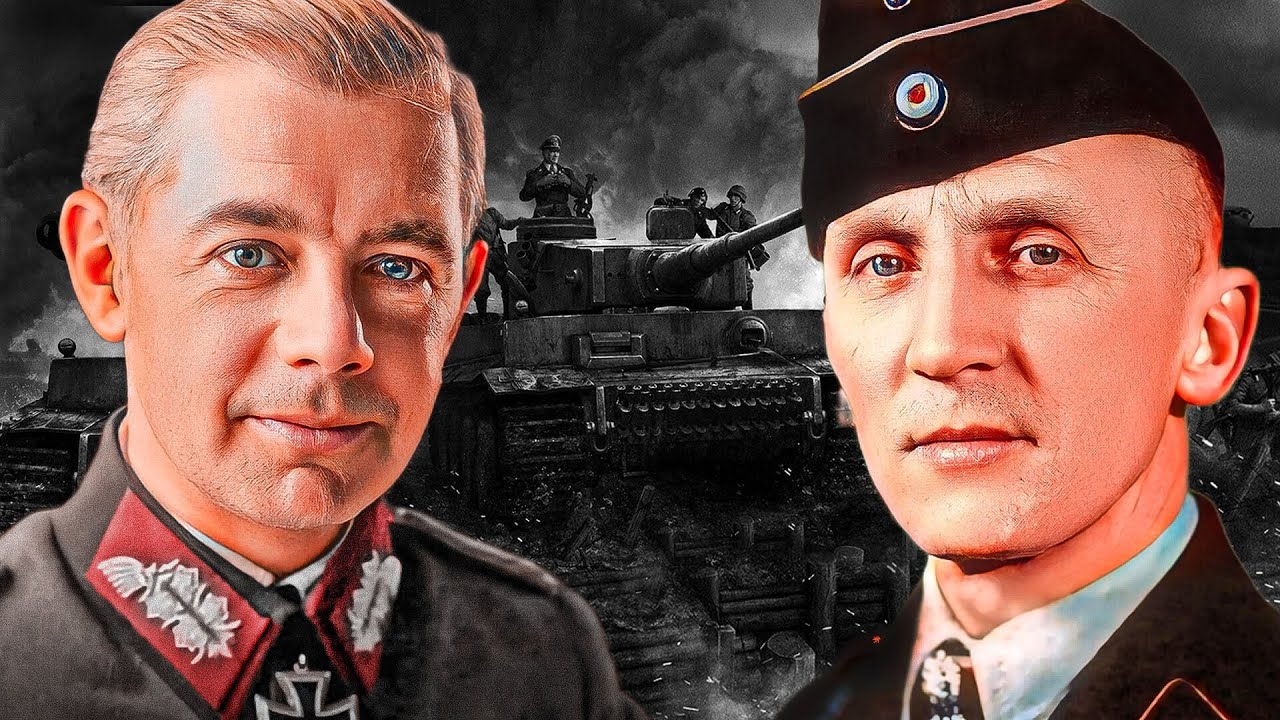
. Wenck came from a new generation of analytical officers rising through the ranks with systematic planning and direct, clear-eyed communication. Manteuffel, by contrast, was steeped in traditional Prussian military culture, which he carried into the age of mechanized warfare. Their paths shaped two fundamentally different leadership styles, ones that would collide with reality as Germany approached its collapse.
. Wenck earned his reputation as ““the Boy General”“ through rapid promotions that reflected his analytical strengths. He entered the Reichswehr in 1920 and served as chief of operations for the First Panzer Division from 1939 to 1942, developing a methodical approach to strategy. In 1944, he submitted a frank report to Hitler, describing the Eastern Front as““like Swiss cheese full of holes.
””“ The informal tone drew criticism, but Hitler appreciated its directness. The episode revealed Wenck’t’s commitment to analytical honesty, even when it meant telling Nazi leadership what they didn’t want to hear. . Manteuffel’s background told a different story.
Born into a Prussian noble family with generations of military service, he transitioned from traditional cavalry to armored warfare during the interwar period. By 1937, he joined the Panzer Troop Command and became a senior professor at Panzer Troop School 2 in Berlin. He wrote early panzer tactics manuals promoting speed and decentralized command, concepts tested when he led the Seventh Panzer Division in 1943 and later the Fifth Panzer Army in 1944. His evolution from cavalry officer to armored commander taught him that modern warfare demanded quick decisions based on battlefield realities.
. The core difference in their military philosophies was clear. Wenck’s staff-driven approach relied on detailed planning and systematic assessment. He examined problems from multiple angles and delivered honest evaluations even when unpopular.
Manteuffel’s frontline pragmatic style emphasized tactical innovation and personal command presence, adapting quickly to battlefield realities. Both men had shown a willingness to challenge conventional military thinking before reaching their final commands. Wenck’s““Swiss cheese”” report demonstrated his preference for honest assessment over wishful reporting. Manteuffel’s tactical innovations reflected his belief that effective leadership demanded flexibility,not blind adherence to doctrine.
These contrasting personalities would lead them to make opposite choices when faced with Hitler’s final demands. . Wenck’s first test came with Hitler’s most desperate gamble to save Berlin. On April 22nd, 1945, General Alfred Jodl unveiled a plan that placed the entire burden of the rescue on Wenck’s 12th Army.
The situation was hopeless. Soviet forces had nearly encircled the city—Zhukov’s First Belorussian Front from the east, Konev’s First Ukrainian from the south. That same day, Wenck was ordered to disengage from the Americans in the west and strike east to link up with General Theodor Busse’s 9th Army, already trapped in the Halbe Forest. .
the makeup of Wenck’s 12th Army revealed the sheer impossibility of his mission. His forces included officer cadets, Hitler Youth barely old enough to carry rifles, and fragments of shattered panzer and infantry divisions rebuilt again and again. These undertrained troops were expected to break through veteran Soviet divisions that had fought from Stalingrad to Berlin. The plan also counted on General Rudolf Holste’s 41st Panzer Corps attacking from the north, another force wholly unfit for the task.
. Wenck initially complied, showing the discipline that had marked his career. His 12th Army pushed east from their positions along the Elbe, leaving the Americans behind. They advanced nearly 30 kilometers toward Potsdam before Soviet Fourth Guards Tank forces brought them to a halt.
Wenck used his strategic instincts to pick the best routes and concentrate what little strength he had for maximum impact. . the reality check came at Potsdam, where Wenck’s troops ran into hardened Soviet resistance. Veterans of the Fourth Guards Tank Army had dug in along the approaches to Berlin.
They had superior numbers, better equipment, and months of brutal combat behind them. Wenck’s amateur soldiers faced T-34s, artillery barrages, and coordinated infantry attacks—proof that a direct assault on Berlin was hopeless. . on the night of April 28th, 1945, Wenck informed Supreme Command that his army had been pushed back across the front and that attacking Berlin was no longer possible.
It was his first open defiance of Hitler’s orders, a clear break from obedience to independent command. Wenck made his critical decision on April 24th, redirecting his army toward the Halbe Forest to save lives rather than follow orders. Instead of pushing toward Berlin, he aimed to break into the Halbe Pocket, where the Ninth Army, Army Group Vistula, Spree, and the Potsdam Garrison were trapped. the shift called on his analytical skills to find weak points in Soviet lines and open escape routes for soldiers and civilians alike.
East of the Elbe had become a vast refugee camp. Wenck’s forces were feeding over 250,000 people a day in April 1945, while still fighting to keep the escape routes open. He told his troops,““Comrades,you’ve got to go in once more. It’s not about Berlin anymore.
It’s not about the Reich anymore. ”“ Their mission was now to save lives from the fighting and from the Russians. Wenck personally oversaw the final crossings of the Elbe. He was among the last to cross, symbolizing his shift from soldier obeying impossible orders to rescuer choosing humanity over war.
His defiance of Hitler saved tens of thousands, even as it ended his military career. . But Wenck wasn’t the only general facing impossible orders in those final weeks. Manteuffel led the Fifth Panzer Army during the failed Ardennes Offensive until March 1945, when he was ordered to the Eastern Front.
On March 10th, he took command of the Third Panzer Army, tasked with defending the Oder River north of Seelow Heights, directly in the path of Zhukov’s First Belorussian Front. It was one of the most difficult commands in the collapsing Wehrmacht, with Soviet breakthroughs already forming and Berlin in their sights. . the hopelessness of Manteuffel’s position became clear within days.
His Third Panzer Army was a shell. Its divisions reduced to company-or battalion-sized groups after months of retreat. Many existed only on paper. Against him stood multiple Soviet tank armies, mechanized corps, and infantry divisions with overwhelming superiority in men, machines, and momentum.
Around him, the German command structure was disintegrating—communications failing, orders lost, headquarters cut off from the front. . Manteuffel’s tactical skill allowed for controlled retreats instead of suicidal last stands. During the Battle of Seelow Heights, when Soviet forces broke through on April 19th, he ordered a series of calculated withdrawals, preserving what strength remained and avoiding encirclement.
His experience in the Ardennes had taught him that Hitler’s no-retreat orders led only to senseless losses. Rather than throw his men into doomed defenses, he pulled back toward the Elbe, slowing the Soviets without losing everything. His pragmatic approach prioritized saving his men over holding doomed ground. Manteuffel saw that sacrificing entire divisions to satisfy rigid orders would only raise the body count and change nothing.
His withdrawals showed a shift from obedience to independent command based on battlefield reality rather than outdated doctrine. . As the front collapsed, Manteuffel faced harsh choices. Soviet breakthroughs shattered any chance of organized resistance.
Supplies were gone, ammunition nearly exhausted. Replacements were either teenagers or old men. In the end, he concluded the only way to save his army from pointless destruction was surrender. On May 3rd, 1945, Manteuffel surrendered to the British.
The choices both generals made in those final weeks didn’t just determine the fate of their armies—they shaped how history would remember them when the Third Reich collapsed. . Their post-war careers revealed how wartime decisions shaped their lives. Wenck surrendered to American forces on May 7th, 1945, and was released in December 1946.
He went on to become managing director of Dr. C. Otto and Comp, a company specializing in industrial ovens, and later led the Diehl Group, an arms manufacturer. His efforts to rescue civilians earned respectful mention in Allied after-action reports.
He rarely spoke about the war in public, but remained respected among former officers for the integrity of his final decisions. In 1957, Wenck was invited to become inspector general of the newly formed Bundeswehr. He declined after learning that his key condition—expanding the role into a true commander-in-chief position—would not be met. Wenck died in 1982 while on a trip to Austria when his car collided with a tree.
. Manteuffel was interned by the Allies at Island Farm until December 1946. He then wrote a detailed monograph on the Ardennes for the US Army historical division. From 1953 to 1957, he served in the Bundestag as a Free Democratic Party representative.
He coined the name Bundeswehr for West Germany’s new military and pushed for rearmament, arguing that Germany needed to defend itself in the emerging Cold War. In 1959, however, he was convicted for the wartime execution of a deserter. Though the sentence was suspended, the case cast a long shadow over his otherwise prominent political and military role in postwar West Germany. Manteuffel died in 1978.
Unlike Wenck, he left behind writings, speeches, and controversy. History remembered them both, but for very different reasons. Their final battles were not for territory, but for legacy. And in that fight, their choices still speak louder than their ranks.
. That’s the story of Wenck and Manteuffel, two panzer commanders who faced the end of the war and chose vastly different exits. .


