The Soviets were five hundred meters from the bunker when the man who had ruled Germany for twelve years decided to get married. He was fifty feet underground, hands trembling, face pale, listening to artillery shake the concrete ceiling above him. In less than forty-eight hours, Hitler would be gone. By late April 1945, his Reich existed mostly on paper.
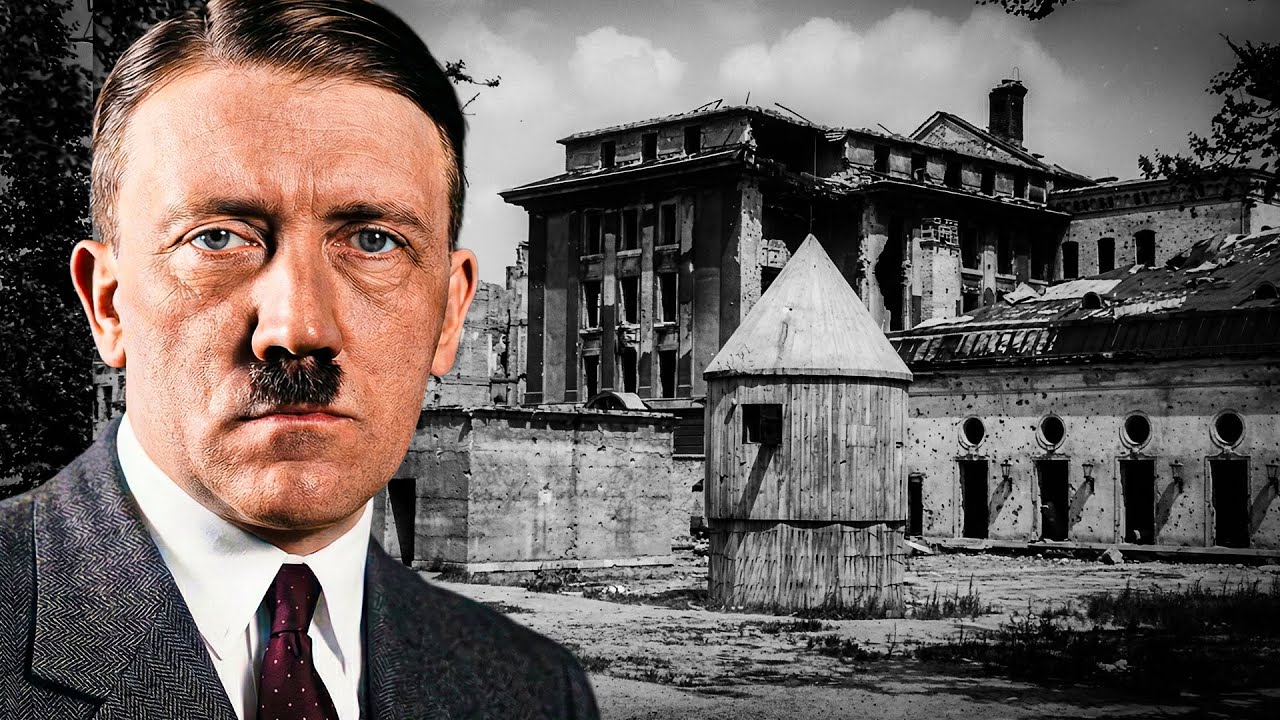
Berlin was being reduced to rubble. The Führerbunker, built beneath the Reich Chancellery, had become his permanent home on January 16th. He would spend a total of one hundred and five days underground. The space was cramped, the air stale, the water failing.
Expensive carpets covered the floors, and artwork hung on the walls, including Hitler’s favorite painting of Frederick the Great above his desk. No amount of decoration could hide the truth. This was a tomb in waiting. On April 28th, the situation was beyond recovery.
The Silesian railway station had fallen. The Tiergarten was in enemy hands. Martin Bormann sent a telegram to Admiral Dönitz that captured the moment in six words: “Reich Chancellery, a heap of rubble. ” General Hans Krebs made his last phone call, telling Field Marshal Keitel that everything would be lost if relief did not arrive within forty-eight hours.
The relief never came. That same day, Hitler received news that shattered what remained of his trust. Heinrich Himmler, head of the SS, had secretly approached the Western Allies to negotiate surrender. Hitler saw it as the ultimate betrayal.
He ordered Himmler’s arrest and had Hermann Fegelein, Himmler’s SS representative in Berlin, court-martialed and executed. Fegelein was Eva Braun’s brother-in-law. It made no difference. Against this backdrop of collapse and betrayal, Hitler made a decision that surprised even those closest to him.
Shortly after midnight on April 29th, a city official named Walter Wagner was summoned to the bunker to officiate a marriage. The bride was Eva Braun, Hitler’s companion of fourteen years. In less than forty hours, she would be dead beside him. The ceremony took place in a small map room.
Wagner asked both parties to confirm they were of pure Aryan descent and free of hereditary disease. Both said yes. The rings were exchanged. According to some accounts, they had been taken from prisoners’ belongings.
They did not fit properly. Witnesses later noted that Wagner seemed almost as excited as the bride. When Eva signed the marriage certificate, she began writing her maiden name out of habit. She crossed it out and wrote Eva Hitler instead.
After fourteen years of secrecy, muscle memory betrayed her at the final moment. A small reception followed in the conference room. Champagne was served. Hitler drank mineral water.
The atmosphere was heavy with gloom. Secretary Gerda Christian later recalled leaving early because she couldn’t stand the mood. Hitler spoke mostly of the past, of better times. He mentioned that the wedding had been an emotional experience, but added that for him only death would mean release from his many worries.
And then, for the first time in front of his staff, he admitted what everyone already knew: the war was lost. The marriage lasted less than forty hours. Later that night, Hitler summoned his secretary Traudl Junge. He had something to dictate.
There was urgency in his voice. Junge later recalled feeling a sense of anticipation. After years at his side, would she finally hear an explanation, a reflection, an admission of regret? She received neither.
What Hitler dictated was a political testament filled with the same accusations and rhetoric he had repeated for decades. No acknowledgement of defeat. No admission of responsibility. Junge described the moment as deeply disappointing.
She finished typing and handed the document to Josef Goebbels around five in the morning. Historians have since examined the document closely. James O’Donnell, author of The Bunker, compared the writing style to both Hitler’s and Goebbels’ known patterns. He concluded that Goebbels likely helped compose the text.
The testament contained Latin phrases Goebbels used frequently, but Hitler never did. Hitler had been reading from notes while dictating. His hand trembled too severely to write properly. Three copies were made.
Three couriers were assigned to carry them out of Berlin. All three eventually fell into Allied hands. The documents were authenticated by the FBI and placed on display at the National Archives in April 1946. The testament was not a confession.
It was propaganda. That same morning, news reached the bunker that Benito Mussolini and his mistress Clara Petacci had been captured and executed by Italian partisans. Their bodies hung upside down in a public square in Milan. Hitler reportedly said little.
But those who saw his face understood he had made his decision. At five in the morning on April 30th, artillery fire woke everyone in the bunker. Within the hour, Hitler appeared in the corridor wearing a dressing gown and slippers. His eyes were bloodshot.
His face was puffy. Staff members noted he looked like a man who had already accepted the end. General Helmuth Weidling, commander of the Berlin defense area, delivered a final briefing. The garrison would run out of ammunition by nightfall.
Organized resistance would collapse within twenty-four hours. There was nothing left to defend. Hitler made his final decisions that morning. His Alsatian dog Blondie was given a cyanide capsule.
The reason, according to multiple accounts, was to test whether the poison worked. Hitler feared the SS had supplied him with fake capsules. Blondie collapsed within seconds. The poison worked.
Hitler then distributed cyanide capsules to his secretaries. He expressed regret that he could not offer them a better parting gift. He added that he wished his generals had been as loyal and reliable as they were. In the early hours, approximately twenty staff members gathered in the corridor.
Hitler emerged from his private quarters, moved down the line, shook hands, and spoke briefly with each person. Then he returned to his room. Most assumed his death was imminent. It was not.
Morning came, and Hitler continued receiving military briefings as though anything still mattered. At around two in the afternoon, he sat down for lunch with two secretaries and his personal cook. A quite unremarkable final meal. Then he rose and said, “The time has come.
It’s all over. ”
The real farewells began. Hitler and Eva Braun said goodbye to those who remained. Magda Goebbels, in tears, reportedly begged him to leave Berlin.
He refused. Goebbels himself, who had long insisted Hitler stay in the capital, now urged him to flee. Hitler refused again. Around half past three in the afternoon, Adolf and Eva Hitler entered his private study.
SS-Sturmbannführer Otto Günsche took up position outside the door. Inside, the couple were alone. What happened next has been reconstructed from what others observed afterward. No one witnessed the moment itself.
At some point, valet Heinz Linge approached the door. He detected the smell of gunpowder. When he and Bormann entered the study, they found Hitler slumped on a sofa, a wound to his right temple. Blood had pooled on the armrest and dripped onto the carpet.
A Walther PPK pistol lay at his feet. Eva Braun sat beside him, motionless, no visible injuries. She had taken cyanide. Günsche entered shortly after.
He later stated that Hitler had shot himself. Linge noted the scent of burnt almonds, characteristic of hydrogen cyanide, suggesting Hitler may have bitten down on a capsule simultaneously. Günsche then walked into the corridor and announced to those waiting, “Hitler is dead. ” The exact sequence remains debated among historians.
What is certain is that both were deceased by approximately half past three on the afternoon of April 30th, 1945. SS personnel wrapped Hitler’s body in a blanket and carried it up the stairs, through the bunker’s emergency exit, and into the Reich Chancellery garden. Eva Braun’s body followed. She wore a blue silk dress.
One witness noted her hair was artificially blond. The bodies were placed in a shallow hole in the garden and doused with petrol. A match was lit. A small group of staff members stood briefly at attention, raised their arms in salute, then retreated inside as Soviet shells continued falling nearby.
The cremation did not go as planned. The fire struggled to consume the remains fully. Additional petrol was poured repeatedly over the following hours. Even then, the destruction was incomplete.
Witnesses reported that charred remains, including visible bones, were still present after several hours, not the clean disappearance often depicted in films. As Soviet troops approached the bunker perimeter, the remains were placed into a shell crater and covered with earth. Soviet forces discovered the remains days later. The bodies were exhumed, examined, and transported to the Soviet Union.
According to declassified reports, the remains were later moved to Magdeburg in East Germany. In 1970, KGB officers reportedly destroyed what was left, retaining only fragments for identification purposes. A jawbone and skull fragments were preserved and later displayed in Moscow in 2000. News of Hitler’s death was broadcast on German radio on May 1st, 1945.
Grand Admiral Karl Dönitz, named as Hitler’s successor in the testament, announced the death and assumed leadership of what remained of the Reich. But confirmation of how Hitler died took longer to establish. In June 1945, Soviet officials publicly stated that Hitler’s body had not been found. The claim was false, but it ignited years of conspiracy theories.
British intelligence assigned historian Hugh Trevor-Roper to investigate. His task was to establish beyond doubt that Hitler had died in Berlin. Trevor-Roper interviewed surviving staff members, examined captured documents, and compiled a report that formed the basis of his 1947 book, The Last Days of Hitler. His conclusion: Hitler had taken his own life in the bunker on April 30th.
Traudl Junge, the secretary who typed Hitler’s final testament, lived until 2002. She admitted she had been fascinated by Hitler, that she had found him a pleasant employer. Her memoir in the documentary Blind Spot captured her attempts to reconcile memory with historical truth. She died shortly after the film was completed.
The bunker was demolished. The witnesses are dead. What survived were their words and the paperwork they left behind.