The Greeks under Miltiades were outnumbered ten to one, but they were not afraid. They were hoplites, heavily armed citizens fighting for their homes, and they had just charged across the plain of Marathon into a storm of Persian arrows. The center of the Greek line was deliberately weak, almost collapsing under the weight of the enemy. But on the wings, the Greek hoplites broke through, and instead of chasing the fleeing Persians, they turned inward, surrounding the enemy center.
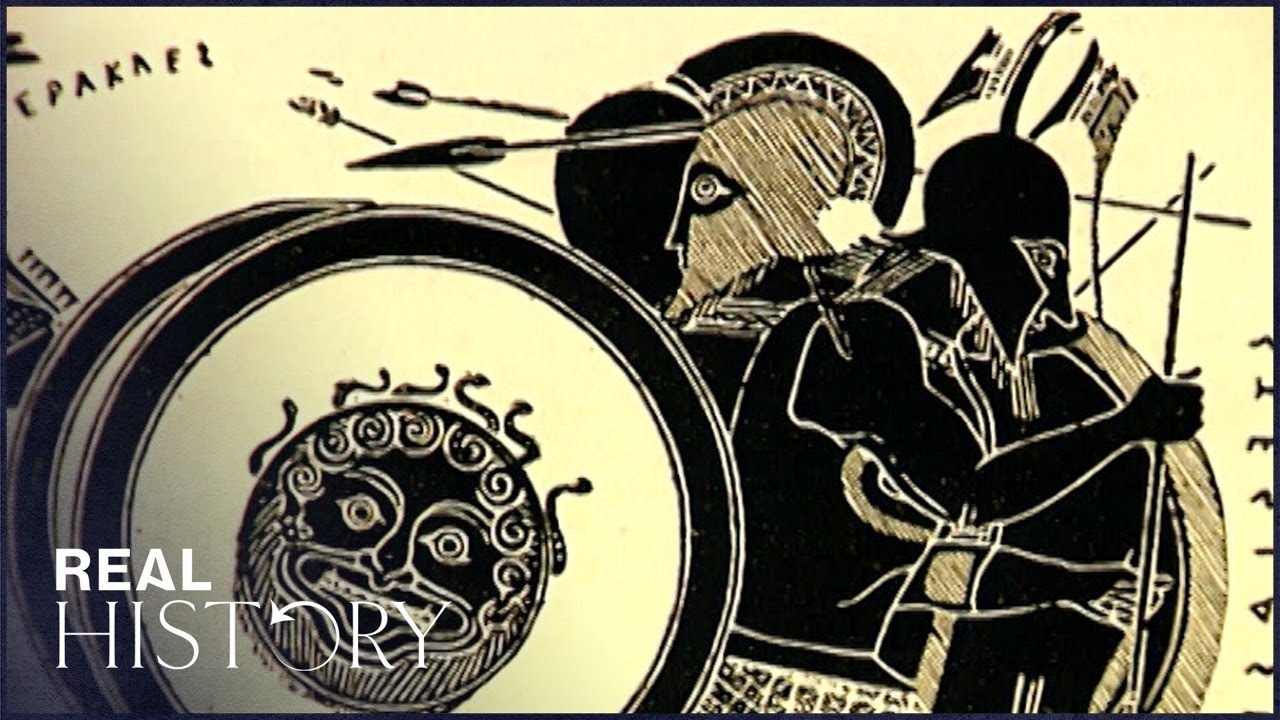
The Persians, light infantry archers who relied on their cavalry, were crushed between the Greek flanks. They tried to escape through a salty marsh, but the Greeks were already there, cutting them off from their ships. Hundreds died in the mud, and the rest fled back to their vessels, sailing away in defeat. The Battle of Marathon was won.
The messenger Pheidippides ran all the way back to Athens, a distance of 27 miles, wearing his armor, covered in blood, and exhausted beyond measure. He reached the city gates, where the entire government was waiting. He looked at them, gasped the word “victory,” and collapsed dead. The Athenians had saved their city, but the threat was not over.
They immediately marched to the coast to repel another Persian landing, arriving just in time, and the Persians, demoralized and broken, retreated across the Aegean. Greece was safe, for now. Darius, the Persian king, was furious. He wanted to conquer Greece and burn Athens to the ground.
But before he could launch a new invasion, he died. His son, Xerxes, took the throne. He was a man who saw himself as a god, with a massive ego and an even larger army. He vowed to avenge his father’s defeat and to crush the Greeks once and for all.
He spent years planning and gathering the most colossal military force the ancient world had ever seen. Troops were conscripted from all corners of the vast Persian Empire, from the Levant to Egypt to Asia Minor, and even Greek mercenaries who fought for whoever paid them. This army was so large that it took days to cross the bridge of boats Xerxes had built over the Hellespont. The Greek city-states, still bitterly divided among themselves, knew they had to unite or die.
The Athenians, who had the largest navy, and the Spartans, who had the strongest army, created the Hellenic League. The leadership of the army and navy would go to Sparta, a concession the proud Athenians surprisingly accepted. They all knew that if they failed, Greece would be enslaved to a tyrant. In the spring of 480 BC, the Persian war machine began its march south.
Thousands of cities surrendered, offering tribute to Xerxes, trying to save themselves. But the Athenians and Spartans refused. They decided to make a stand at the narrow pass of Thermopylae. It was a bottleneck between the mountains and the sea, a perfect place to negate the Persian numerical advantage.
The Spartan king, Leonidas, took with him 300 of his best warriors, his personal bodyguard, along with about 7,000 allies from various Greek city-states. When Xerxes arrived at the pass and saw the small force waiting for him, he was amused. He sent an envoy demanding they lay down their arms. Leonidas gave a legendary response: “Come and take them.
” Xerxes, insulted by their defiance, sent his elite troops, the Immortals, to break the Greek line. But the Greeks held, using their long spears and heavy shields to create a dense wall of bronze. The Persians, with their light armor and short swords, were no match. They were slaughtered in waves.
Xerxes watched from his throne, enraged and confused. The Greeks weren’t just holding; they were cutting his army to pieces. He ordered wave after wave, but the Greeks stood firm. Then, the luck of the Greeks ran out.
A local Greek named Ephialtes, bribed with gold, showed the Persians a secret mountain path that led directly behind the Greek position. When the Greeks learned they were surrounded, most of the allies withdrew and fled. But Leonidas and his 300 Spartans stayed, with a few Thespians and Thebans, knowing it was a death sentence. They fought to the last man, their long hair combed before the battle so they would look their best when they died, a nod to their belief that a beautiful death was the highest honor.
Surrounded on all sides, with their spears broken, they fought with their swords, and then with their bare hands. The Persians, fearing a stalemate, finally encircled them and shot them down with a rain of arrows so thick it blocked out the sun. Leonidas fell, and his 300 Spartans with him, but they had bought the Greek fleet precious time. Thermopylae was a moral victory but a tactical disaster.
The road to Athens was wide open. The Persians marched south, and the Athenians, forced to abandon their city, watched from the nearby island of Salamis as their homes were plundered and burned. The Greek fleet, docked in the straits near the island, was the last hope. The Spartan army, meanwhile, was building a wall across the Isthmus of Corinth, trying to protect the Peloponnese and forsaking Athens.
The Athenian general, Themistocles, knew the fleet could only be saved if it fought in the narrow straits of Salamis, where Persian numbers would be useless. He devised a desperate plan. He sent a secret message to Xerxes, claiming he was changing sides and advising the king to attack the Greeks before they could sail away. Fooled, Xerxes ordered his massive fleet into the straits.
The Persian ships were large and heavy, and as they entered the narrow waterway, they became crowded and chaotic. The lighter, swifter Greek triremes then attacked, crashing into the Persian ships, breaking their oars, and boarding them. The battle raged for hours. The Persians, relying on their Phoenician and Ionian allies, were thrown into disorder.
The Greek ships, smaller and more maneuverable, rammed them relentlessly. The Ionian Greeks, forced to fight for the Persians, put up a fierce fight, but in the end, they were overwhelmed. The Persian fleet was decimated. Xerxes, watching from a golden throne on the shore, saw his naval power destroyed.
He ordered a retreat back to Asia, leaving a portion of his army behind in Greece under the command of General Mardonius. Mardonius was determined to finish what Xerxes had started. He wintered in Thessaly, and the next year, he marched south and sacked Athens again. The Athenians, forced to evacuate once more, appealed to the Spartans for help, threatening to join the Persian side if they were abandoned.
This time, the Spartans responded. A League army, led by the Spartan general Pausanias, marched north and met the Persians at Plataea. For two weeks, the armies faced each other, neither willing to attack. The Persians, harassing the Greeks with their cavalry, managed to cut off their water supply and poison the springs.
Pausanias ordered a strategic retreat in the night, but it was chaotic and disorganized. The next morning, Mardonius saw the Greeks seemingly in flight and ordered his entire army to pursue them, thinking the battle was won. But he was wrong. The Greeks, tired and thirsty, suddenly turned and formed a defensive line.
The Spartans fought with a viciousness that stunned the Persians. They stood their ground, their spears and shields a wall of death. The Athenians, on the other side, fought off the Boeotian allies of the Persians. Mardonius was killed in the chaos of the battle, and with his death, the Persian morale shattered.
The Persian forces broke and fled, and the Greek hoplites pursued them, slaughtering thousands and destroying their camp. The victory at Plataea was total. The Persians were driven from Greece for good. The Persian Wars, which had threatened to extinguish the flames of Greek freedom, were over.
The tiny, proud Greek city-states had defeated the greatest empire in the world. They had preserved the seeds of democracy, as well, philosophy, art, and science, which would blossom in the coming Golden Age of Athens. The Athenians, their city burned, rebuilt it as a marble monument to their gods and their freedom, building the Parthenon, which stands as a symbol on the Acropolis. But the conflict with the Persian Empire didn’t end entirely.
It would be a century later, when the Greek world was once again fractured by civil wars, that the empire would finally fall, not to a unified Greek army, but to a single man of extraordinary ambition, Alexander of Macedon, but that is another story.