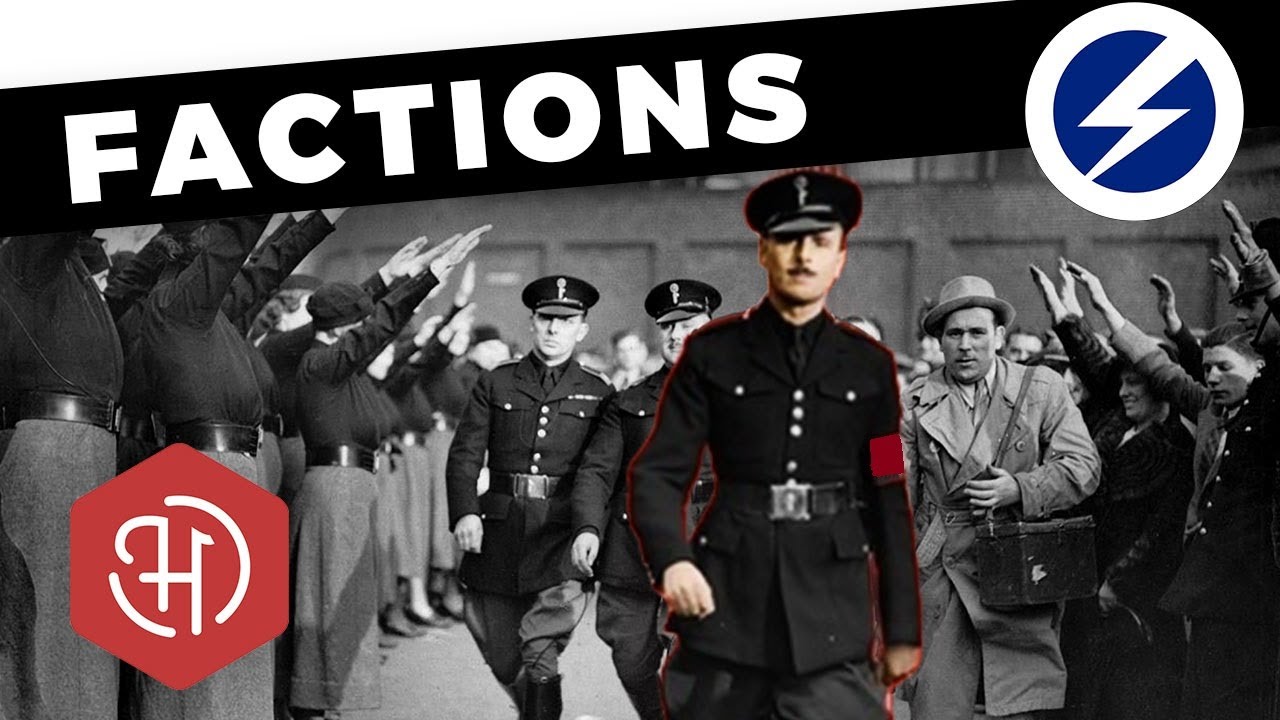
The black shirts marched through the East End of London, their boots striking the pavement in unison beneath the lightning bolt insignia. It was the 1930s, and the Great Depression had shaken Britain’s faith in its own democracy. Sir Oswald Mosley, a former MP turned fascist leader, promised to make the nation strong again—and thousands were listening. Mosley was born into privilege in 1896, the eldest son of a baronet, but his childhood was marked by his father’s gambling and absence.
He was raised largely by his mother and grandfather, excelling at boxing and fencing, and later entering the Royal Military College. The First World War brought him to the Western Front, then to the Royal Flying Corps, where a crash left him with a permanent limp and a reputation for reckless courage. His political career began inside the system he would later reject. Elected as a Conservative MP in 1918, he joined Labour in 1924, then stormed out in frustration in 1930 when his ambitious economic plans were ignored.
His proposals—state-led investment, public job creation, protectionist trade within the empire—were ahead of their time, but his patience was not. Convinced that democratic leaders lacked the will to act, he turned to authoritarian solutions. In 1932, Mosley founded the British Union of Fascists. His vision was not merely violent; it was seductive.
He promised action, order, and national revival. The movement grew quickly, reaching around 50,000 members by 1933, and won the backing of the Daily Mail, which admired Mussolini’s Italy. His seaside camps displayed fascist symbols alongside the Union Jack, and Mosley inspected his uniformed followers with theatrical pride. But the movement’s true nature was exposed in June 1934 at a rally in Olympia, where his stewards brutally attacked protesters.
The violence shocked the public, and support collapsed. Mosley later defended his men, claiming they had restored free speech by silencing those who tried to disrupt meetings. But the damage was done. He was no longer seen as a patriot restoring order—he was seen as the source of disorder.
He shifted his focus to London’s East End, exploiting anti-Jewish resentment in poor white neighborhoods. By then, his rhetoric had become openly antisemitic, though he denied it for the rest of his life. He claimed his quarrel was only with certain Jews who allegedly pushed Britain toward another war. His own propaganda provoked the opposition he complained about, and his movement was reduced to a local, discredited sect.
Throughout the 1930s, MI5 kept close watch on Mosley, infiltrating his ranks and bugging his communications. When the Second World War broke out, his calls for Britain to accept Hitler’s peace offer sealed his fate. In May 1940, he was arrested under Defence Regulation 18B and imprisoned without trial. His wife Diana was also detained, and the British Union of Fascists was banned.
Mosley spent years in prison, reading history and politics, and was released in 1943 due to illness. After the war, he tried again, founding the Union Movement in 1948 to promote a united Europe. His rallies were met with constant opposition, and he eventually left Britain for Ireland and later France. In his final years, he became notorious for denying the Holocaust and campaigning against immigration.
He died in 1980, a deeply discredited figure. But his story remains a warning of how economic fear and charismatic leadership can lead a nation to the edge of fascism—and how the resilience of democratic institutions, combined with public opposition, can stop it from crossing the line. Fascism never took root in Britain, not because Mosley lacked ambition or brutality, but because the country’s existing system proved strong enough to survive the storm.


