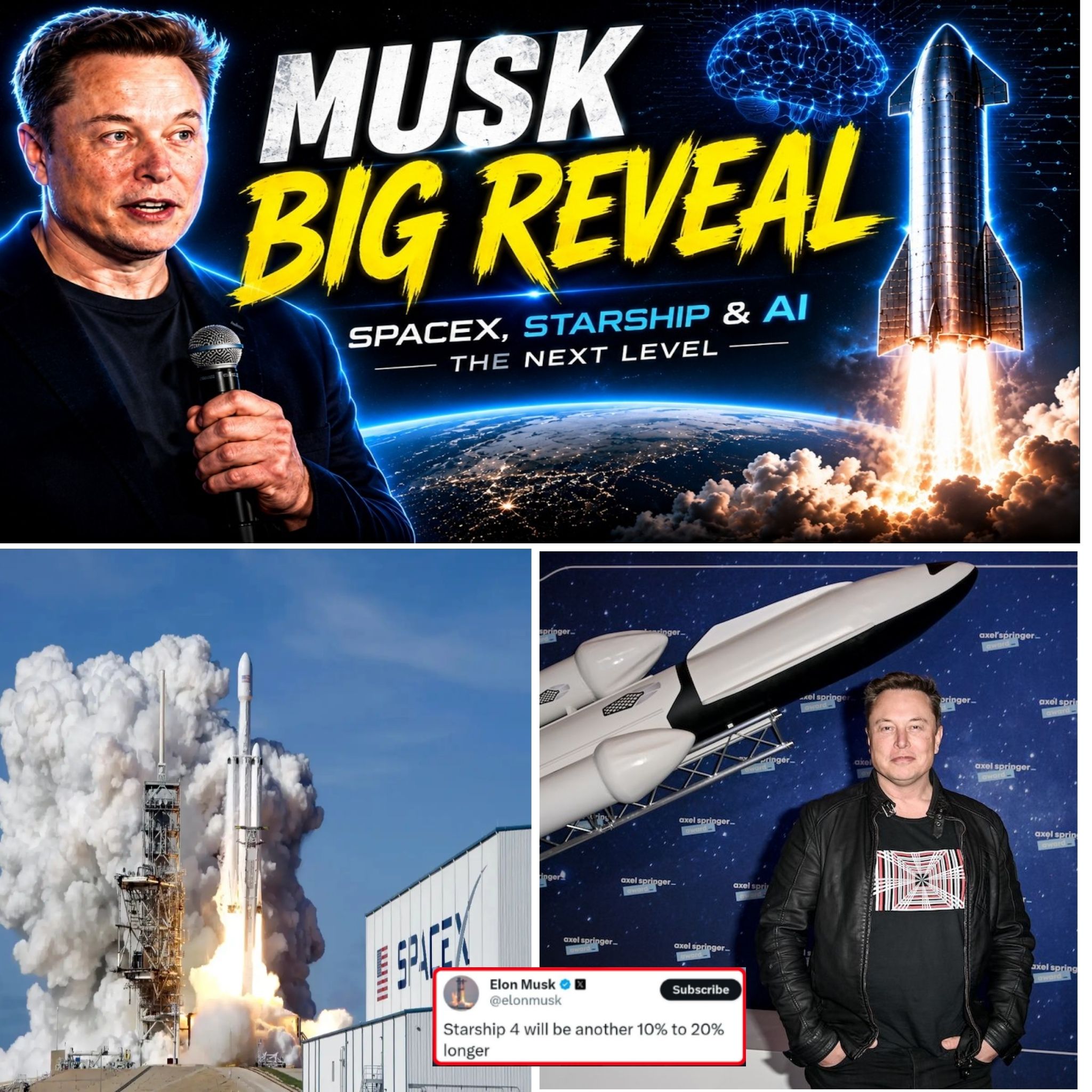
For more than two decades, almost every impossible promise attached to SpaceX has eventually come down to one question:
Can the rocket actually fly?
Falcon 1 had to reach orbit.
Falcon 9 had to prove a booster could return from space instead of being thrown into the ocean.
Dragon had to carry astronauts.
Starlink had to turn thousands of satellites into a working global network.
And Starship—the largest and most ambitious launch system SpaceX has ever attempted—has been expected to unlock the Moon, Mars and a radically cheaper way of moving enormous amounts of mass beyond Earth.
But during a recent SpaceX company update, Elon Musk introduced a possibility that changes the way the entire story may need to be understood.
The next chapter of SpaceX may not be defined by a bigger rocket.
It may be defined by what those rockets carry.

And if Musk’s projections are even close to correct, SpaceX could be transforming from a launch company with an internet business into something far stranger: a vertically integrated system combining rockets, satellites, communications, artificial intelligence, enormous computing infrastructure, robots and eventually solar-powered computing beyond Earth.
That was the real surprise buried inside an update that initially sounded like a victory lap.
Musk began by going backward.
He ended by talking about a future in which biological humans may no longer represent most of the intelligence operating beyond Earth.
And somewhere between those two points, SpaceX’s identity appeared to change.
The story began in a place almost absurdly small compared with what SpaceX has become.
Musk reminded employees of the company’s earliest days, when SpaceX operated from modest facilities in El Segundo, California, and its future depended on Falcon 1—a small rocket built by a company that had never successfully put anything into orbit.
There was no Starlink.
No Dragon fleet regularly traveling to the International Space Station.
No reusable Falcon 9 boosters landing on drone ships.
No Starbase.
No tower catching giant rocket hardware.
No constellation containing thousands upon thousands of spacecraft.
There was simply a small organization attempting something that established aerospace institutions had spent decades learning to do.
And at first, SpaceX failed spectacularly.
Falcon 1’s first launch failed.
Then the second failed.
Then the third.
For a young rocket company with limited resources, a sequence like that can become fatal remarkably quickly.
The fourth flight in September 2008 finally reached orbit.
Today, that moment looks like the inevitable beginning of the SpaceX story.
At the time, nothing about it was inevitable.
That distinction matters because Musk used the company’s history almost like evidence for what he was about to propose next: SpaceX had repeatedly entered areas where the conventional assumption was that the problem was either impossible, uneconomical or simply unnecessary.
Then, after enough engineering iterations, the impossible became routine.
And nothing demonstrates that pattern better than reusable rockets.
For decades, orbital launch vehicles were largely treated as disposable hardware. The machine would perform one extraordinary flight, and much of it would then be lost.
SpaceX attacked that economics problem directly.
Could the most expensive portion of a rocket launch, the booster, survive the journey and return?
Could it land vertically?
Could it be inspected, refueled and flown again?
And most importantly, could that process become routine enough to change the economics of launch?
The early attempts supplied plenty of reasons for skeptics to say no.
Boosters hit the ocean.
Landing attempts ended in explosions.
Vehicles tipped over.
Hardware was destroyed in seconds after months of work.
But gradually, failure stopped being the ending.
It became data.
Then one booster landed.
Then another.

Then previously flown boosters began launching again.
Eventually, the remarkable image of a Falcon 9 first stage descending through the atmosphere and touching down on a drone ship became so familiar that audiences could watch it without realizing how bizarre the scene would have looked to aerospace engineers a generation earlier.
In 2026, Falcon operations have reached a scale where repeated launch and recovery are no longer experimental demonstrations but part of SpaceX’s operating machine. The company has said that its reuse model has enabled higher flight rates and lower launch costs while feeding post-flight inspection data back into engineering.
That shift created the first great SpaceX flywheel.
Reusable rockets made frequent launches possible.
Frequent launches made a giant satellite network possible.
And a giant satellite network created a business far larger than traditional launch contracts alone.
That business became Starlink.
But before Musk arrived there in his retrospective, he stopped at another symbol of how dramatically SpaceX’s ambitions had expanded: Falcon Heavy.
When Falcon Heavy made its demonstration flight in 2018, SpaceX needed a payload.
A traditional aerospace company might have launched a block of concrete or another inert mass simulator.
Musk sent his own Tesla Roadster.
A mannequin in a spacesuit—”Starman”—sat behind the wheel.
The stunt looked ridiculous to some observers.
It was also unforgettable.
The car left Earth.
And it became something like a monument to the peculiar culture that SpaceX had developed: serious engineering wrapped in an almost adolescent refusal to make spaceflight look boring.
Yet while Falcon Heavy produced one of the company’s most famous images, Dragon demonstrated something far more consequential.
SpaceX became the first private company to send a spacecraft to the International Space Station, and later began transporting astronauts under NASA’s Commercial Crew Program.
By March 31, 2026, company roadshow material said Dragon had completed more than 50 visits to the ISS and had safely flown 78 crew members representing 20 countries.
That number is easy to glide past.
It should not be.
A company that once could not get Falcon 1 into orbit had reached the point where human beings climbed into its spacecraft and trusted its machines to take them away from Earth—and bring them home.
Then came Starlink.
And this is where the scale of the story suddenly becomes difficult to visualize.
Musk’s logic was straightforward: once SpaceX possessed rockets capable of flying frequently, what should the company put on them?
Its answer was to build an internet infrastructure in orbit.
Not a handful of satellites.
Thousands.
At the end of June 2026, SpaceX’s regulatory filings described a connectivity network powered by more than 10,200 Starlink broadband and mobile satellites operating in low Earth orbit across 167 countries, territories and markets. In the August company update, Musk said the number was approaching 11,000 and described approximately 13 million high-bandwidth subscribers plus about 22 million Starlink Mobile users.
The scale becomes clearer when you compare it with the company that existed before Falcon 1’s first flight.
SpaceX started by trying to build one functioning rocket.
Now it operates a communications architecture composed of more spacecraft than any organization in history has controlled.
And Musk does not intend to stop at roughly 11,000.
SpaceX has sought authority for a next-generation constellation that could eventually involve as many as 100,000 satellites, while its V3-generation Starlink spacecraft are designed to exploit Starship’s dramatically greater payload capability. Regulatory materials have described V3 satellites offering roughly one terabit per second of downlink capacity per spacecraft, with a single Starship mission potentially deploying dozens at once.
That is the first clue that Starship is not the final destination of SpaceX’s strategy.
Starship is the transportation layer.
The things it makes possible may ultimately matter more.
There is also Starshield, SpaceX’s government-focused satellite business.
Musk told employees that there were limits to what he could discuss publicly because of the classified nature of parts of the program, but characterized Starshield as increasingly important to American national security. Publicly available information is necessarily limited compared with Starlink, making it one of the least visible pieces of the company described during the update.
Then Musk arrived at Starship.
If the presentation had ended there, the message would have been familiar.
Falcon 1 proved SpaceX could reach orbit.
Falcon 9 proved rockets could be reused.
Dragon proved SpaceX could carry people.
Starlink proved the company could build infrastructure on a planetary scale.
Starship would finish the job by making enormous-scale access to orbit possible.
Musk has repeatedly described Starship as an engineering problem near the limits of what biological human intelligence can design, joking in another 2026 discussion that future artificial intelligence might look back at the machine and conclude that humans had done reasonably well.
There is a reason for the hyperbole.
SpaceX does not merely want Starship to become another heavy-lift rocket.
The design is meant to become fully reusable.
Not partially reusable.
Not a booster recovered while another expensive stage is discarded.
The long-term objective is for both stages to be reused rapidly enough that orbital transportation begins to resemble a logistics network rather than a sequence of individually precious missions.
If SpaceX can achieve that at scale, the implication is enormous.
The company currently measures annual payload-to-orbit capability in thousands of tons.
Its vision for Starship is measured in hundreds of thousands and eventually millions.
That is not an incremental improvement.
It is a category change.
A civilization cannot build a permanent city on Mars by sending a few scientific payloads every year.
It cannot construct a large lunar settlement using transportation economics designed for occasional government missions.
And it certainly cannot build industrial-scale infrastructure in orbit if every kilogram remains extraordinarily expensive to deliver.
Millions of tons change what can be imagined.
Factories.
Fuel depots.
Habitats.
Power systems.
Mining equipment.
Robots.
Thousands of spacecraft.
And, increasingly, computers.
That last word became the pivot.
Because after spending much of the presentation celebrating rockets, spacecraft and communications systems, Musk suddenly moved into a business that would have sounded almost unrelated to SpaceX only a few years earlier.
Artificial intelligence.
Not as a side project.
Not as software to improve rocket engineering.
Not merely as a useful tool for employees.
As a core business.
SpaceX’s own June-quarter filing now formally describes the company as operating three reportable segments: Space, Connectivity and AI. The AI segment includes Grok, AI products, X and large-scale computational infrastructure, reflecting the incorporation of xAI into the broader SpaceX structure earlier in 2026.
Then Musk made one of the most striking predictions of the entire meeting.
He told employees that AI revenue could exceed all of SpaceX’s other businesses combined as soon as September.
Not in ten years.
Not after Mars.
Not after Starship becomes fully mature.
September.
And he predicted that by the fourth quarter, AI revenue could significantly exceed the company’s non-AI revenue.
That was the first real plot twist.
SpaceX had just spent years persuading the world that Starlink was becoming an economic machine capable of financing humanity’s expansion into space.
Then Musk essentially told the people who built that machine:
Something else could become bigger.
The numbers explain why the statement attracted attention.
SpaceX reported $7.81 billion in second-quarter 2026 revenue, according to reports based on its results. AI represented about $2.56 billion, while connectivity—including Starlink—generated roughly $4.29 billion and space products about $962 million.
For Musk’s September prediction to come true, the AI segment would need to cross from a major business into the company’s dominant revenue engine at extraordinary speed.
And Musk did not stop there.
He reportedly told the gathering that within four or five years, AI could represent roughly 99% of SpaceX’s value.
Read that again.
Ninety-nine percent.
A company whose name literally contains the word “Space.”
A company famous for landing rockets on ships.
A company building the largest rocket system ever flown.
A company operating the largest satellite constellation in existence.
Musk’s prediction is that nearly all of its value could eventually come from artificial intelligence.
This does not mean SpaceX is abandoning rockets.
It means the rockets may become infrastructure for something even larger.
And that is where the second twist appears.
To understand it, ignore the rockets for a moment and look at electricity.
Artificial intelligence is increasingly constrained not simply by algorithms but by physical resources: chips, cooling, construction, transmission capacity and above all electrical power.
Training and operating enormous AI systems requires enormous amounts of energy.
So SpaceX is scaling compute infrastructure with the same philosophy it applied to rockets: vertically integrate, build aggressively and remove bottlenecks.
In its second-quarter discussion, Musk said SpaceX expected to end 2026 with more than two gigawatts of compute capacity. For the end of 2027, he suggested cumulative capacity could be closer to 10 gigawatts than five.
The company has also committed to Nvidia’s Vera Rubin architecture for future AI infrastructure.
Ten gigawatts is a staggering amount of power.
It is the kind of number that stops sounding like a technology-company plan and starts sounding like national infrastructure.
Musk went further, estimating during the employee update that a 10-gigawatt AI operation could potentially support $300 billion to $500 billion of annual revenue under the economics he expects.
That is a projection, not a guaranteed outcome.
The cost of chips, power, cooling, networking, capital, maintenance and future competition will determine what such infrastructure is actually worth.
But the scale of the forecast reveals how Musk is thinking.
He no longer appears to see AI as merely software running inside data centers.
He sees intelligence as an industrial product.
Something manufactured from electricity and silicon.
Something whose production can be scaled.
Something whose factories may eventually leave Earth.
And then came another turn.
Grok.
Musk told SpaceX employees that future versions of Grok would be trained on the accumulated body of information produced inside the company.
Decades of engineering experience.
Design decisions.
Lessons from failures.
Manufacturing knowledge.
Operational knowledge.
The extraordinary amount of information generated by an organization that has designed engines, rockets, spacecraft, satellite factories, launch pads, communications networks and automated systems.
During SpaceX’s Q2 earnings discussion, Musk said Grok 5 was expected to incorporate the company’s full internal data corpus, predicting that doing so could make it an exceptionally capable engineering model.
But during the all-hands, he framed the idea more personally.
Employees, he suggested, would effectively become the AI’s “parents.”
Their work would shape what it learned.
Their decisions would become examples.
Their accumulated thinking would become part of the intellectual environment in which the system developed.
For some employees, that framing must have sounded inspiring.
For others, it probably raised entirely new questions.
What exactly counts as employee data?
How much internal information will be used?
How is proprietary or personally attributable material handled?
Reports about the presentation noted that the precise mechanics and privacy implications remained unclear.
But Musk was making a broader philosophical point.
AI may eventually become far more capable than biological humans.
And if that is true, he argues, then the values and knowledge embedded during its development matter enormously.
His analogy was essentially that of raising an unusually intelligent child.
The fact that the child may someday surpass the parent does not make the parenting irrelevant.
It makes the early influence more important.
That idea led directly into the most speculative—and perhaps most revealing—part of Musk’s presentation.
Space.
But not space as astronauts experience it.
Space as an energy environment.
Earth receives only a tiny fraction of the Sun’s total output.
Move industrial infrastructure beyond the constraints of the planet, and solar energy becomes available at extraordinary scale.
There are no clouds in orbit.
No night in the conventional sense if systems are positioned appropriately.
No local communities objecting to a new transmission line.
No terrestrial land-use problem.
And eventually, Musk’s logic goes, computing infrastructure may follow the energy.
This is the point where the familiar SpaceX story flips upside down.
For years, the narrative was:
Build rockets so humans can go to Mars.
Now another possibility is appearing alongside it:
Build rockets so machines can build enormous computational infrastructure in space.
Starship becomes the truck.
Starlink becomes the nervous system.
Solar arrays become the power source.
AI accelerators become the factories.
Robots build more factories.
And the output is intelligence.
SpaceX has already discussed orbital AI computing publicly, and its broader long-term plans now connect high-capacity satellites with growing demand from AI systems. The company has also explored vastly larger satellite architectures, including proposals connected to space-based computing.
This is where Musk invoked one of science fiction’s oldest ways of measuring advanced civilizations: energy.
The Kardashev scale classifies civilizations according to how much energy they can harness—first on the scale of a planet, then a star, then vastly beyond.
Humanity is nowhere near controlling the output of the Sun.
But Musk’s argument is that the direction of technological civilization points outward.
Once computing demand becomes enormous enough, energy availability becomes the central constraint.
And once launch becomes cheap enough, Earth itself may become a constraint.
So instead of dragging all of the energy down to the computers, perhaps civilization eventually moves the computers toward the energy.
That is an astonishing reversal.
For most of industrial history, humans built machines where humans lived.
SpaceX’s long-range vision suggests a future in which humanity’s largest machines may be located in places humans rarely visit.
Robotic construction systems.
Autonomous maintenance spacecraft.
Massive solar arrays.
AI computing clusters operating beyond the atmosphere.
Satellites exchanging unimaginable quantities of data through optical links.
A kind of machine ecosystem surrounding Earth before expanding farther into the solar system.
And then, according to Musk’s logic, something else happens.
The balance between biological and digital intelligence begins to change.
Humans are astonishingly efficient organisms.
The brain operates on roughly the energy consumption of a household light bulb.
But humans are also difficult to keep alive in deep space.
We need oxygen.
Pressure.
Water.
Food.
Temperature control.
Radiation protection.
We suffer from isolation.
Our bodies degrade in microgravity.
Mars is not a welcoming second Earth waiting for settlers to arrive.
It is a freezing, irradiated desert with a thin atmosphere and planetary-scale engineering problems.
Machines have different requirements.
That does not make humans irrelevant.
It means robots and AI could become the advance force of a spacefaring civilization.
They can inspect.
Dig.
Build.
Repair.
Manufacture.
Operate in environments that are lethal to people.
And potentially prepare locations before humans ever arrive.
In Musk’s vision, the transition to a multiplanetary civilization may therefore happen through two expansions simultaneously.
One biological.
One digital.
Humans spread beyond Earth.
Intelligence spreads much faster.
That distinction turns Starship into something far more consequential than a Mars transport.
If Starship eventually becomes capable of delivering vast quantities of cargo cheaply and repeatedly, it does not merely transport astronauts.
It transports industrial capacity.
The machines required to make more machines.
The solar arrays required to power them.
The computers required to coordinate them.
The robots required to assemble them.
The communications hardware required to connect them.
In other words, Starship may become the bootstrap mechanism for infrastructure that can begin growing after it leaves Earth.
That is the part of Musk’s update that deserves more attention than another rendering of astronauts standing on Mars.
Because the Mars image is familiar.
Humans in spacesuits.
A settlement.
Domes.
Rockets on the horizon.
It looks like science fiction we already understand.
A solar-powered, robotic, self-expanding computational economy distributed through space is stranger.
And possibly more transformative.
Musk reached even farther, referencing Robert Heinlein’s classic novel The Moon Is a Harsh Mistress and discussing the idea of large-scale lunar infrastructure and mass-driver-like systems capable of sending material away from the Moon without requiring conventional Earth-style launches.
The Moon has one-sixth of Earth’s gravity and no meaningful atmosphere.
That radically changes transportation.
A future industrial system established there could, at least in principle, exploit conditions impossible to reproduce cheaply on Earth.
Imagine automated mining equipment extracting lunar materials.
Manufacturing plants processing them.
Solar power fields feeding massive computational facilities.
And electromagnetic launch systems throwing standardized cargo packages toward orbital construction sites.
No giant booster needed for every shipment.
No thick atmosphere to fight.
No ocean to drop stages into.
Just machines building machines in an environment where gravity itself offers a discount.
Musk said he hoped to see something resembling that future.
Then he made the vision personal again.
He told SpaceX employees that those who wanted to travel to the Moon or Mars should eventually have that opportunity.
The imagery shifted from gigawatts and artificial intelligence back to human experience.
People on the Moon.
People on Mars.
And, in Musk’s typically playful version of the future, parties in low gravity.
It sounded almost deliberately lighthearted after an argument that had just expanded to civilization-scale energy consumption.
But it revealed something important about the entire presentation.
The objective, at least in Musk’s framing, was not to create a universe populated only by machines.
The machines are supposed to enlarge the range of what humans can do.
That leads to the final twist.
The headline from this update is easy to write incorrectly.
“SpaceX moves beyond Starship.”
That sounds as though Starship has somehow become obsolete before it has fulfilled its purpose.
The opposite may be true.
There was no unveiling of a mysterious Starship replacement.
No “Starship 2” waiting behind a curtain.
No new super-rocket suddenly superseding the vehicle SpaceX has spent years developing.
The bigger revelation is that Starship may be only one piece of an architecture whose scale was not obvious when the rocket was first announced.
In that architecture, Falcon proves reuse.
Dragon proves human transportation.
Starlink proves mass-produced orbital infrastructure.
Starshield proves strategic applications.
Starship provides extreme transportation capacity.
AI provides intelligence.
Robotics provides labor.
Solar power provides energy.
And space provides room to scale.
Every previous chapter begins to look less like a separate Musk project and more like a component.
That is the “I should have seen it coming” moment.
SpaceX spent years learning how to reach orbit cheaply.
Then it learned how to fill orbit with hardware.
Now it wants to fill that hardware with computation.
Once those three capabilities intersect—transportation, energy and intelligence—the nature of the company changes.
A rocket company sells launches.
A satellite company sells connectivity.
An AI company sells intelligence.
But a company that controls transportation to orbit, an enormous communications network, large-scale computing infrastructure and increasingly capable AI systems can theoretically build things no single-layer competitor can easily imitate.
The rocket can launch the computer.
The satellite network can connect it.
The AI can design and operate it.
The revenue can finance the next generation.
The next generation can launch more infrastructure.
And the cycle repeats.
That is the flywheel Musk appears to be trying to construct.
Whether it works is another question entirely.
Musk’s history is filled with timelines that moved.
Mars schedules have slipped.
Fully reusable Starship remains an unfinished engineering objective.
Building gigawatts of AI infrastructure requires extraordinary amounts of capital and electricity.
Space-based computing faces heat-management, radiation, maintenance, networking and launch-cost challenges that cannot be erased by a dramatic presentation.
A 100,000-satellite architecture would require regulatory approvals and would intensify existing concerns about orbital congestion and astronomy.
And predicting that AI will account for 99% of SpaceX’s future value is exactly that—a prediction.
It is not a financial law.
Musk has always been willing to place dates next to outcomes that other executives would describe much more cautiously.
That should not be forgotten simply because SpaceX has succeeded at several things that once sounded implausible.
But dismissing the presentation as another collection of Musk superlatives would miss what has actually changed.
SpaceX’s financial reporting already recognizes AI as one of three major operating segments.
Its filings show connectivity at global scale.
Its satellite network has crossed 10,000 spacecraft.
Its plans point toward vastly larger constellations.
Its compute infrastructure is being expanded aggressively.
And Musk is publicly linking all of those pieces to a future in which AI and orbital infrastructure converge.
That makes the latest company update more than a motivational speech.
It is a declaration about what SpaceX thinks it is becoming.
And the timing is significant.
Twenty-four years ago, SpaceX was trying to figure out how to build a rocket.
In 2008, three consecutive Falcon 1 failures left its orbital ambitions hanging by a thread.
Then the fourth flight worked.
Years later, a Falcon 9 booster descended through the sky and landed vertically.
Then a reused booster flew again.
Dragon carried astronauts.
Starlink covered the sky with communications spacecraft.
Starship rose from South Texas on millions of pounds of thrust.
Every time, the scale increased.
But the scale of the next bet is different.
It is no longer simply about building a larger machine.
It is about building a system capable of producing more capability than humans could manually design, operate or even supervise in the traditional way.
Musk’s old SpaceX goal was easy to phrase:
Make life multiplanetary.
His newer argument adds a second question:
What kind of intelligence becomes multiplanetary with us?
Perhaps humans arrive first.
Perhaps robots do.
Perhaps artificial intelligence extends civilization into environments where biology cannot easily survive.
Perhaps all three expand together.
Nobody knows.
But one point from Musk’s update was unmistakable.
SpaceX is no longer thinking only about the vehicle that gets humanity off Earth.
It is thinking about what happens when transportation stops being the biggest limitation.
For twenty years, the rocket was the breakthrough everyone was waiting for.
Now Musk is betting that the rocket becomes the road.
And the truly consequential machines will be the things traveling on it.
That may ultimately be Starship’s greatest achievement—not becoming the final machine in SpaceX’s story, but becoming the machine that makes everything after it possible.
Because the most important moment in a technological revolution is sometimes not when an impossible machine finally works.
It is when that impossible machine becomes ordinary enough that people start asking what they can build next.