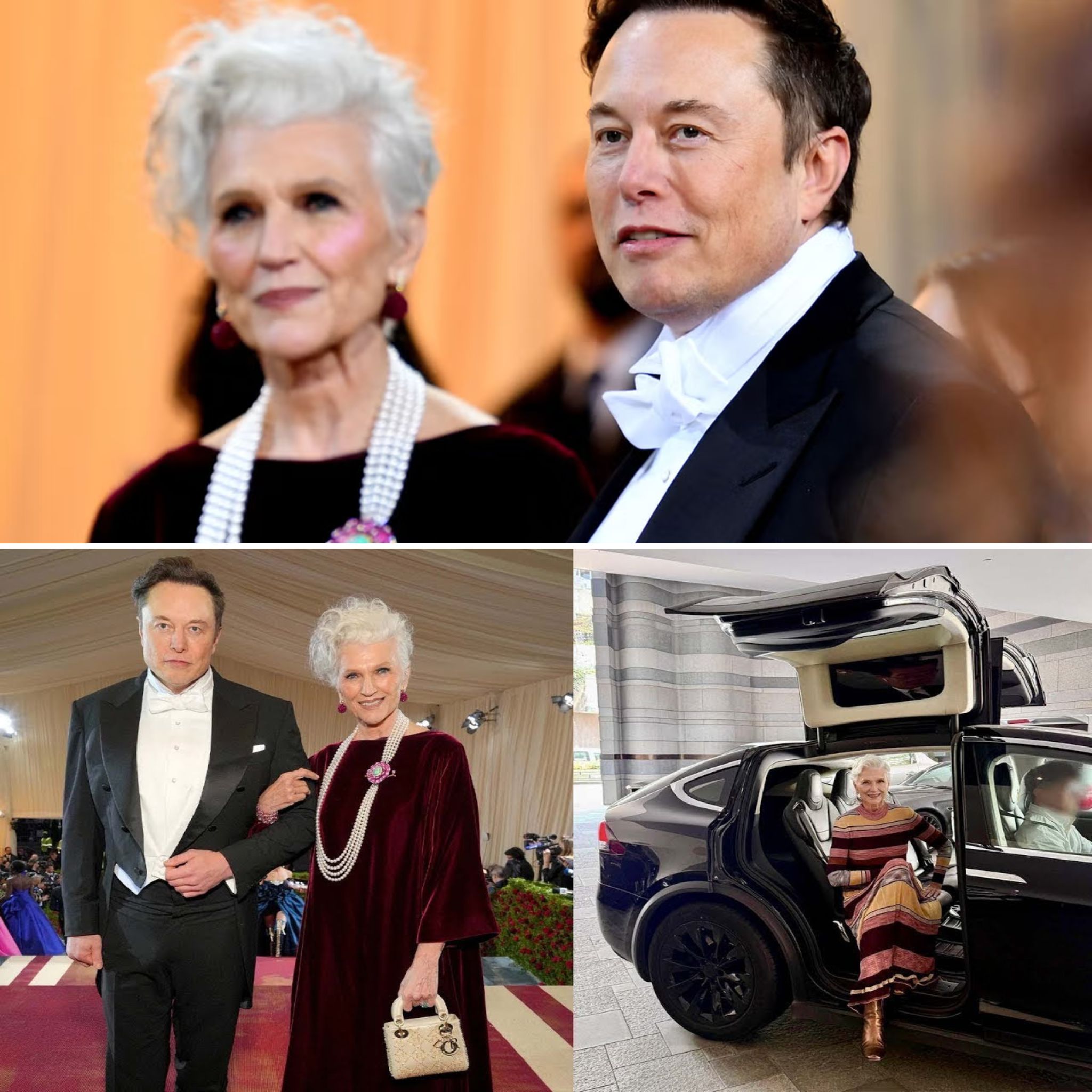
Maye Musk spent decades rebuilding her life, raising three children, surviving financial pressure, and repeatedly starting over. Now, at 78, with another book arriving in September 2026, her story raises a question that is harder to answer than it first appears: how much of Elon Musk’s relentless drive was learned simply by watching his mother refuse to quit?
For years, the introduction followed her everywhere.
“This is Maye Musk, Elon Musk’s mother.”
It was technically true.
It was also spectacularly incomplete.
Long before Tesla became one of the most closely watched companies on Earth, before SpaceX rockets landed themselves, before Elon Musk’s name became inseparable from technology, wealth, controversy and political power, Maye Musk already knew what it felt like to gamble on an uncertain future.
She had modeled since she was a teenager. She had trained as a dietitian. She had moved between countries, rebuilt professional practices from scratch and raised three children while working because, by her own account, not working was never really an option.
Then came the strange reversal.
The son whose ambitions once looked almost impossibly risky became one of the richest and most famous men alive. Suddenly, the woman who had spent decades creating an identity of her own was being introduced primarily through his.
But Maye did something unexpected.
She did not retire into the comfortable role of billionaire’s mother.
She became more visible.
In her 60s, she appeared on major magazine covers and giant advertising displays. At 69, she became CoverGirl’s oldest spokesmodel at the time. At 74, she appeared on the cover of the Sports Illustrated Swimsuit issue, then the oldest woman ever to hold that distinction. Her modeling career, which had begun at 15, was not shrinking with age.
It was accelerating.
And now another reinvention is arriving.
Maye Musk’s official site says her new book, TIMELESS: The Art of Reinvention and Resilience at Any Age, is scheduled for release in September 2026. At 78, while most people would be forgiven for treating a six-decade career as complete, she is once again presenting herself as a woman in the middle of the story rather than at the end of it.
That is where the familiar Musk family story begins to look different.
Because the more closely you examine Maye Musk’s life, the more difficult it becomes to see Elon’s appetite for risk, discomfort and reinvention as something that appeared from nowhere.
Before There Was a Musk Empire, There Was a Small Airplane and a Family That Refused to Stay Still
Maye was born Maye Haldeman in Saskatchewan, Canada, in 1948.
When she was a small child, her family moved to Pretoria, South Africa.
Her parents were not celebrities. They were chiropractors.
But conventional they were not.
Maye has described her parents as adventurers who flew long distances in a single-engine airplane in an era without the navigation technology modern travelers take for granted. In one extraordinary journey, they flew from South Africa toward Australia, crossing huge stretches of Africa and Asia.
The family also made repeated expeditions into the Kalahari Desert, searching for a legendary lost city.
To a child, that kind of upbringing changes the definition of “normal.”
Risk was not automatically a warning to stop.
The unknown was not necessarily something to fear.
A difficult journey did not become unreasonable simply because other people would never attempt it.
And work started early.
Maye later recalled that she and her siblings were helping with their parents’ business when they were children. The adults worked. The children contributed. Independence was not presented as an inspirational slogan.
It was the way the household functioned.
Decades later, people would use words such as “fearless,” “ambitious” and “unusually independent” when describing the Musk children.
But those characteristics did not first appear in Silicon Valley.
They had been circulating through the family long before Silicon Valley knew their surname.
Maye started modeling at 15 in Pretoria.
There was no Instagram audience waiting to be built. No personal brand consultant. No influencer ecosystem capable of converting a photograph into instant international attention.
Modeling meant showing up.
It meant auditions, agencies, travel, rejection and uncertainty.
And Maye did not assume beauty would provide a permanent career.
She studied science.
She earned a Bachelor of Science degree in dietetics from the University of Pretoria, studying in Afrikaans, and later accumulated advanced qualifications in dietetics and nutritional science. Over the course of her professional life, she would establish nutrition work in multiple cities and countries, repeatedly dealing with the qualifications and professional requirements of a new place.
That detail matters.
Because the mythology surrounding wealthy families often works backward.
People see enormous success in the present and unconsciously rewrite the past to match it.
The mansion appears first in the imagination.
Then the private schools.
Then the financial safety net.
Then connections.
Then privilege.
But Maye Musk’s own description of the years in which she was raising her children sounds very different.
There were secondhand clothes.
There was work.
There were bills.
And there was very little room for self-pity.
Then Her Life Broke Open
At 22, Maye married Errol Musk.
The marriage lasted nine years.
What happened inside it would later become one of the darkest parts of her memoir and public interviews.
Maye has described the relationship as abusive. In a 2019 interview with Harper’s Bazaar, she spoke about physical and emotional abuse and about the fear and humiliation she said accompanied the marriage and continued through bitter post-divorce custody disputes.
When the marriage ended, she was 31.
She had three children.
Elon.
Kimbal.
Tosca.
And suddenly the abstract idea of independence became something far more brutal.
It became survival.
There is a photographically clean version of success that people like to remember later.
The elegant woman.
The silver hair.
The couture.
The red carpets.
The international travel.
But those images arrived after years that looked nothing like them.
Maye had to build her nutrition practice while continuing to model. She has described approaching doctors, marketing her services and waiting for opportunities while supporting her children. Later, after moving to Canada, she again had to establish herself professionally in a new country.
She has said that she did not feel guilty about being a working mother for one simple reason:
She had no choice.
There had to be food.
There had to be a roof.
There had to be clothes.
At times, she worked multiple jobs simultaneously. Sports Illustrated later summarized her account of working as many as five jobs while raising her three children.
And the children saw it.
That may be the most important part of the story.
Maye did not sit them down every evening for motivational lectures about entrepreneurship.
She did not create a curriculum called “How to Become a Billionaire.”
She worked.
The children watched.
She struggled.
They watched.
She started again.
They watched that too.
Years later, when asked how she had raised such successful children, Maye’s answer was almost anti-dramatic.
She gave them responsibility.
She did not constantly supervise their homework.
She did not choose their careers.
She expected them to pursue their interests and take ownership of their decisions.
When they were young, they even helped in her nutrition business. Tosca assisted with letters. Elon helped his mother understand functions on an early word processor. Kimbal helped too.
There was no romantic mythology in it.
Maye has said plainly that she needed the assistance.
That environment produced something more useful than constant praise.
It produced competence.
The Boy in the Corner Was Reading Everything
Elon, in Maye’s recollection, displayed one behavior very early that separated him even inside his unusual family.
He read constantly.
And he remembered.
Maye has said that while she herself could read a story and soon forget its details, Elon appeared to retain what he absorbed.
He consumed information.
Books became a kind of private infrastructure.
That child would eventually build companies around electric vehicles, reusable rockets, artificial intelligence, brain-computer interfaces and communications technology.
But before all of those companies existed, his obsession was largely invisible.
He was simply a boy who kept reading.
Maye did not claim to have programmed that obsession into him.
In fact, she has often rejected simplistic recipes for producing exceptional children.
She encouraged interests rather than assigning them.
When Elon created a computer game as a child, she encouraged him to submit it to a publication. At 12, he sold the code for the game Blastar for about $500.
The amount was modest.
The signal was not.
A child had created something.
Someone outside the family believed it had value.
And the world had paid him for it.
There is an easy temptation here.
It would be convenient to say that Maye “made” Elon Musk.
That would also be too simple.
Children are not engineering projects. Elon’s personality, intellect, choices and later behavior cannot be reduced to a single parent or a single childhood lesson.
Maye herself has resisted that interpretation.
In one interview, she essentially said she could understand Kimbal and Tosca more easily, while Elon remained harder for her to explain.
That admission is revealing.
Even his mother does not pretend there is an easy formula.
But influence does not require a formula.
Sometimes influence is an example repeated so often that it becomes invisible.
Get up.
Work.
Solve the problem.
Adapt.
Do not expect comfort.
Start again.
Those ideas were present in Maye’s life years before they became part of the public mythology around her eldest son.
Then Came Another Reset: Canada
At 41, Maye returned to the country where she had been born.
Canada did not greet her with a glamorous second act.
It required another restart.
She settled in Toronto, requalified professionally and continued her education, eventually earning a Master of Science in nutritional sciences from the University of Toronto.
Her official biography says that across her career she built her nutrition business in eight cities and three countries.
Eight cities.
Three countries.
Think about what that sentence actually means.
New professional networks.
New clients.
New regulations.
New routines.
New reputations.
Again and again.
For many people, starting over once is a defining trauma.
For Maye Musk, reinvention became almost administrative.
Meanwhile, the children were becoming increasingly independent.
Elon went to Canada as a teenager and later studied in the United States.
Then, in the mid-1990s, he made one of those decisions that retrospectively looks inevitable only because we know how the story ends.
He left the safer academic route.
He entered the internet business.
And suddenly Maye was not merely watching her son take a risk.
She was about to put something of her own on the line.
THE FIRST MAJOR TWIST: ELON’S EARLY STARTUP WAS NOT SOME DISTANT FAMILY PROJECT
In later years, the Musk fortune would become so enormous that $10,000 could sound almost irrelevant.
In the mid-1990s, it was anything but irrelevant.
Elon and Kimbal Musk were developing Zip2, an early internet company designed to help newspapers and users connect business information with online maps and directories.
The operation was famously lean.
Elon has described the early company as so cash-conscious that he and his brother slept in their office and showered at a nearby YMCA.
This was not Tesla.
It was not SpaceX.
There were no factories filled with robots.
There were no rockets on launchpads.
There were two brothers trying to keep a startup alive.
And their mother became directly involved.
According to accounts Maye has given about that period, she traveled from Toronto to Silicon Valley, helped with practical business matters, bought food and clothing, helped with presentations and contributed money.
One widely reported figure is $10,000—described as her savings—put toward Zip2’s expenses.
She later called it her best investment.
The amount did not buy her a mythology.
It bought time.
One detail from those early days captures the distance between the Musk family of then and the Musk family the world sees now.
Maye recalled staying up late with Kimbal preparing color copies of a presentation at Kinko’s.
Not a private office tower.
Not a corporate strategy retreat.
Kinko’s.
Paper.
Printing.
Expenses.
A credit card.
A family trying to convince investors that an internet company might matter.
That is the part of great fortunes people often edit out.
The empire usually looks ridiculous before it looks inevitable.
Maye could not know that Zip2 would eventually be sold to Compaq for more than $300 million.
Elon could not know with certainty either.
He has said that when he began the company, he considered failure entirely plausible.
That is what makes risk genuine.
If success is guaranteed, it is not courage.
It is paperwork.
When Zip2 was acquired in 1999, Elon received roughly $20 million to $22 million from the sale, according to his own recollections and biographical accounts.
Then he did something that would become characteristic.
He did not retreat into safety.
He put much of his money into his next venture.
Then came X.com.
Then PayPal.
Then SpaceX.
Then Tesla’s rise.
Again and again, the same pattern appeared:
Acquire something valuable.
Put it back at risk.
Accept the possibility of public failure.
Work through crisis.
Double down.
It would be absurd to credit all of that to Maye Musk.
But it would be equally strange to ignore what Elon had seen growing up.
His mother had been practicing a less spectacular version of the same behavioral loop for decades.
Build.
Lose stability.
Move.
Requalify.
Work.
Rebuild.
Repeat.
While Elon Was Building Companies, Something Else Was Happening to Maye
At this stage, most family biographies would become predictable.
The son becomes wealthy.
The mother relaxes.
The difficult years become stories told at dinners.
The family wealth expands, and the parent gradually disappears into the background.
Maye went in the opposite direction.
Her career became bigger.
Not despite her age.
Partly because of it.
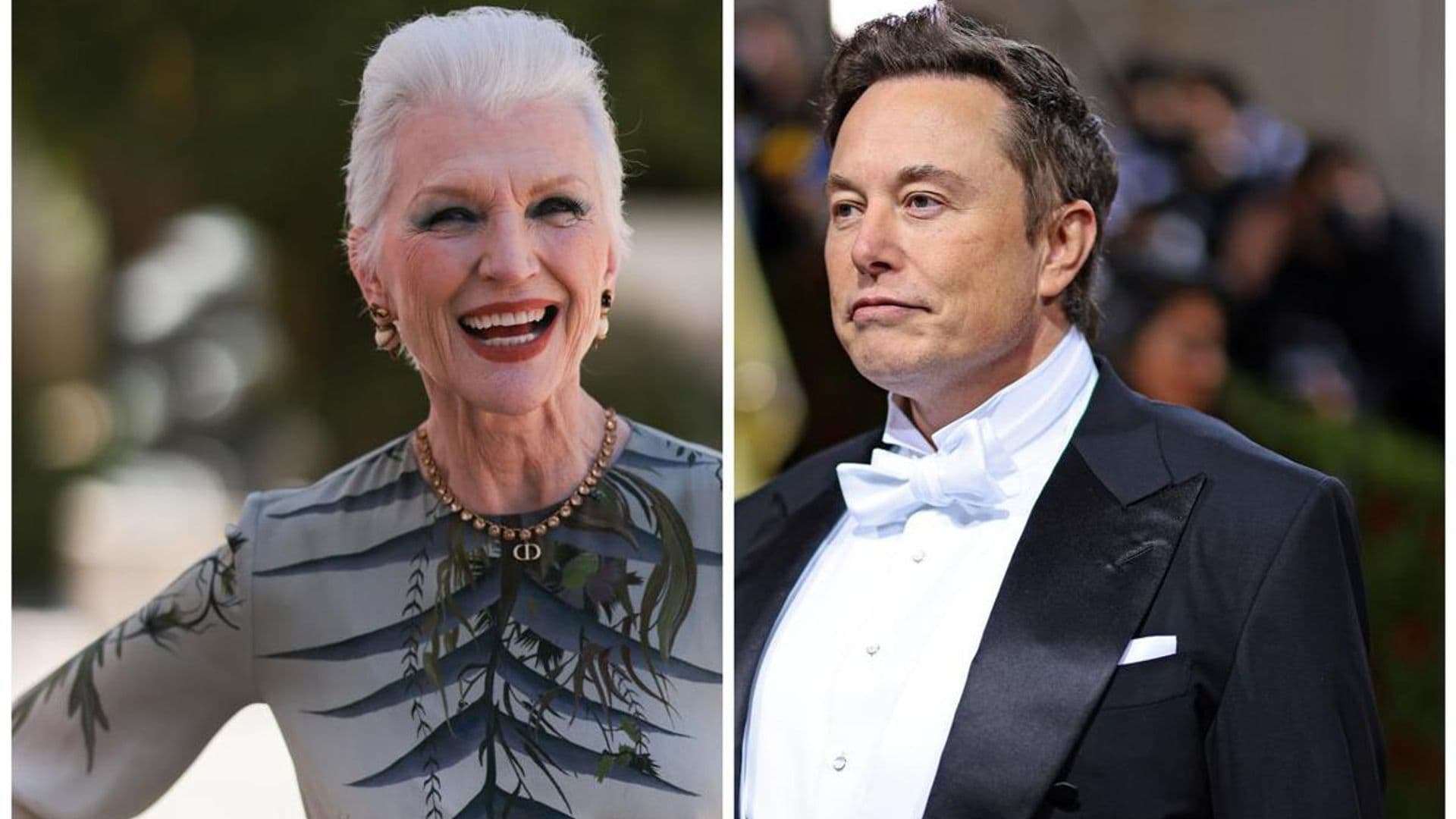
She had modeled for decades with dark hair. But her white hair eventually became one of the defining elements of her image.
Instead of disguising age, she built around it.
Fashion—an industry routinely accused of obsessing over youth—began treating the older Maye Musk as more interesting than the younger one.
She signed with IMG.
She appeared in publications including Vogue.
She worked campaigns and high-profile shoots.
Her image appeared on massive billboards.
She became a CoverGirl spokesperson at 69.
Then came Sports Illustrated.
In 2022, at 74, Maye appeared on the swimsuit issue’s cover, at the time making her its oldest cover model. Martha Stewart would surpass the record a year later at 81, but Maye’s cover had already made its point.
Her age was not being hidden.
It was the story.
Think about the reversal.
At 15, Maye could reasonably have assumed modeling would be temporary.
At 31, newly divorced and raising three children, fashion could hardly have looked like a reliable road to a spectacular later life.
At 41, she was rebuilding in Canada.
At 48, she was still dealing with professional registration requirements in another country.
At 60, conventional wisdom might have suggested slowing down.
Instead, some of the biggest modeling milestones of her life still had not happened.
That is not a normal career arc.
It is almost backwards.
And that became her advantage.
The Woman Once Buying Secondhand Clothes Was Now Entering Fashion’s Most Exclusive Rooms
The visual contrast is irresistible.
Maye Musk’s present-day public life includes international fashion events, speaking appearances and luxury-brand work.
Her own website lists engagements across cities and regions including New York, Dubai, Lisbon, Hong Kong, Stockholm, Budapest, Toronto and other international destinations.
Fashion houses dress her.
Photographers shoot her.
Audiences pay to hear her speak about entrepreneurship, aging, nutrition, confidence and resilience.
To someone encountering Maye only now, it would be very easy to see the silver-haired model stepping into another polished event and assume this was always her world.
It was not.
That is what makes the image powerful.
The same woman photographed in couture has spoken publicly about periods when luxuries simply were not part of the calculation.
She has recalled that when money was tight, dinners out, beauty appointments and unnecessary spending disappeared because survival took priority.
The glamorous life came after the discipline.
Not before it.
And she kept another career alive throughout much of it.
Maye was not a celebrity nutrition hobbyist.
She was a registered dietitian with scientific training, two master’s degrees and a professional history spanning counseling, research, consulting, writing and public speaking.
Her official professional biography lists work connected to chronic disease, nutritional research and professional dietetic organizations.
This makes the usual headline—“Elon Musk’s model mother”—sound almost comically narrow.
Model.
Dietitian.
Researcher.
Entrepreneur.
Author.
Speaker.
Single mother.
Immigrant.
And, yes, mother of Elon Musk.
The order changes depending on which part of her life you are looking at.
THEN COMES THE TWIST THAT THE INTERNET OFTEN GETS WRONG
There is a dramatic version of Maye Musk’s story spreading through lifestyle content that sounds irresistible:
She survived hardship.
Her son became a billionaire.
She built a luxurious empire of her own.
And eventually, the mother of a billionaire somehow became a billionaire herself.
There is only one problem.
The last part is not supported by reliable public evidence.
Maye Musk unquestionably built a successful independent career. She has modeling contracts, books, speaking work and a long-running nutrition career behind her. Her international profile is substantial.
But credible biographies and her own official professional materials do not establish that Maye Musk herself is a billionaire.
Nor do the reliable sources reviewed for this story substantiate sweeping claims that she personally owns some enormous independently created portfolio of luxury property and billion-dollar investments.
Her exact finances are private.
So the cleanest version of the truth is also the more interesting one:
Maye Musk does not need to be secretly worth a billion dollars for her story to matter.
In fact, calling her a billionaire can actually erase the most remarkable part of the story.
Her defining achievement is not that she supposedly matched her son’s fortune.
It is that she managed to preserve an identity that did not depend on it.
That changes the entire picture.
The money surrounding the Musk name is so enormous that it can distort everything nearby.
But Maye had been modeling for decades before Tesla became a household name.
She had built a nutrition career before SpaceX existed.
She had advanced degrees before Elon became famous.
She raised children before she could possibly know one of them would someday command companies worth sums difficult for ordinary people even to visualize.
The fortune arrived later.
The work ethic did not.
And That Leads to the Question People Keep Asking: Did She Create Elon Musk’s Drive?
It is an attractive theory.
It is also impossible to prove.
Elon Musk is one of the most psychologically analyzed public figures of the modern era. Admirers describe extreme persistence, first-principles thinking and an unusual tolerance for risk. Critics point to impulsiveness, conflict, controversial decisions and a management style that can be extraordinarily demanding.
No serious account can reduce a person that complicated to one parental influence.
But Maye’s own parenting philosophy gives us something more concrete.
She expected independence.
She let her children pursue their own interests.
She did not try to remove every difficulty from their lives.
She believed they should take responsibility early.
And they lived without the assumption that comfort was guaranteed.
“When your children aren’t used to luxuries,” she has argued in essence, they learn they can survive without them.
That sentence sounds very different when placed beside Elon Musk’s early startup life.
The office floor.
The YMCA shower.
The tiny burn rate.
The willingness to put a large portion of one success into the next gamble.
The repeated acceptance of circumstances that wealth would have allowed him to avoid.
Again, correlation is not proof.
But patterns matter.
Maye has also said something that may reveal more than any parenting formula.
Her children saw her work hard.
That was the lesson.
Not a speech.
Not a rule framed on the wall.
Behavior.
She had a problem, so she worked.
She moved, so she rebuilt.
She needed qualifications, so she studied.
She needed clients, so she found them.
She was rejected by conventional expectations of age, so she kept modeling anyway.
She could not control every circumstance.
She could control the next move.
That is a very Musk-like philosophy.
Or perhaps, viewed chronologically, the Musk children inherited a very Maye-like one.
THE MOMENT THE POWER DYNAMIC FLIPPED
There is another scene worth imagining—not because it happened in one documented dramatic instant, but because the transition unfolded publicly over years.
For decades, fashion could look at an older model and silently calculate subtraction.
Fewer campaigns.
Less visibility.
Less commercial value.
Retirement approaching.
Maye kept arriving.
Then CoverGirl named her a spokesperson at 69.
Then came more major campaigns.
Then came Sports Illustrated at 74.
The institution that might once have considered her “too old” was suddenly using her age as evidence of why she mattered.
The flaw had become the selling point.
The limitation had become the headline.
The room had changed.
Not Maye.
That is the recognition moment in her story.
It is not one villain realizing he underestimated her.
It is an industry doing it.
You can almost see the shift.
The silver hair is no longer something to disguise.
It is illuminated.
The age is no longer omitted from the press release.
It is put in the first paragraph.
The woman who should, by old fashion standards, have become less marketable with every birthday is now more distinctive because she refused to imitate youth.
And once that happened, Maye’s story expanded beyond modeling.
She became a symbol for reinvention itself.