Hitler Couldn’t Reach the Field Marshal Who Surrendered at Stalingrad—So the Nazis Came for His Wife, His Children, and His Grandchild

The men who came for Friedrich Paulus’s family did not need to accuse them of espionage.
They did not need evidence of sabotage.
They did not need to prove that his wife had passed military secrets, that his daughter had plotted against the government, or that his small grandson had committed any imaginable crime.
By the logic of Adolf Hitler’s collapsing Reich, their crime was much simpler.
They belonged to him.
And by the autumn of 1944, simply carrying the Paulus name had become dangerous enough to put a grandmother, a widowed daughter, a wounded army captain, their spouses—and even small children—behind barbed wire.
The strangest part was that Friedrich Paulus himself was completely beyond Hitler’s reach.
He was hundreds of miles away, alive, guarded by Soviet soldiers.
So the regime decided to punish the people he loved instead.
And before it was over, one family would be shattered by Stalingrad, Anzio, the Eastern Front, the Gestapo, Dachau, Soviet captivity, widowhood, bereavement, and suicide.
The battle that destroyed the German Sixth Army lasted months.
For the Paulus family, Stalingrad would last almost thirty years.
It began with a surrender Hitler had never expected to see.
On January 31, 1943, Friedrich Paulus was a newly promoted field marshal standing amid the ruins of one of the most catastrophic military defeats in German history.
Stalingrad had become a frozen graveyard.
The Sixth Army had entered the city months earlier believing victory was within reach. Instead, the Soviet counteroffensive encircled it. Supply lines collapsed. Food disappeared. Fuel ran out. Wounded men froze in makeshift hospitals. Horses were slaughtered for meat. Soldiers who had once marched east as part of Hitler’s seemingly unstoppable war machine were reduced to exhausted figures waiting in cellars and ruins.
Hitler refused permission for the army to surrender.
In the final hours, he promoted Paulus to field marshal—a promotion carrying an unmistakable message. German military tradition offered no precedent Hitler cared to acknowledge for a field marshal allowing himself to be captured. Hitler expected death rather than capitulation.
Paulus chose neither a heroic last stand nor suicide.
He surrendered.
The southern pocket under his command capitulated on January 31; the last German forces in Stalingrad ceased fighting on February 2. The defeat became one of the great turning points of the war in Europe. (HISTORY TV Nederland)
For Hitler, however, something personal had happened.
He had not merely lost an army.
A field marshal he had expected to die had remained alive.
That distinction mattered.
Hitler raged that Paulus should have shot himself. Within the dictatorship’s warped culture of loyalty, survival itself could be interpreted as betrayal.
But Paulus was now in Soviet hands.
Hitler could not arrest him.
He could not court-martial him.
He could not drag him before a German tribunal.
He could not place him in a concentration camp.
Not yet.
His family, however, still lived inside the Reich.
And the Nazis were watching them.
Paulus’s wife was Elena Constance Rosetti-Solescu, usually called Coca by those close to her.
She was Romanian by birth, from an aristocratic family, and had married the young German officer in 1912, long before anyone could have imagined Stalingrad, Hitler, or the ruins into which Europe would eventually descend.
They had three children.
Their eldest, Olga, was born in 1914.
Four years later came twin sons, Friedrich and Ernst Alexander. (Deutsche Biographie)
By the time their father became one of the most famous prisoners of war on earth, all three children were adults.
And all three were about to discover that in a dictatorship, adulthood offers no protection when the government decides blood itself can be evidence.
At first, after Stalingrad, the punishment was less visible.
The Gestapo watched.
Letters intended for Paulus in Soviet captivity were intercepted. According to research on Nazi family punishment, surveillance of the family began soon after the disaster, while the regime monitored any attempt at contact with the captured field marshal. (dokumen.pub)
Coca waited.
There was little else she could do.
She did not know when—or whether—her husband would return.
Neither did anyone else.
The German public had been given a heroic mythology about Stalingrad, but behind the propaganda there was a simpler reality: Paulus was alive in enemy hands, tens of thousands of his men were prisoners, and Germany’s war was beginning to turn against it.
For Coca, however, the first truly devastating blow after Stalingrad did not come from the Gestapo.
It came from Italy.
One of the twin sons, Friedrich, was serving as an officer.
In February 1944, during the fighting around Anzio, he was killed.
He was twenty-five.
The symmetry was almost unbearable.
A father had disappeared into captivity in the east.
Now one son was dead in the south.
But the family had barely begun to absorb that loss when another branch of it started collapsing.
Olga, Paulus’s daughter, had married Achim von Kutzschenbach.
She had children of her own.
For a family in wartime Germany, that meant every telegram, every knock on a door, every delayed letter could become an object of terror.
In July 1944, Olga’s two-year-old daughter died. Municipal remembrance records in Baden-Baden note that the little girl had been born with a disability and died on July 28, 1944.
Less than two months later, on September 19, Olga’s husband Achim was killed on the Eastern Front.
Within weeks, Olga had gone from being a military wife and mother to a woman mourning both a child and a husband.
She still had her young son.
Soon, the state would take him into custody with her. (Gedenkbuch der Stadt Baden-Baden)
And all of this was happening while her father, imprisoned in the Soviet Union, was undergoing a transformation that would place the rest of the family in even greater danger.
For roughly a year and a half after Stalingrad, Paulus resisted Soviet efforts to use him politically.
That changed in 1944.
The war had deteriorated catastrophically for Germany. Allied armies were advancing in the west. The Red Army was driving westward. On July 20, German officers attempted to assassinate Hitler.
The bomb failed.
The consequences did not.
Hitler unleashed a wave of arrests, executions, interrogations, and reprisals against people connected to the conspiracy.
One of the tools used by the regime carried an old German word with a terrifying new meaning:
Sippenhaft.
Family liability.
Under this principle, the state could punish relatives for the perceived treason of one member of the family.
Your husband rebelled?
Your wife could suffer.
Your father conspired?
His children could disappear.
Your surname connected you to someone the Führer now considered an enemy?
That surname could become a prison sentence.
There was something almost medieval about it, but the machinery implementing it was entirely modern: police files, surveillance reports, railway transports, detention centers, military prisons, Gestapo officers, concentration camps.
Then Friedrich Paulus crossed the line Hitler had feared.
In August 1944, he publicly aligned himself with German officers in Soviet captivity who were calling for an end to Hitler’s rule and urging Germans to stop a war they believed was already lost.
For Berlin, surrender at Stalingrad had been humiliating.
This was worse.
The former commander of the Sixth Army was now lending his name to anti-Hitler appeals from Moscow.
Hitler could hear him.
But he could not touch him.
So the Reich reached for his family.
The Gestapo moved quickly after Paulus’s first anti-Nazi broadcast. Historical research records that his wife, surviving son Ernst Alexander, daughter Olga, and Olga’s young son were arrested; Ernst’s wife and child were also taken into custody. The arrests unfolded over the following months and were essentially complete by November 1944. (dokumen.pub)
Imagine the grotesque imbalance of power in that moment.
One of Europe’s most feared governments was hunting a small boy because of something his grandfather had said in Moscow.
Olga had not commanded Stalingrad.
Her son had not even been born when Hitler came to power.
Coca had not signed Paulus’s anti-Hitler proclamations.
But the regime was not looking for guilt.
It was looking for leverage.
And this is where one of the most revealing episodes in the family story occurred.
According to accounts preserved in the historical record, Coca was pressured to separate herself publicly from her husband—to renounce him, abandon his name, or submit to divorce.
There was an escape route, at least on paper.
She could tell the regime what it wanted to hear.
She could declare that the prisoner in Moscow was no longer her husband in anything but memory.
She could perhaps save herself by helping Hitler humiliate him.
She refused.
Research into the Paulus family’s Sippenhaft notes that she was asked to renounce her husband’s surname through divorce and would not do so, although historians caution that even compliance might not actually have protected the family. (dokumen.pub)
That distinction matters.
This was not a fairy tale in which saying the correct words guaranteed safety.
The Nazis had already decided what the family represented.
But Coca’s refusal turned a bureaucratic act of intimidation into something else.
She had no army.
No rank.
No microphone in Moscow.
No guards.
No political organization.
Her husband had commanded hundreds of thousands of men.
Her resistance consisted of refusing to erase a name.
And for a regime obsessed with obedience, symbols mattered.
The field marshal had refused to die when Hitler expected him to.
Now the field marshal’s wife refused to disown him when Hitler’s system expected her to.
The Paulus family had lost control of almost everything.
The regime could determine where Coca slept, whether Olga could go home, whether Ernst remained free, whether children stayed with their parents.
But it could not force Coca to rewrite her marriage voluntarily.
The punishment intensified.
Ernst Alexander, the surviving twin, had already experienced the Eastern Front and had been badly wounded during the war.
Now his own uniform offered no protection.
He was a German army captain.
His father had been one of the most senior officers in the Wehrmacht.
None of that mattered.
He was arrested and sent into military detention, including the Wehrmacht facility at Küstrin used for politically unreliable officers.
His wife Lora and their son were also detained.
By early 1945, as Soviet forces threatened Küstrin, Ernst was moved again, eventually being held under guard farther west as the Reich contracted around him. (dokumen.pub)
Consider what that must have signaled to every officer who heard of cases like his.
The regime was saying:
Your service does not protect you.
Your wounds do not protect you.
Your uniform does not protect you.
Your obedience yesterday does not protect you from your father’s disobedience today.
The only permanent loyalty in Hitler’s Germany flowed upward.
Protection did not necessarily flow back down.
For Olga, the descent was even crueler because she entered captivity while already carrying fresh grief.
Her daughter was dead.
Her husband was dead.
Her father was a prisoner.
One brother had been killed at Anzio.
Her other brother had been arrested.
Now Olga herself was being taken away with her little boy.
Baden-Baden’s memorial record states that Olga and her son, born in 1942, were detained with her mother beginning in November 1944, passing through camps and detention sites before ending up within the Dachau concentration camp system. (Gedenkbuch der Stadt Baden-Baden)
A little boy had become a Sippenhäftling—a family prisoner.
There is an important distinction here.
The Paulus family belonged to a category of politically significant or “special” prisoners, and their treatment should not be casually equated with the systematic starvation, forced labor, torture, mass murder, and exterminatory persecution inflicted upon the principal victim groups imprisoned in the Nazi concentration-camp system.
But the larger fact remains chilling.
The dictatorship had placed women and children inside its machinery of coercion not because of something they had done, but because of the man to whom they were related.
And as Germany’s military situation deteriorated, their captivity became more dangerous, not less.
The front lines were coming closer.
Cities were being bombed.
Railways were breaking down.
Authorities shuffled prisoners from place to place while Allied armies entered Germany from the west and the Red Army approached from the east.
The regime that had once controlled most of continental Europe was shrinking by the week.
That should have meant freedom was getting closer.
Instead, for prisoners, it could mean something terrifying.
A collapsing dictatorship can become more dangerous in its final hours because its leaders know the evidence of their crimes is about to fall into enemy hands.
The Paulus women and other relatives of anti-Hitler officers were moved repeatedly.
At one point, a group of family prisoners was housed in huts in the Harz region.
For some, the conditions were less brutal than conventional prison confinement. They could speak among themselves and, under guard, had limited movement.
But nobody knew what would happen next.
Then the prisoners were moved again.
In February 1945, as advancing Soviet armies changed the geography of captivity almost by the day, the group was pushed deeper into what remained of Germany.
They were transported toward Buchenwald.
And then came another surreal turn.
The camp reportedly refused to receive them because of overcrowding.
So they were sent onward to Dachau.
During the journey, their train passed through Nuremberg while an air raid was tearing into the city.
The prisoners remained trapped in the transport.
Above them, bombs were falling on the same Reich that was still spending men, fuel, paperwork, guards, rail capacity, and administrative effort to imprison grandmothers and children because their relatives had turned against Hitler.
The war was being lost.
German cities were burning.
Enemy armies were entering the country.
And still the machinery of family punishment kept moving. (dokumen.pub)
That may be the most frightening characteristic of a bureaucratic dictatorship.
It does not always stop when its actions cease making rational sense.
Sometimes the procedure becomes the purpose.
The file says transfer them.
So they are transferred.
The order says guard them.
So they are guarded.
The state itself may be weeks from extinction, but a railway carriage is still found for a child whose grandfather gave the wrong speech.
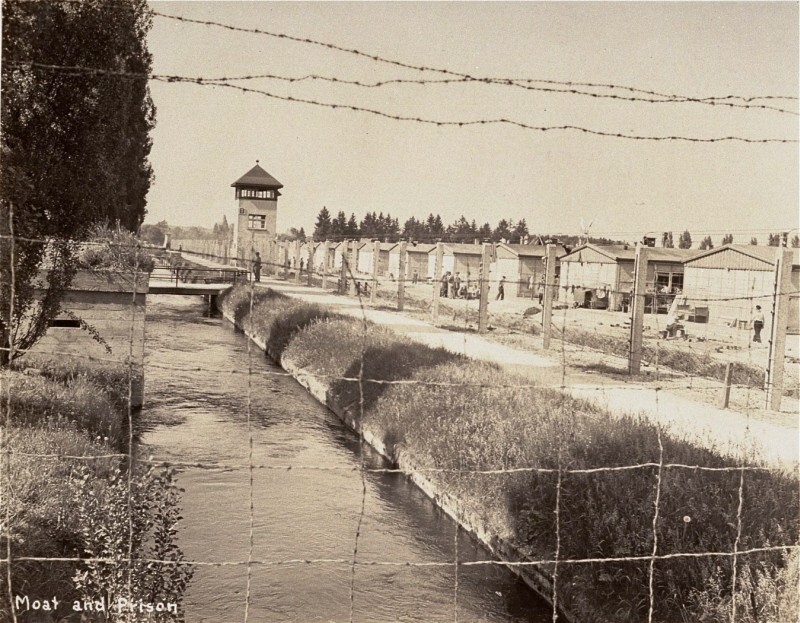
Eventually Coca, Olga, and the others reached Dachau.
By 1945, the name Dachau had accumulated twelve years of terror.
The concentration camp had opened in 1933 and had become one of the central institutions of Nazi repression, a place through which political opponents and many other persecuted prisoners had passed, suffered, and died.
Now the family of one of Hitler’s former field marshals was inside that universe too.
For Coca, the reversal could hardly have been more extreme.
Her husband had once sat at the highest tables of the German military establishment.
Now she was a prisoner of the same state he had served.
For Olga, the reversal was deeper still.
A few years earlier she had been building a family.
By the spring of 1945, she was a widow, a bereaved mother, the daughter of a Soviet prisoner, the sister of a dead officer, the sister of an imprisoned officer—and a prisoner herself.
Her young son remained beside her.
The boy had lost his father before he was old enough to understand the war that killed him.
Now armed men were moving him through detention sites because of a grandfather he barely knew.
Outside the wire, history was accelerating.
American troops were advancing through southern Germany.
The Red Army was preparing for the final assault on Berlin.
Hitler had retreated into the Führerbunker.
The Thousand-Year Reich had weeks left to live.
And then, just when freedom seemed almost inevitable, came one more terrifying twist.
The prisoners were moved again.
Detailed research on Sippenhaft records that a group including the relatives of anti-Hitler officers was transported away from Dachau in mid-April and sent south, toward the Tyrol. Other local memorial records summarize Olga’s liberation as occurring from Dachau at the end of April; surviving records differ in how they describe the final stage of that chaotic movement. What is clear is that the family’s last days in captivity unfolded between Dachau and the Alpine region as Nazi authority disintegrated. (dokumen.pub)
For prisoners who knew what the SS had already done to political enemies, being transported away from approaching Allied armies was not automatically good news.
It could mean relocation.
It could mean hostage-taking.
It could mean an attempt to bargain with the Allies.
Or it could mean that somebody had decided they should not be found alive.
No prisoner could know.
The guards still had weapons.
Orders still existed somewhere.
Hitler was still alive.
And Europe was full of people murdered only days—or hours—before liberation reached them.
The Paulus family had survived Stalingrad’s consequences, the Gestapo, transfers, detention, bombing, and Dachau.
They could still die in the final week.
Then the structure holding them collapsed.
Near the end of April 1945, in the Tyrol, guards abandoned the prisoners as the Nazi system fell apart.
After months of being watched, transported, counted, and controlled, the authority surrounding them simply vanished.
Freedom did not arrive with a ceremonial announcement.
There was no restored home waiting just beyond the road.
There was only the realization that the men who had possessed the power to decide where they slept had gone.
The war in Europe was almost over.
But this was not the ending Olga had once imagined.
Liberation could not bring back her husband.
It could not bring back her daughter.
It could not resurrect her brother Friedrich from Anzio.
It could not restore the years her father would spend in Soviet custody.
It could not return the family to January 1943 and change the decision that had connected their name forever with Stalingrad.
Olga eventually returned to Baden-Baden after a period of recovery.
She returned with her surviving son.
But she returned as a widow.
There was no husband waiting at the door.
No little daughter running toward her.
Her father was still gone.
Her brother Ernst had survived Nazi detention, but the family that existed before Stalingrad would never again exist in the same room.
And Coca still waited for Friedrich.
This is where the story becomes cruel in a quieter way.
During the war, the danger had been obvious.
Men in uniform.
Locked doors.
Orders.
Railway transports.
Barbed wire.
After the war, the danger became time.
Coca survived Hitler.
She survived Sippenhaft.
She survived captivity.
She lived to see Nazi Germany destroyed.
But she did not live long enough to see her husband come home.
Friedrich Paulus remained in Soviet hands after the fighting ended.
He appeared as a witness at the Nuremberg trials in 1946, testifying about the planning of the German attack on the Soviet Union.
Years passed.
1946 became 1947.
Then 1948.
Then 1949.
Coca had already endured the kind of sequence that would seem excessive if invented: her husband captured, one son killed, her daughter widowed, her family imprisoned, her grandchildren dragged into detention, her country destroyed.
She had outlived the dictatorship that arrested her.
She had not outlived the separation.
On November 9, 1949, Elena Constance “Coca” Paulus died in Baden-Baden.
Friedrich was still a prisoner.
They had been married for thirty-seven years.
They had not seen each other since before Stalingrad.
There would be no reunion.
That may have been the final punishment the Nazis could never have consciously designed but had helped create nevertheless.
Coca had refused to divorce Paulus when officials tried to separate her from his name.
Death separated them before captivity ended.
Four more years passed.
Only in 1953 was Friedrich Paulus finally allowed to return to Germany.
Not to Coca.
To a country that had become two countries.
He settled in East Germany.
The man who had commanded Hitler’s Sixth Army now lived under a socialist government allied with the Soviet Union that had captured him.
The field marshal who had entered Stalingrad as one of the senior commanders of an invading army returned from Soviet custody into the political order created from Germany’s defeat.
History had turned almost everything upside down.
But not one fact.
His wife was still dead.
No political rehabilitation, no lecture, no title, no house, no public appearance could change that.
He could survive Stalingrad.
He could survive more than a decade under Soviet control.
He could survive Hitler’s rage.
He could survive the collapse of the regime he had once served.
He could not go backward four years and walk into Coca’s room before November 1949.
And there is another uncomfortable truth that makes this family story more powerful, not less.
Friedrich Paulus was not simply an innocent man caught in history.
He had been a senior commander in Hitler’s war.
He had participated in the machinery of German conquest in the Soviet Union and commanded the Sixth Army during one of the most destructive campaigns ever fought.
The suffering of his family does not erase the suffering caused by the war in which he played a major role.
Thousands upon thousands of Soviet families had already lost fathers, mothers, children, homes, and entire communities before the Gestapo ever knocked on the Paulus family’s door.
This story is not about turning Friedrich Paulus into a spotless hero.
It is about something darker.
A regime can punish the relatives even of its own servants.
A man can help a dictatorship wage war and still discover that when he finally disobeys it, the dictatorship recognizes no boundary between him and his children.
The machine does not care who once stood beside it.
It cares who refuses it now.
By the mid-1950s, Paulus’s health began to deteriorate.
He never completed the full account of Stalingrad he intended to write.
On February 1, 1957—almost exactly fourteen years after his surrender—Friedrich Paulus died in Dresden.
He was sixty-six.
At first, his remains were interred there.
Later, his ashes were moved to the family grave in Baden-Baden.
Beside Coca.
The woman who had refused to abandon his name when abandoning it might have made her life easier was finally reunited with him only in death. Sources on his burial record that his urn was ultimately placed beside his wife in Baden-Baden. (Wikipedia)
It sounds almost like the natural end of the story.
It was not.
One child remained who carried a particularly complicated inheritance.
Ernst Alexander Paulus had survived the Eastern Front.
He had survived serious wounds.
He had survived the Gestapo’s punishment for his father.
He had survived military detention.
He had survived Nazi Germany.
He had lived long enough to see his father return from Soviet captivity.
But surviving the war did not mean escaping Stalingrad.
Father and son did not share the same view of everything that happened afterward.
Friedrich Paulus’s collaboration with the Soviet-sponsored anti-Hitler movement left political and personal wounds that did not simply disappear in 1945.
To the Nazis, Paulus’s change of position had been treason.
To the Soviets, it had been useful.
To later observers, it could be interpreted as awakening, opportunism, guilt, realism, survival, or some combination of them.
But to a son who had worn the German uniform, been wounded in the same war, lost his twin brother, watched his family arrested, and then lived through the ideological division of postwar Germany, the inheritance was far more intimate.
The name Paulus no longer belonged only to a family.
It belonged to history.
In 1970, Ernst Alexander died by suicide.
He was fifty-two.
The surviving twin had outlived his brother by twenty-six years and his father by thirteen.
But the chain of consequences that began around Stalingrad had now reached another generation.
One twin had died in battle.
The other survived the war but not old age.
There was one final contrast.
Olga—the daughter who had lost her little girl, lost her husband, been arrested with her young son, and passed through Nazi detention—lived on for decades.
She survived the regime that imprisoned her.
She survived both her brothers.
She survived her parents.
She died in Baden-Baden in 2003, aged eighty-nine. The city’s memorial archive now records her not as the daughter of a defeated field marshal, but as one of Baden-Baden’s victims of National Socialist persecution. (Gedenkbuch der Stadt Baden-Baden)
That may be the most extraordinary reversal of all.
In 1942, Friedrich Paulus stood near the peak of German military power.
His name represented an army advancing toward the Volga.
In 1943, the same name represented Germany’s greatest defeat.
In 1944, it became dangerous enough that a woman and a small child could be imprisoned for carrying it.
In 1945, the regime that had punished the family ceased to exist.
In 1949, Coca died waiting.
In 1953, Paulus finally came home too late.
In 1957, he died.
In 1970, his surviving son took his own life.
And decades later, what remains is not the power the family once appeared to possess, but the cost of living beneath a government that believed loyalty could be enforced through blood.
That was the real horror of Sippenhaft.
It told ordinary people that there was no such thing as an individual conscience.
A wife could be punished for her husband.
A daughter for her father.
A child for his grandfather.
Your family was no longer simply the group of people you loved.
It could become the hostage a dictatorship kept against your obedience.
And perhaps that is why Coca’s refusal to renounce Paulus remains one of the smallest yet most haunting moments in the entire story.
She could not rescue her husband from the Soviet Union.
She could not save her son Friedrich at Anzio.
She could not protect Olga from widowhood.
She could not stop the Gestapo from arresting her family.
She could not prevent herself from being transported through the dying Reich.
But when a dictatorship tried to dictate whom she was permitted to call her husband, it encountered one decision that still belonged to her.
She said no.
The regime imprisoned her anyway.
Then the regime disappeared.
Her decision did not.
That is the lesson hidden behind the famous photographs of Stalingrad.
Wars do not end when generals sign surrender papers.
They continue in unopened bedrooms, empty chairs, missing fathers, widowed daughters, children who grow up without parents, prisoners who return too late, and survivors who spend decades carrying memories that no peace treaty can erase.
Friedrich Paulus surrendered one army in 1943.
But his family spent the next generation paying for a war that followed them long after the guns fell silent.
A dictatorship reveals its deepest weakness when it has to imprison children to punish the conscience of an adult—and history should never allow us to forget what kind of government becomes afraid of an entire family.