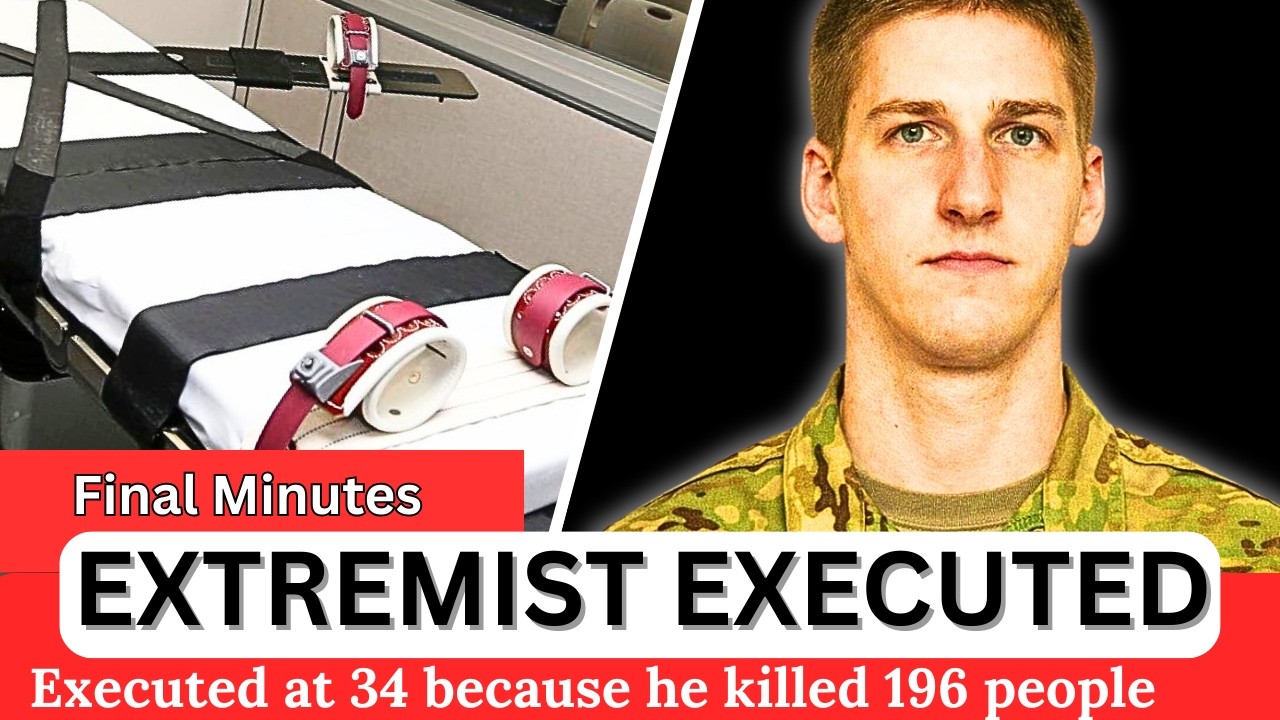
The last words of Ramiro Felix Gonzales were an apology, a plea for peace, and a declaration of faith, spoken calmly as he lay strapped to a gurney in a Texas execution chamber. The 41-year-old condemned man, who spent over two decades on death row for the brutal rape and murder of 18-year-old Bridget Townsend, was pronounced dead at 6:50 p. m.
on June 26th, 2024. His execution date was a chilling piece of symmetry, falling on the same day his victim would have celebrated her 42nd birthday.
 Gonzales’ final statement, delivered just moments before the lethal dose of pentobarbital was administered, was directed at the family seated behind the glass partition. He expressed deep sorrow for taking someone precious from the world and hoped that Bridget had found peace. He prayed for the healing of her family, asking God to give them strength, before concluding that he was lost but had found faith and was ready to go home.
Witnesses reported that his voice remained steady, a stark contrast to the gravity of the crime that had defined his life.
The execution inside the Huntsville Unit brought a definitive close to a case that had haunted Medina County for over two decades. Bridget Townsend vanished on January 15th, 2001, leaving behind a family desperate for answers and a case that quickly went cold. For years, her disappearance remained a mystery, with no leads and no suspects, leaving her mother, Patricia, and brother, David, to wonder if they would ever know the truth about what happened to their beloved daughter and sister.
The truth, when it finally emerged, came from the most unexpected of sources: the very man responsible for her death. At the time of his confession, Gonzales was already serving a prison sentence for the kidnapping and rape of another young woman, a crime he committed at just 18 years old. In 2004, three years into his incarceration, he stunned investigators by claiming he knew where Bridget’s body was buried, a revelation that would unravel a web of lies and lead to his own conviction for capital murder.
Initially, Gonzales spun a tale of a Mexican drug lord, claiming that someone else had committed the murder and he had only helped cover it up. He then shifted the blame to Bridget’s boyfriend, a known small-time drug dealer, insisting the boyfriend was the killer. However, under the pressure of intense questioning, his fabricated stories began to crumble, and the horrifying truth came pouring out in a full confession that detailed his own depraved actions.
Gonzales admitted that on the day of the murder, he had gone to Bridget’s home in search of drugs, knowing her boyfriend kept a stash there. When Bridget answered the door and said her boyfriend wasn’t home, Gonzales broke in, dragged her to his car, and drove her to a remote location. He confessed to raping her in the back of the car before shooting her twice in the head with a .
357 Magnum, ending her life without hesitation and burying her body in a shallow grave.
He later led investigators to the desolate scrubland in Medina County where he had hidden her remains. The recovery of Bridget’s body, with two bullet holes in her skull, confirmed the chilling details of his confession. The district attorney did not hesitate in seeking the death penalty, painting Gonzales as a calculated and cold predator.
In 2006, a jury found him guilty of capital murder and sentenced him to die by lethal injection.
 The case against Gonzales was built on his own words, a confession that his defense team argued was the act of a damaged man seeking redemption. They pointed to his traumatic childhood, marked by neglect, addiction, and instability, but prosecutors argued that his past did not excuse the calculated violence he inflicted on Bridget. The jury agreed, and the sentence of death was handed down, setting the stage for a long and arduous legal battle that would last nearly two decades.
Following his sentencing, Gonzales was moved to death row, where a remarkable transformation reportedly began. He immersed himself in religion, reading, writing, and speaking with chaplains, claiming to have found God and a profound sense of remorse. He stated that he had come forward about Bridget not to manipulate the system, but to give her family the closure they desperately needed, a claim that was met with skepticism by some and cautious belief by others.
His spiritual adviser described him as a changed man, someone who was genuinely remorseful and had taken full responsibility for his actions. Gonzales himself spoke of the complexity of remorse, stating that it meant taking responsibility and understanding the depth of what he owed to the family of his victim. He said it was a continual task to feel the weight of the life he had taken, a burden he carried with him every day on death row.
Despite his claims of spiritual renewal, the machinery of justice continued to move forward. His legal team filed a series of appeals, all of which were denied by state and federal courts, including the U. S.
Supreme Court. In 2022, he made a desperate plea for a stay of execution, not to save his own life, but to donate a kidney to a stranger in need, a request that was ultimately denied by the courts.
As his final execution date approached, Gonzales’ attorneys submitted a clemency petition to the Texas Board of Pardons and Paroles, detailing his traumatic upbringing and his transformation in prison. They argued that he was no longer the man who had committed the murder, but a man of quiet faith who wrote letters to Bridget’s family begging for forgiveness. The board, however, was unmoved, unanimously rejecting his plea for clemency and a six-month reprieve.
On the day of his execution, the atmosphere outside the Huntsville Unit was tense but subdued. Small groups of protesters gathered, some holding signs of support for the condemned man and others carrying photos of Bridget Townsend, a stark reminder of the life that was stolen. Inside the prison, Gonzales was offered a final meal, but Texas had abolished the special last meal request, so he was served the standard prison fare of chicken fried steak, mashed potatoes, green beans, and sweet tea.
As the clock neared 6:45 p. m. , Gonzales was escorted into the execution chamber and strapped to the gurney.
 His arms were spread, and IVs were inserted as the families of both the victim and the condemned watched through the glass. When the warden asked for his final words, he delivered his apology, a moment that would be his last chance to address those he had harmed. He spoke of his remorse and his faith, before the lethal injection began to flow.
The execution was swift. At 6:50 p. m.
, Gonzales was pronounced dead, becoming the second person executed in Texas in 2024 and the eighth in the United States. The single dose of pentobarbital stopped his heart, ending the life of a man who had taken another’s life in a fit of drug-fueled violence. For Bridget’s family, the moment brought a long-awaited sense of justice, a finality that had eluded them for 23 years.
Bridget’s brother, David Townsend, addressed the press outside the prison, his voice steady as he declared that justice was done. He acknowledged the long and painful journey that had led to this moment, stating that while Gonzales could claim to have changed, they remembered what he had done. His mother, Patricia, was less forgiving, telling reporters that she did not forgive him, and that a difficult childhood did not excuse murder.
She stated that he had chosen his path and received what he deserved.
Gonzales’ attorneys released a statement following his death, painting a different picture of the man they had come to know. They described him as a deeply spiritual, generous, and intentional man, filled with remorse and transformed by years of self-reflection. They maintained that his faith was genuine and that he had found peace in his final days, a stark contrast to the anger and grief expressed by the victim’s family.
The execution of Ramiro Felix Gonzales closes a dark chapter in Texas criminal history, a case that began with a young woman’s disappearance and ended with a killer’s final apology. It is a story of violence, addiction, and grief, but also one of a man who claimed to have found redemption in the shadow of his own death. For the family of Bridget Townsend, however, the date of June 26th will forever hold a dual meaning, marking both the birthday of their lost loved one and the day they saw her murderer brought to justice.
The case has also reignited the ongoing debate over the death penalty in the United States, with advocates on both sides using Gonzales’ execution to further their arguments. Supporters of capital punishment point to the heinous nature of the crime and the closure it provided to the victim’s family, while opponents highlight the condemned man’s apparent transformation and the moral questions surrounding state-sanctioned killing. The debate is unlikely to be resolved, but for now, the state of Texas has spoken.
 In the final analysis, the story of Ramiro Felix Gonzales is one of contradictions. He was a man who committed an unspeakable act of violence, yet he was also a man who voluntarily confessed to his crime and expressed profound remorse. He was a predator who stalked and killed a young woman, yet he was also a man who claimed to have found God and sought to make amends.
In the end, the state determined that his crimes outweighed his redemption, and he was put to death for the life he took.
Bridget Townsend’s family will now have to learn to live with the outcome, carrying the memory of their daughter and sister while navigating a world without her. The execution of her killer brings a measure of closure, but it cannot bring her back. The pain of her loss will remain, a permanent scar on the lives of those who loved her.
The apology from her killer, however sincere, was too late to undo the damage he had caused.
The legal journey that led to this execution was long and complex, marked by numerous appeals and legal maneuvers. Gonzales’ attorneys fought tirelessly to spare his life, citing his troubled past and his spiritual awakening. They argued that he was a changed man who no longer posed a threat to society and that his execution would serve no purpose other than vengeance.
The courts, however, consistently upheld the original sentence, finding no legal grounds to overturn the jury’s decision.
The execution itself was carried out with clinical precision, a procedure that has become routine in Texas, the state with the highest number of executions in the country. The use of pentobarbital, a single drug protocol, has become the standard method, replacing the previous three-drug cocktail. The process is designed to be swift and painless, though opponents argue that it is anything but humane.
For the state, it is a necessary function of justice.
As the sun set on Huntsville on June 26th, 2024, the story of Ramiro Felix Gonzales came to an end. He was buried in an unmarked grave, his final resting place a stark contrast to the life he had taken. His legacy will be one of violence and remorse, a cautionary tale of how a broken childhood and addiction can lead to devastating consequences.
For Bridget Townsend, her memory lives on in the hearts of her family, a bright light extinguished far too soon.