The Netherlands had just been liberated from the Nazis, and almost immediately it launched a colonial war of its own in Indonesia. On paper, the Dutch military campaign looked like a success. Cities fell, leaders were arrested, and the Indonesian Republic seemed defeated. Yet the Netherlands lost the war, not on the battlefield, but politically.
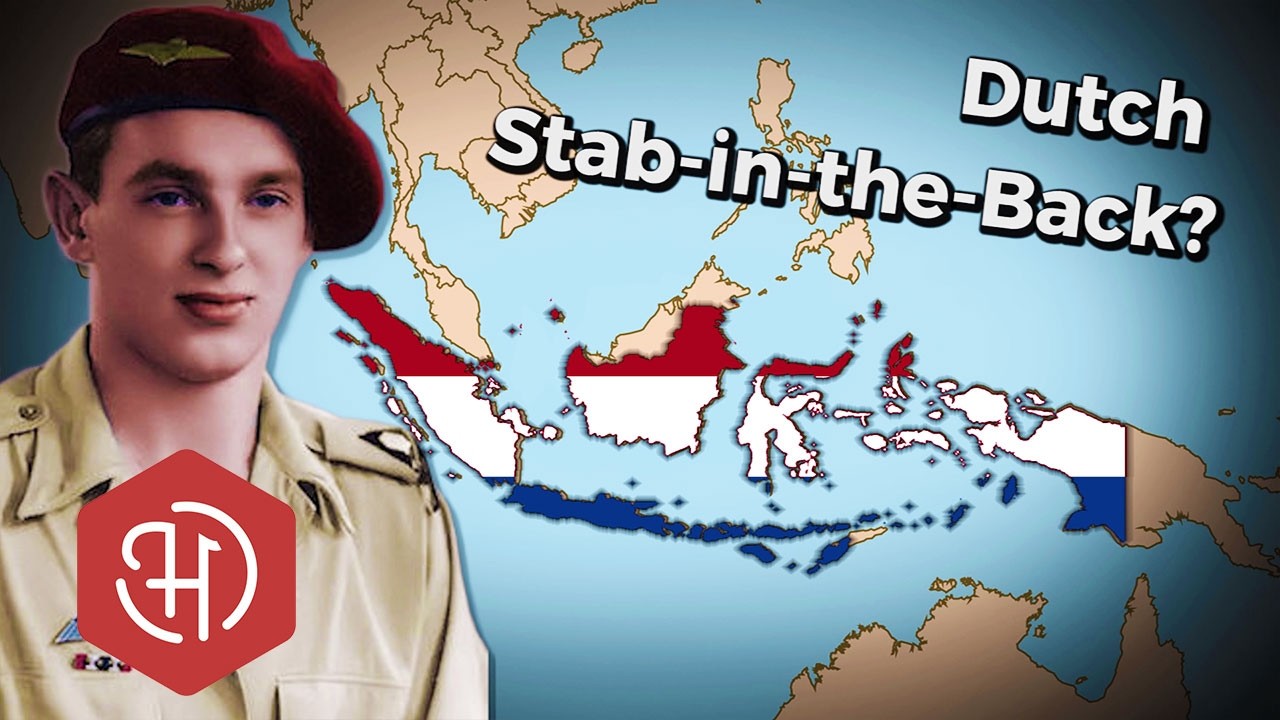
And soon after, an explanation emerged that many Dutch soldiers latched onto. It was a stab-in-the-back legend. They claimed their own government had betrayed them. Politicians, international pressure, and weak policy had thrown away a victory that the army had already won.
But is that the truth, or is it a myth designed to hide a painful reality? By 1948, the Netherlands had been trying for years to reconquer Indonesia. The war had effectively begun right after the Japanese surrender in August 1945, when Indonesian nationalist leaders declared independence. The first phase of the Indonesian War of Independence lasted from that moment until the Linggadjati Agreement and the British withdrawal at the end of 1946.
During this period, Indonesian armed forces grew rapidly while the Netherlands had almost no military presence in the region. The Dutch army was still reorganizing after its own liberation, and many colonial soldiers had been weakened or had died in Japanese captivity. British troops temporarily took control, tasked with disarming Japanese soldiers and evacuating Dutch civilians from internment camps. But they too soon became entangled in the conflict.
This phase became known for its extreme violence, with events like the Bersiap period and the Battle of Surabaya. The second phase, from November 1946 until August 1947, was marked by rising tensions, continuous skirmishes, and the gradual collapse of the Linggadjati Agreement. Dutch troops expanded their influence and eventually launched a major offensive called Operation Product. It brought large parts of Java and Sumatra under Dutch control, but Indonesian resistance was not broken.
The third phase, from August 1947 until December 1948, saw the Netherlands try to consolidate its gains and restore order. Meanwhile, Indonesian fighters switched to guerrilla tactics that the Dutch approach proved incapable of handling. At the same time, the international position of the Indonesian Republic improved, partly due to political developments such as the Renville Agreement and the suppression of the Madiun Uprising. Without broad support among the population and under increasing pressure, the Netherlands felt compelled to launch a second major offensive at the end of 1948.
Operation Crow, known as Kraai in Dutch, had a different objective than Operation Product. This time, the capital of the Indonesian Republic, Yogyakarta, was attacked, and the political leaders of the Republic were captured. On December 19, 1948, the operation began, marking the final and bloodiest phase of the War of Independence. General Spoor, the Chief of Staff of the Royal Netherlands East Indies Army and the Royal Dutch Army in the Indies, was allowed to advance on Yogyakarta, where the political leadership of the Republic allowed itself to be taken prisoner.
The military leadership of the Indonesian Armed Forces and the bulk of the TNI, the forces of the Indonesian Republic, managed to escape. Unlike Operation Product, this one was less of a surprise, because Indonesian resistance had become better organized. Under heavy international pressure from the United Nations, the offensive was halted on January 5. On paper, the Netherlands had at that moment occupied all of Java and strategically important parts of Sumatra.
The operation cost 113 Dutch lives, while more than 3,000 Indonesians were killed on Java alone. Even after the offensive, Dutch troops carried out large-scale clearing operations supported by artillery, the Special Forces Corps, and the Air Force. Outside the cities, however, Dutch authority remained extremely fragile and was contested by the TNI as well as other armed groups. Violence escalated.
The number of Dutch fatalities rose from 34 to 155 per month, while Indonesian casualties, according to Dutch figures, reached 46,800. Due to a shortage of experienced soldiers, the dispersal across thousands of isolated outposts, and constant danger along the so-called death roads, the Dutch strategy of pacification became increasingly ineffective. Violence, intimidation, and counter-terror intensified, while local Republican shadow administrations emerged. Shortly before his death in April 1949, Army Commander Spoor remained optimistic about the success of Dutch operations, although he now estimated that pacification would take eighteen months instead of a few.
The cabinet in The Hague was far more pessimistic. Under international pressure, negotiations with the Republic were resumed, leading to the Roem-Van Roijen Agreement and a ceasefire on May 7. On June 22, the Dutch evacuated Jakarta, a moment that would later become the foundation of the infamous stab-in-the-back myth. Spoor died a few weeks later after suffering a heart attack, exhausted from his work.
Sukarno returned to Jakarta in early July. A final ceasefire was proclaimed on August 10 for Java and August 14 for Sumatra. Eventually, near the end of 1949, the transfer of sovereignty took place, ending Dutch colonialism in Indonesia with the exception of Papua New Guinea. But the central question remains.
Could the Dutch have won this war, or was it doomed from the start? Prior to the large-scale Dutch actions in November 1945, the Lieutenant Governor-General of the Dutch East Indies, Hubertus van Mook, stated that he needed 75,000 men. A year later, however, he requested 100,000 men to bring Java and Sumatra under Dutch control. A Dutch military officer warned that a military solution would be extremely difficult, if not impossible.
His name was Wiebrandus Schilling. Now a general major, he had earlier fought in Aceh. He warned that the troops of the Indonesian Republic were far stronger than expected. What they lacked in experience, they compensated for with high morale.
Schilling estimated that for Java alone, 200,000 men would be needed and that the war could last up to ten years. He presented the following to his government. Can the Dutch population of only eight million, which suffered so much during the German invasion, endure the drain on human and material resources required to wage a war of reconquest of a scale and duration outlined in the previous analysis, a war of a scale never before seen in our colonial history? Before the Japanese occupation, Dutch colonial authority had been firmly in control.
The colonial state possessed an effective military apparatus against local uprisings, including an air force, armored vehicles, and an organized communications network. Indonesia was not yet a cohesive national unit. The archipelago consisted of hundreds of ethnic groups, diverse cultures, different religions, and an infrastructure poorly suited for rapid communication across long distances. The idea of Indonesia as a single political community was emerging, but it was far from deeply rooted.
The colonial state benefited from this diversity by playing groups against each other or by ruling through local elites through indirect rule. It was the Japanese who shattered this system. Their overthrow of colonial authority and mass mobilization of the Indonesian population during the occupation were decisive for the post-war period. After the Japanese easily defeated the Dutch forces in the East Indies, they dismantled Dutch institutions.
The Dutch literally disappeared from the streets as they were interned in the notorious Japanese internment camps. At the same time, Japan mobilized the Indonesian population. Indonesians were trained in discipline and weapons use, skills that later proved crucial in the fight against the Dutch. This was done through various organizations such as Heiho and PETA.
Hundreds of thousands of Indonesians were drilled using anti-imperialist rhetoric aimed at ending centuries of colonial rule. Through both militarization and brutalization during the occupation, many Indonesians, especially on Java and Sumatra, were ecstatic when independence was proclaimed by their leader Sukarno. Writer David Van Reybrouck spoke with an Indonesian eyewitness and wrote in his book Revolusi. Once you understand that, you understand much better why the people of Indonesia were so opposed to the return of either one.
“Free of everything,” shouted ninety-five-year-old Toegeno Wiryodidjojo in Dutch when Van Reybrouck asked him about his motivation for taking up arms. He was hard of hearing and articulated it extremely clearly. Vrij van alles. Yes, that more or less summed it up.
And with that, the genie was out of the bottle. Before World War II, Dutch authority had still been firmly in control, and potential troublemakers had been imprisoned or exiled. Now, the Netherlands faced an entire population of hundreds of thousands of insurgents who were determined not to return to Dutch rule. What followed was asymmetrical warfare.
At its core, asymmetrical warfare is a conflict between two sides using completely different military means and tactics. On one side stood the Netherlands with a conventional army equipped with tanks, artillery, and air power. Their strategy focused on capturing key areas such as major cities and economically important plantations, assuming that control over power centers would lead to a quick victory. On the other side stood the young Indonesian Republic, which knew it could not win a direct confrontation.
Instead, it adopted guerrilla tactics. Indonesian fighters retreated into difficult terrain, mountains and jungles where Dutch advantages were neutralized. Rather than defending cities, they often abandoned them, striking from the shadows with hit-and-run attacks. They targeted convoys, destroyed infrastructure, and disappeared before the Dutch could respond.
Local population support was crucial, as guerrillas blended into the civilian population for intelligence and supplies. This asymmetry created a situation where the Netherlands won almost every battle but never gained full control. Dutch soldiers were constantly on edge against an invisible enemy, which severely affected morale. In the end, it was not defeat on the battlefield but the political unsustainability of this war that forced the Netherlands to recognize Indonesian independence.
Historian Remy Limpach noted in Burning Kampongs of General Spoor, “One of the biggest mistakes made by those in charge was underestimating the enemy. Even during the bloody conquest of the archipelago by the KNIL, which at first glance seemed to have been largely completed with a difficult and never definitive victory in the Aceh War, the military leadership continued to assume that the enemy was an inferior native or indigenous opponent. The authorities displayed this contemptuous attitude again during the reconquest of Indonesia after the Japanese surrender in 1945. ”
But what about the outcome after Operation Crow?
The Netherlands had captured the Republic’s stronghold and arrested its leaders, among them Sukarno. For Dutch soldiers in the field, this felt like the final blow. They believed they had finally won the war. That euphoria turned into disbelief and anger when the international community, led by the United Nations and the UN Security Council, condemned the Netherlands.
Under the threat of losing Marshall Aid, the Dutch government was forced to withdraw and release Republican leaders. To soldiers who had lost comrades taking Jakarta, this was incomprehensible. They saw a defeated enemy being restored by politics. Yet, even without this, the TNI resistance had not been destroyed.
Outside cities, Dutch authority remained fragile. Violence and casualties even increased after Operation Crow. Dutch pacification had become a dead end. Troop shortages, a shrinking budget, and an unsustainable strategy.
In the end, the war was not winnable for the Netherlands. Instead of clinging so rigidly to the colonial rule of before World War II, the Dutch might have conceded more to Indonesian demands for autonomy and tried to win hearts and minds. But that simply did not align with colonial thinking in the 1920s and 1930s. By the time Japan surrendered, the situation had fundamentally changed.
Pacification was, in hindsight, an impossible task. General Schilling had already seen it, but he was ignored. The result was hundreds of thousands of Indonesian deaths, thousands of Dutch casualties, immense material damage, and a severely damaged reputation for the Netherlands. And even after 1949, the unrest did not stop.
The Dutch had won the battles, but they had lost the war long before the first shot was fired.