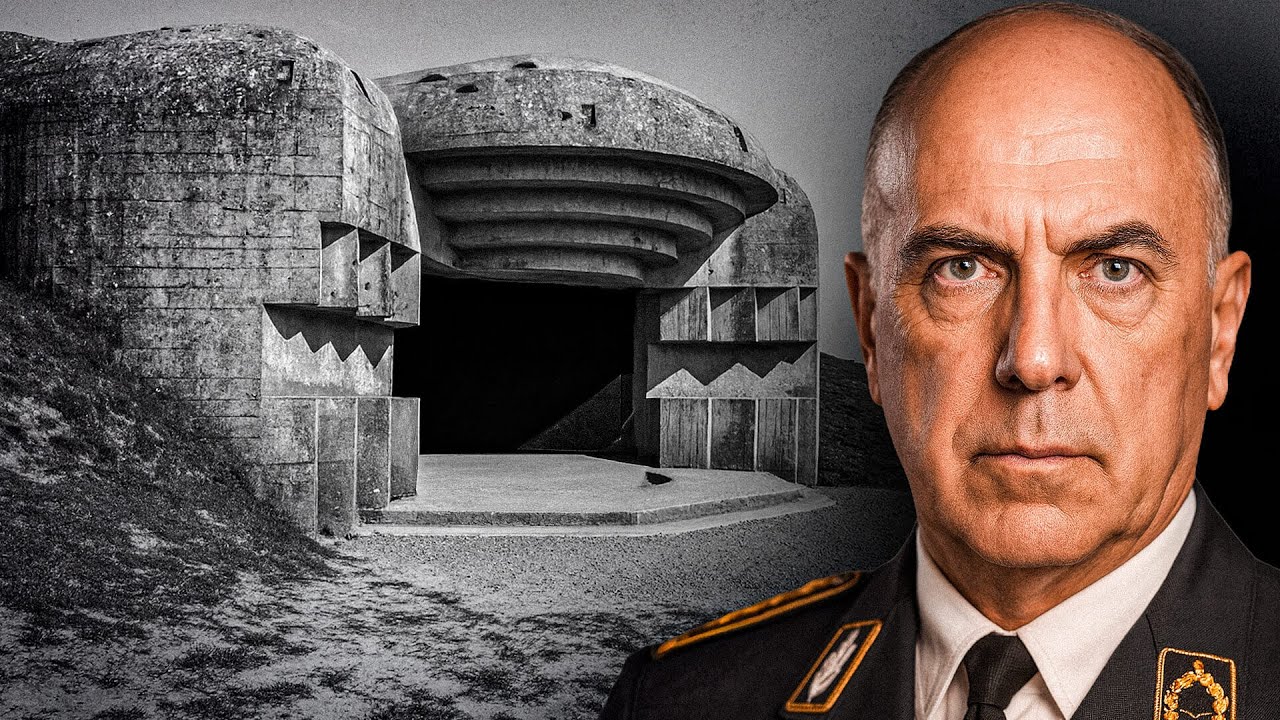
THE MYSTERIOUS DEATH OF FRITZ TODT — THE ENGINEER WHO BUILT HITLER’S WAR MACHINE, TOLD HIM THE WAR COULD NOT BE WON… AND DIED HOURS LATER
At 9:40 on the freezing morning of February 8, 1942, a German military aircraft lifted away from an airfield near Hitler’s heavily guarded headquarters in East Prussia.
Inside was one of the most powerful men in Nazi Germany.
He was not a famous field marshal.
He had never commanded a panzer division.
His name did not inspire the terror of Himmler or the theatrical swagger of Göring.
He was an engineer.
Dr. Fritz Todt.
And in some ways, that made him more important than many of the generals whose names would later fill history books.
Because armies could conquer territory only if somebody gave them roads.
Tanks could advance only if somebody built bridges strong enough to carry them.
Submarines needed reinforced pens.
Factories needed power.
Soldiers needed railways.
Borders needed fortifications.
And Hitler’s dreams of conquest needed millions of tons of concrete poured into the earth.
For years, Fritz Todt had been the man who made those things happen.
Now his aircraft climbed into the winter sky.
It barely got away from the airfield.
Something went catastrophically wrong.
Witnesses saw the aircraft turn as though trying to return.
Moments later, it crashed near the field and burned.
Todt was dead.
So were the other men aboard.
The timing could hardly have been more unsettling.
Todt had just spent hours with Adolf Hitler.
By then, the engineer who had spent years building the physical foundations of Nazi power had reportedly reached a conclusion Hitler did not want to hear.
Germany could not win the war.
Then Todt walked out of Hitler’s headquarters.
He boarded an aircraft.
And within minutes, the man who knew perhaps more than anyone about the physical limits of Hitler’s empire was gone.
The official investigation would reject sabotage.
The rumors would not.
And decades later, one question would remain impossible to separate from the wreckage:
Was Fritz Todt simply the victim of a terrible accident?
Or had the machinery he helped build finally turned on one of its own creators?
To understand why the question survived, you have to understand who Fritz Todt really was.
Because the most frightening thing about him was not that he looked like a monster.
It was that he looked like an engineer.
Todt had been born in 1891 in Pforzheim, Germany.
He studied engineering.
During the First World War, he served in the German military and later earned a doctorate.
On paper, there was nothing particularly mysterious about the path ahead of him.
He could have spent his career calculating loads, designing roads, managing construction projects and arguing over budgets.
Instead, politics entered the equation.
Todt joined the Nazi Party in the early 1920s.
Long before Hitler became chancellor.
Long before the swastika hung over government ministries.
Long before joining the Nazi movement became professionally convenient.
That fact matters.
Because decades later, men who had served the Third Reich would often portray themselves as technicians trapped inside a political system.
They had only designed.
Only calculated.
Only organized.
Only followed contracts.
Todt could not so easily be separated from the ideology whose ambitions his engineering would eventually serve.
And when Hitler took power in 1933, the obscure engineer suddenly found himself standing beside a leader obsessed with monumental construction.
Hitler loved architecture.
He loved scale.
He loved projects so enormous that they seemed to prove political greatness simply by existing.
Buildings, highways and fortifications were not merely practical things to him.
They were propaganda made physical.
Todt understood that.
And more importantly, he knew how to turn sketches into schedules.
Schedules into contracts.
Contracts into construction sites.
And construction sites into symbols.
His breakthrough came with Germany’s new motorway network.
The autobahns.
Today, photographs from the era can appear almost strangely modern: sweeping roadways, concrete bridges, graceful curves disappearing toward the horizon.
But in Hitler’s Germany, the highways were presented as something far greater than transportation.
They were photographed.
Filmed.
Celebrated.
Hitler appeared at ceremonies with shovels, surrounded by workers and cameras.
The regime used the roads to project an image of national rebirth.
Germany was moving again.
Germany was building again.
Germany, the propaganda suggested, had found a leader who could transform speeches into concrete.
Standing behind much of that transformation was Fritz Todt.
In 1933, Hitler made him General Inspector for German Roadways.
It was an extraordinary appointment.
Todt’s authority increasingly bypassed ordinary bureaucratic restraints and placed him close to Hitler himself.
That was the first great transformation of his career.
The engineer had become a political engineer.
And he was learning a lesson that would define the Third Reich:
Efficiency was power.
The autobahn project helped make Todt famous inside the regime.
But highways were only the beginning.
By the late 1930s, Hitler was preparing Germany for something much larger.
War.
And he needed the construction system to move faster than normal government institutions could possibly move.
In 1938, Hitler ordered the rapid expansion of Germany’s western fortifications.
The project became known as the West Wall.
Thousands of defensive positions had to rise along Germany’s western frontier.
Bunkers.
Tank obstacles.
Command positions.
Roads.
Communication systems.
Concrete structures stretching across hundreds of kilometers.
Military planners had imagined years of work.
Hitler wanted speed.
Todt supplied it.
He brought together construction companies, state authorities, labor services, engineers, administrators and an enormous supply network.
The loose structure created around him became known by the simplest possible name:
Organisation Todt.
The name sounded bureaucratic.
Almost dull.
That dullness concealed what it would become.
At the height of West Wall construction, hundreds of thousands of people were involved.
Entire industries were redirected.
Concrete disappeared into fortifications.
Trucks ran continuously.
Rail cars moved construction materials west.
The regime celebrated the accomplishment as proof of German organizational genius.
Todt had demonstrated something Hitler found irresistible.
Given enough authority, enough resources and enough human beings, he could make almost impossible construction deadlines look achievable.
And that success contained the first dark twist in Todt’s story.
Every time he solved an impossible problem, Hitler gave him a larger one.
A highway network became fortifications.
Fortifications became military infrastructure.
Military infrastructure spread into conquered countries.
And the engineer who had once built roads across Germany found himself helping construct the skeleton of an empire.
When Germany invaded Poland in September 1939, the nature of Todt’s world changed.
Construction was no longer happening behind the lines.
Organisation Todt followed war.
Where the Wehrmacht advanced, engineers arrived behind it.
Damaged roads had to be restored.
Bridges rebuilt.
Railways repaired.
Airfields expanded.
Ports adapted.
Military positions constructed.
Then Germany invaded Denmark and Norway.
Then Belgium.
The Netherlands.
France.
By the summer of 1940, Hitler appeared unstoppable.
France had collapsed with stunning speed.
German forces stood along the Atlantic coast.
And suddenly Todt had access to a construction zone stretching across much of Europe.
He was no longer simply Hitler’s road builder.
In March 1940, he became Reich Minister for Armaments and Munitions.
Now his responsibilities touched the machinery of war itself.
Weapons production.
Raw materials.
Industrial coordination.
Infrastructure.
The boundaries between civilian engineer, political administrator and military organizer were disappearing.
Todt had reached the highest level of the Nazi state.
But the further Organisation Todt expanded, the harder it became to maintain the myth that engineering was somehow separate from what the regime was doing.
Because enormous projects require enormous numbers of workers.
And Nazi Germany was rapidly running out of workers it could obtain normally.
German men were being pulled into the armed forces.
Construction demands were multiplying.
Factories demanded manpower.
Occupied territories had to be exploited.
The solution increasingly became coercion.
Foreign laborers.
Prisoners of war.
People compelled to work under occupation.
Later, concentration-camp prisoners would also be used on Organisation Todt projects.
The polished diagrams in Berlin did not show exhaustion.
A blueprint did not record hunger.
A production table could turn human beings into numbers.
Ten thousand workers needed here.
Twenty thousand there.
Another railway.
Another bunker complex.
Another road.
Another deadline.
That was how oppression could become administrative.
No dramatic order was required every morning.
Someone calculated the concrete.
Someone scheduled the trains.
Someone assigned the labor.
Someone signed the paperwork.
And somewhere hundreds of kilometers away, men who had never volunteered to build Hitler’s empire picked up shovels.
Todt stood near the center of that system.
He did not need to personally swing a whip to be part of its machinery.
He organized the machinery.
Then, in June 1941, Hitler made the decision that would eventually change Todt’s view of the war.
Germany invaded the Soviet Union.
Operation Barbarossa.
At first, the news appeared spectacular.
German armies smashed across the frontier.
Hundreds of thousands of Soviet soldiers were captured.
Entire formations collapsed.
The maps in headquarters rooms filled with arrows pointing east.
To Hitler, it looked like confirmation.
One more enormous gamble.
One more rapid victory.
But engineers see wars differently from propagandists.
A propagandist sees territory captured.
An engineer sees distance.
A propagandist sees an arrow moving east across a map.
An engineer asks how many trucks are required to feed the men at the tip of that arrow.
How much fuel will those trucks burn?
What happens when the road turns into mud?
What happens when rail gauges do not match?
Where will replacement engines come from?
How quickly can bridges be repaired?
How many winter uniforms exist?
How many spare parts?
How many locomotives?
How many days before the system breaks?
Todt traveled to the Eastern Front.
What he saw there reportedly disturbed him deeply.
The German army had moved across immense distances.
Supply systems were strained.
Vehicles were wearing out.
Road conditions were disastrous.
Winter was approaching.
The Soviet Union had not collapsed.
And behind the victorious photographs, mathematics was beginning to expose reality.
Germany was fighting Britain.
The Soviet Union remained alive.
And after Pearl Harbor in December 1941, the United States entered the war as well.
Germany was no longer merely competing against armies.
It was competing against industrial continents.
Factories.
Oil.
Steel.
Ships.
Trucks.
Aircraft.
Railways.
Millions of workers.
Production capacity on a scale ideology could not wish away.
This was the language Todt understood.
Numbers.
Capacity.
Output.
Logistics.
And the numbers were becoming terrifying.
By late 1941, his confidence in victory had severely deteriorated.
According to historical accounts, after inspecting conditions in the east, Todt warned Hitler that Germany’s material situation was becoming unsustainable.
The engineer who had spent years turning Hitler’s demands into reality was approaching the most dangerous conclusion a man could reach inside the Third Reich:
Some demands could not be engineered into reality.
There was another problem.
Hitler did not treat pessimism as analysis.
He treated it as weakness.
His political career had been built on the conviction that will could overcome supposedly rational limitations.
Again and again, cautious men had told him something could not be done.
Again and again, he believed he had proved them wrong.
The Rhineland.
Austria.
Czechoslovakia.
Poland.
France.
Each victory taught Hitler the same dangerous lesson.
Experts worried too much.
Professionals lacked courage.
Generals exaggerated risks.
Bureaucrats created obstacles.
The impossible merely required more will.
That worldview had helped create Todt’s power in the first place.
Whenever conventional institutions said a project required five years, Hitler could hand it to Todt and demand eighteen months.
Todt’s efficiency had helped reinforce the myth.
Now the engineer faced the consequence.
He had spent years proving that limits could be overcome.
He now needed to convince Hitler that a limit had finally arrived.
And this one was called reality.
The Eastern Front had stalled.
Soviet resistance had hardened.
German troops were suffering through the winter.
Equipment failed in conditions for which much of it had not been designed.
The quick war Hitler had expected was becoming a war of production.
That was precisely the kind of war Germany could least afford.
Todt understood what that meant.
And he apparently said so.
One account places a particularly blunt warning in late November 1941: the war, Todt argued, could no longer be won militarily and would require a political solution.
Imagine the reversal.
For almost a decade, Todt had been valuable because he could give Hitler what he wanted.
Now his expertise was telling Hitler the one thing Hitler would never want to hear.
You are going to lose.
By early February 1942, the pressure was intense.
Todt traveled to Hitler’s headquarters near Rastenburg in East Prussia, the heavily fortified complex known as the Wolf’s Lair.
The place itself had been built to protect Hitler from almost every imaginable external threat.
Concrete bunkers hid among forests.
Guard posts controlled movement.
Barbed wire and minefields surrounded secure zones.
Visitors passed checkpoints.
Orders went outward from this isolated world and moved armies across continents.
Todt arrived there on February 7.
According to later historical accounts, he met privately with Hitler for hours.
Exactly what passed between them remains uncertain.
No complete transcript exists that allows us to sit in the room with confidence.
But we know the larger conflict.
Todt had become pessimistic about Germany’s chances.
Hitler had not.
The engineer had numbers.
Hitler had belief.
Todt had seen the supply lines.
Hitler saw maps.
Todt understood production.
Hitler still demanded victory.
The discussion was reportedly difficult.
By the time Todt went to sleep that night, one thing was undeniable.
The relationship between the dictator and the engineer who had solved so many of his practical problems was under strain.
Early the next morning, Todt prepared to leave.
He was 50 years old.
He could not have known that his career now had only minutes left.
The aircraft waiting for him was a twin-engine Heinkel He 111.
A type known to millions from photographs of the Luftwaffe.
Todt boarded with his secretary and crew.
The engines started.
The aircraft moved down the runway.
Then it lifted into the cold morning air.
What happened next is the point at which history becomes frustrating.
Because there was no surviving passenger to explain it.
Shortly after takeoff, something was wrong.
The aircraft appeared to turn back toward the airfield.
It lost control.
Then came the crash.
Flames.
Smoke.
Twisted metal.
Five men dead.
Fritz Todt, Reich Minister for Armaments and Munitions, General Inspector for German Roadways and one of Hitler’s most important technical organizers, had been alive minutes earlier.
Now he was lying in wreckage only a short distance from Hitler’s headquarters.
And almost immediately, the circumstances looked like the beginning of a conspiracy story.
A senior official.
A private confrontation with Hitler.
A warning that the war was unwinnable.
An aircraft destroyed the next morning.
There was even a detail that would make the story more unsettling decades later.
Another man at the Wolf’s Lair had been connected to the planned journey.
Albert Speer.
Speer was younger than Todt.
Ambitious.
Educated.
An architect rather than an engineer.
He had risen spectacularly through Hitler’s inner circle by designing the enormous architectural spectacles the dictator loved.
Hitler liked him personally.
That mattered enormously in the Third Reich.
Speer had also worked increasingly with Todt on wartime construction problems.
And according to Speer’s later account, he had been expected to fly with Todt.
But he did not board the plane.
Speer said he stayed behind.
Todt took off without him.
Minutes later, the aircraft crashed.
And here comes the first twist.
The man who did not get onto Todt’s doomed aircraft would soon inherit Todt’s power.
Speer became his successor.
Think about how that looked.
Todt tells Hitler the war cannot be won.
Todt dies leaving Hitler’s headquarters.
Speer avoids the flight.
Speer survives.
Speer takes Todt’s position.
If this were fiction, readers would immediately know where to look.
But history is more difficult than fiction.
Coincidence is real.
Memory is unreliable.
Survivors write memoirs.
And suspicious circumstances are not the same thing as evidence.
The official inquiry rejected sabotage.
Later claims that Hitler had ordered Todt murdered were never proved.
Nor has convincing evidence emerged that Speer arranged the crash.
Todt’s own son, according to later accounts, reportedly examined the possibility and did not believe an explosive device had destroyed the aircraft.
Which creates the second twist.
The most suspicious-looking explanation may not be the most likely one.
The crash could have been exactly what the official story said it was:
A catastrophic aviation accident during wartime.
Machines fail.
Pilots make mistakes.
Weather interferes.
Aircraft crash.
Powerful people die randomly.
Sometimes the coincidence is what makes an accident look like murder.
But there was still a problem.
The exact cause never became satisfying enough to silence the questions.
And in dictatorships, secrecy creates its own ghosts.
When governments lie routinely, even the truth becomes difficult to believe.
Hitler publicly mourned Todt.
The dead engineer received extraordinary honors.
But Nazi Germany did not stop because one organizer had died.
The paperwork moved.
The meetings continued.
The factories continued.
The construction sites continued.
And Albert Speer moved into the vacuum.
This is where the story takes its darkest turn.
Because if someone had actually murdered Fritz Todt to preserve Hitler’s war machine, the killing would almost be less disturbing than what really happened next.
Nobody needed Todt alive anymore.
The system had learned how to reproduce him.
Organisation Todt continued after its founder’s death.
It grew.
Its projects spread.
The Atlantic Wall expanded across occupied Europe.
Massive reinforced-concrete submarine pens rose along the coast.
Military roads cut through occupied territories.
Launching sites, bunkers and defensive works consumed resources on a colossal scale.
And the labor system became even more brutal.
Todt did not personally command the organization during its later peak.
He was already dead.
But the structure bearing his name survived him.
By late 1944, Organisation Todt had roughly 1.36 million workers under its control.
Only a small fraction were Germans.
Huge numbers were foreign laborers, prisoners of war and people compelled to work under German occupation.
Concentration-camp prisoners were also used.
That number belongs to the later organization under Todt’s successors, not to the workforce Todt personally commanded on the morning he died.
But that distinction does not absolve him.
Because the system had not appeared from nowhere after February 1942.
Todt had helped create the institutional machinery that made expansion possible.
Private companies.
State power.
Military requirements.
Centralized coordination.
Compulsory labor.
Occupied resources.
Construction on command.
Take away the Nazi uniforms and much of it could resemble an enormous project-management organization.
That is precisely why the story is uncomfortable.
The horror did not always announce itself with gunfire.
Sometimes it arrived as a requisition.
A deadline.
A labor quota.
A concrete order.
A railway schedule.
A signed engineering document.
Todt’s death has often tempted people into telling a simpler story about him.
The brilliant engineer finally understood Hitler was doomed.
He courageously confronted the dictator.
He died mysteriously.
Perhaps he had become dangerous because he knew too much.
It is an attractive narrative.
Almost a redemption story.
But it leaves out the most important detail.
Todt did not discover the nature of Hitler’s regime in 1942.
He had joined the Nazi movement roughly twenty years earlier.
He had built for it.
Risen through it.
Benefited from it.
Expanded its capabilities.
Turned political ambition into physical infrastructure.
His doubts about the war did not transform him into an opponent of Nazism.
Realizing that Hitler might lose was not the same thing as rejecting what Hitler represented.
That is the third twist.
Fritz Todt may have been more realistic than Hitler.
That does not make him innocent.
Competence is not morality.
An efficient servant of a criminal system can sometimes recognize disaster earlier than the fanatic at the top.
That only means he understands the system better.
And perhaps that is why the mystery of his death continues to attract attention.
Because the final hours invite us to imagine a dramatic reckoning.
Engineer versus dictator.
Numbers versus delusion.
Reality versus ideology.
A six-hour argument.
A cold morning.
A plane.
An explosion.
A successor who was supposed to travel but did not.
A rapid transfer of power.
An investigation that ruled out sabotage.
Questions that never completely disappeared.
Every ingredient of a political thriller is there.
But the greatest plot twist is not hidden inside the wreckage.
It is what happened outside it.
Todt died.
The machine continued.
His successor reorganized production with even greater intensity.
German armaments output rose dramatically in the years that followed, even as Allied bombers attacked Germany and the Wehrmacht suffered catastrophic defeats.
The Nazi state squeezed occupied Europe harder.
Millions across the German-controlled economy were forced into labor.
Factories went underground.
Fortifications grew.
Prisoners worked under lethal conditions.
The entire continent became a reservoir of labor and material for a war increasingly impossible to win.
The engineer who had finally recognized the limits of the system was gone.
The system responded not by accepting those limits…
but by demanding more from human beings.
There is a tendency to imagine tyranny as something constructed entirely by fanatics.
Men screaming into microphones.
Men wearing uniforms.
Men carrying guns.
That image is incomplete.
Every dictatorship also needs professionals.
Accountants who make the numbers work.
Lawyers who create the regulations.
Managers who organize the companies.
Railway officials who coordinate transport.
Scientists who solve technical problems.
Architects who design buildings.
Engineers who make impossible ambitions physically possible.
Fritz Todt belonged to that world.
He demonstrates one of history’s most uncomfortable truths:
Technical skill does not contain its own morality.
A bridge does not know who is crossing it.
A highway does not know what army will use it.
A bunker does not know whom it protects.
A factory does not know what its products will destroy.
But engineers know who signs their orders.
Managers know what system employs them.
Officials know where the workers came from.
Human beings make the choices that machines cannot.
That is why calling technology “neutral” can become such a dangerous excuse.
A tool may be neutral.
A decision rarely is.
On February 8, 1942, Fritz Todt’s plane came down near Rastenburg and burned.
More than eight decades later, no credible evidence has proved that Hitler ordered his death.
No credible evidence has proved that Albert Speer engineered it.
The official inquiry rejected sabotage.
Historians have offered accident scenarios.
And yet the coincidence remains eerie enough that the question refuses to disappear completely.
Perhaps the aircraft failed.
Perhaps a wartime mechanical problem killed everyone aboard.
Perhaps the most dramatic explanation is simply wrong.
But the uncertainty around Todt’s final minutes should not distract from what is certain about the years before them.
He helped give Hitler roads.
Then fortifications.
Then construction armies.
Then an administrative system capable of turning occupied Europe into material, labor and infrastructure for Germany’s war.
He rose because he could make things work.
Then, eventually, he looked at the same numbers that had made him powerful and saw something Hitler refused to see.
The machine had reached its limit.
Germany could build another bunker.
It could recruit another labor column.
It could demand another factory increase.
It could pour another hundred thousand tons of concrete.
But engineering could not manufacture victory from insufficient resources forever.
Todt seems to have understood that before Hitler did.
And then he died.
Maybe that is why his story feels so unsettling.
Not because we can prove an assassination.
We cannot.
Not because he became a hero.
He did not.
But because his life exposes a question much larger than the mystery of one burning aircraft.
At what point does the person who designs the infrastructure become responsible for what that infrastructure makes possible?
At what point does professional competence become collaboration?
At what point does “I was only solving the technical problem” stop being an explanation?
And if an engineer builds the roads that carry an army, the bunkers that protect a dictatorship, and the labor system that exploits conquered people…
can he really claim that the politics belonged to someone else?
Fritz Todt spent years transforming Hitler’s imagination into concrete.
Then, near the end of his life, reality finally delivered an engineering verdict even Hitler could not permanently escape.
Resources were finite.
Logistics were finite.
Industrial capacity was finite.
Human endurance was finite.
Ideology could order reality to obey.
It could punish anyone who disagreed.
It could force millions of people to work.
It could build highways across a nation and bunkers across a continent.
But it could not abolish mathematics.
Todt’s aircraft fell from the sky in February 1942.
Three years later, the regime whose infrastructure he had helped build collapsed with it.
The mystery is still whether someone killed Fritz Todt.
The lesson is far more certain:
The most dangerous people in a tyranny are not always the ones giving the speeches. Sometimes they are the quiet professionals who make the speeches possible.