In that white building across the street, there once sat the headquarters of the Reichskommissariat Ostland, the Nazi civilian administration for the Baltic states and western Belarus. The man who ran it, Reichskommissar Hinrich Lohse, controlled Estonia, Latvia, Lithuania, and a slice of Belarus that had been conquered by the Third Reich. But what did Hitler actually plan for this land? The answer is tangled, brutal, and far more complicated than a simple map.
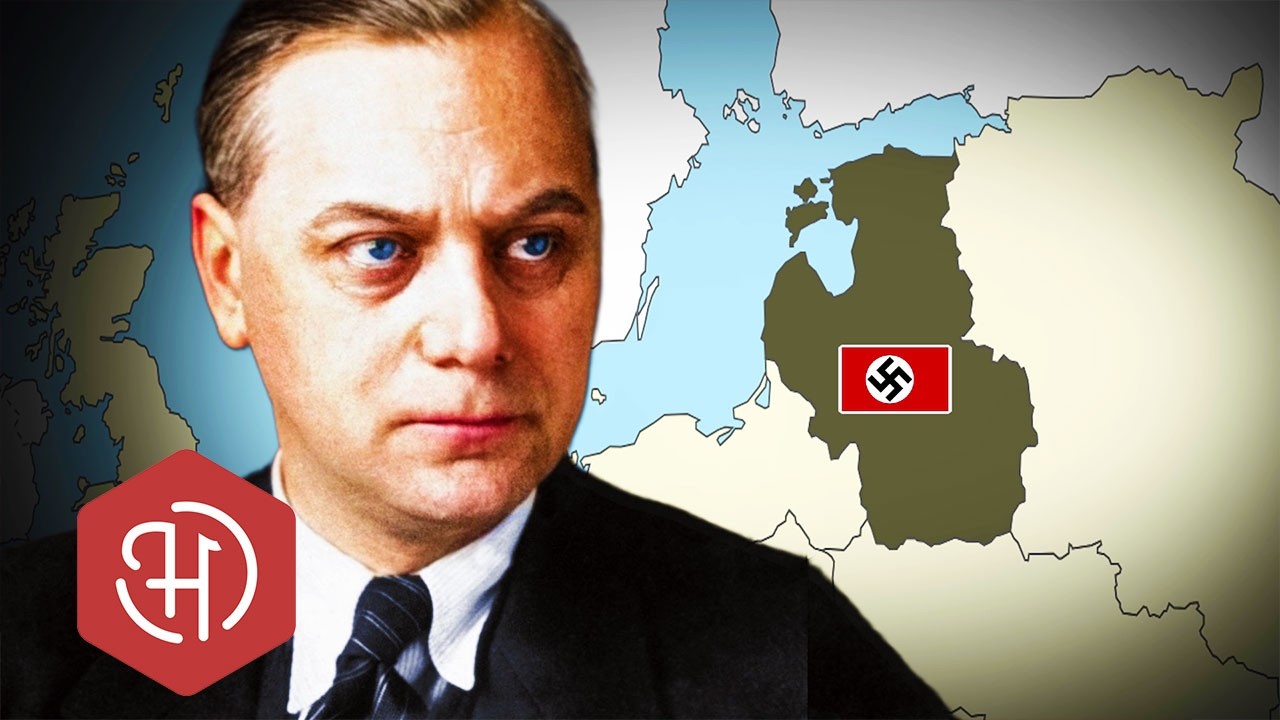
Hitler did not just control the timing of Germany’s aggression in World War II. He set the ideological goals behind it. His long-term vision was a Europe reorganized by race, dominated by what he believed to be a pure German people. At the heart of this vision was the concept of Lebensraum, living space, which meant expanding eastward into Soviet territory to seize land, food, and resources.
Hitler believed this land should be taken by destroying, enslaving, or deporting the local populations, particularly Slavs and Jews. Although Nazi propaganda claimed the invasion of the Soviet Union was aimed at defeating Bolshevism, Hitler’s real intention was a war of annihilation. This was not merely a campaign to defeat armies. It was designed to starve civilians, exploit resources, and carry out mass murder, especially of Jews.
Within the Nazi leadership, rival officials pushed competing visions for how the conquered east should be ruled. Alfred Rosenberg, the ideologue, suggested using some non-Russian national groups as partners under German control. Heinrich Himmler and the SS, on the other hand, demanded a far harsher approach involving mass deportations, extermination, and German colonization under what was called the General Plan East. Hitler largely favored Himmler’s more extreme model for the Baltic states.
The Nazi plans for this region were always aimed at annexation and Germanization, never at Baltic independence. Nazi racial theorists debated how valuable Estonians, Latvians, and Lithuanians were and how many could be assimilated into the German race rather than deported. These judgments shifted over time and were heavily influenced by Germany’s military fortunes. In reality, no single master plan for the East was ever fully implemented.
Rival Nazi agencies fought constantly over authority. Policies were inconsistent, and decisions often depended on how individual officials interpreted Hitler’s wishes. As Germany’s war situation worsened after 1942 and 1943, ideological colonization plans were forced to give way to military necessity. Still, the core goals never changed.
The extermination of the Jews was absolute and never abandoned. At dawn on the 22nd of June 1941, Nazi Germany launched Operation Barbarossa, the largest invasion in history. For the Baltic states, this meant that one brutal occupation, Soviet rule, was about to be replaced by another, Nazi rule. German Army Group North smashed into Lithuania, Latvia, and Estonia with terrifying speed and shock.
Soviet bases, airfields, ports, and railway stations were bombed in the opening hours. The Red Army was caught completely off guard and collapsed almost immediately. Command structures broke down and entire formations fled east in chaos. In Lithuania, local resistance rose up to fight the retreating Soviets.
They managed to seize control in Kaunas and Vilnius and other cities before the Wehrmacht arrived. A few cities saw serious fighting between German and Soviet forces. In Liepaja, trapped Soviet troops fought desperately to escape encirclement rather than defend the city itself. Elsewhere, the German advance was swift.
Vilnius fell within days. Riga was entered on the 1st of July, and Tallinn was isolated shortly after. To many locals, the Germans initially appeared as liberators. Just weeks earlier, the Soviets had deported tens of thousands of people from the region in brutal mass removals.
The Reichskommissariat Ostland was the name given to the civil administration of part of the eastern territories of the Third Reich. The name Ostland referred to the occupied Baltic states plus western Belarus. This area was administrated as a colony of Nazi Germany, established by a Führer decree on July 17th, 1941. Ostland became one of the Reichskommissariats, the civil administrative units of the greater German Reich that fell under the authority of Reich Minister Alfred Rosenberg, who was in charge of the occupied eastern territories.
Rosenberg himself drew up detailed instructions for the administrators of these territories. The highest authority in Ostland was Reichskommissar Hinrich Lohse. The area was subdivided into four general districts: Estonia, Latvia, Lithuania, and White Ruthenia, which was part of Belarus. Each general district was further divided into smaller district commissariats.
The capital of Ostland was Riga. Estonia was governed by General Commissar Karl-Siegmund Litzmann, with his seat in Tallinn. This general district was in fact fairly independent, since Estonia had been switched from military to civil administration earlier than the others. Latvia was administrated by General Commissar Otto-Heinrich Drechsler, with Riga as its capital.
Lithuania was administrated by General Commissar Theodor Adrian von Renteln, with Kaunas as its capital. White Ruthenia was administrated by Wilhelm Kube until his assassination in 1943, and then by Curt von Gottberg afterward, with Minsk as its capital. While the civilian administrators handled daily governance, the SS controlled the military and security apparatus. Fritz Sauckel, as the Plenipotentiary for Labor, controlled the workers and the labor camps.
Hermann Göring and Albert Speer managed economic affairs. In July 1941, a civil administration was announced for the occupied territories in the Soviet Union, but it had not yet been actually established. In the vacuum that followed, the SS and all its cooperating organizations filled the void. In this way they gained unlimited and absolute power in these areas.
They relinquished that power with great reluctance in September 1941 when the civil administration finally came into force. Heinrich Himmler, the head of the SS, tried unsuccessfully until the end of 1943 to regain it. This partially explains the difficult and hostile relationship between the SS and the administrative apparatus in Ostland. Matters were made even more complicated by Franz Walter Stahlecker, the SS commander who was fiercely criticized by his opponents in both the SS and the administration for his corruption, brutality, and reckless behavior.
Stahlecker commanded the Einsatzgruppen death squads and was personally responsible for ordering and organizing the deaths of over a hundred thousand Jews, Romani, and other so-called undesirables. He was killed in 1942, but those who survived the war and committed similar crimes were hanged after it ended. Immediately after Hinrich Lohse was appointed, he announced the confiscation of all state property of the Soviet Union in Belarus and the Baltic states and its transfer to German administration. In Ostland, land that had been confiscated by the Soviets was returned to its former owners.
Farms in villages, shops, businesses, and industries were also given back, but the owners had to pay high taxes to the occupying forces in return. Jewish property was permanently confiscated, with no possibility of return. Belarus was an exception to this policy. There, a state-owned company was established to manage all former Soviet state property.
State monopolies and private industrial companies affiliated with the German government were quickly created to manage the confiscated businesses. The Hermann Göring Werke, IG Farben, and Siemens all took over the management of former Soviet state enterprises across Ostland and Ukraine. In Belarus, the German authorities expressed regret that what they called the Soviet Bolshevik government had ignored all basic ideas and concepts of private property, ownership, or personal initiative. This stood in contrast to the Baltic states, where the Germans reported that during the war and the early stages of occupation, the population showed that it genuinely wanted to cooperate and that it might then be able to obtain an autonomous government.
Of course, that autonomy never happened. Nationalist sentiments among the Baltic peoples were strong, and the Germans played on them, but they never intended to honor them. According to Schwerin von Krosigk, the Reich Minister of Finance, the German government received more than 753. 6 million Reichsmarks in occupation costs and taxes from the region until February 1944.
The Reich Ministry for the Occupied Eastern Territories asked Lohse and the Commissioner for Ukraine, Erich Koch, to supply Germany with workers. They needed a total of 360,000 agricultural workers and 247,000 industrial workers. The Germans regarded Russians, Belarusians, and Ukrainians as slave laborers who could be worked to death. There was no concern for their survival beyond their usefulness.
Alfred Rosenberg described the political goals as the expulsion of the Eastern European peoples and the elimination of what he called the Great Russian threat. But the long-term plans for Ostland differed from those of the Reichskommissariat Ukraine and the proposed commissariats in the Caucasus and Moscow. The Baltic countries were to be transformed into a Germanized protectorate that would eventually come after an alliance with Germany. Rosenberg said these countries had a European character, the result of seven hundred years of history.
They would provide living space for German settlers. All this could be achieved, he believed, through the racial assimilation of the Baltic peoples and some Belarusians into a uniform Germanic population. The regime planned to encourage Germans to settle in Ostland after the war, since it was seen as an area traditionally inhabited by Germanic peoples. In the province of Zhytomyr in Ukraine, ethnic Germans from Romania, together with Dutch people, were resettled.
The settlement of Dutch colonists was managed by the Dutch East Company, a combined Dutch-German organization. The conquered territories further east remained under military administration throughout the war and were never granted civil rule. At the time of the German invasion in June 1941, there were significant Jewish minorities in Ostland, numbering almost 480,000 people. This number was increased by Jews deported from Germany, Austria, and occupied territories.
The Jews were confined to the ghettos of Riga, Kaunas, Liepaja, and Minsk, which soon became overcrowded beyond any human capacity. From there they were taken to execution sites. The Red Army later discovered extermination centers near Kaunas and Vilnius, part of the Final Solution. The murder of prominent Jews began almost immediately after the invasion and was later expanded to include all Jews.
By the fall of 1943, the ghettos had been liquidated. The remaining inhabitants were moved to concentration camps. Those who were not considered fit for work or who survived the journey were killed immediately. Both German and local police organizations were constantly engaged in fighting partisans in Belarus.
They reported that the so-called infected zones where partisans were active covered an area of five to six hundred square kilometers around Minsk, Pinsk, Gomel, Smolensk, and Vitebsk, including the important railroads. The partisans were a constant drain on German resources and manpower. Ostland’s existence ended because Nazi Germany began losing the war against the Soviet Union. From 1943 onward, the Red Army pushed west after major victories like Stalingrad and Kursk, and especially during Operation Bagration.
German forces in the Baltic region were slowly forced to retreat. Soviet troops retook Belarus in 1944 and most of the Baltic region the same year. As the front collapsed, the German civilian administration of Ostland stopped functioning. Nazi officials fled, were evacuated, or came under direct military control.
By late 1944, almost all of Ostland had been reconquered by the Soviets. The last German holdout was Courland in western Latvia, where a large German force was surrounded by the Red Army. This Courland Pocket remained under German control until May 1945, when Germany finally surrendered. With the German defeat, the Reichskommissariat Ostland was dissolved.
The Baltic states were reoccupied by the Soviet Union, and the brutal cycle of foreign domination continued. Ostland had existed as a colonial Nazi regime, built on exploitation and terror. It disappeared the moment German military power collapsed, leaving behind tens of thousands of dead and a region scarred by occupation. Despite its brutality, many Eastern Europeans collaborated with the Nazis for all sorts of reasons.
Some believed in the ideology. Some loathed Soviet rule. Some were driven by pragmatism. And some were simply coerced.
Their choices, and their consequences, would shape the region for decades to come.