The noise was everywhere. Shells hammered the concrete overhead, and the walls of the Führerbunker shook with each impact. Soviet artillery had Berlin in its grip, and the city was burning. Inside the cramped, damp rooms, Adolf Hitler sat on a small sofa beside the woman who had been his wife for barely forty hours.
Eva Braun was dead beside him by the time those waiting in the corridor heard the shot. A single gunshot at three twenty-five in the afternoon. When his adjutant Otto Günsche and his valet Heinz Linge finally opened the door, they found Hitler slumped to one side, blood dripping from his right temple. At his feet lay a Walther PP in 7.
65 millimeters, still smelling of powder. A brass shell casing rested on the floor. Eva Braun showed no wounds. She had taken cyanide.
The pistol that ended the life of the most infamous dictator of the twentieth century should have been buried with him or collected by the victorious Soviets as proof of his death. It was neither. It vanished into the chaos of a collapsing empire, and its fate became one of the great unresolved mysteries of the Second World War. The trail of Hitler’s personal guns leads from Berlin to Cleveland, from Saskatchewan to somewhere on the West Coast of the United States, and into the ground beside a Berlin canal, where it may still lie today.
Hitler was never a gun enthusiast. He did not collect firearms for sport or display. He never hunted, and there is no record of him ever visiting a shooting range for recreation. Those who knew him said he found elaborate presentation weapons garish and unprofessional.
He preferred simple, functional sidearms that he could carry discreetly. His relationship with firearms was purely practical, shaped by his time as a corporal in the trenches of the First World War and sharpened by the constant threat of assassination that followed him through his years in power. By the time he led the Nazi Party, he had settled on the products of one company, Walther, which had established itself as Germany’s premier manufacturer of compact pistols. The firm had been founded in 1886 by Carl Walther in the Thuringian town of Zella-Mehlis.
For decades it refined small arms for police and civilian markets. In 1929, Carl’s son Fritz introduced the Polizeipistole, or PP, the world’s first commercially successful double-action semi-automatic pistol. It had an exposed hammer, a fixed barrel, a single-column magazine, and an innovative safety that could decock the hammer without danger. Two years later came an even more compact variant, the PPK, short for Polizeipistole Kriminal, designed for plainclothes detectives and undercover officers who needed a concealable weapon.
With its shortened barrel and reduced grip, the PPK weighed just over a pound and measured less than six inches. It slipped easily into a jacket pocket or vanished beneath clothing. Throughout the 1930s, the PP and PPK became status symbols among Nazi officials and high-ranking officers. While the standard military sidearm was the larger Luger P08 and later the Walther P38, the smaller pistols were issued to police, Luftwaffe personnel, intelligence officers, and the Gestapo.
Some officials commissioned elaborate presentation versions with gold plating, ivory grips, and fine engravings, given as gifts for promotions or acts of loyalty. The Walther factory kept a special department for such commissions, producing personalized pistols for Heinrich Himmler, Hermann Göring, and members of Hitler’s inner circle. Hitler himself was known to possess at least three Walther pistols. The first was a small weapon in 6.
35 millimeters, known in America as . 25 ACP. It was carried in a specially tailored holster sewn into the inside of his trousers, allowing him to keep a firearm on his person at all times without the bulk of a traditional belt holster. This kind of concealed carry suited his particular brand of paranoia, especially after the assassination attempts he survived, including the bomb plot of July 20, 1944.
The second was a standard Walther PP in 7. 65 millimeters, worn on his belt as a service sidearm when visiting troops or appearing in military settings. Photographs from September 1939, taken during his inspection of Polish positions after the conquest, show Hitler wearing a holstered pistol on his left hip. Both weapons were plain, commercial-grade, without special markings or embellishments.
The third pistol was altogether different. On April 20, 1939, Hitler celebrated his fiftieth birthday with an extravagant show of Nazi pageantry. Parades, speeches, and hundreds of gifts from officials, industrialists, and foreign dignitaries marked the occasion. Among the tributes was a presentation Walther PP from the Walther family themselves.
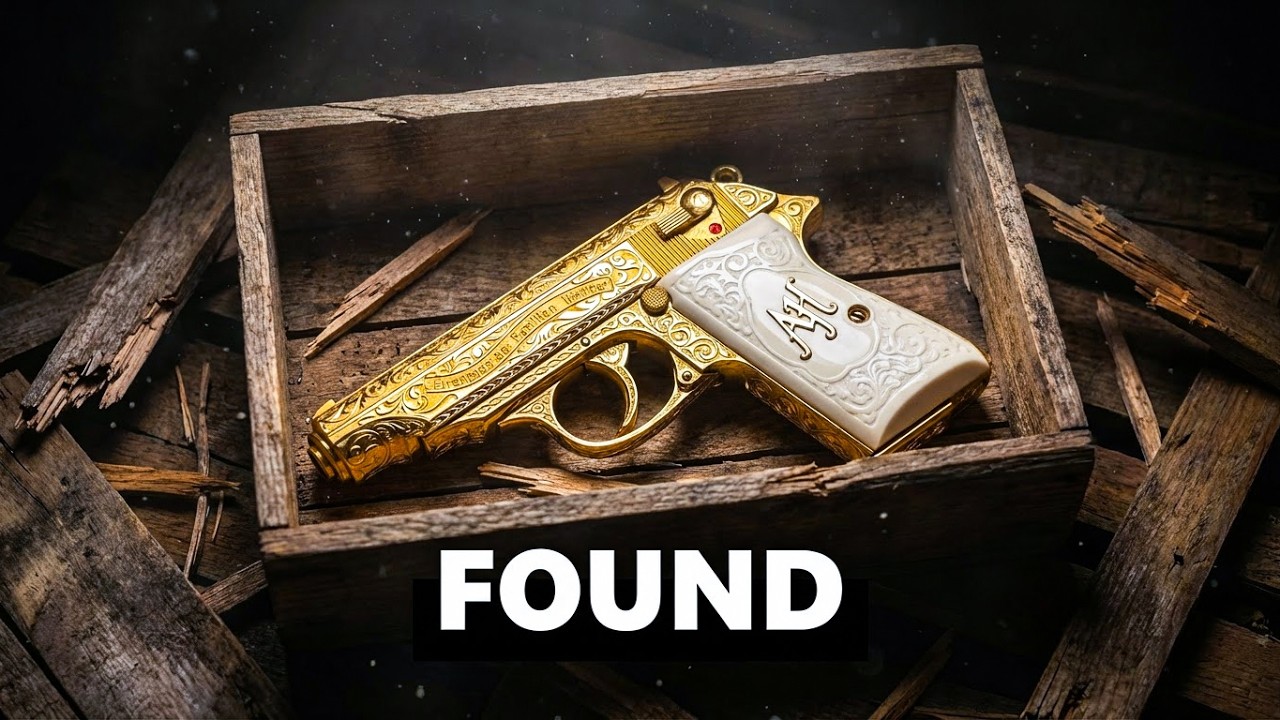
It was unlike anything in Hitler’s personal collection. Finished in twenty-four-karat gold wash, it featured extensive floral engravings covering the slide and frame, ivory grips inlaid with the initials AH in gold, and an inscription on the left side of the slide reading “Ehrengabe der Familien Walther,” meaning honor gift of the families Walther. Carl Walther himself likely presented the pistol, acknowledging the dictator’s role in arming the German military with Walther P38s to replace the aging Luger. Despite the extravagance, Hitler reportedly never carried the golden pistol.
True to his preference for simplicity, he kept it in a desk drawer in his Munich apartment at Prinzregentenplatz 16, the private residence he had maintained since the early 1930s. There it remained, unused and largely forgotten, as the war he started consumed Europe. The circumstances of Hitler’s final days have been reconstructed from the testimony of survivors who were present during those chaotic hours. By late April 1945, the war was irretrievably lost.
Soviet forces had surrounded Berlin and were fighting their way toward the Reich Chancellery. On April 22, Hitler suffered a nervous collapse during a military briefing and declared for the first time that the war was lost. He announced his intention to remain in Berlin and take his own life rather than flee or surrender. In the days that followed, he consulted with SS physician Werner Haase about the most reliable method of suicide.
Haase recommended what he called the pistol and poison method, combining a dose of hydrogen cyanide with a gunshot to the head. The cyanide would cause rapid death within minutes, and the gunshot would ensure the job was done. Hitler had already been given cyanide capsules by Heinrich Himmler through another SS doctor, Ludwig Stumpfegger, but after learning of Himmler’s secret negotiations with the Allies, he began to doubt whether the capsules were genuine. On April 29, he ordered Haase to test one on his dog, Blondie.
The dog died instantly. Shortly after midnight, Hitler married Eva Braun in a brief civil ceremony in the bunker’s map room. They had approximately forty hours to live. By late morning on April 30, Soviet troops were only five hundred meters from the Führerbunker.
At around two thirty in the afternoon, Hitler and his new wife retreated to his private study, a small room on the south side of the bunker. Günsche stood guard outside. At approximately three twenty-five, those waiting in the corridor heard a single gunshot. No one entered for several minutes.
Then Günsche and Linge opened the door. According to Linge, the weapon was a Walther PP or PPK in 7. 65 millimeters, lying at Hitler’s feet. A brass shell casing was found on the floor.
Günsche emerged to announce Hitler’s death to those waiting in the briefing room, including Josef Goebbels, the generals Hans Krebs and Wilhelm Burgdorf, and Hitler Youth leader Artur Axmann. Several entered the study to view the bodies. What happened next determined the fate of Hitler’s suicide weapon. According to testimony given to Soviet interrogators by Hans Rattenhuber, the head of Hitler’s bodyguard, the Walther PP was removed from the study by Heinz Linge.
Rattenhuber stated that Artur Axmann then took possession of the pistol, declaring that he would hide it for better times. Axmann was one of the most fanatical Nazis in the bunker, a thirty-two-year-old leader of the Hitler Youth who had lost his right arm on the Eastern Front in 1941 but continued to serve the regime with unwavering devotion. He had offered to lead two hundred Hitler Youth boys in a desperate attempt to evacuate the Führer from Berlin, using them as a human shield. Hitler had declined but shook Axmann’s hand and thanked him for his loyalty.
In the hours after Hitler’s death, his body and that of Eva Braun were carried up the stairs and through the bunker’s emergency exit to the Reich Chancellery Garden. There, in accordance with Hitler’s written instructions, the bodies were doused with petrol and set alight. The burning continued for hours, though the remains were only partially consumed. Inside the bunker, the surviving staff prepared for their own escape or suicide.
At around eleven o’clock on the night of May 1, the first breakout group left the Führerbunker. Their plan was to travel through the U-Bahn tunnels to Friedrichstrasse Station, then surface and attempt to cross Soviet lines to the northwest. The first group, led by SS-General Wilhelm Mohnke, avoided the main bridges and used a footbridge to cross the Spree undetected. Axmann was part of the second group, which included Martin Bormann, Hitler’s private secretary, and Ludwig Stumpfegger.
They joined a larger battle group of SS soldiers, Wehrmacht remnants, and terrified civilians all trying to escape the doomed city. They emerged at Friedrichstrasse to find Berlin in flames, Soviet shells bursting everywhere. The air was thick with smoke and the stench of burning buildings. Several attempts to cross the Weidendammer bridge over the Spree failed under heavy fire.
A group of tanks attempted to force a passage, but one was hit by an anti-tank round. Axmann, Bormann, and Stumpfegger were knocked to the ground by the blast. Eventually, after multiple attempts and heavy casualties, they managed to cross the river and continued along the railway tracks toward Lehrter station. According to accounts given decades later, Axmann buried Hitler’s suicide pistol during this flight through the ruins.
The most detailed version, reported by historian Mark Felton, states that Axmann hastily buried the Walther PP next to the Sandkrug bridge over the Berlin-Spandau shipping canal, approximately one mile north of the bunker. He intended to recover it later when circumstances permitted. Axmann had every reason to believe he would survive. He was young, resourceful, and determined to continue the Nazi cause even after Hitler’s death.
At Lehrter station, Axmann separated from Bormann and Stumpfegger. He headed west while they continued east along the Invalidenstrasse. When he encountered a Soviet patrol, he doubled back and retraced his steps. Near the railway switching yard, he found two bodies lying on their backs in the moonlight.
He recognized them as Bormann and Stumpfegger. Both were dead. Axmann did not stop to investigate. He continued on, eventually escaping Berlin and spending six months hiding in the Bavarian Alps under the alias Erich Seibert, organizing a Nazi underground movement among former Hitler Youth members.
In December 1945, American counterintelligence agents uncovered Axmann’s network and arrested him in Lübeck. He was interrogated extensively about his time in the bunker and his escape. He provided detailed accounts of Hitler’s final hours, noting that blood appeared to drip from both of Hitler’s temples, which he attributed to a gunshot through the mouth. He also confirmed he had seen the bodies of Bormann and Stumpfegger, a statement not verified until 1972, when their remains were discovered during construction work near Lehrter station.
What Axmann did not reveal, at least in any publicly available record, was what happened to the pistol he claimed to have buried. Did he ever return to retrieve it? Did he tell anyone its location? The answers remain unknown.
Axmann was sentenced by a denazification court in 1949 to three years and three months imprisonment as a major offender. After his release, he worked as a businessman with mixed success, spent years on the island of Gran Canaria, and eventually returned to Berlin, where he died in 1996 at the age of eighty-three. He never publicly discussed the fate of Hitler’s suicide weapon, and no excavation has ever recovered it. The second pistol present in Hitler’s study, the small Walther in 6.
35 millimeters, followed a different path. According to some accounts, one of Axmann’s adjutants, Gerhard Welz, took it during the escape from the bunker. Welz was later captured by the Red Army, and the pistol disappeared without a trace. It may have been confiscated by Soviet soldiers, lost in the chaos of the final battles, or simply discarded.
No reliable evidence of its survival has ever surfaced. The golden presentation Walther had an entirely different fate. Unlike the suicide weapon, which vanished into the rubble of Berlin, the gold pistol was discovered by American soldiers during the final days of the war and eventually made its way to the United States, where its journey through collectors and auctions can be traced across eight decades. The story of its recovery begins in the pre-dawn hours of April 29, 1945, the same day Hitler would take his own life hundreds of miles to the north.
In Munich, American forces were closing in. Lieutenant Ira Palm of Company B, 179th Infantry Regiment, 45th Infantry Division, led a small group of soldiers on a mission to locate and possibly capture the German leader. Palm and his men had fought across France and into the heart of Germany over many difficult months. In Munich, they were assisted by German soldiers who had revolted against the Nazi regime in a desperate attempt to prevent the total destruction of the city.
Palm reached Hitler’s apartment at Prinzregentenplatz. They burst through the door to find the residence vacant. Hitler had not been in Munich for years. He was in his bunker in Berlin, hours away from death.
But the apartment still contained personal effects and valuables. Palm made his way into Hitler’s office and opened a desk drawer. Inside, he found the gold-plated Walther PP with its ivory grips and elaborate engravings. He slipped it into his jacket pocket and left with his men.
A few hours later, Palm was wounded in a firefight while making his way out of Munich. By September 1945, he had returned to the United States with his prize, arriving home to his wife in Salisbury, North Carolina. For reasons never explained, Palm subsequently gave the golden pistol to Reverend Charles Woodbridge, a pastor at the Independent Presbyterian Church in Savannah, Georgia. Woodbridge was a close friend of Palm, and the two men were reportedly like brothers.
The minister delighted in showing the remarkable weapon to friends and members of his congregation, displaying it as a trophy of the war. But his possession was brief. In 1947, the weapon was stolen during a burglary of the Woodbridge family home. The golden Walther disappeared into the criminal underground, and for nearly a decade, its whereabouts were unknown.
The pistol resurfaced in the mid-1950s when a police detective in Wichita, Kansas, spotted it at a gun show. Intrigued by the weapon’s apparent connection to Hitler, the detective arranged to take it to the local crime laboratory, where it was photographed. He could not afford the asking price, and the pistol was returned to its anonymous owner. Those photographs, taken in a Kansas crime lab, remain some of the earliest documented images of the weapon in America.
The next public appearance came in March 1966, when the men’s magazine Argosy featured a color photograph of the golden Walther on its cover. The accompanying article revealed that the pistol was being offered for sale by a gun dealer in Cleveland, Ohio. The publicity generated by the magazine spread awareness of the weapon’s existence among collectors of military memorabilia. As a result, the pistol was sold to Andrew Wright, a Canadian collector of Nazi memorabilia from Swift Current, Saskatchewan.
Wright had built a private museum on his farm to showcase his collection of Third Reich artifacts, and he intended the golden Walther to be the centerpiece. But the crowds Wright envisioned never materialized. Interest in his museum was limited, and in 1987, he consigned the pistol to auction. At the Mohawk auction, Hitler’s golden Walther PP sold for one hundred fourteen thousand dollars, the highest price ever paid for an item of military memorabilia at that time.
The buyer chose to remain anonymous, and for several years, the pistol’s location was unknown. It eventually passed to Warren Anderson, an Australian construction magnate, who added it to his collection before selling it to a firearms dealer in Georgia. The dealer subsequently sold the weapon to another anonymous buyer, reportedly located on the West Coast of the United States. That is where the golden pistol is believed to remain today, held in a private collection away from public view.
Its estimated value has risen dramatically over the decades. Some experts suggest it could fetch over a million dollars if brought to auction today. But its owner has shown no inclination to sell. The fate of Hitler’s personal firearms reflects the chaos that engulfed the Third Reich in its final days.
Unlike many artifacts of the Nazi regime, which were systematically recovered and preserved by Allied forces, Hitler’s weapons slipped through the cracks. The suicide pistol was carried off by a fanatical youth leader who claimed to have buried it beside a Berlin canal, only to take its location to his grave. The golden presentation piece was looted by an American soldier, stolen from a Georgia pastor, and passed through the hands of collectors for eight decades before disappearing into an anonymous private collection. A third weapon simply vanished, likely lost forever in the ruins of Berlin or confiscated by Soviet troops who had no idea what they held.
The Soviets examined every room of the bunker, photographed the blood-stained sofa where Hitler died, and interrogated surviving witnesses at length. Yet the suicide weapon itself was not among their recovered items. Stalin’s paranoia shaped the investigation, as he refused to accept the evidence of Hitler’s death and encouraged rumors that the Führer had escaped to South America. It was not until 1968 that a Soviet book by journalist Lev Bezymenski provided detailed information about the dental remains, finally allowing Western historians to confirm what eyewitnesses had said all along.
By then, the weapons were long gone, and no Soviet document has ever surfaced indicating they were recovered. The Walther company’s records were destroyed during the Allied advance, making verification of any surviving Hitler weapon extraordinarily difficult. Without factory documentation, any pistol claiming a connection to the dictator must be evaluated based on provenance, testimony, and comparison to known photographs. This uncertainty has created a cottage industry of forgeries.
The collector market for Nazi memorabilia, particularly items with ties to Hitler himself, commands extraordinary prices, and unscrupulous dealers have fabricated or enhanced ordinary Walther pistols with fake engravings, gold plating, and fabricated documentation. Questions have occasionally been raised about whether the pistol recovered by Lieutenant Palm was actually the birthday gift, but most historians accept the Munich apartment recovery story as accurate, supported by the testimony of the soldiers involved and the chain of custody that followed. The cultural legacy of Hitler’s Walthers extends beyond the specific weapons he owned. The PPK model he carried became, ironically, one of the most famous handguns in the world, not because of its Nazi associations, but because of its adoption by fictional British spy James Bond.
When Ian Fleming armed his secret agent with a Walther PPK in the 1958 novel Dr. No, he was following the advice of firearms expert Geoffrey Boothroyd, who had criticized Bond’s original weapon, a . 25 caliber Beretta, as unsuitable for a professional assassin. The compact Walther became Bond’s signature weapon for decades.
The same basic design that Hitler preferred for its concealability and reliability became synonymous with Cold War espionage and cinematic glamour. Walther itself survived the war and rebuilt in West Germany after the original factory in Zella-Mehlis fell under Soviet occupation. Fritz Walther escaped to the American zone before the handover, eventually establishing new production facilities in Ulm in 1950. The Soviets stripped the original factory, and for years the site sat idle.
The PP and PPK remained in production for decades, with variants manufactured under license in France and the United States. When the Gun Control Act of 1968 banned the importation of compact pistols into America, Walther created the PPK/S to meet the new regulations, and by 1983, licensed production of the PPK began in the United States itself. For collectors, the Walther pistols of the Nazi era occupy a complicated space. They are artifacts of one of history’s darkest periods, yet also examples of innovative design and fine craftsmanship.
The presentation pieces with their gold plating and intricate engravings represent a tradition of gun making stretching back centuries. Museums that hold Nazi-era Walthers typically display them as historical artifacts, with emphasis on understanding the period, not celebrating the regime. The generation that fought the war is nearly gone, and with them goes a direct connection to the events of 1945. The artifacts they brought home become increasingly important as primary sources.
Hitler’s personal guns, whether recovered or lost, occupy a unique place in this material history. They were intimate objects, carried on the body of one of history’s most destructive figures, used in his final act. The suicide weapon, wherever it lies, fired the shot that ended an era of unprecedented horror. The golden presentation piece, passing through the hands of collectors across continents, carries the weight of that association with every transaction.
Eight decades later, the questions remain. Where exactly did Artur Axmann bury the suicide weapon, and does it still exist? Will the golden presentation Walther ever emerge from its anonymous collection to be authenticated and displayed publicly? What happened to the small concealed pistol that Hitler carried in his trouser pocket for years?
The answers may never come. The witnesses are dead, the records destroyed, the physical evidence buried or scattered beyond recovery. What remains is the documented history of a dictator who preferred simple, functional weapons over elaborate displays, who carried a small pistol against the constant threat of assassination, and who in the end used that weapon to escape the consequences of the catastrophe he had created.