The eastern front in winter was a place where the cold seemed to breathe. It settled over the Ukrainian plains like a living thing, turning the snow to a pale blue crust and freezing the breath of the men who moved across it. They came from the farms of Denmark, the cities of Belgium, the fjords of Norway, and they stood shivering in a dawn that was not their own, wearing insignia that bound them to a cause both sacred and terrible in the eyes of their countrymen. They were the volunteers of the fifth SS Panzer Division Wiking, and they had come to fight a war that would consume them entirely.
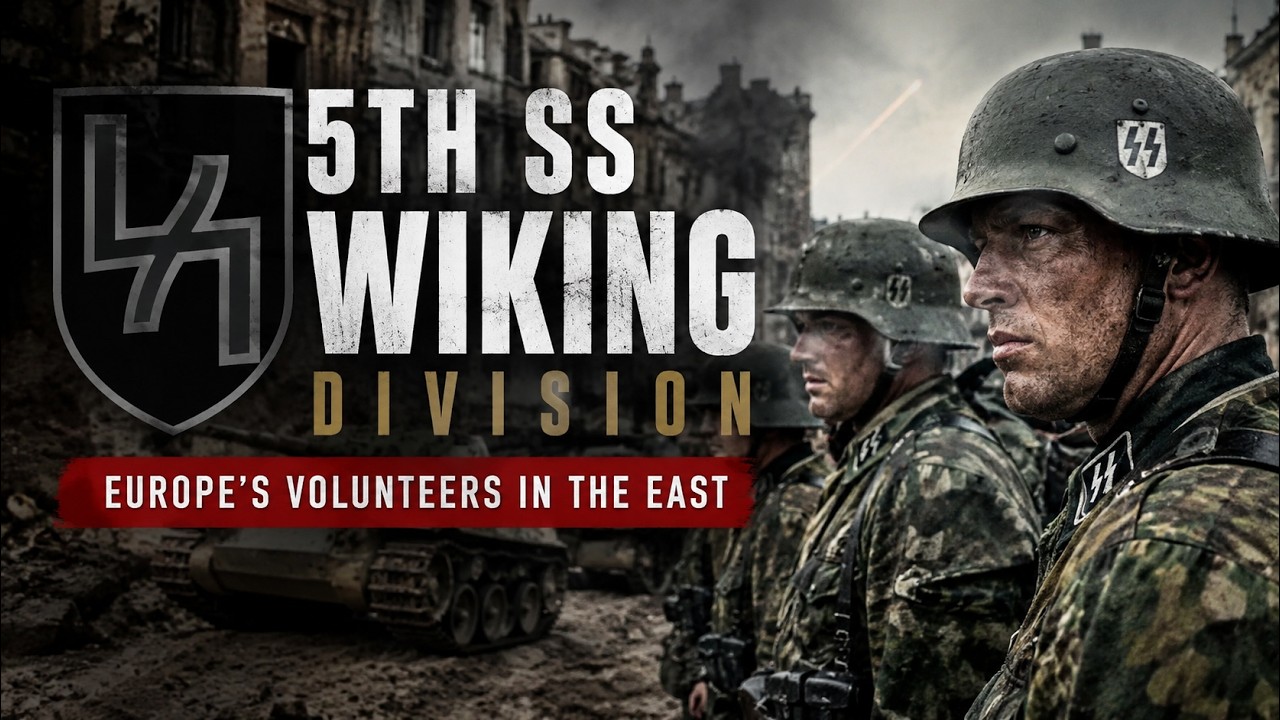
The division had its genesis in 1940, when the SS Standarte Germania was joined by foreign volunteers to create a new formation. The name Wiking was chosen deliberately, invoking the ancient Norse explorers and suggesting a continuity between Germanic expansion and the Nazi project. It was meant to appeal to Scandinavians, Dutch, Belgians, and others who could imagine themselves as heirs to a shared European heritage. The SS leadership, under Heinrich Himmler, harbored a mystical belief in the racial kinship of Germanic peoples spread across the continent, and they envisioned a pan-European militia united not by nationality but by ideological conviction.
Recruitment offices opened quietly across Northern Europe. In the Netherlands, posters depicted strong, purposeful soldiers against heroic backdrops. Young Dutch men encountered messaging about racial solidarity and a common destiny in the struggle unfolding in the East. In Belgium, particularly in the Flemish-speaking regions, the appeal emphasized political liberation and the notion that participation in the great crusade against Bolshevism might serve national interests.
Denmark, which retained a functioning government under German influence, saw some recruits channeled through official military channels, while others enlisted independently, driven by personal conviction or admiration for German military tradition. Norway, occupied and with its own fascist party, yielded volunteers who perceived an existential threat in Soviet communism. The propaganda apparatus was sophisticated. Pamphlets described the great historical moment, the final confrontation between European civilization and the Bolshevik threat.
Newsreels showed the division in formation. Radio broadcasts carried testimonies from volunteers speaking in their native languages about the nobility of the undertaking. Yet beneath this carefully constructed messaging, the actual motivations of recruits were extraordinarily varied. Some men were responding to economic opportunity in times of scarcity.
Others were motivated by fear of unemployment or reprisals. Younger men were susceptible to the promise of camaraderie and the sense that they were participating in something larger than themselves. The recruitment drives also benefited from timing. In 1940 and 1941, Germany appeared to be winning decisively, and the prospect of joining a victorious military force held considerable appeal.
What awaited them in the training camps was a deliberate forging of identity. The rhythm of the training day started well before dawn. Men were roused from their bunks and pushed through endless drilling, root marches across the German countryside, and small unit tactics. Woven throughout the day was the ideological framework.
Evening lectures spoke of European civilization, of the racial struggle defining the age, of the Bolshevik threat. The men were shown maps of Europe redrawn according to theories of Germanic racial settlement. They were told that they were not merely soldiers, but warriors in a historical struggle. The SS developed a transnational mythology, the idea that all Germanic peoples shared a common racial heritage, and that the SS represented the truest expression of this shared essence.
Nordic volunteers were flattered by this narrative, told that they represented the purest expression of Germanic blood. The regiments took shape. The Nordland regiment drew together the men from the north, Danish and Norwegian volunteers along with Swedes. The Westland regiment gathered the Dutch, Belgian, and Flemish volunteers.
Officers were often German, particularly in the higher ranks, but at company and platoon level there was room for promotion from within the foreign volunteers themselves. The men learned to move as one organism, to internalize the same cadence. They learned each other’s names, their habits, their differences in humor. They shared cigarettes and letters from home.
A shared hardship forged bonds that transcended national origin. By the spring of 1941, Felix Steiner, a Prussian officer of the old guard, assumed command of the division. He was not in the conventional sense a Nazi true believer. He was a professional military man, educated in the old Prussian tradition of officer craft.
But he had chosen the black uniform of the SS. His approach to command emphasized small unit tactics and mission-based orders, pushing down responsibility and encouraging officers to think and adapt. It was a radical notion within an SS structure where ideology and centralized control often reigned supreme. The men found in him a figure of respect rather than affection, a commander who demanded excellence without resorting to the cruder forms of intimidation.
As the men of Wiking moved east, the landscape itself became their teacher. The summer of 1941 brought heat and dust that coated everything in a fine grit. The men advanced across a vast, empty step that seemed to stretch without horizon. The first real contact with Soviet forces came gradually.
Around the Dnieper River, the Westland regiment was committed to an assault near the town of Berezina in August. The heat was oppressive, and the dust from tracked vehicles hung in clouds so thick that visibility was measured in tens of meters. The Soviet defense was stubborn, and the division found itself slowed by a resistance that did not align with the intelligence predictions of quick victory. By autumn, the character of the engagement had matured.
The Red Army was not a spent force. The men had seen that Soviet soldiers fought with determination, and the terrain itself had become their teacher. The winter came with a sudden violence. Temperatures dropped by dozens of degrees in a matter of days.
Engine oil congealed. Diesel fuel gelled in the tanks. Men who had been trained for combat found themselves spending hours each day simply trying to keep their machines running. The fighting around Rostov in early December was a grinding, savage affair, and the Soviet winter counteroffensive caught the German forces in a posture of severe disadvantage.
The men fought in freezing darkness that lasted nearly twenty hours a day. Cold was killing them as effectively as Soviet bullets. The division fell back into what was hoped would be a more defensible line, but the Red Army pressed hard. By the spring of 1942, the strategic temperature had shifted.
German high command directed its remaining offensive energy toward the oil fields of the Caucasus. Wiking, now a seasoned formation tempered by months of brutal combat, was assigned to Army Group South as it prepared for Operation Edelweiss. The journey south was a remarkable logistical movement across thousands of kilometers of captured Soviet territory. The landscape transformed from rolling grasslands to the first foothills of the Caucasus range.
Through the summer of 1942, the division pushed deeper into the region, moving through valleys where the summer heat was relentless and supply was increasingly precarious. The advantages of armor and mobility that had served Wiking so well on the open steppe diminished when the terrain forced men to dismount and climb. The great breakthrough that might have secured the oil fields never came. Far to the north, around a city called Stalingrad, the entire southern army group was being drawn into a consuming battle of attrition that would reshape everything.
The surrender of the Sixth Army at Stalingrad in February 1943 sent a shock through every command post. The period that followed became a threshold, a moment when the Eastern Front transformed from a place of potential German victory into a place of German struggle. Wiking, reinforced and prepared for what was meant to be a renewed offensive, was positioned as part of Operation Citadel. The very fact that such an operation was necessary suggested a profound shift in the strategic equation.
The Germans could still imagine, with some plausibility, that they might stabilize the line, but this was already the thinking of a military establishment that was beginning to lose the war. The division was remade as a full Panzer division, a full-strength armor-heavy formation. At its core sat two Panzer regiments, Westland and Nordland, with battalions of tanks organized into smaller tactical companies. The division received Panzer IVs and some Panthers, supported by Panzergrenadier regiments in halftracked vehicles.
The transformation had a subtle effect on the division’s character. There was more emphasis on technological sophistication, on the coordinated ballet of moving large quantities of steel across the landscape. War became about maintaining supply lines, about ensuring tanks did not outrun their fuel trucks. By January 1944, Soviet forces had begun a coordinated offensive designed to encircle the German line entirely.
Wiking found itself cut off from supply and reinforcement, surrounded in an area around the town of Cherkassy. The plan that emerged was to attempt a breakout, a concentrated, violent push through the Soviet lines. On February 16, 1944, the division attacked westward with concentrated fury. Ground was gained, and losses were taken on both sides.
The breakout was not a clean success, but a partial opening in the encirclement that began to widen as more troops pushed through. Wiking emerged severely depleted, with gaps in its ranks that would take weeks to fill. The historical record demands that any honest account confront the question of what happened when these soldiers, embedded within an organization explicitly built on racial ideology, encountered Soviet civilians, partisan fighters, and prisoners of war. The war on the Eastern Front was from the outset a war of annihilation.
The stated objective was not merely military victory but the destruction of Bolshevism as an ideological and racial force. Civilians were not neutral inhabitants to be displaced or governed, but part of an existential threat. The Vafan SS divisions operated within a framework that explicitly severed the Eastern Front from conventional rules of engagement. There were mass shootings of prisoners of war, reprisal killings against civilian populations, deliberate starvation policies, and mass exterminations of Jews.
The scale of these crimes was immense. Units of Wiking were present in Ukraine during periods when mass killings were occurring. They operated in regions where partisans were active and reprisals were implemented. Even if direct involvement in the worst killings was limited, the division operated within the system that enabled those killings.
The soldiers were not free from the weight of this. The retreat through Poland in 1944 was a different sort of ordeal, slower, more deliberate, yet somehow more exhausting because it carried the weight of inevitability. In August 1944, Warsaw became the stage for the Polish Home Army uprising. Wiking’s relationship to the suppression of that uprising remains contested by historians.
Some units were present in the region, some elements saw action in or around Warsaw. What we know is that the division was part of the German military apparatus operating in Poland during the uprising, contributing to the apparatus of force that held Poland during one of the most devastating urban battles of the war. By the winter of 1945, the division was repositioned northward toward Pomerania, fighting to slow the Soviet winter offensive. The land itself seemed hollowed out by conflict.
Roads filled with refugees fleeing the advance. The men found themselves defending a homeland they did not own, retreating across land that was fundamentally foreign to them. The fighting was characterized by tactical patterns that had become familiar. The Soviets would launch coordinated attacks, usually at dawn.
German counterattacks were limited in scope. Each withdrawal meant abandoning more ground. By February 1945, the division had been pushed back across much of Pomerania. The men who had volunteered in the hopeful years of 1940 and 1941 found themselves in circumstances almost unimaginably distant from their initial convictions.
For those who survived into the war’s closing years, the internal landscape had shifted. Some maintained a fierce pride in their formation, but for many, the ideology that had brought them east had been rendered almost irrelevant by the sheer fact of being tired, hungry, and perpetually under fire. A Norwegian wrote to his sister of the camaraderie that still bound the regiment together, but beneath those words lay a quiet acknowledgment that the grand ideological project seemed increasingly hollow. Some attempted to desert, hoping to surrender to American or British forces rather than fall to the Soviets, fearing the camps that awaited them in Siberia.
The division was pulled from the Pomeranian plains and repositioned toward the Alpine regions of Austria. The supply lines were skeletal. Fuel was rationed to the point of near immobility. The men moved through Austrian valleys in early 1945 with a knowledge that went deeper than reason, the war was ending.
In the final weeks of April, Wiking units were drawn into Bohemia and Moravia as Soviet forces pressed westward. The character of the final fighting shifted. There was less formal coordination, more improvisation. The old structures were breaking down.
Soldiers became increasingly focused on personal survival, on where the American lines lay, on how to surrender to the Western Allies rather than to the Russians. By early May 1945, the division had ceased to exist as a coherent military unit. Some components were still fighting in Austria. Others were retreating toward American lines.
Felix Steiner was attempting to consolidate what units remained and move them toward negotiation with Western Allied forces. Many men simply abandoned their weapons, discarded their insignia, and walked toward the sound of English voices. By the first week of May, scattered Wiking units began appearing at American divisional headquarters throughout northern Austria and Bavaria. They were processed, sorted, and held in increasingly overcrowded camps.
The fates of individual men diverged widely from this point. Some faced trials in the coming years. Some were convicted and executed. Others served prison sentences.
Still others were released as the cold war began to reshape American priorities. Felix Steiner was captured and eventually tried at Nuremberg. He was convicted of war crimes and crimes against humanity, but his sentence was comparatively light, twenty years with a substantial reduction granted during the Cold War. He would eventually walk free.
In Denmark, the return of the volunteers raised painful questions about what collaboration meant. Some Danes saw these soldiers as dupes, others as collaborators. A number of them were tried by Danish courts for treason, and the stigma attached to their service did not fade. In the Netherlands, the postwar courts prosecuted some collaborators and let others slip away.
Norway’s reckoning was perhaps the most painful, as a substantial number of Norwegian volunteers had served in the SS. When they returned, they were often publicly shamed. Some faced imprisonment. Others vanished into small towns or immigrated, trying to escape a past that had become too heavy to carry.
The Soviet Union treated German prisoners harshly, and foreign soldiers captured from SS units faced additional suspicion. Many languished in Soviet camps for years after the war had officially ended. In each of these nations, the impulse emerged not toward grand celebration, but toward careful documentation, honest silence, or muted remembrance. The question of memory itself became a landscape that each nation navigated in its own way.
As the decades accumulated and those who had lived through the war passed from the world, the monuments began to age. Some were maintained with quiet care. Others were allowed to become overgrown. The original stones remained, and the names remained, but the meaning they carried became increasingly historical.
What remains after all the marching orders have been filed away and the uniforms hang silent in museums is the compressed weight of human choice. Thousands of men made their way toward the eastern front under the banner of the fifth SS Panzer Division Wiking, and each one carried with him a life that had been lived before and which he hoped to live again. The photographs that survive show faces we might pass on any street in Amsterdam or Copenhagen. Young men whose letters home speak of cold, of hunger, of the strange fraternity that forms between soldiers who share the same trench.
The human cost of military insignia is measured not only in the deaths that occurred, but in the texture of lives interrupted, altered, bent toward purposes that most of the men involved did not fully comprehend when they enlisted. The insignia finally is a kind of mirror. It reflects back to us what we are willing to see. It shows us organization, efficiency, the trappings of power.
But it also shows us, if we look carefully enough, the presence of human faces behind the symbolism. Young men with names and families and futures that were interrupted. Men who marched and fought and died in service to a cause that the world eventually judged abhorrent.
Men who were at once agents of history and victims of it, perpetrators and casualties simultaneously.