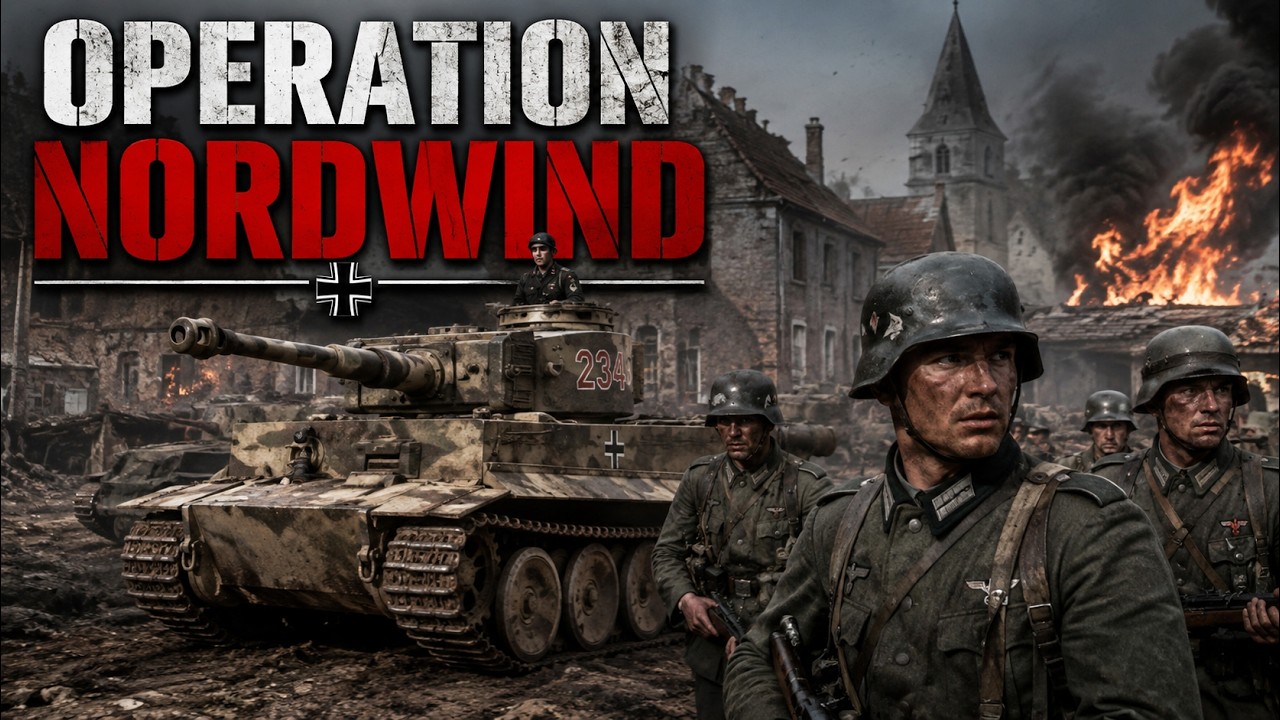
By the last evening of 1944, while the world’s attention had locked onto the massive German breakthrough in the Ardennes, a second German offensive was already rolling into position three hundred miles to the south. Beneath a week of steady snowfall, across the frozen plains of Alsace and the wooded ridges of the Vosges, that offensive was gathering itself. Its name was Operation Nordwind, and it would involve more troops than many of the war’s most famous battles, yet history would nearly forget it entirely, eclipsed by the drama unfolding to the north. American soldiers of the Seventh Army, under General Alexander Patch, had been holding their positions for weeks.
Their foxholes were rimmed with ice that never thawed. The cold here was not the sharp, shocking cold of a sudden storm; it was a persistent, creeping cold that settled into every layer of cloth and fold of skin, stealing warmth gradually over hours until a man realized he could not feel his fingers. The trees stood heavy with frost, their branches bending under the accumulated white. Sound traveled strangely in that landscape, voices carrying farther than they should, yet muffled, as though the air itself had thickened.
In the quiet moments, a soldier could hear nothing but the whisper of wind through the branches, and the war could seem almost abstract, something happening far away. But the men knew better. For weeks, intelligence reports had hinted at unusual German troop concentrations beyond the Rhine and the Vosges. Supply lines were moving north and south.
The Germans were planning something. The waiting had a weight of its own, heavier than the cold, heavier than the fear of what might come. A soldier cleaning his rifle for the fourth time, checking the ammunition in his pouches, moving with a particular slowness born of the knowledge that action was approaching, was not just passing time. He wanted to be ready.
He was afraid he would not be ready enough. The Seventh Army was dangerously thin. It held a front far too long for the number of men assigned to it, stretching from the Rhine in the east to the foothills of the Vosges in the west. The divisions were depleted, the reinforcements had been drawn off to the Ardennes, and the strategic reserve that might have cushioned an attack had been consumed by the crisis in Belgium.
Patch knew his forces were about to be hit. He knew he had almost nothing in reserve to meet it. Behind the front, in the streets of Strasbourg, liberated just weeks earlier, there was an uneasy mixture of celebration and dread. Civilians gathered for New Year’s Eve, but the proximity of the German border, of the enemy massing just beyond the frozen hills, remained present in every mind.
The future felt unknowable in a way that transcended ordinary wartime uncertainty. As darkness fell and midnight approached, the temperature dropped further. Soldiers checked their watches, aware that the turning of the calendar might bring more than a new year. The snow continued to fall, covering everything in another thin layer of white.
Somewhere on the other side of the mountains, German officers were checking their own watches, waiting for the signals that would send thousands of men forward into the frozen landscape. The plan had been born months earlier, in the secret conferences of Hitler’s forward command post. Hitler, refusing to accept that Germany was losing, had insisted on striking again in the south while the Ardennes offensive consumed the northern theater. His generals harbored deep reservations.
They knew the divisions available were exhausted, their ranks filled with boys and older men and survivors of catastrophic defeat. The fuel was rationed, the ammunition scarce, the air superiority lost. General Hermann Balck and General Johannes Blaskowitz, who would command the assault, recognized the operation as a counsel of desperation rather than military necessity. But to question Hitler directly, especially after the July assassination attempt, was to risk everything.
So they obeyed. They planned the routes and the objectives with professional precision, even as they understood the offensive was doomed. The orders were given. The machinery of German military organization ground forward.
Nordwind would be launched almost simultaneously with the northern offensive, diffusing German strength across two widely separated theaters, neither of which could receive the concentrated force necessary for decisive success. The strategic dilemma for the Allies was agonizing. The Ardennes offensive had caught them off guard and was consuming everything. Eisenhower’s staff poured divisions northward toward Bastogne and the Belgian forests.
Tank battalions that might have reinforced the south were racing to the crisis in Belgium. Infantry replacements that might have rotated through Alsace were being funneled into the grinding fights around Malmedy and Saint-Vith. The Seventh Army, already stretched beyond its means, grew thinner still. Patch understood the mathematics before him were unforgiving.
You cannot defend a hundred miles of front with divisions meant to hold seventy. You cannot hold a sector against surprise attack when your reserves have been stripped away. But there was nothing to be done except hold with what he had and hope that something, somewhere, would shift. The men who would face the onslaught were a mixture of battle-hardened veterans and new replacements.
Some had fought since Normandy, their uniforms patched, their faces marked by months of cold and fear and insufficient sleep. Others were fresh from the States, assigned to units they had never trained with, learning to fight together in the midst of a campaign that showed no mercy for inexperience. The cold was unlike anything most of them had encountered. Frostbite was becoming as much a danger as enemy fire.
There were not enough blankets, not enough fuel for warming fires, not enough rotation to escape the freezing conditions for even a few hours. They were, in many ways, the most vulnerable soldiers in the entire European theater, not because they lacked courage, but because they were too few, too exhausted, and too far from support. The German forces assembled for the offensive were a shadow of what the Wehrmacht had once been. The 19th Army, which would bear the weight of the northern thrust toward Bitche and Wingen, included veteran formations like the 21st Panzer Division, but their armored strength had dwindled to perhaps a hundred tanks and assault guns scattered among the regiments.
Many units had been rebuilt from scratch after catastrophic losses in France. Some platoons contained men who had fought at Stalingrad and Kursk; others held mostly boys and middle-aged men who had never heard a shot fired in anger until the opening barrage began to fall around them. The Sixth SS Mountain Division Nord had been formed from Norwegian and Danish volunteers, but by 1945 its ranks had been diluted with conscripts and transfers. The artillery was scraped together from across the front, but ammunition was carefully rationed.
The fuel situation was critical; a Panzer division might be allocated enough for two or three days of continuous movement. The logistics were cracked. The rail network had been systematically destroyed by Allied bombing. The men themselves, many of them, understood the truth.
They knew Germany was being pressed from east and west, that the cities were burning, that the supply situation was deteriorating. They moved forward with grim determination because orders had come and must be obeyed, but there was little conviction that Nordwind would reverse the fortunes of the Reich. And there was another weight pressing down on the Allied command, one that had nothing to do with tanks and everything to do with the heart of a nation still learning to beat again after occupation. Strasbourg had become a symbol.
When the Allies liberated the city in late November, French hopes had crystallized around it. To Charles de Gaulle, Strasbourg was non-negotiable, proof that France was returning, that its liberation was real and irrevocable. When Eisenhower’s staff, studying the maps with cold strategic logic, suggested that the city might need to be evacuated if the German offensive threatened it, de Gaulle was adamant. France would not permit the loss of Strasbourg a second time.
If the Allies would not defend it, France would defend it themselves, even if it meant acting independently. Eisenhower found himself caught between military logic and political reality. He could not hold the alliance together if France believed its vital interests were being traded away as a mere tactical consideration. The exchanges were tense, the messages carefully diplomatic.
In the end, Eisenhower determined that Strasbourg would be held. The Seventh Army would stay in place. The risk would be accepted. The city would be defended not merely because it was militarily important, but because to abandon it would shatter something in the alliance itself.
The first guns of Operation Nordwind spoke near midnight on December 31st. Along a front that stretched from the low Vosges down toward the Rhine plain, the night seemed to split open. German divisions, restored to fighting strength with replacements scraped from training depots and rear-area units, began their drive toward the towns of Bitche and Wingen. These were not glamorous objectives, not the names that would resonate through history like Sedan or Bastogne.
Bitche was a small fortress town sitting stubbornly in the pine forests. Wingen lay further south, another cluster of houses and farmland in the Vosges foothills. But to the German planners, they were essential waypoints. If the initial assault could break through the American line here, a wider exploitation might become possible.
The initial shock was not the overwhelming strength of the assault, but its sheer simultaneity. The night erupted in flashes and thunder from multiple directions at once. The German artillery was used with careful precision, concentrating fire to batter weak points in the American line. American forward observers called down counter-battery fire, and soon the sky was illuminated with the red and orange flashes of exploding shells.
Radio communications were degraded by cold and terrain. Orders traveled slowly. Men were disoriented, uncertain whether the shadows moving through the snow were German assault troops or their own men falling back. The American defenders held their ground with a kind of stoicism.
They had prepared fields of fire, knew the ground, and waited for the enemy to come into view. Around Bitche, the German assault developed as a frontal push through the passes. As German infantry emerged from the treeline and crossed the snow-covered approaches, American riflemen and machine gunners opened fire. The snow in those fields was soon marked with the dark stains of the wounded and the fallen.
The pattern became grinding and repetitive: the Germans would assault, be repulsed, regroup, and assault again. Around Wingen, the terrain was narrower, constraining the deployment of armor. The fighting devolved into a series of small, bitter engagements scattered across the snowy landscape, firefights in darkness where men could see only muzzle flashes and the calls of officers trying to maintain control. In the village of Rimling, the fighting was particularly confused and brutal.
The American units there, mostly from the 42nd Infantry Division, the Rainbow Division, found themselves under assault before dawn. German forces, elements of the 197th Division and supporting Panzergrenadier units, came across the snow with grim determination. Within the village, American soldiers dug in around buildings, setting up machine gun positions in windows and behind rubble. They had to hold, the orders said, even as reinforcements were hours away.
The fighting was almost hallucinatory in character. Men described shapes in the snow that might have been men or might have been the drifting landscape playing tricks on exhausted eyes. The acoustic properties of snow and winter air made distance impossible to judge. The cold itself was a constant, mounting enemy.
Fingers went numb, feet were in constant danger of frostbite. For hours, the Germans pressed, and there were moments when it seemed quite possible that Rimling might fall. But the Americans dug deeper, called in artillery support, and held. Neither side could achieve a decisive advantage, and both settled into a grinding stalemate that would define the character of the campaign.
The true nature of the fighting in Alsace was not a quick breakthrough or a decisive victory, but an extended, bitter struggle that wore down both sides impartially. In the villages of the low Vosges, the combat was claustrophobic and intimate. The fighting around Hatten and Rittershoffen, two small towns separated by a few kilometers of frozen ground, reached a particular intensity. The villages sat astride the natural avenue of advance, controlling the tactical picture for miles around.
The fighting was house-to-house, sometimes room to room, within the same buildings. Windows became firing positions, cellars transformed into command posts. The narrow streets offered no easy approach and no clear sight lines. German companies clawed their way through the villages meter by meter, and the Americans, though often outnumbered, fought with ferocity.
The conditions were almost inconceivably harsh. Temperatures dropped well below freezing at night. Wounded men left exposed faced not only bleeding but hypothermia. Frostbite was as much an enemy as German bullets.
Officers lost control of the battle almost as soon as it began, and men learned to move quickly, to throw grenades before entering rooms, to trust their instincts. The villages changed hands multiple times over the weeks, and civilians huddled in cellars, listening to the sounds of warfare echoing through the chambers above them, unable to predict whether the next uniformed figure they saw would be German or American. The civilians of Alsace carried a particular burden. They had endured four years of German occupation, of Nazi schooling and conscription that drew their sons into German uniforms whether they wished it or not.
And then, barely two months before, the Americans had liberated them, or so the word went. Now, with Nordwind, they faced the prospect of being caught between two armies once again, of their homes becoming battlefields. Their identity was bound up in this tragedy. Alsace had been German, then French, then German again, and now French once more.
Many families had relatives across the Rhine in the Third Reich. During the occupation, young Alsatian men had been pressed into the Wehrmacht; now some found themselves fighting against the uniforms they had worn. The questions of who belonged and who did not, of who had collaborated and who had merely survived, would haunt the region for generations. In the villages nearest the fighting, families huddled in cellars or fled westward.
The old and infirm remained behind and hoped the war would somehow pass them by, a hope almost never fulfilled on a battlefield. Even as the German offensive pressed forward, the American response was beginning to gather force. Eisenhower, despite the enormous strain of the Ardennes, possessed reserves that could move with relative swiftness. Word of the Nordwind offensive spread slowly at first, but the American command began to siphon forces from less threatened sectors.
Tank destroyer companies arrived. Artillery batteries that had been earmarked for other operations suddenly materialized in forward positions. The Germans, who had launched their offensive to pierce the thin American lines before reinforcements could arrive, discovered that those reinforcements were arriving even as their own momentum was beginning to falter. The American system, for all its flaws, possessed the capacity to respond.
Trucks could carry troops, supply caches could be reorganized. The German offensive began to experience opposition that was growing stronger with each passing day rather than weaker. Each village taken required more effort than the last. Each advance became more costly.
By the middle of January, the balance of momentum had shifted decisively, though quietly. There were no dramatic encirclements, no vast surrenders. Instead, there was a gradual accretion of American strength, a slow thickening of the defenses, a steady arrival of fresh units and additional firepower. Far to the south, a related offensive, Operation Sonnenwende, had been launched from the Colmar pocket, that stubborn German salient west of the Rhine containing roughly one hundred fifty thousand trapped troops.
The German commanders hoped to break through the American containment line and link up with forces advancing from the north. The pressure was real for several days, and it seemed possible the Germans might achieve local success. But the same dynamic applied. The Allies responded by moving reserves southward, and the German momentum dissipated under the weight of resistance.
The offensive hardened into a grinding attritional struggle. The Colmar pocket, rather than serving as a springboard for deeper penetration, was becoming a trap. The hopes of the German command, never strong, were crumbling. The Battle of the Bulge had turned decisively against Germany, and the reserves that might have reinforced Nordwind would not materialize.
The supply lines were stretched to the breaking point. Fuel was rationed so severely that some Panzer companies could not operate their tanks. The Luftwaffe was nowhere to be seen. By the final week of January, the German divisions had stopped attempting ambitious breakthroughs.
The orders shifted from advance and exploitation to holding key terrain and inflicting maximum casualties. The offensive, which had been born in desperation and sustained by the terrible will of men who knew their cause was lost, was dying not with a dramatic defeat, but through the patient application of superior resources. By February, Operation Nordwind had quietly ceased to exist as an offensive operation. The German forces had reverted to defensive postures, and the focus of German command had shifted entirely to the Eastern Front, where the Soviet offensive posed an existential threat.
When the snow finally ceased falling across the Alsatian plains, the accounting began. German casualties in Operation Nordwind reached somewhere between twelve and fifteen thousand men killed, wounded, captured, or lost to frostbite. The American Seventh Army suffered thousands of casualties of their own. The French forces pressing on the Colmar pocket endured perhaps two thousand more.
The numbers told a story of grinding attrition. Behind each figure stood a man, or in some cases, a young soldier barely old enough to have truly grown. There were the frostbite cases, hundreds upon hundreds, toes and fingers and sometimes entire feet surrendered to the cold, gangrene, and amputation. There were the psychological casualties, men whose minds fractured under the weight of house-to-house fighting.
There were the prisoners; by February, over five thousand German soldiers had been processed into camps, their war effectively over. The Colmar pocket was finally cleared in the first weeks of February, compressed from all sides by converging American and French forces until the last defenders were captured, killed, or managed to escape across the Rhine. And then, almost as quickly as it had begun, the campaign faded from the world’s consciousness. The Ardennes, with its dramatic breakthrough and famous stand at Bastogne, captured the imagination of commanders and journalists alike.
Nordwind was slow and grinding, ultimately a failure of modest proportions in a war of massive proportions. It achieved none of its primary objectives. It was untidy and inconclusive, ending not with a decisive breakthrough but with a slow, grinding halt, with men dying in small villages for a few frozen miles that would be retaken anyway, with prisoners shuffling away in the snow. There was no iconic moment, no famous reply, no single action that encapsulated the entire operation.
And so it slipped into obscurity, into the footnotes of military history, kept alive only in specialist monographs and the memories of the men who fought there. But for those who were there, the winter of 1944 and 1945 left scars that never fully healed. The soldiers of Nordwind knew nothing of their obscurity. They fought with the same intensity and the same fear as those whose names would be remembered in textbooks.
The snow that fell on Alsace has long since melted, and the fields have been plowed and planted many times over. The villages have grown and changed, and the survivors have passed away, taking their stories with them into the silence. Yet in the deep part of winter, in those villages where the daylight fades early and the cold settles in with the darkness, you might feel something of what those soldiers felt, a stillness that can feel almost like forgetting itself.
The snow falls still on the Alsatian plains, and it falls on all the small villages whose names are known primarily to those who live there, covering the earth with a blanket of white that is both beautiful and isolating, peaceful and cold.