In May 1945, American soldiers from the 101st Airborne Division climbed the winding mountain roads toward Hermann Göring’s Alpine estate at Berchtesgaden. They were expecting military supplies or strategic documents. Instead, they found room after room filled with paintings, sculptures, and antiquities. Renaissance masterpieces leaned against walls, medieval tapestries hung in storage rooms, and crated canvases bore labels from museums across occupied Europe.
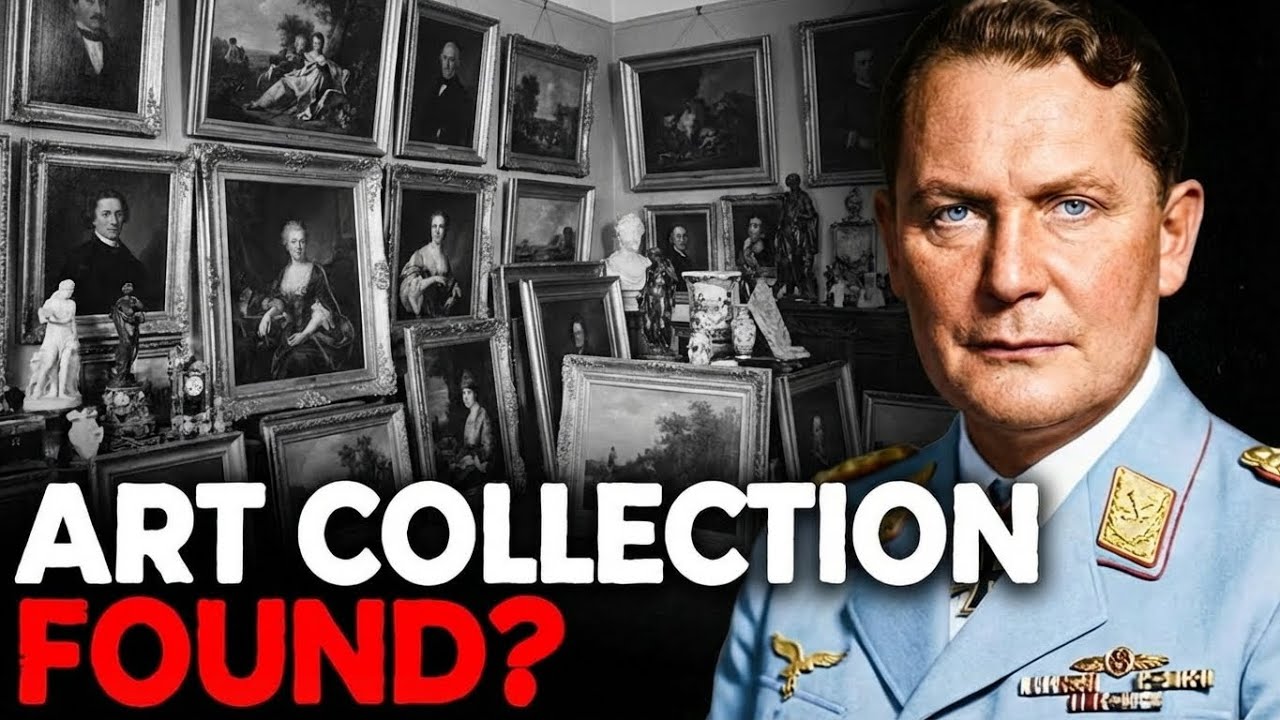
The Reichsmarschall, second only to Hitler in the Nazi hierarchy, had assembled one of the largest private art collections in history. After the war, one question remained: what would become of the stolen treasures Göring had spent years gathering? The answer proved stranger than anyone expected—a story of military recovery, diplomatic tension, and restitution efforts that continue into the present day. Göring’s obsession with art began long before the war.
A decorated World War I fighter ace who became one of the founding members of the Nazi Party, he cultivated an image of cultured sophistication that set him apart from other Nazi leaders. By the early 1930s, as he rose to become commander of the Luftwaffe and minister president of Prussia, he began acquiring paintings, tapestries, and sculptures with growing intensity. His stated goal was to create a museum-quality collection that would rival those of European royalty. What started as personal collecting soon transformed into systematic plunder on an unprecedented scale.
When Germany invaded Poland in September 1939, Göring established clear procedures for art confiscation. He issued orders that all significant cultural property in occupied territories should be inventoried and made available for his personal inspection before any other Nazi officials could claim it. Special units attached to the Wehrmacht were tasked with identifying valuable collections, libraries, and museums. In Poland alone, Göring’s agents seized paintings from the Czartoryski Museum in Kraków, including works that had belonged to Polish aristocratic families for centuries.
By the end of 1939, the first shipments were arriving at Carinhall, his vast hunting lodge north of Berlin, named after his first wife. The fall of France in June 1940 opened an entirely new realm of opportunity. Paris held some of the world’s finest private collections, many owned by Jewish families who had fled or been deported. The Einsatzstab Reichsleiter Rosenberg, known as the ERR, became the primary agency for art confiscation in France.
But Göring maintained privileged access to everything they seized. He made more than twenty trips to Paris between 1940 and 1942, personally inspecting works stored at the Jeu de Paume Museum, which the ERR used as a central sorting depot. Göring selected hundreds of paintings during these visits, including works by Rembrandt, Vermeer, Rubens, Van Dyck, and Cranach. His agents transported them back to Germany in special rail cars, often accompanied by detailed photographic inventories.
Göring’s collecting extended beyond paintings. He acquired medieval altarpieces from Dutch churches, Renaissance bronzes from Italian collections, illuminated manuscripts from Belgian monasteries, and Gobelin tapestries from French aristocratic estates. His agents scoured auction houses, private dealers, and occupied museums. In many cases, they offered payment, often at prices far below market value.
But the transactions were hardly voluntary. Gallery owners understood that refusal meant confiscation without compensation—or worse. By 1942, Göring’s collection exceeded 1,500 major works, not counting furniture, ceramics, and decorative objects. The mechanics of Göring’s operation involved multiple layers of personnel.
Bruno Lohse, an art historian who worked for the ERR in Paris, acted as one of Göring’s primary advisers, helping him identify valuable pieces and negotiate acquisitions. Walter Andreas Hofer, Göring’s official art curator, managed the collection itself, cataloging new arrivals and arranging their display at Carinhall and other properties. Both men would later become central figures in postwar investigations. Transport officers coordinated the movement of works across occupied Europe using military vehicles and special rail cars.
Conservators and framers were employed to restore damaged pieces. The entire enterprise operated with the efficiency of a state bureaucracy, which in many ways it was. As Allied bombing intensified over Germany in 1943, Göring understood that his collection was vulnerable. He began dispersing works to safer locations.
Some went to underground storage facilities in Bavaria, others to castles in Austria. By early 1944, Carinhall itself was becoming untenable. Göring ordered the removal of the most valuable pieces to his homes in Berchtesgaden and to a network of storage sites scattered across southern Germany. The movement was hasty and often poorly documented.
Crates were mislabeled or left without inventories. Some shipments were diverted by local officials or stolen by retreating Wehrmacht units. By the time Germany collapsed in May 1945, Göring’s collection had been fragmented across dozens of locations, many of them unknown even to his own staff. When the war ended on 8 May 1945, Hermann Göring was in American custody.
He had attempted to negotiate a separate peace with the Allies in late April, leading Hitler to strip him of all ranks and positions. Göring surrendered to American forces on 9 May near Radstadt, Austria. Within days, Allied intelligence officers were questioning him about the location of his art collection. Göring was forthcoming, even proud.
He provided lists of storage sites and described individual works from memory. His cooperation reflected his belief that the collection was legitimate property rather than stolen goods—a view the Allies would spend years contesting. The recovery of Göring’s collection began almost immediately. American units fanned out across Bavaria and Austria, following leads from captured documents, local informants, and Göring’s own statements.
On 14 May, soldiers from the 101st Airborne reached Göring’s residence in Berchtesgaden, where they found approximately 1,200 works packed in crates or displayed on walls. The sheer volume overwhelmed the initial recovery teams. Paintings were stacked in hallways, rolled tapestries filled storage rooms, and sculptures crowded staircases. Captain Harry Ettlinger, a German-born American soldier who later became one of the Monuments Men, described the scene as resembling a museum storeroom rather than a private home.
At Unterstein, a small village near Berchtesgaden, American forces discovered an additional cache hidden in a stone barn. Local residents had reported suspicious activity involving military trucks unloading crates in the weeks before the surrender. Inside, investigators found works that had belonged to the Rothschild family in Paris, including a Vermeer and several Rembrandts. The crates bore markings from the ERR confirming their origin.
Similar discoveries followed at Neuhaus am Schliersee, where Göring had stored medieval altarpieces, and at Veldenstein Castle in Franconia, where dozens of tapestries and Renaissance paintings were found in a chapel converted into a storage room. The Monuments, Fine Arts, and Archives program—known as the Monuments Men—took charge of securing and cataloging the recovered art. These officers, mostly art historians and museum professionals in civilian life, had been tracking Nazi art looting since the Allied invasion of Italy in 1943. By mid-1945, they established a central collecting point at Schloss Neuschwanstein in Bavaria, where works from Göring’s collection were brought for inventory and assessment.
The task was immense. Each painting required authentication, condition reports, and documentation of its provenance. Many works had been separated from their original frames or had labels removed. Photographs from Göring’s own records, which American forces had captured, became essential tools for identification.
Captain James Rorimer, who had been a curator at the Metropolitan Museum of Art before the war, led much of the Neuschwanstein operation. His team worked alongside French and British officers, each nation seeking to identify works stolen from their territories. Tensions occasionally arose over jurisdiction. France claimed priority for all works taken from French collections, while the Netherlands sought the return of paintings confiscated from Dutch museums.
The Americans, as occupying authorities, controlled the process but faced pressure to expedite restitution. By late 1945, Rorimer’s team had cataloged more than 800 major works directly traceable to Göring, though many more remained unaccounted for. The Soviet Union approached Göring’s collection differently. Soviet trophy brigades operating in the eastern occupation zone had located several storage sites containing works from Carinhall.
Rather than immediately repatriating these pieces, Soviet authorities transported them to Moscow and Leningrad, where they were held in museum storage. The official Soviet position was that these works constituted war reparations and would remain in Soviet hands until Germany fulfilled its obligations under the Potsdam Agreement. This included paintings by Lucas Cranach, medieval religious art, and Renaissance sculptures. Some would not resurface until the 1990s, decades after the war ended.
Beyond official structures, the immediate postwar period saw significant theft and black market activity involving Göring’s collection. American and French soldiers stationed in Bavaria occasionally helped themselves to smaller works—prints, drawings, decorative objects that could be easily concealed. Local Germans with access to storage sites sometimes removed items before Allied authorities arrived. The chaos of occupation made tracking these losses nearly impossible.
In one documented case, a French officer assigned to the Monuments Men was found to have taken several drawings from a cache at Unterstein. He was caught and arrested, but the drawings were never recovered. Such incidents complicated restitution efforts and raised questions about how thoroughly the collection had been secured. By late 1946, the focus shifted from recovery to restitution.
The Allied Control Council established procedures for returning looted art to its rightful owners or their heirs. Claims had to be supported by documentary evidence—bills of sale, prewar inventories, photographs, or witness statements. For works stolen from museums, the process was relatively straightforward. Museums had records, and most pieces could be identified through catalog entries or published scholarship.
Private collections presented greater challenges. Many owners had fled Europe, and their records had been lost or destroyed. Jewish families faced additional obstacles, as Nazi confiscation had often occurred without any documentation. In many cases, claimants relied on family photographs showing works hanging in their homes before the war.
France moved quickly to reclaim works taken from its territory. The French government established the Commission de Récupération Artistique in 1944, which sent representatives to Germany to identify and retrieve stolen art. By 1947, France had recovered more than 60,000 objects, including several hundred from Göring’s collection. Notable returns included paintings from the Rothschild family, the David-Weill collection, and the Musée des Beaux-Arts in Lyon.
Works were displayed publicly in Paris at the Musée du Jeu de Paume in a series of exhibitions intended to document the extent of Nazi looting and celebrate their recovery. The French public responded with overwhelming interest, and the exhibitions became important moments in the nation’s postwar cultural recovery. The Netherlands also prioritized restitution. Dutch Monuments Men working alongside their American counterparts identified works from the Goudstikker collection, one of Amsterdam’s most important private galleries.
Jacques Goudstikker, a Jewish art dealer, had fled the Netherlands in May 1940, dying in an accident during the escape. His collection, which included works by Rubens, Tintoretto, and Dutch Golden Age masters, had been systematically looted by Göring’s agents. After the war, Goudstikker’s widow, Désiée, submitted claims supported by gallery records and correspondence. By 1948, several dozen works had been returned, though disputes over others would continue for decades.
Some pieces that Göring had acquired through intermediaries in neutral countries remained legally ambiguous, caught between competing claims and unclear ownership histories. Poland’s restitution efforts were complicated by the postwar political situation. The new communist government in Warsaw sought the return of works looted from Polish museums and private collections, but the process was slow. The Czartoryski family’s collection, which Göring had targeted early in the war, included Leonardo da Vinci’s Lady with an Ermine.
This painting was recovered from Göring’s storage at Neuschwanstein and returned to Poland in 1946, becoming a symbol of national cultural recovery. Other works from the Czartoryski collection, however, remain missing to this day, including Raphael’s Portrait of a Young Man, which was last seen in storage at the Governor General’s residence in Kraków in 1945. Yet the wounds of recognition remained raw, particularly for families whose losses could not be fully documented. Many Jewish collectors had been murdered in concentration camps, and their heirs faced the challenge of proving ownership decades after the fact.
In cases where Göring had acquired works through intermediaries or art dealers in neutral countries like Switzerland, legal disputes often hinged on whether the transactions had been voluntary. Swiss dealers argued that they had purchased works in good faith from individuals fleeing persecution. Survivors and their heirs countered that these sales had been forced—made under duress to fund escapes or obtain exit visas. Courts in Switzerland, France, and the United States heard dozens of such cases throughout the 1950s and 1960s, with outcomes varying widely.
In the years that followed, some works from Göring’s collection entered public museums through complex legal settlements. The Seattle Art Museum acquired a painting by Lucas Cranach the Elder in 1949, which was later identified as having passed through Göring’s hands. The museum returned it in 2011 after descendants of the original owner filed a claim. Similarly, the Norton Simon Museum in Pasadena acquired two Cranach paintings in the 1970s that had belonged to Göring.
When Dutch heirs filed claims in the 1990s, lengthy negotiations resulted in the museum retaining the works while compensating the claimants. These cases illustrated the long shadow of wartime looting and the challenges of resolving ownership disputes decades after the fact. The creation of what became known as orphaned or heirless property added another layer of complexity. These were works recovered from Göring’s collection for which no claimants emerged.
In some cases, entire families had been killed and no surviving relatives could be located. In others, prewar ownership could not be established with certainty. Allied authorities held these works in trust, hoping that claimants would eventually appear. By 1949, hundreds of such pieces remained in storage at collecting points in Munich and Wiesbaden.
Some were eventually transferred to German state museums, where they remain today with notations indicating their uncertain provenance. The question of how to handle these works continues to generate debate among restitution experts and ethicists. The Nuremberg trials, which began in November 1945, included detailed testimony about Göring’s art collecting. American prosecutors used captured photographs and documents to illustrate the systematic nature of Nazi looting.
Bruno Lohse and Walter Andreas Hofer both testified about their roles in acquiring works for Göring, providing details about specific transactions and the networks of dealers who facilitated them. Göring himself, appearing as a defendant in the main trial, showed little remorse. When questioned about his collection, he insisted that he had paid fair prices and that many works had been gifts or legitimate purchases. He dismissed accusations of theft as Allied propaganda.
The judges at Nuremberg found Göring guilty on multiple counts, including crimes against humanity. He was sentenced to death, but committed suicide by cyanide poisoning on 16 October 1946, the night before his scheduled execution. Dealers and intermediaries who had worked with Göring faced varying fates. Some, like Lohse, were prosecuted but received relatively light sentences due to the complexity of proving criminal intent in individual transactions.
Lohse served four years in French custody before being released in 1950. He returned to art dealing in Munich and remained active in the trade for decades, always maintaining that his wartime activities had been legal. Other dealers fled to South America or changed identities to avoid prosecution. The networks that had facilitated Nazi looting during the war often reformed in the postwar period, as dealers with expertise in looted art found new markets among collectors who asked few questions about provenance.
The emergence of Cold War tensions complicated long-term restitution efforts. By 1949, Germany was divided into East and West, each with different approaches to handling looted art. West Germany, under Allied pressure, established procedures for processing claims and returning works to rightful owners. East Germany, under Soviet influence, was less cooperative, particularly regarding works that had been taken to the Soviet Union.
This division meant that some families pursuing claims faced bureaucratic obstacles depending on where their property had ended up. Works recovered in the eastern zone often remained inaccessible to western claimants until after German reunification in 1990. The physical state of Göring’s properties also evolved in the postwar years. Carinhall, his grand hunting lodge, had been destroyed on his orders in late April 1945 to prevent its capture by Soviet forces.
Explosives demolished the main building, and fires consumed what remained. Soviet troops found only ruins when they arrived days later. The site was eventually cleared, and little visible evidence of the estate survived into the 1950s. Göring’s residence at Berchtesgaden was incorporated into American military facilities and later demolished to make way for new construction.
Veldenstein Castle, where he had stored part of his collection, was returned to its original owners and eventually opened to the public as a historic site, though with no mention of its wartime use as an art repository. Several works from Göring’s collection were lost entirely during the chaos of 1945. Allied investigators documented cases where storage sites had been looted before their arrival, transport trucks had been ambushed, or crates had been destroyed in the final weeks of fighting. One notable loss involved a Rembrandt self-portrait that Göring had acquired from a Dutch collection in 1941, documented in photographs from his personal albums.
The painting was supposedly packed for transport to Berchtesgaden in April 1945 but never arrived. Despite extensive searches, it has never been recovered and is presumed destroyed or held in an unknown private collection. Similar mysteries surround several other major works that Göring owned, documented in his records but not found among the recovered pieces. From the 1950s through the 1970s, restitution efforts slowed but did not stop.
Families continued to file claims as new information emerged or as descendants gained the resources to pursue legal action. Art historians using captured German archives that were gradually being declassified began to piece together more complete pictures of individual works’ movements during the war. Publications like Göring’s own photographic albums, which documented his collection in the early 1940s, became crucial research tools. Museums and collectors who had acquired works in the postwar period sometimes discovered troubling gaps in provenance when scholars identified their holdings in these wartime records.
The 1990s marked a significant turning point. The end of the Cold War and the reunification of Germany made previously inaccessible archives available to researchers. International attention to Holocaust-related restitution increased, driven by high-profile cases and growing public awareness. In 1998, the Washington Conference on Holocaust-Era Assets established principles for handling looted art, emphasizing moral obligations beyond legal requirements.
Museums and governments agreed to conduct provenance research and to consider claims even when legal title appeared secure. This shift in attitude led to renewed investigations of works that had passed through Göring’s hands, even if they had subsequently entered public collections through seemingly legitimate transactions. Several major museums faced restitution claims related to Göring’s collection during this period. The Museum of Fine Arts, Boston returned a painting by Osias Beert in 1999 after research confirmed it had belonged to a Jewish collector in Vienna before being acquired by Göring in 1941.
The Art Institute of Chicago returned a painting by Camille Pissarro in 2000 under similar circumstances. In Europe, museums in France, the Netherlands, and Austria all conducted comprehensive provenance reviews, identifying dozens of works with problematic wartime histories. Some institutions negotiated settlements with heirs, while others returned works outright. These cases demonstrated that even decades after the war, the legacy of Nazi looting remained unresolved.
The discovery of the Gurlitt collection in 2012 brought renewed attention to artworks that had passed through Nazi hands. Cornelius Gurlitt, the son of Hildebrand Gurlitt, a dealer who had worked with Göring and other Nazi officials, was found to possess more than 1,300 works, many looted from Jewish collectors. Although the collection primarily involved works his father had acquired for other Nazi officials, the case highlighted ongoing challenges in tracking looted art. It also revealed how private collectors could hold significant quantities of such works without detection for decades.
The German government eventually established a task force to investigate the Gurlitt collection, leading to the return of several pieces to heirs of original owners. Modern technology has aided recent restitution efforts. Digital databases, including the Nazi-Era Provenance Internet Portal and the Art Loss Register, allow researchers to cross-reference ownership histories across multiple archives. High-resolution imaging makes it possible to compare works in current collections with wartime photographs.
DNA analysis has been used in rare cases to authenticate family connections when documentary evidence is lacking. These tools have enabled identifications that would have been impossible in the immediate postwar period, when research relied on physical files and limited photographic records. Legal frameworks for handling Nazi-looted art have evolved as well. Some countries, including Austria and Germany, have passed laws facilitating restitution even when standard statutes of limitations would bar claims.
The Netherlands established a restitutions committee in 2001 with authority to recommend returns from national collections. The United States has taken a case-by-case approach, generally deferring to international norms while allowing heirs to pursue claims through civil courts. These varying approaches reflect ongoing debates about how to balance the rights of current holders, many of whom acquired works in good faith, against the claims of families seeking to recover what was stolen from their ancestors. The question of financial compensation has complicated many restitution cases.
Heirs have sometimes accepted monetary settlements rather than insisting on physical return, particularly when works have significant market value or are held by institutions unwilling to release them. In 2006, the heirs of art dealer Jacques Goudstikker reached an agreement with the Dutch government involving the return of over 200 works from state collections valued at tens of millions of euros. Other families have chosen not to pursue claims, either because of the cost and complexity of litigation or because they feel that public display in museums serves a greater purpose than private ownership. These individual decisions reflect the deeply personal nature of restitution, which involves not just legal rights but questions of memory, justice, and historical accounting.
Today, the dispersed remnants of Göring’s collection can be found in museums, private collections, and government storage facilities around the world. The Tank Museum at Bovington holds several pieces of military art and artifacts that Göring acquired. The Musée du Louvre displays works that were returned to France and subsequently donated to the state. The Metropolitan Museum of Art in New York and the National Gallery in Washington both hold paintings with documented Göring provenance, acquired through postwar purchases from restituted collections.
These institutions maintain detailed provenance records and make them publicly available, acknowledging the complex histories of these works. Scholarly research continues to uncover new information about Göring’s collecting practices and the fate of individual works. Art historians have published detailed studies examining his acquisition methods, his relationships with dealers and intermediaries, and the impact of his collecting on the European art market during the war. These works often rely on archives that have been digitized and made accessible only recently.
They reveal a man whose obsession with art was intertwined with his political ambitions and personal vanity—someone who saw collecting as both a statement of power and a claim to cultural legitimacy. The broader lessons of Göring’s art plundering extend beyond individual cases of restitution. His actions demonstrated how cultural heritage could be weaponized, used as both a tool of oppression and a marker of conquest. The systematic looting he orchestrated represented an attempt to erase the cultural identity of occupied nations and Jewish communities while simultaneously claiming their achievements as German.
The postwar response, though imperfect and incomplete, established important precedents for how the international community addresses cultural property crimes. Modern international law, including the 1954 Hague Convention for the Protection of Cultural Property in the Event of Armed Conflict, reflects lessons learned from the Nazi period. Göring himself left no written account of his motivations or any expression of regret. His statements at Nuremberg suggested he saw his collection as entirely legitimate, a form of connoisseurship rather than theft.
This refusal to acknowledge wrongdoing has been interpreted by historians as emblematic of the broader Nazi leadership’s inability or unwillingness to accept responsibility for their crimes. The contrast between Göring’s self-image as a cultured aesthete and the reality of his systematic plundering remains one of the more troubling aspects of his legacy. The families whose collections were destroyed or dispersed by Göring’s agents carry memories that extend across generations. For some, the loss of family art collections represents a tangible connection to ancestors who were murdered in the Holocaust.
Recovered works become not just property but symbols of survival and continuity. Restitution processes, even when successful, cannot restore what was lost—the homes in which paintings once hung, the lives that were destroyed, the cultural worlds that were erased. Yet the act of seeking restitution and the occasional recovery of a family heirloom provide a form of historical justice that many descendants consider essential. Recent years have seen increased attention to the role of art dealers, auction houses, and intermediaries in facilitating Nazi looting.
Scholarly research has traced networks of dealers who operated across borders, moving works from occupied territories to neutral countries where they could be sold without scrutiny. Some of these dealers are now recognized as having played knowing roles in laundering stolen art, while others may have been unaware of or indifferent to the origins of what they handled. The ethical responsibilities of the art market continue to be debated, particularly regarding due diligence requirements for researching provenance before sale. Museums have increasingly embraced transparency about the wartime provenance of their collections.
Many institutions now publish online databases detailing the ownership histories of works acquired between 1933 and 1945, inviting public scrutiny and facilitating claims. This represents a significant shift from earlier decades, when such information was often kept confidential or not systematically researched. The commitment to transparency reflects both moral imperatives and practical recognition that hidden problems tend to emerge eventually, often causing greater reputational damage than proactive disclosure. The psychological dimensions of restitution deserve consideration as well.
For survivors and their descendants, the return of a painting or sculpture can provide a sense of closure or acknowledgement that their suffering and loss are recognized. For museum professionals and government officials handling restitution claims, the work involves balancing competing interests and making decisions that affect how history is remembered and preserved. These human dimensions of the restitution process are sometimes lost in legal proceedings but remain central to understanding why these cases continue to matter eight decades after the war ended.


