What Happened to Karl Dönitz’s Family After World War II?
In May 1945, Karl Dönitz briefly inherited something almost no sane man would have wanted.
Adolf Hitler was dead.
Berlin was collapsing.
Germany was surrounded.
And in Hitler’s final political testament, the man chosen to become head of state was not Hermann Göring. It was not Heinrich Himmler.
It was Grand Admiral Karl Dönitz—the naval commander whose U-boats had spent years hunting Allied shipping across the Atlantic. Hitler named him Reich President, and for roughly three desperate weeks, Dönitz presided over the dying remains of the Third Reich before the Allies arrested him on May 23, 1945.
But there was something almost unbearably personal hidden behind the admiral’s uniform.
By the time Dönitz inherited a defeated country, the war he had helped direct had already taken both of his sons.
One had disappeared beneath the Atlantic.
The other had gone to sea when he was not supposed to be there at all.
And the strangest chapter of the Dönitz family story would not happen during the war.
It would happen afterward.
Because while Karl Dönitz went to prison as a convicted war criminal, one member of his family—a former German U-boat commander—would eventually be employed by the very British naval establishment he had once fought.
And then came one final detail.
A detail so small that it is easy to miss.
But once you notice it, the entire family story suddenly feels different.
To understand it, you have to go back before the collapse, before Nuremberg, before Spandau Prison.
Back to a family that had become almost inseparable from the German Navy.
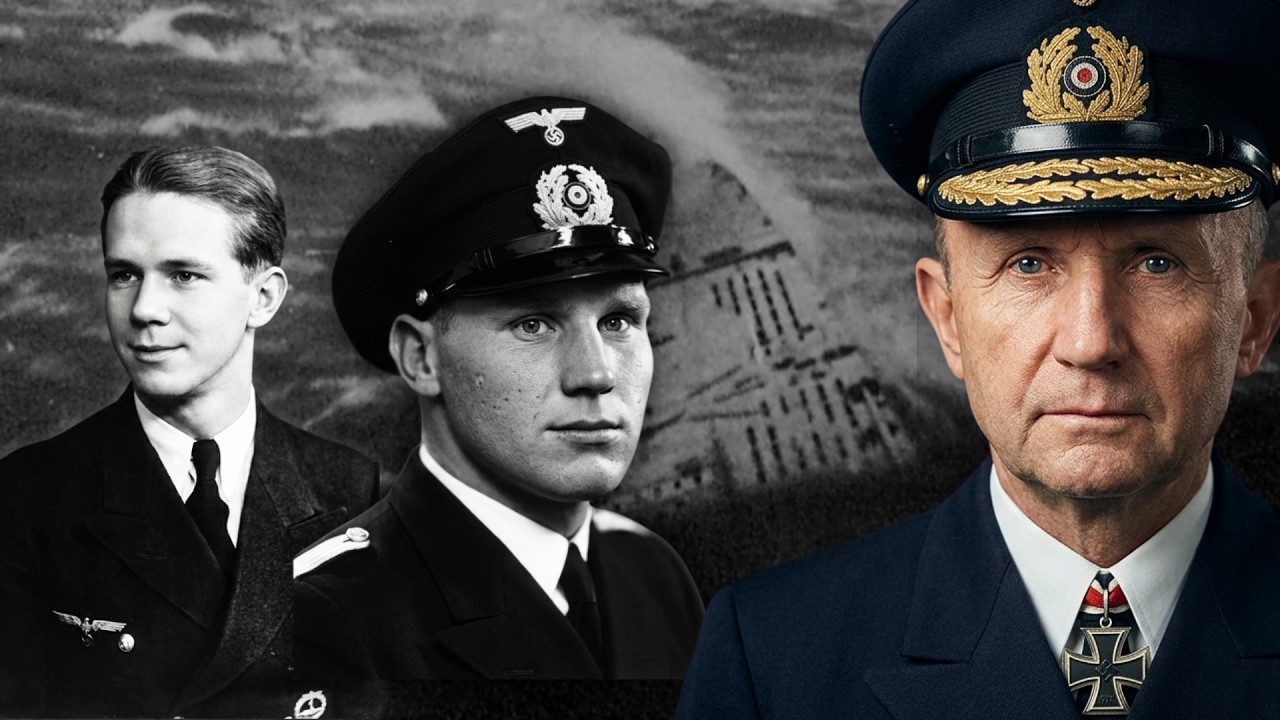
Karl Dönitz married Ingeborg Weber in 1916. She had trained as a nurse and was the daughter of German general Erich Weber. Together they had three children: Ursula, born in 1917; Klaus, born in 1920; and Peter, born in 1922.
The sea was not merely Karl Dönitz’s profession.
It became the family’s world.
Their daughter Ursula married naval officer Günter Hessler in 1937.
Their sons entered naval service.
Hessler would eventually become a successful U-boat commander himself.
And Dönitz would rise until he became the man most closely associated with Germany’s submarine campaign.
From the outside, it must have seemed like a naval dynasty.
But dynasties built around war carry a particular danger.
Eventually, the orders being issued from headquarters reach somebody you love.
By 1939, Dönitz commanded Germany’s U-boat force.
The strategy was terrifyingly simple in concept.
Britain depended on shipping.
Food, fuel, weapons, raw materials and troops had to cross oceans.
Cut those routes, and Germany might accomplish at sea what it could not accomplish on land.
So submarines went hunting.
Individual U-boats were formed into coordinated groups—the famous “wolfpacks”—and directed toward Allied convoys.
The Battle of the Atlantic became an enormous contest of intelligence, technology, endurance and destruction.
Sonar.
Radar.
Radio direction finding.
Codebreaking.
Escort carriers.
Depth charges.
Torpedoes.
Aircraft.
Convoys.
Submarines.
And thousands upon thousands of sailors and merchant seamen caught between them.
Dönitz was not watching this struggle from the deck of one boat.
He was directing an entire weapon system.
Names, numbers and positions flowed toward headquarters.
U-boats reported contacts.
Headquarters issued orders.
Convoys changed direction.
Submarines converged.
Ships disappeared.
Boats stopped answering.
And every submarine commander understood the ugliest reality of the Atlantic war:
Sometimes a U-boat did not report that it had been sunk.
It simply stopped transmitting.
For families, that meant waiting.
For commanders, it meant looking at an empty space on a chart.
And in 1943, one of those empty spaces acquired a name Dönitz knew better than almost any other.
Peter.
His youngest son.
Peter Dönitz was serving as a watch officer aboard U-954, a Type VIIC submarine commanded by Kapitänleutnant Odo Loewe.
The boat left Kiel in April 1943.
It would never return.
May 1943 was already becoming catastrophic for the German submarine force.
Allied anti-submarine warfare had improved dramatically. Better radar, aircraft coverage, escort tactics, intelligence and weapons were turning the Atlantic into a far more dangerous place for U-boats.
The hunters were increasingly becoming the hunted.
On May 19, U-954 was operating in the North Atlantic southeast of Cape Farewell, Greenland.
British escort vessels HMS Jed and HMS Sennen attacked.
U-954 went down.
There were no survivors.
Forty-seven men died.
Among them was Peter Dönitz.
He was twenty-one.
And there was a cruel symmetry to what had happened.
Karl Dönitz had spent years thinking about submarines as formations, patrol lines, tonnage, deployment schedules and strategic weapons.
Now one missing submarine contained his son.
There was no funeral beside a grave.
No body brought home.
No final conversation that could be replayed until every word had been memorized.
Peter and the rest of U-954 remained with the boat.
Under the Atlantic.
For the Dönitz family, the war had crossed a boundary.
It was no longer something Karl commanded.
It was something sitting at the dinner table even when nobody spoke about it.
One son was gone.
That should have meant the other would be protected.
And for a while, that appeared to be exactly what would happen.
Klaus Dönitz was older than Peter.
After Peter’s death, Klaus was removed from a combat role and pursued medical studies. Biographical accounts agree that he was not supposed to be participating in combat operations.
It appeared that the family had already paid enough.
Peter had been lost.
Klaus would survive.
At least that was the hope.
Then came May 1944.
Almost exactly one year after Peter vanished.
Klaus was approaching his 24th birthday.
Friends were serving aboard German fast attack boats—S-boats, known to the Allies as E-boats.
These craft were nothing like U-boats.
They were fast surface vessels built to strike at night, launch torpedoes and disappear into darkness.
They operated close enough to enemy waters that engagements could unfold violently and quickly.
Klaus was not assigned to one of them.
He did not need to be there.
That is what makes what happened next so difficult to understand.
He joined S-141 as a guest.
On the night of May 12–13, 1944, German S-boats of the 5th and 9th flotillas moved against Allied shipping near Selsey Bill on the English coast.
The Allied escorts responded.
German boats were driven back.
And then the French destroyer La Combattante engaged S-141.
The German boat was sunk.
Among the dead was a man who was not actually part of its regular crew.
Oberleutnant zur See Klaus Dönitz.
Karl Dönitz’s remaining son.
He died on May 13, 1944—one day before his 24th birthday.
Think about the dates.
Peter: May 19, 1943.
Klaus: May 13, 1944.
Two brothers.
Less than a year apart.
Both lost at sea.
And their father was the commander-in-chief of the German Navy.
There are moments in history when rank becomes almost meaningless.
An admiral can command fleets.
He can send coded signals across an ocean.
He can stand beside dictators.
He can move submarines across maps.
But he cannot order the sea to return his children.
And yet the most surprising thing about Karl Dönitz is what did not happen next.
He did not withdraw from the regime.
He did not break publicly with Hitler.
He did not become a symbol of opposition.
Instead, his political importance continued to grow.
He had succeeded Erich Raeder as commander-in-chief of the German Navy in January 1943. The Nuremberg Tribunal later noted that from that point onward Dönitz was repeatedly consulted by Hitler and remained an important part of Germany’s war leadership.
The personal losses did not remove him from the machinery of war.
The machinery kept moving.
And so did Dönitz.
Then, in April 1945, everything began collapsing at once.
Soviet forces closed in on Berlin.
German armies were disintegrating.
Cities were ruins.
Refugees moved west.
Military units surrendered wherever they could.
The Nazi leadership began destroying documents, changing clothes, searching for escape routes or preparing for death.
Inside the Führerbunker, Hitler made one final political decision.
Göring had fallen from favor.
Himmler had attempted his own maneuvering.
Hitler chose Dönitz.
In his final testament, Hitler designated the Grand Admiral as his successor as head of state. Hitler killed himself on April 30.
On May 1, Dönitz became Germany’s head of state.
Imagine the absurdity of the inheritance.
There was no victorious Reich waiting for him.
No empire.
No realistic path to victory.
He inherited collapse.
Dönitz established his government in the Flensburg area near the Danish border.
Its room for maneuver was tiny.
The main strategic question was no longer how Germany could win.
Germany had already lost.
The question was how the surrender would occur—and, from Dönitz’s perspective, how many German troops and civilians could move west before Soviet forces reached them.
The International Military Tribunal later recorded that Dönitz continued resistance in the East while explaining that his objective was to permit evacuation and an orderly retreat westward. Historians have debated the effectiveness and motives of these final decisions, and Germany’s Federal Archives notes that Dönitz’s later accounts often presented his government’s actions in a more favorable light than the surviving administrative record supports.
But whatever Dönitz thought he could still accomplish, his government had almost no future.
Germany surrendered.
The war in Europe ended.
For a strange interval, Dönitz and his ministers remained at Flensburg.
Then on May 23, 1945, British forces arrested them.
The admiral who had once directed U-boats against Britain was now a prisoner.
His uniform could not protect him.
His title could not protect him.
Hitler’s testament could not protect him.
And his family was left with a brutally simple reality.
Two sons were dead.
The father was in Allied custody.
The son-in-law was also entangled in the reckoning that followed Germany’s defeat.
Only the women and children of the family remained outside the prison system trying to discover what life after the Reich would even look like.
Karl’s wife Ingeborg had lived through the loss of Peter.
Then Klaus.
Then Germany’s defeat.
Then her husband’s arrest.
Their daughter Ursula had her own uncertainty to face.
Her husband, Günter Hessler, had not been an anonymous naval officer.
He had commanded U-107.
He had participated directly in the submarine war.
After his period at sea, he served on Dönitz’s U-boat command staff.
And he was Dönitz’s son-in-law.
If there was one family whose identity seemed chained permanently to the defeated Kriegsmarine, this was it.
The war was over.
But judgment had only begun.
Karl Dönitz was taken through the Allied detention system and eventually brought to Nuremberg.
There, the surviving leadership of Nazi Germany faced the International Military Tribunal.
The courtroom was a different kind of battlefield.
No torpedoes.
No depth charges.
No radio signals.
Documents did the damage now.
Orders.
Minutes.
Speeches.
War diaries.
Captured correspondence.
The prosecution charged Dönitz on Counts One, Two and Three of the indictment.
The Tribunal did not convict him on every allegation.
That distinction matters.
It found him not guilty on Count One, but guilty on Counts Two and Three—crimes against peace and war crimes.
On October 1, 1946, he was sentenced to ten years’ imprisonment.
One part of the judgment is often oversimplified.
Dönitz had been accused over Germany’s conduct of unrestricted submarine warfare. But the Tribunal considered evidence showing comparable Allied practices, including a statement by U.S. Admiral Chester Nimitz concerning American unrestricted submarine warfare in the Pacific. The judges explicitly stated that Dönitz’s sentence was not assessed on the basis of his breaches of the international law of submarine warfare.
At the same time, the Tribunal still found him guilty on the other grounds supporting Counts Two and Three.
In other words, the historical reality is more complicated than either “Dönitz was convicted merely for doing what Allied submarines did” or “every prosecution allegation against him was accepted.”
Neither is accurate.
The actual judgment is still there.
And it is precise.
Dönitz went to Spandau Prison in Berlin.
Ten years.
He served the full term.
For a man who had once commanded one of the most feared branches of the German military, prison reduced life to walls, regulations and repetition.
Outside those walls, Europe was changing at extraordinary speed.
Germany was divided.
The Cold War began.
West Germany was created.
A new German military would eventually emerge.
The U-boat pens fell silent.
The maps changed.
The Reich disappeared.
Men who had once held enormous power became prisoners, witnesses, defendants, refugees, businessmen, pensioners—or names in history books.
Ingeborg remained alive.
Ursula remained alive.
And Günter Hessler remained alive.
That last fact would create the most extraordinary postwar turn in the family story.
Because Hessler had something the victors wanted.
Knowledge.
Detailed knowledge.
He knew how the German U-boat command had operated.
He knew the staff procedures.
He understood the decisions from inside.
He had commanded a U-boat himself and later worked at U-boat headquarters.
And after the shooting stopped, Britain had an obvious reason to understand exactly how its former enemy had conducted the Atlantic campaign.
This is where the story suddenly changes direction.
Günter Hessler—the son-in-law of Karl Dönitz, the man who had commanded U-107 against Allied shipping—was commissioned after the war to work on an account of the German submarine campaign for the British naval authorities.
From 1947 to 1951, Hessler worked on what became The U-Boat War in the Atlantic, 1939–1945.
He was assisted by former U-boat officer Alfred Hoschatt.
The project became a three-volume study based heavily on German naval war diaries and primary records.
A later edition was published by Britain’s HMSO; bibliographic descriptions note that Hessler was given access to German naval records and that the work had originally been prepared for the British Admiralty.
Read that again.
Only a few years earlier, Hessler had been part of the German submarine organization trying to defeat Britain at sea.
Now Britain wanted him to explain how that organization had worked.
The enemy commander had become a source.
The hunted records had become research material.
The battle maps became historical documents.
And one of Karl Dönitz’s closest naval relatives was helping the former enemy reconstruct the story of Dönitz’s war.
That is the plot twist that makes the family’s postwar history so fascinating.
Because military defeat does something strange to expertise.
Ideology can collapse overnight.
Governments can disappear in days.
Flags can be lowered.
Ranks can become meaningless.
But knowledge survives.
How did the Germans coordinate wolfpacks?
What did U-boat headquarters know?
How were patrol lines constructed?
How were commanders instructed?
How did German officers interpret Allied tactics?
What did they understand about radar?
Aircraft?
Signals intelligence?
Convoys?
Which assumptions had been correct?
Which had been catastrophically wrong?
The British had spent six years fighting those questions in real time.
Now they could examine them from the other side of the plotting table.
Hessler’s work was not an absolution of the regime he had served.
Nor did employment on a historical project erase his wartime actions.
It reflected something colder and more practical.
The war was over.
Understanding the war mattered.
And sometimes the person who can best explain your enemy’s machinery is the man who once sat inside it.
Meanwhile, Karl Dönitz remained behind bars.
For ten years.
Then, on October 1, 1956, he was released from Spandau.
He had entered prison as one of the most famous surviving officers of the Third Reich.
He emerged into a completely different Germany.
The military he had commanded no longer existed.
Hitler was dead.
The Nazi state had been destroyed.
Both sons were still beneath the waters where they had died.
And six years later, in 1962, Ingeborg died.
She had lived long enough to see her husband return from prison.
But the household they had created before the war could never be restored.
There would never be a photograph of Karl and Ingeborg in old age surrounded by Peter and Klaus as middle-aged men.
There would never be sons returning from work.
No weddings for Peter and Klaus.
No careers after the navy.
No stories of what they might have become once uniforms stopped defining their lives.
Their timelines ended at twenty-one and twenty-three.
But the family itself had not ended.
Ursula had survived.
Günter Hessler had survived.
And together they had children.
Three of them.
A daughter named Ute.
And two sons.
Their names were Peter and Klaus.
That is the detail that lands differently than every rank, every trial transcript and every naval statistic.
Peter.
Klaus.
The names of Ursula’s two dead brothers.
Repeated in the next generation.
The war had taken the original Peter and Klaus into the sea.
Their sister carried their names forward through her sons.
History often tells us what governments did.
Who invaded where.
Who signed what treaty.
Which ship sank.
Which general surrendered.
Which defendant received which sentence.
But families remember differently.
Families remember names.
A name spoken at breakfast.
A name written on a birthday card.
A name called from another room.
A name belonging first to a brother who never came home—and then to a child growing up after the war.
Nothing could bring Peter and Klaus Dönitz back.
Naming children after them did not undo 1943 or 1944.
But it meant those names did not end on casualty lists.
There was another complication, however.
Karl Dönitz himself did not emerge from prison as a man eager to publicly repudiate his entire wartime record.
He spent much of his remaining life defending his image as a professional naval officer.
In 1958, he published the memoir commonly known in English as Memoirs: Ten Years and Twenty Days—the title referring to his years at the center of the U-boat command and the brief period in which he headed the German state.
His postwar narrative emphasized the image of an essentially professional, “apolitical” navy separated from the broader criminality of the Nazi regime.
Modern historical scholarship has challenged that portrayal.
Germany’s Federal Archives states that Dönitz’s postwar memoirs and interviews helped shape an overly favorable early interpretation of his role and that he repeatedly minimized his responsibility. The German biographical archive similarly describes his postwar writings as promoting the image of an “unpolitical” Kriegsmarine supposedly distant from the Nazi leadership state.
Dönitz did criticize aspects of dictatorship in his memoirs and claimed that what he learned about Nazi crimes after the war had affected him.
But historians have questioned the extent of that reckoning.
The National WWII Museum, for example, characterizes his postwar position as fundamentally unrepentant and notes that while awaiting judgment at Nuremberg he wrote of having a “clear, clean conscience.”
That makes the final decades of his life uncomfortable in a way that a simpler story would not be.
Because this is not a story where suffering automatically produces insight.
Dönitz experienced losses that would have shattered many families.
Both sons died.
His regime collapsed.
He became a prisoner.
He stood trial.
He spent ten years behind bars.
His wife later died.
Yet personal suffering and historical responsibility are not interchangeable.
A man can suffer terribly and still refuse to interpret his own choices the way later generations do.
That is what makes history more difficult than fiction.
Fiction likes conversion.
A villain sees the truth.
A proud man breaks down.
A final revelation changes everything.
Real human beings often do something messier.
They defend themselves.
They edit memory.
They separate what happened to them from what happened because of institutions they served.
They insist that duty excuses decisions.
They remember loyalty more clearly than responsibility.
Dönitz lived quietly near Hamburg after leaving prison.
He wrote.
He corresponded.
Former naval officers visited him.
His version of the German Navy’s wartime history retained supporters, particularly among veterans who regarded him primarily through the traditions of naval service rather than through the broader political and criminal history of the Third Reich.
Günter Hessler, meanwhile, died in 1968.
Ursula lived until 1990.
Karl Dönitz lived until 1980.
He died on December 24 at the age of eighty-nine.
By then, nearly four decades had passed since Peter disappeared with U-954.
More than thirty-six years had passed since Klaus went down with S-141.
The men they might have become were unknowable.
Only their photographs remained frozen in youth.
At Dönitz’s grave, the story of his two sons remained part of the family memory.
But perhaps the most haunting memorial was never carved into stone.
It was alive.
Peter Hessler.
Klaus Hessler.
Two grandchildren carrying the names of two uncles they could never truly know.
And that is where the Dönitz family story becomes much larger than one admiral.
Because after wars, history tends to divide people into categories.
Victors.
Defeated.
Commanders.
Prisoners.
Criminals.
Victims.
Witnesses.
Survivors.
But families do not fit neatly into those boxes.
In the Dönitz family, one man helped direct a devastating submarine campaign and later became the final head of Nazi Germany.
Two of his sons died serving in the war.
His daughter survived.
His son-in-law fought for Germany, survived captivity, and then helped Britain document the very campaign in which he had participated.
His wife lived through her sons’ deaths, Germany’s destruction and her husband’s imprisonment.
And the next generation carried forward the names of the dead.
That is not a story of simple redemption.
It is not a story in which tragedy cancels responsibility.
And it should not be turned into one.
The Allied sailors and merchant seamen killed during the U-boat campaign had families too.
So did the forty-seven men aboard U-954.
So did the crews of ships Hessler attacked.
So did millions of people whose lives were destroyed by the regime Dönitz served.
Historical memory becomes dangerous when it remembers only the grief on one side.
But it also becomes incomplete when powerful figures are reduced to cardboard symbols and the consequences inside their own families disappear.
The two truths can exist together.
Karl Dönitz was a father who lost both of his sons.
Karl Dönitz was also a senior leader of Nazi Germany who was convicted at Nuremberg of crimes against peace and war crimes.
One fact does not erase the other.
And perhaps the strangest image in the entire story is not of Dönitz in uniform.
It is not a submarine breaking the Atlantic surface.
It is not Hitler’s final testament.
It is not the courtroom at Nuremberg.
It is a desk after the war.
A former German U-boat officer sitting with captured German records.
Working for the naval establishment of the country he once fought.
Writing down how the U-boat war had actually been conducted.
Somewhere behind those records were the decisions of his father-in-law.
Somewhere in those casualty lists was Peter.
Somewhere off the English coast lay Klaus.
And somewhere at home were children carrying those same two names into a world in which Germany and Britain were no longer at war.
That may be the most powerful consequence of all.
Wars end on official dates.
Families do not.
For them, a war survives in empty chairs, old photographs, prison visits, books written decades later—and sometimes in the names given to children who are born after the guns finally fall silent.
History records when a war ends. A family reveals how long its consequences remain.