
The Enigmatic Celtic Prince of Glauberg: Iron Age Masterpiece
In the rolling hills of Hesse, Germany, a discovery in 1996 sent shockwaves through the world of archaeology: the life-sized sandstone statue of a Celtic prince, unearthed near a monumental burial mound at Glauberg. Dating to around 500 BCE, this striking figure—known as the Keltenfürst, or Celtic Prince—has reshaped our understanding of Iron Age Europe. Far from being merely a warrior, the prince embodied a fusion of political authority, religious power, and celestial knowledge, a testament to the sophistication of Late Hallstatt and Early La Tène culture.
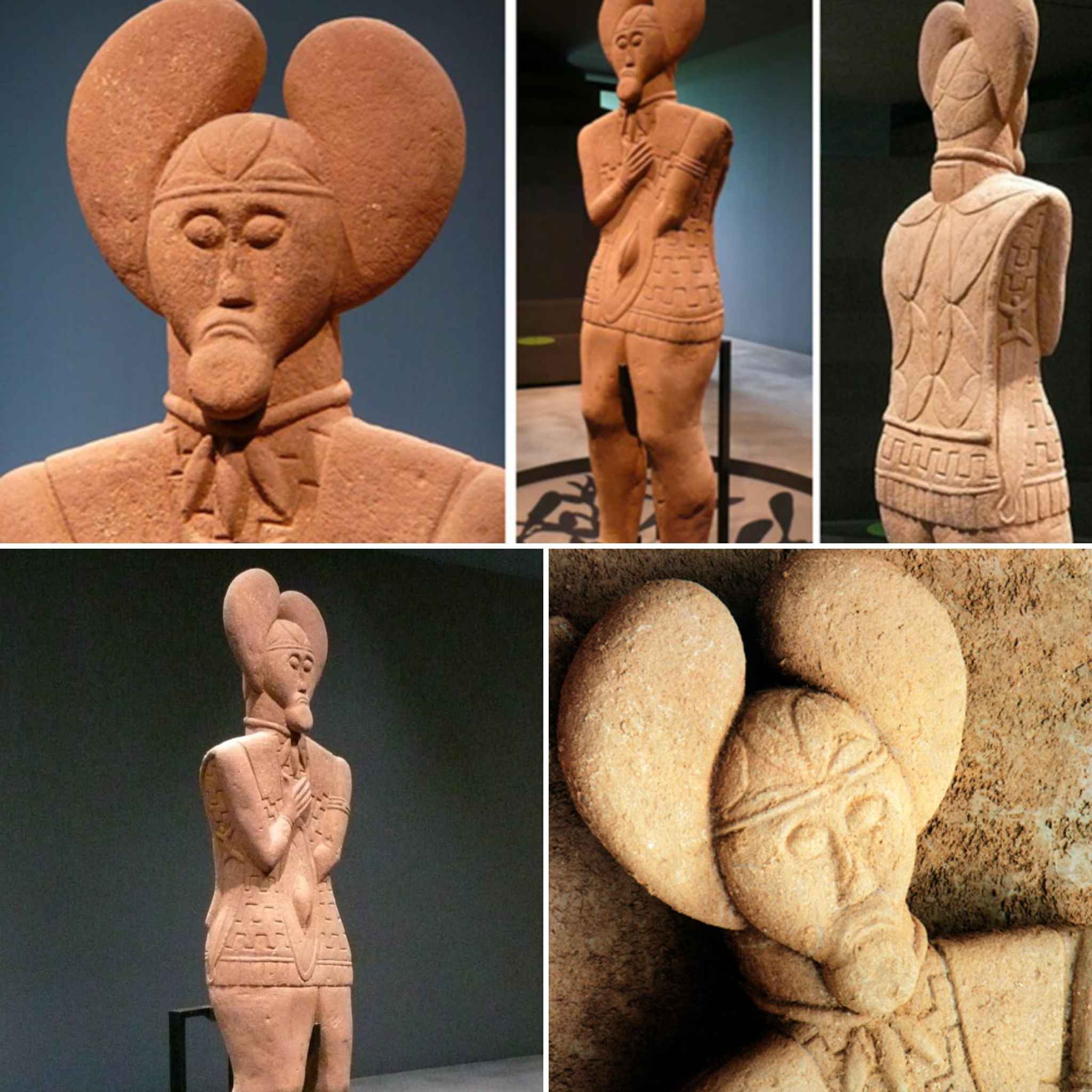
A Warrior in Stone
The sandstone statue stands 186 centimeters tall and weighs 230 kilograms, fully armed and regal. The figure carries a wooden shield, wears a composite armor tunic, and has a short sword with an anthropomorphic hilt at his side. Around his neck rests a distinctive torc, the rigid neck ring of aristocratic rank. Remarkably, a solid gold torc of similar design was found within the nearby burial chamber, leading many experts to suggest that the statue may be a portrait of the very prince interred beneath the mound.
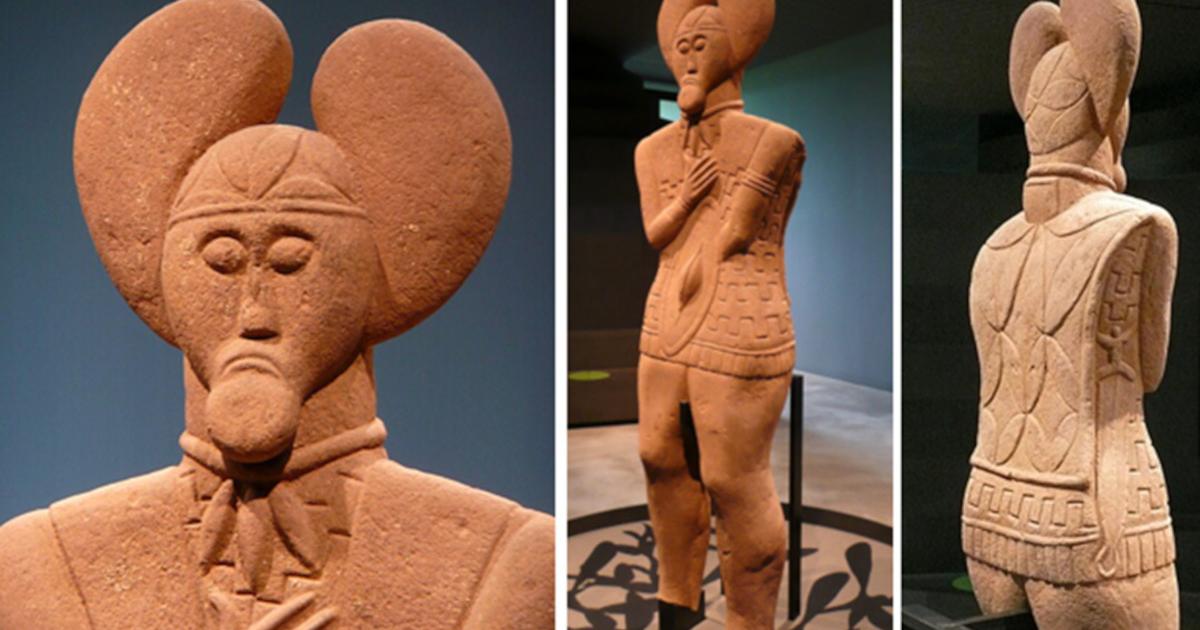
Head and shoulders of the Glauberg Prince, with distinctive torc and “leaf crown.” (©Heinrich Stürzl/CC BY-SA 4.0)
Every detail of the sculpture conveys authority. Its lifelike proportions and expressive stance speak to an elite culture capable of producing art that fused realism with symbolism. The prince was not merely a military leader—he was the embodiment of power, prestige, and divine sanction.
The Mistletoe Crown and Druidic Authority
Perhaps the most arresting feature of the statue is the unusual headdress. Often described as a “leaf crown,” it resembles two large mistletoe leaves protruding from the hood-like cap. In Celtic belief, mistletoe was sacred—associated with healing, ritual, and spiritual authority. Scholars suggest that this crown indicates the prince’s dual role as both warrior and religious leader, possibly a high-ranking druid.
The anthropomorphic short sword further supports this interpretation. Similar weapons across central and western Europe bear lunar symbols, likely connected to calendars or eclipses, implying advanced astronomical knowledge. This combination of martial and ritual authority aligns with historical accounts of druids, who wielded spiritual and political influence, guiding both the living and their relationship to the cosmos.
The Princely Burial Mound
The statue was discovered just outside Mound 1, a massive tumulus originally measuring nearly 50 meters in diameter and six meters in height, surrounded by a circular ditch ten meters wide. Excavations conducted between 1994 and 1997 revealed a lavish, unlooted tomb of a high-status warrior.
Inside the wooden burial chamber lay the prince himself, accompanied by extraordinary grave goods: the gold torc, finely crafted weapons, and a bronze tubular jug that once held mead. Nearby, a second, smaller mound contained another warrior, accompanied by a decorated fibula, a gold ring, and more weapons. These finds place Glauberg alongside other famous Celtic princely burials, such as Vix in France and Hochdorf in Germany, reflecting the wealth and status of its inhabitants.

Grave mound reconstructed in its original position at Glauberg. The 16 wooden poles represent a Celtic calendar. (Foto: Sven Teschke /CC BY-SA 3.0)
A Monument Aligned with the Heavens
The landscape surrounding the mound is equally remarkable. A 350-meter-long processional avenue, flanked by deep ditches, leads to the tumulus from the southeast. Archaeologist Axel Posluschny demonstrated that this avenue aligns with the major lunar standstill, an astronomical event occurring once every 18.6 years. Other ditches and postholes mark the solstices, indicating that the entire complex functioned as a celestial calendar, merging rituals of death with cosmic observation.
This interplay of landscape, monument, and astronomy suggests that the Glauberg prince was not only a political and religious figure but also a keeper of cosmic knowledge, his burial a celebration of earthly and celestial authority.
A Network of Celtic Power
Glauberg was part of a broader network of Celtic oppida—proto-urban centers stretching from southern Germany to France, including Heuneburg, Bibracte, and Manching. These sites were hubs of trade, where metals, salt, and Mediterranean luxury goods circulated. Imported materials found at Glauberg indicate the prince’s far-reaching connections, linking him to long-distance trade and the wider political landscape of Iron Age Europe.
Fragments of three additional statues discovered nearby suggest that the original ensemble included four figures, perhaps representing an ancestor cult or a council of elite leaders. Together with the monumental burial and processional avenue, these elements underscore the prince’s status as a central figure in both life and death, bridging human society and the cosmos.
The Legacy of the Keltenfürst
Today, the Keltenfürst and the treasures of his tomb are displayed at the Keltenwelt am Glauberg Museum, which opened in 2011 and has welcomed over 300,000 visitors. The statue continues to captivate audiences, a haunting reminder of a society where power, spirituality, and knowledge were inseparable.
The Glauberg prince was more than a warrior. He was a master of ritual, a keeper of celestial wisdom, and a leader whose authority extended from the battlefield to the heavens. His life and death illuminate the extraordinary sophistication of early Celtic Europe, providing a rare glimpse into a culture that balanced earthly rule with spiritual and cosmic understanding.
The Keltenfürst statue displayed at the Keltenwelt am Glauberg museum, Hesse, Germany. (Source: ©Heinrich Stürzl, CC BY-SA 4.0)
In an era where monuments were often expressions of domination, the Glauberg prince demonstrates that Celtic elites also celebrated knowledge, ritual, and their place in the universe—a ruler of both men and the heavens.
