Stunning Fossils From Ethiopia Suggest Human Evolution Was Far More Crowded Than Scientists Once Believed
In the dry badlands of northeastern Ethiopia, a handful of fossil teeth are forcing scientists to rethink one of humanity’s oldest stories.
For decades, many people imagined human evolution as a relatively straightforward progression: ape-like ancestors gradually transformed into more advanced human species, one replacing another over time. But new discoveries from the Ledi-Geraru research area in Ethiopia’s Afar region paint a radically different picture—one in which several human relatives may have lived side by side, competing, adapting, and evolving simultaneously.
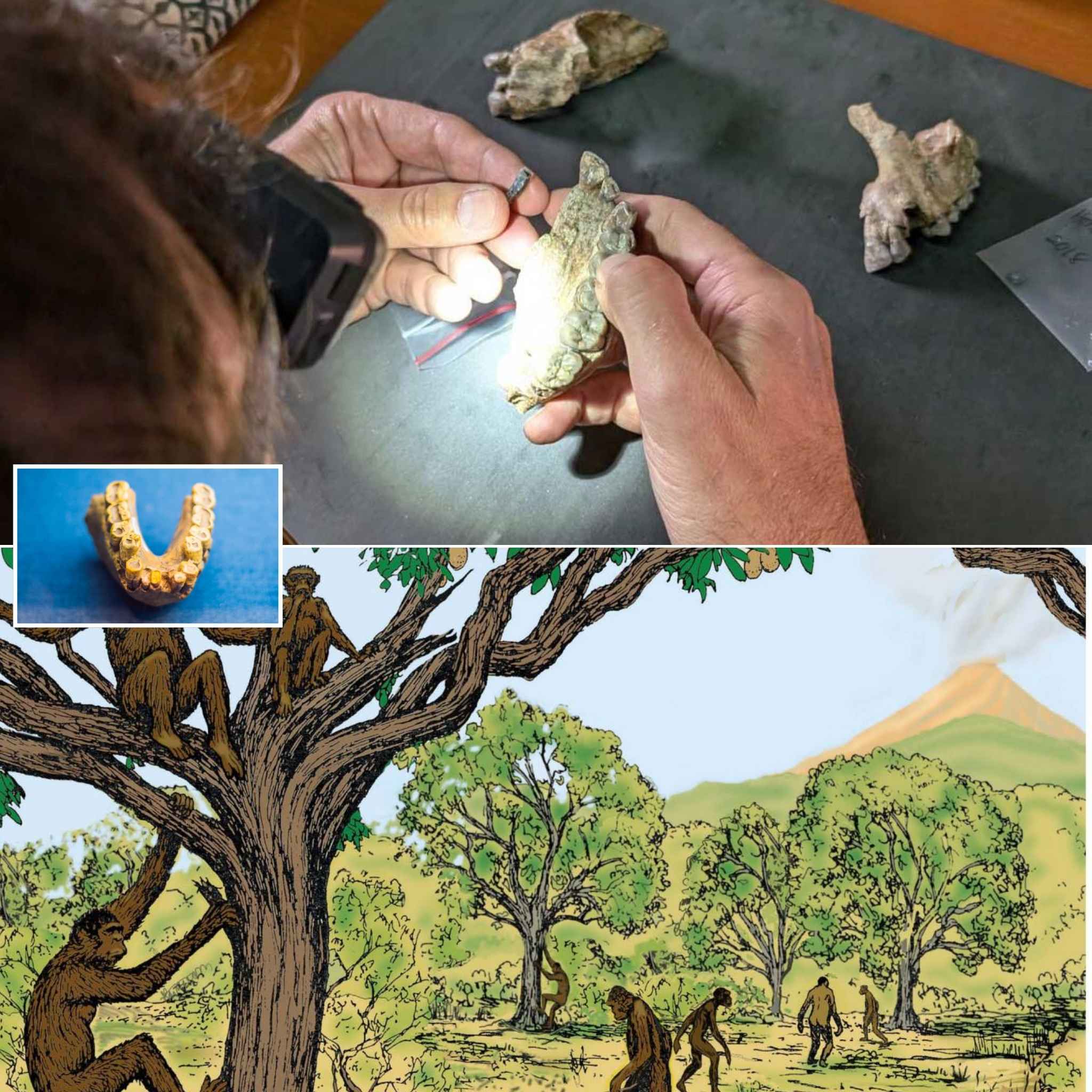
The findings, published in Nature in 2025, suggest that early human evolution was not a ladder, but a tangled ecosystem of overlapping species. Among the discoveries are fossil teeth belonging both to some of the earliest known members of the genus Homo and to an unidentified species of Australopithecus never before seen anywhere on Earth.
Together, the fossils hint at a prehistoric world far more complex—and far more experimental—than scientists once imagined.
The site already famous for rewriting history


The Ledi-Geraru field site has already earned a legendary reputation in paleoanthropology. In 2013, researchers working there uncovered a jawbone dated to roughly 2.8 million years ago—widely considered the oldest known fossil assigned to the genus Homo, the lineage that would eventually include modern humans.
The site also produced some of the earliest known Oldowan stone tools, primitive cutting implements associated with early human ancestors.
Now, new fossil discoveries from sediments dated between 2.6 and 2.8 million years ago are adding another dramatic chapter to the story.
This time, the evidence comes from something deceptively small: just 13 ancient teeth.
Tiny teeth, enormous implications
Researchers analyzed fossil teeth collected between 2015 and 2018 from several locations within the Ledi-Geraru research area.
Although the fossils are fragmentary, teeth are among the most informative parts of the skeleton for paleoanthropologists. Tooth shape, enamel thickness, root structure, and wear patterns can reveal evolutionary relationships, diet, and species differences with remarkable precision.
The results stunned researchers.
Some of the teeth clearly belonged to early Homo. Others, however, came from a species of Australopithecus unlike any previously identified.
Importantly, both species appear to have lived in the same region during the same time period.
That overlap fundamentally challenges older ideas that one species simply evolved into another in a clean chronological sequence.
Not Lucy’s species
The mysterious Australopithecus fossils are especially intriguing because researchers determined they did not belong to Lucy’s species, Australopithecus afarensis.


Lucy, discovered in Ethiopia in 1974, remains one of the most famous human ancestors ever found. Her species lived between roughly 3.9 and 2.95 million years ago and was long viewed as a likely ancestor to early humans.
But the new findings support the growing conclusion that Lucy’s species may already have disappeared by 2.95 million years ago—before the fossils from Ledi-Geraru were deposited.
This means another, previously unknown species of Australopithecus may have occupied the region later, alongside the earliest members of Homo.
For now, scientists cannot formally name the species because the evidence is limited mainly to teeth. More fossil material—especially skulls or limb bones—will be needed to understand where it fits in the human family tree.
A crowded prehistoric Africa
The discovery adds to mounting evidence that eastern Africa around 3 to 2.5 million years ago was populated by multiple hominin lineages at the same time.
Instead of one dominant ancestor evolving in isolation, the fossil record increasingly suggests a crowded landscape filled with different evolutionary experiments.
According to the researchers, as many as four hominin groups may have coexisted during this period:
- Early Homo
- Paranthropus
- Australopithecus garhi
- The newly identified Ledi-Geraru Australopithecus species
This emerging picture resembles an evolutionary “bush” rather than a straight line.
Some branches survived. Others vanished completely.
Only one lineage eventually led to modern humans.
Volcanoes preserve the timeline
One of the biggest challenges in paleoanthropology is determining the age of fossils with precision. In the Afar region, volcanoes provide the answer.
Millions of years ago, volcanic eruptions repeatedly blanketed the landscape with ash. That ash contained feldspar crystals, which scientists can date using radiometric methods.
Because the fossil-bearing sediments lie between volcanic layers, researchers can establish a reliable timeframe for when the ancient hominins lived.
This geological context makes the Afar region one of the most important places on Earth for studying human origins.
The same tectonic forces still shape the landscape today. The Afar Depression remains one of the planet’s most geologically active rift zones.
Reconstructing a vanished world
The Ethiopia these ancient hominins inhabited looked very different from today’s harsh badlands.
Researchers believe the landscape once contained rivers, shallow lakes, and greener environments that expanded and contracted with changing climate conditions.


As the climate gradually became drier, different hominin species may have adapted in different ways.
Some likely specialized in tougher vegetation. Others may have become more flexible omnivores. The emergence of stone tools suggests behavioral changes that may have helped early Homo exploit new food sources.
Researchers are now studying microscopic wear and enamel chemistry in the teeth to determine what these species were eating and whether they competed for the same ecological niches.
Evolution was not a march toward perfection
One of the most important implications of the discovery is conceptual.
For generations, popular depictions of human evolution showed a simple sequence: ape → primitive human → modern human. But scientists increasingly argue that this image is deeply misleading.
Evolution does not move toward a predetermined goal. It produces diversity through adaptation, experimentation, and extinction.
Some species thrive temporarily before disappearing. Others coexist for long periods. Occasionally, one lineage survives while many others fail.
The Ledi-Geraru discoveries vividly illustrate that reality.
As paleoecologist Kaye Reed explained, human evolution was not linear—it was “a bushy tree.”
Nature’s many experiments in being human
The findings also highlight how little scientists still know about the critical transition between Australopithecus and Homo.
Researchers understand some broad anatomical trends:
- Larger brains
- Smaller teeth and jaws
- More sophisticated tool use
- Dietary flexibility
But exactly how—and why—these traits evolved remains uncertain.
The coexistence of multiple species suggests that evolution may have explored several different strategies simultaneously.
Some lineages developed powerful chewing adaptations. Others evolved traits linked to mobility, dexterity, or cognition.
Only one branch ultimately survived into the present.
The search is far from over
The 13 fossil teeth from Ledi-Geraru may seem insignificant compared to dramatic skeletons or skulls, but in paleoanthropology, even tiny fragments can transform entire theories.
And researchers believe this is only the beginning.
More fossils almost certainly remain buried beneath Ethiopia’s ancient sediments. Each discovery has the potential to complicate—or completely overturn—existing ideas about where humans came from.
For now, the mysterious Australopithecus species from Ledi-Geraru remains unnamed, represented only by its teeth and the questions it raises.
But its existence sends a powerful message: humanity’s origins were never simple.
The path to modern humans was not a straight road marching inevitably forward. It was a crowded, branching landscape filled with experiments, dead ends, survivors, and species that shared the same rivers, forests, and plains millions of years ago.
And somewhere among them, eventually, was us.