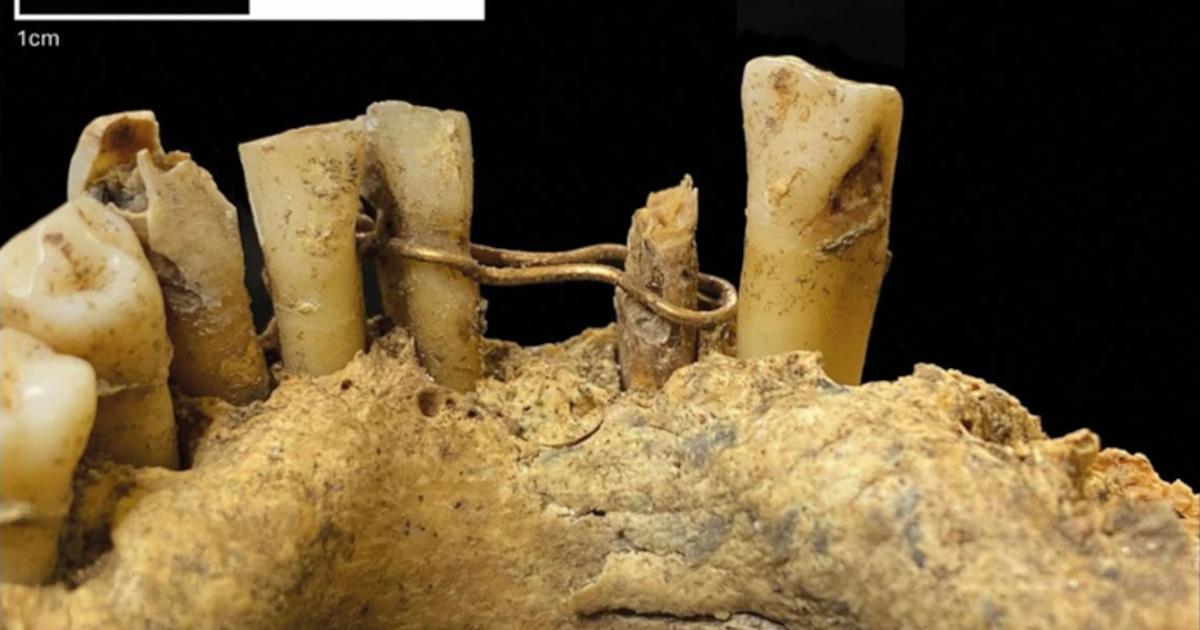
 Archaeologists studying skeletal remains from medieval Scotland have uncovered what may be the country’s earliest known example of restorative dentistry — a delicate 20-carat gold dental bridge woven between the teeth of a man who lived hundreds of years ago.
The remarkable discovery was made during a reassessment of human remains excavated from the historic St Nicholas Kirk in Aberdeen. According to a new study published in the British Dental Journal, the remains belonged to a middle-aged man who lived sometime between 1460 and 1670 AD.
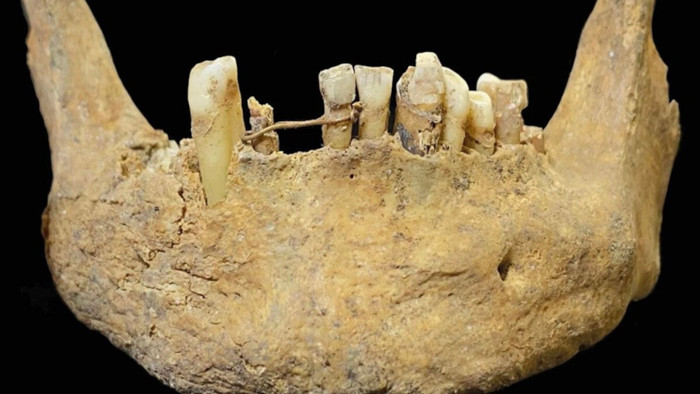
While researchers found evidence of severe dental disease and multiple cavities, it was an intricate gold wire fixed between the lower front teeth that immediately captured scientific attention. Experts say the device functioned similarly to a modern dental bridge — centuries before dentistry became a formal profession.
A 20-Carat Gold Dental Device
The gold ligature was tightly wrapped around two lower incisors, spanning the gap left by a missing tooth. Researchers believe it was designed either to stabilize a loose tooth or to support a prosthetic replacement.
According to the study, the craftsmanship behind the object was highly sophisticated for its era. Scientific analysis revealed the wire was composed of approximately 82.4% gold, mixed with small amounts of silver and copper — equivalent to modern 20-carat gold.
Using scanning electron microscopy, researchers determined that the wire had been carefully shaped by pulling it through a draw plate and tightened with pliers before being tied into place. The teeth themselves displayed grooves caused by prolonged contact with the wire, indicating the device had been worn for a significant period before the man’s death.
Experts suggest the procedure was likely carried out by a semi-skilled craftsman, possibly a local goldsmith rather than a physician. During the Late Medieval and Early Modern periods, dentistry was still undeveloped, and specialized dental professionals were rare.
Historical records indicate that Aberdeen was home to more than 20 active goldsmiths during this period, making it entirely possible that one of them produced the intricate dental appliance.
Dentistry Before Modern Medicine
Dental treatment in medieval Europe was often crude, painful, and deeply inconsistent. People suffering from tooth problems commonly turned to barbers, barber-surgeons, traveling tooth pullers, or local folk healers.
In Scotland, traditional remedies for dental pain ranged from herbal treatments to far stranger practices. Historical accounts describe the use of heated turf to ease toothaches on the Isle of Skye and even cow dung poultices for abscesses in parts of Aberdeen.
Against this backdrop, the gold dental bridge stands out as an exceptionally advanced and expensive procedure.
Out of approximately 100 individuals excavated from the site dating to the same era, this was the only skeleton showing evidence of restorative dental work involving precious metals. Researchers say the cost of using high-purity gold alone would have placed the treatment far beyond the reach of ordinary people.
The man’s burial location within the affluent East Kirk section of St Nicholas Kirk further suggests he likely belonged to Aberdeen’s wealthier social class.
 Teeth, Status, and Social Reputation
Researchers believe the motivation behind the procedure may have extended beyond health alone.
In medieval Europe, physical appearance was often closely associated with morality, status, and personal reputation. A damaged or missing smile could affect how a person was perceived socially, especially among the upper classes.
The gold bridge therefore served not only as a functional medical device, but also as a visible symbol of status and self-presentation.
Similar uses of gold wire for dental stabilization have previously been documented among ancient civilizations such as the Egyptians and Etruscans, as well as among wealthy individuals in Renaissance Europe. One notable example is Anne d’Alegre, a 16th-century French noblewoman known for using gold wire to stabilize failing teeth.
However, the Aberdeen discovery marks the first confirmed example of such dental technology ever identified in Scotland.
A Rare Glimpse Into Early Dentistry
Researchers say the find offers an extraordinary insight into the history of medicine, craftsmanship, and social identity during the Late Medieval and Early Modern periods.
The study was conducted by scholars from the University of Aberdeen, the Australian National University, and the Edward Via College of Osteopathic Medicine in Louisiana, with funding provided by the British Academy.
For historians and archaeologists alike, the gold dental bridge is more than a medical curiosity — it is a reminder that people centuries ago were already willing to invest extraordinary effort and wealth into preserving both their health and their public image.